Best Time to Study: Match Hard Work to Your Body Clock
There is no single best time to study for everyone. Do your hardest problem solving at your peak hours, which are mornings for early types and late afternoon or evening for night owls. Use off-peak hours for brainstorming, and do a short review before sleep so the night can consolidate it.
Ask ten students about the best time to study and you will hear ten firm answers: some swear by 5 a.m., while others only wake up mentally after dinner. Both groups can be right, because your brain does not run at the same level all day, and the peak arrives at different hours for different people. The useful question is not when is the best time but which task belongs in which hour.
This guide shows you how to find your own peak, what kind of work to put there, and how to use the hours when you feel slow. It ends with sample days for early risers, night owls and everyone in between.
Is there one best time to study for everyone?
No. Performance on demanding tasks rises and falls with your circadian rhythm, and the timing differs by chronotype. Early types peak in the morning, late types later in the day. The best time to study is the window where your own focus is strongest.
Researchers call your natural timing your chronotype. In a study of 80 students aged 11 to 14, Goldstein and colleagues tested morning types and evening types either between 8 and 10 a.m. or between 1 and 3 p.m. Students tested at their preferred time did better on reasoning tasks, a gap the authors estimated at about 6 IQ points. Vocabulary, which draws on stored knowledge, did not change with the clock.
That distinction matters for studying, because tasks that require fresh reasoning, like solving unfamiliar physics problems or working through a proof, are sensitive to timing, whereas tasks that draw on existing knowledge are considerably less sensitive. Consequently, the clock matters most for your most demanding material.
Age also moves the clock. A survey of about 25,000 people summarized by Nature News found that people sleep later and later through their teens, peaking at about 19.5 for women and 20.9 for men. If you are in high school or college, a late body clock is normal biology, not laziness.
How do you know if you are a morning or evening person?
Look at a free day with no alarm. Note when you naturally fall asleep and wake up, then find the midpoint. A midpoint before about 3 a.m. suggests an early type, after about 5 a.m. a late type, and anything between is neutral.
You do not need a lab test. The quick method below borrows the idea behind the questionnaires researchers use: your sleep on free days shows your real clock, because no alarm is forcing it. The cutoffs are rough guides, not a diagnosis.
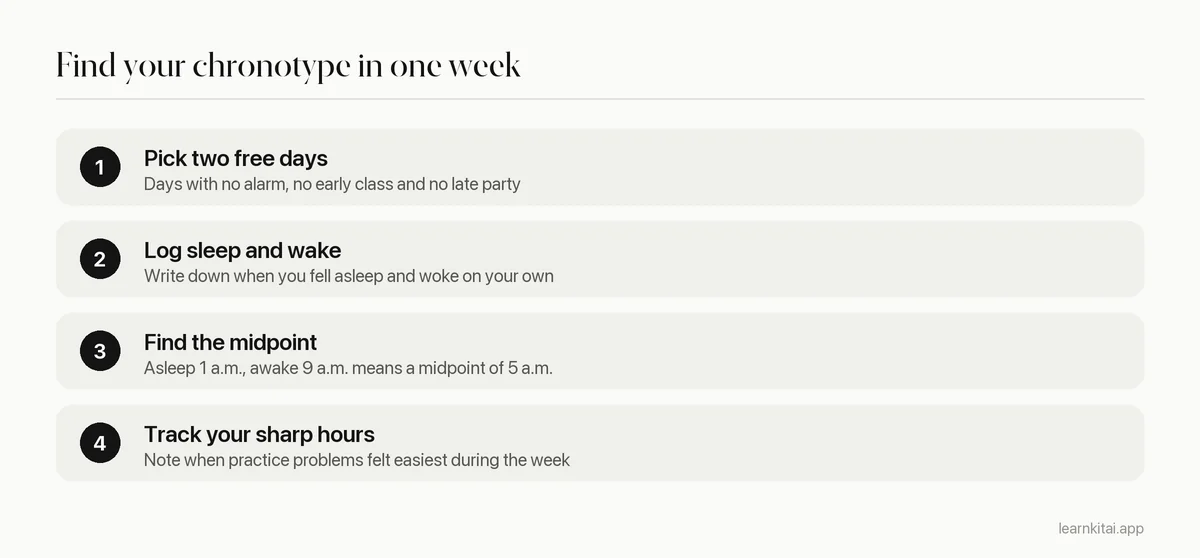
Step four is the one most students skip. For a week, jot a quick 1 to 5 rating next to each study block describing how sharp you felt, and patterns usually emerge within a few days. Many students find a clear two to three hour window where hard problems feel lighter.
What should you study at your peak, and what off-peak?
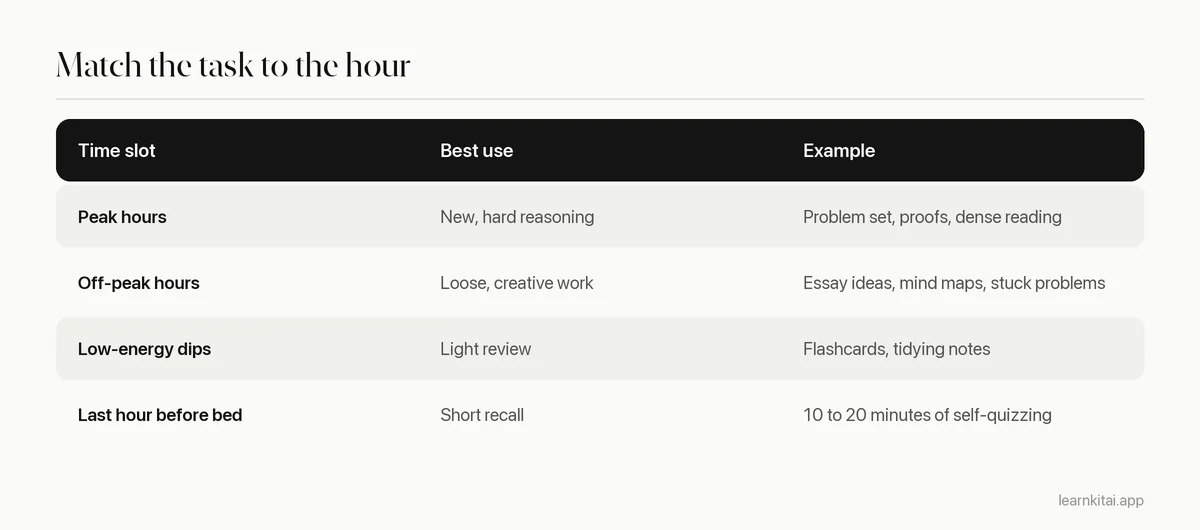
Put new, difficult, analytical work at your peak: problem sets, proofs, first passes through dense chapters. Save off-peak hours for flashcard review, organizing notes and brainstorming, where a looser mind can even help.
Here is the twist. Off-peak hours are not just worse hours. In a study of 428 undergraduates, Wieth and Zacks gave students analytic problems and insight problems at 8:30 a.m. or at 4 p.m. Analytic performance did not change much with the time. Insight problems, the kind that need you to drop your first idea and see the puzzle differently, were solved more often at the student's non-optimal time.
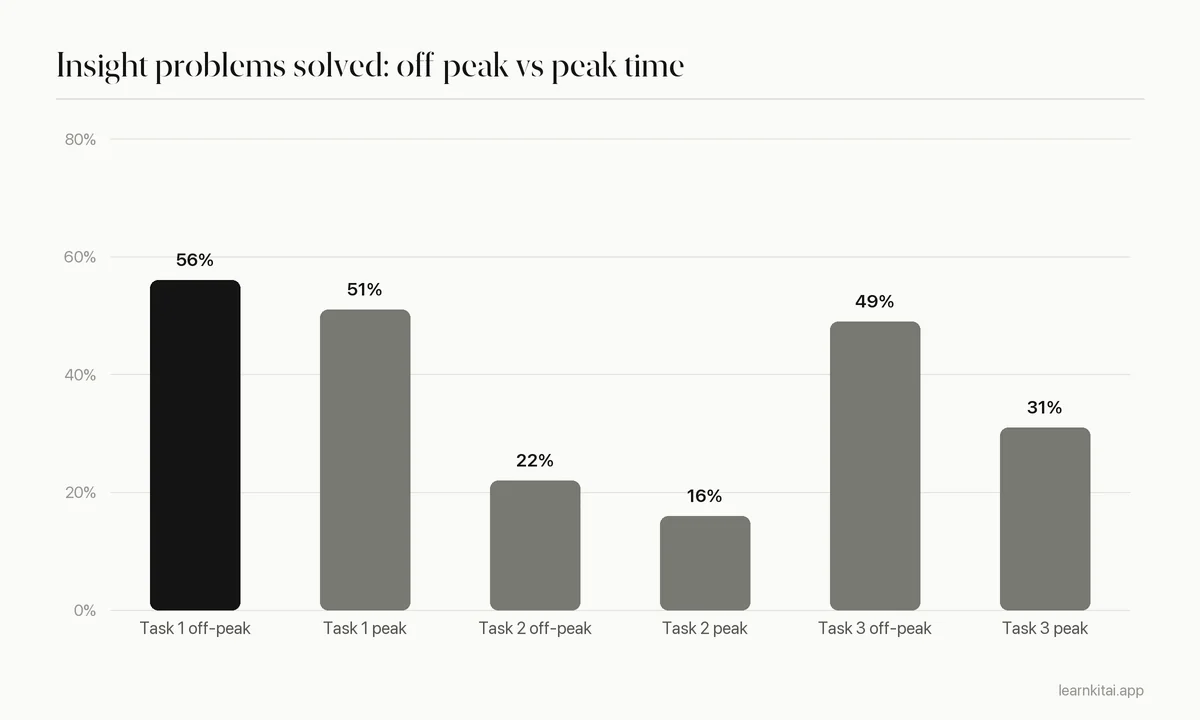
The likely explanation is that a tired brain filters less, so more stray associations leak in, and occasionally one of them is the answer. That makes off-peak time a reasonable fit for essay brainstorming, outlining a project or revisiting a problem you are stuck on.
Is it better to study at night or in the morning?
Study hard material when you are sharpest, which may be morning or evening. Then review key points in the evening: sleep soon after learning helps memory. Avoid trading sleep for late study, because losing sleep cancels the gain.
Night studying has one real advantage: sleep comes soon after. Gais, Lucas and Born had high school students learn vocabulary either in the morning or in the evening. Forgetting was much higher when learning happened in the morning, with a full day of waking life before sleep. Students who slept after learning also recalled more than students kept awake all night, and the benefit held 48 hours later.
That does not mean you should study until 2 a.m. The gain comes from sleep, so cutting sleep defeats it. The CDC reports that pediatricians recommend 8.5 to 9.5 hours of sleep for teens, and that the average US middle and high school started at 8:03 a.m. in the 2011 to 2012 school year. If your class starts early and your clock runs late, protect sleep first. Our guide to sleep and memory explains why.
Sample study days for three body clocks
Use these as starting templates for a day with classes. Shift them to fit your own sharp hours, and break each block into focused sessions with short rests, as described in our Pomodoro technique guide.
- Early type (sharp 7 to 11 a.m.): one hard 60 to 90 minute block before class. Light flashcard review in the mid-afternoon dip. Creative or essay planning in the early evening. Bedtime recall, lights out early.
- Night owl (sharp 4 to 10 p.m.): classes and easy admin in the morning. Brainstorm or outline at midday. Main problem-solving block from about 5 p.m. Short recall, then bed at a steady time.
- Neutral type (sharp late morning): hard block from roughly 10 a.m. to noon or right after lunch. Review in short gaps between classes. Evening for practice questions and a short recall before sleep.
Before exams, the same rule applies. Put past papers and the toughest topics in your peak window, and keep review of older material for lower energy slots. Our exam study schedule guide shows how to spread topics across days.
Common timing mistakes to avoid
- Copying a 5 a.m. routine you saw online. If your clock runs late, you will be awake but not sharp.
- Putting the hardest subject in the last slot. By then you are tired and likely to quit after a few minutes.
- Studying past your sleep time. One late night costs more memory than the extra hour adds.
- Ignoring the afternoon dip. Plan light review there instead of fighting it with a hard problem set.
- Changing the plan every day. A steady daily slot builds a habit, so you start faster and argue with yourself less.
The best time to study is the one that fits both your body and the task. Find your sharp window, guard it for hard work, use the off hours for review and ideas, and let sleep finish the job.
Frequently asked questions
Can you change your chronotype?
You can shift it a little with steady wake times and bright morning light, but large changes are hard. Your clock also moves on its own with age, getting later through the teens and earlier after about 20. It is usually easier to plan around your clock than to fight it.
Is studying right after waking up a good idea?
For many people the first 30 to 60 minutes after waking feel foggy. Use that time for something easy, like reviewing yesterday's flashcards, and start the hard work once you feel alert.
What if my only free time is late at night?
Then keep late sessions short and focused on recall rather than brand new hard material, and set a firm stop time that protects your sleep. A rested 40 minutes beats a tired two hours.
Should I take my exam at a certain time to do better?
You usually cannot choose, so practice at the exam's time of day in the week before. Do a few timed past papers at that hour so your brain is used to performing then.
Sources
- Time of day, intellectual performance, and behavioral problems in morning versus evening type adolescents, Personality and Individual Differences (via PubMed Central) (80 adolescents; better fluid reasoning at preferred time, about 6 IQ points)
- Time of day effects on problem solving: When the non-optimal is optimal, Thinking and Reasoning (Insight problems solved more often at non-optimal times; analytic problems unaffected)
- You're most creative when you're at your groggiest, BPS Research Digest (428 participants; success rates 56, 22, 49 percent vs 51, 16, 31 percent)
- Sleep after learning aids memory recall, Learning and Memory (via PubMed Central) (Sleep soon after vocabulary learning reduced forgetting)
- School Start Times for Middle School and High School Students, United States, 2011 to 2012, CDC MMWR (Average start time 8:03 a.m.; AAP recommends 8.5 to 9.5 hours of sleep for teens)
- Early sleep marks the end of adolescence, Nature News (About 25,000 people; sleep timing latest at 19.5 (women) and 20.9 (men))
Keep reading
Pomodoro Technique for Studying: 25 Minutes, Done Right
A kitchen timer, 25 minutes and a short break. Here is how to use the Pomodoro technique for real study tasks, what the research says and how to adapt it.
Sleep and Memory: Why the All-Nighter Backfires
Sleep is when your brain files what you studied, and it gets you ready to learn the next day. What the research shows and how to plan study around it.
Study Breaks: How Long, How Often, and What to Do
Five minutes or fifty? Scheduled or whenever you feel tired? What research says about study breaks, plus a simple rule for timing them.

The Study Schedule That Works Backward From Exam Day
Most study plans fail because they start from today. Start from the exam date instead, count your real hours, and space every topic at least three times.