The Study Schedule That Works Backward From Exam Day
Start from the exam date and work backward. List every topic, count the study hours you really have, and give each topic at least three short sessions on different days. Put the hardest courses in your best hours, keep one buffer day a week for slippage, and end with mixed practice tests.

A typical study schedule begins on Monday with good intentions and dies by Thursday. The plan was not wrong because you lacked discipline. It was wrong because it started from today, guessed how much time you had, and treated every topic as a single block of reading. A schedule that survives does the opposite. It starts from the exam, counts real hours, and plans for things going wrong.
Below is a 20-minute method to build one, a worked example for three exams in four weeks, and the mistakes that usually sink a plan.
Why should a study schedule work backward from the exam?
Because the exam date is the only fixed point. Working backward shows how many days you really have, forces you to place a final review and practice test first, and stops early topics from eating all your time.
When you plan forward, the first topics get generous time and the last ones get squeezed into the final weekend. Planning backward fixes that. You first lock in the last few days (mixed practice, a full past paper, a light final review). Then you fill the earlier days with topic work. Whatever space is left tells you, honestly, how deep you can go.
How to build your study schedule in 20 minutes
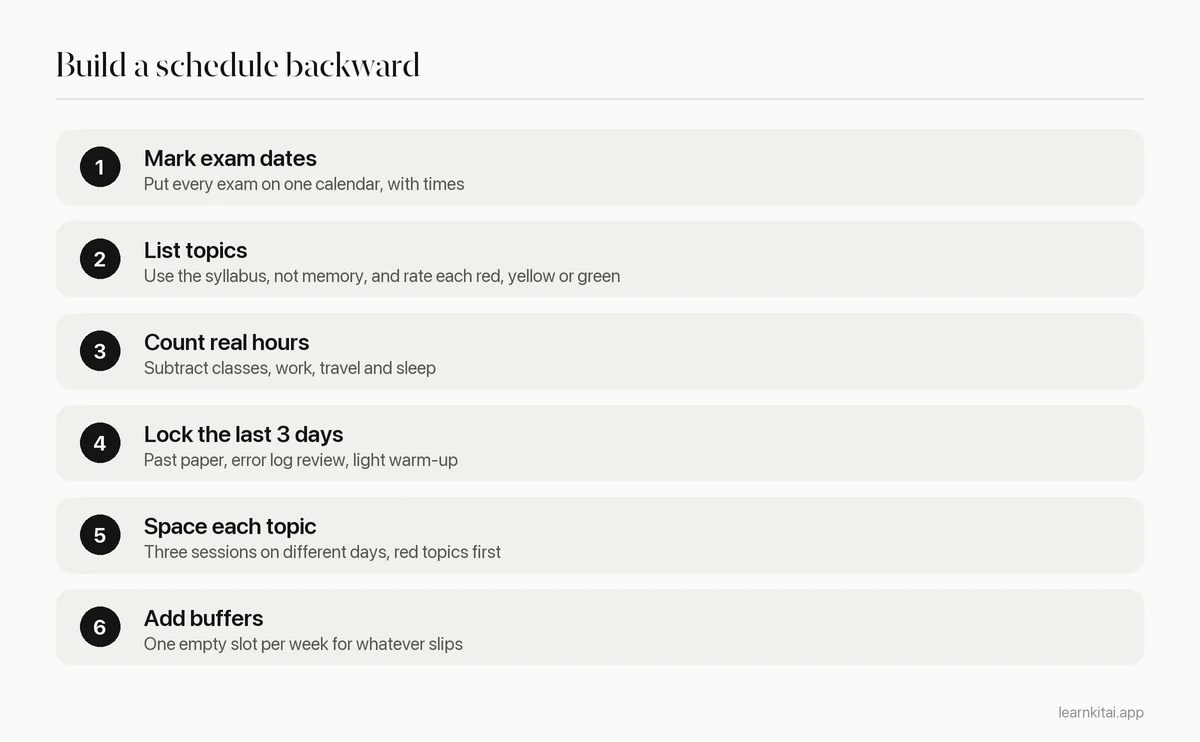
The step most people skip is counting real hours. Take a normal week and block out everything fixed: classes, work shifts, commuting, meals and at least seven hours of sleep. What remains is your study budget. Then cut it by a quarter, because life always takes some of it. That number, not an ideal, is what you plan with.
Next, rate each topic. Red means you could not explain it today. Yellow means you half know it. Green means you could teach it. Red topics need three or four sessions. Yellow need two or three. Green need one quick test to confirm.
How far apart should study sessions be?
For an exam a week or two away, revisit each topic every two to four days. In a large study, the best gap for a one-week test was about 20 to 40 percent of that week. Longer horizons call for longer gaps between reviews.
This is the spacing effect, and it is one of the most reliable results in learning research. In an experiment with more than 1,350 people, Cepeda and colleagues found that the best gap between sessions grows as the test gets further away. For a test one week out, it was about 20 to 40 percent of the delay. For a test a year out, it was about 5 to 10 percent.
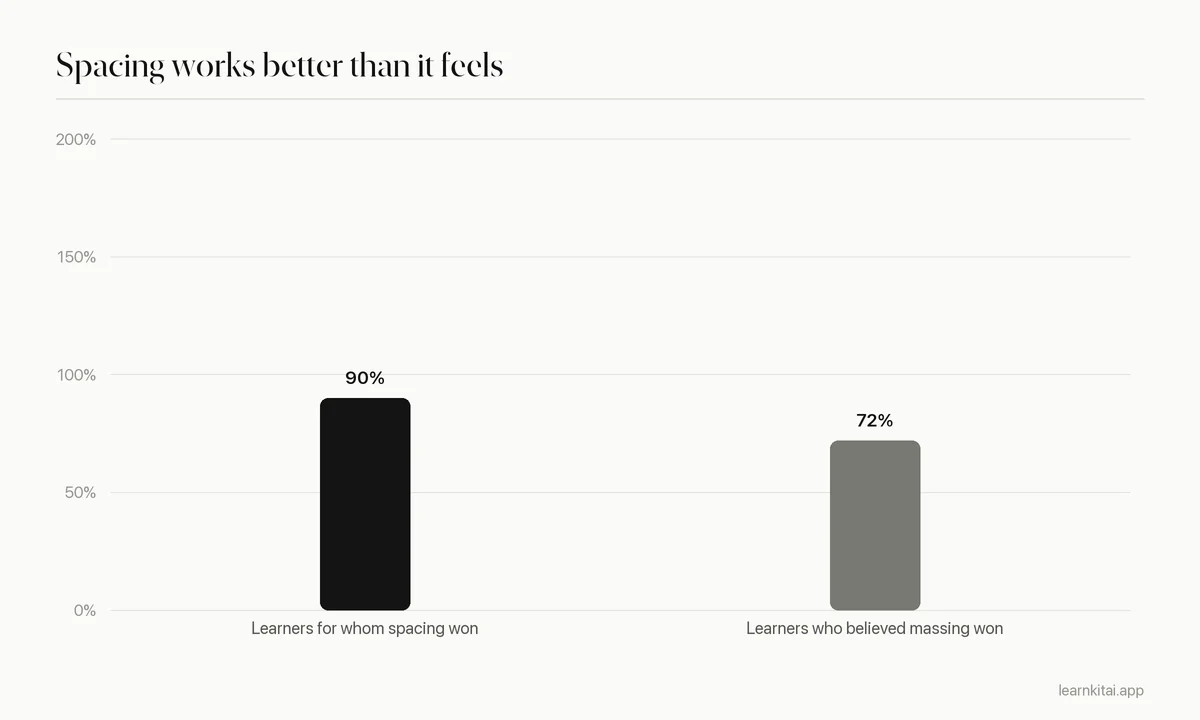
Spacing also feels worse while you do it, which is why students avoid it. In a flashcard study by Nate Kornell, spacing beat massed study for 90 percent of participants. Yet after the first session, 72 percent believed massing had worked better. Trust the schedule over the feeling. For the deeper theory, see our guide to spaced repetition.
What does a good exam study schedule look like?
It rotates two or three subjects per day, gives the riskiest course the most sessions, repeats each topic several times on different days, and saves the final days for mixed practice tests rather than new content.
Here is a worked example. Jordan has biology on day 28, statistics on day 25 and history on day 21. Biology is the weakest course. Jordan has about 12 real study hours a week after classes and a part-time job, which comes to roughly fourteen 50-minute blocks.
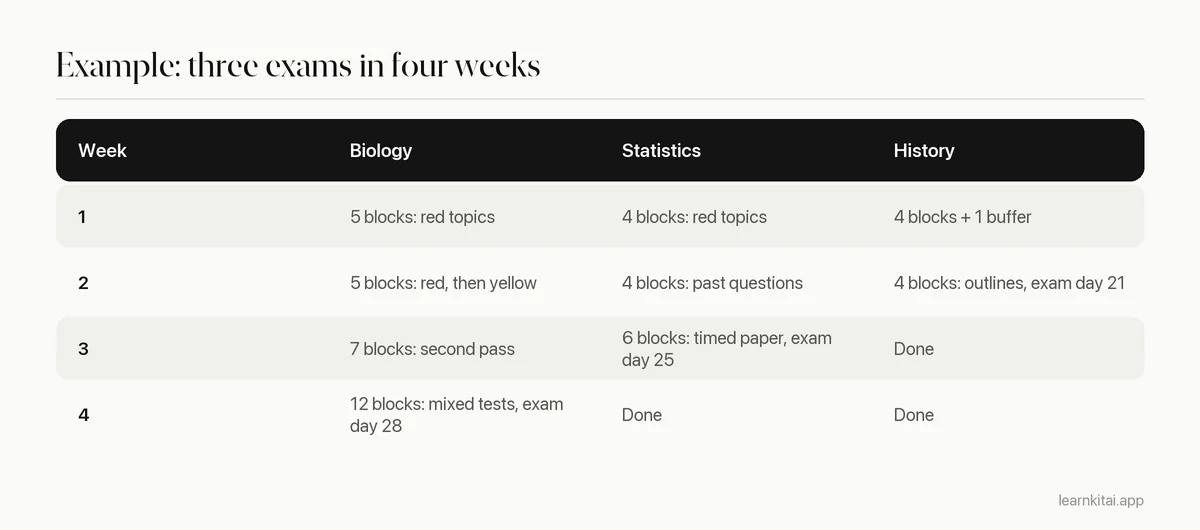
Each week, Jordan studies two or three subjects on the same day rather than one per day. That spreads each course across more days, which is spacing for free. As each exam passes, its blocks go to the next course. By week four, biology gets almost all the time, and most of it is spent on mixed practice questions rather than reading.
Jordan also leaves one block each week empty. When a shift runs late or a session goes badly, that block absorbs it. Without buffers, one bad day pushes every later session back and the plan collapses.
How do you fit a study schedule around work, sports or family?
Plan around your fixed commitments first, then use short, regular blocks instead of rare long ones. Two 30-minute sessions on a busy weekday, protected like appointments, usually achieve more than an exhausting five-hour session squeezed into Sunday.
Students with jobs, training schedules or caring responsibilities often assume that a proper revision timetable is only for people with empty afternoons. In reality, their constraints make the planning more important, not less. Start with a weekly template that shows every fixed commitment, then look for the predictable gaps: the forty minutes before practice, the commute if you take public transport, the hour after younger siblings go to bed.
Assign the demanding work, such as timed problems or essay outlines, to the gaps where you are most alert, and keep flashcard review for the tired or interrupted moments. Short, frequent sessions also happen to suit the spacing effect, so a fragmented week can produce surprisingly durable learning if every fragment has a clear task.
What should go inside each study block?
A question first. Start each block by testing yourself on the topic, then spend the rest fixing what you missed. End with two minutes writing what to test next time. Reading only happens when a question shows a gap.
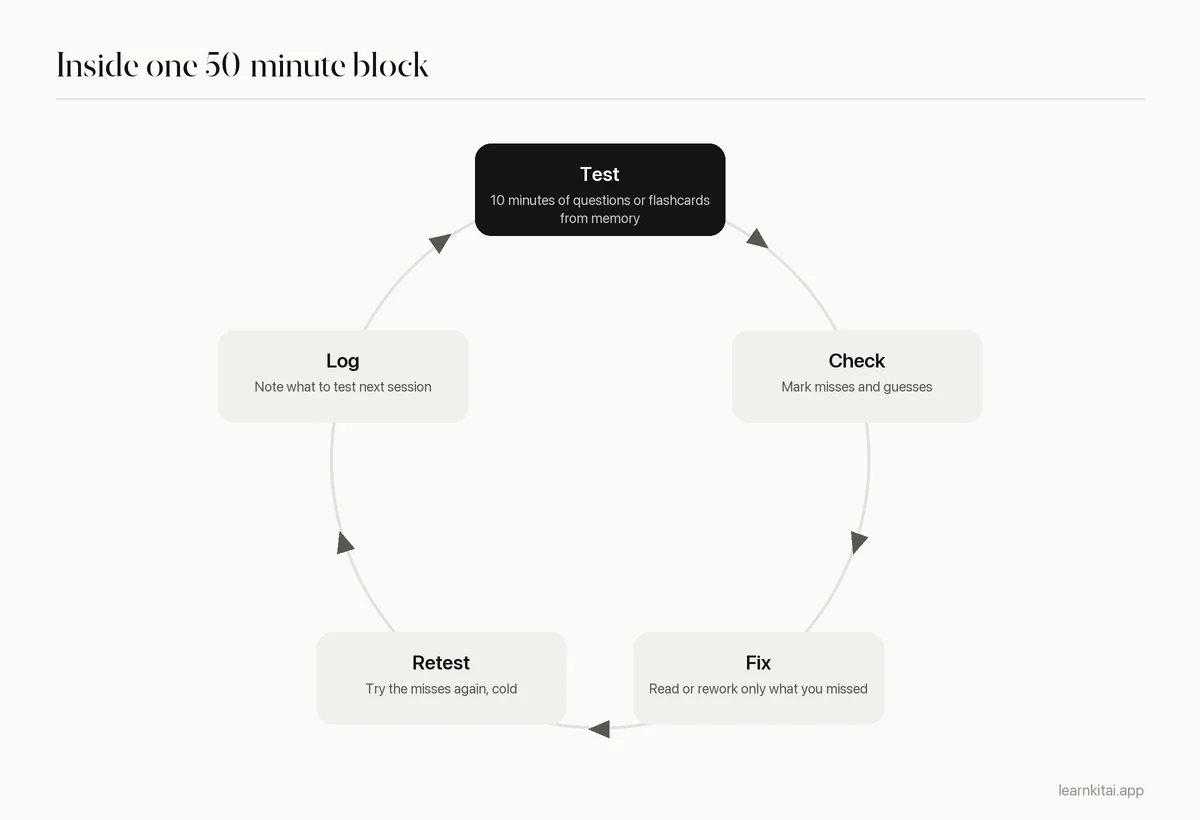
A schedule tells you when to study. This loop tells you what to do once you sit down. It keeps every block tied to active recall rather than passive reading. If you study on your phone, a focus timer with session stats makes the blocks easy to track. The LearnKit iPhone app has a Pomodoro timer built in next to your flashcards and quizzes.
Common study schedule mistakes
- Planning ideal hours. If your plan needs six free hours a day and you have three, it will fail by midweek.
- Blocks named after chapters. Read chapter 5 invites passive reading. Name blocks by task: 15 practice problems on chapter 5.
- One subject per day. It feels focused but gives each course fewer spaced sessions.
- No buffers. Every plan slips. Build the slip in.
- Cutting sleep when behind. Cut green topics first. Sleep is part of the plan.
If you would rather not build the calendar by hand, a study plan generator can draft one from your exam dates. Just check that it spaces topics and leaves buffers, because many do not.
Frequently asked questions
How many hours a day should my study schedule include?
Plan from your real free time, not a target. For most students, three to five focused hours on a full study day is sustainable. Count finished blocks, not hours at a desk.
Should I schedule breaks?
Yes. Put short breaks between blocks and one longer break each half day. Breaks keep the later blocks productive and make the plan easier to stick to.
What if I fall behind my schedule?
Use the buffer slot first. If that is gone, drop or shorten green topics rather than pushing everything back. Re-plan once a week, not every time something slips.
Is a paper planner or an app better for a study timetable?
Either works. What matters is that every exam date and every block lives in one place you check daily. Pick the tool you already open every morning.
Sources
- Spacing Effects in Learning: A Temporal Ridgeline of Optimal Retention, Psychological Science (Cepeda et al., 2008) (Optimal gap about 20 to 40 percent of a one-week delay and 5 to 10 percent of a one-year delay; more than 1,350 participants.)
- Optimising learning using flashcards: Spacing is more effective than cramming, Applied Cognitive Psychology (Kornell, 2009) (Spacing beat massing for 90 percent of participants; 72 percent believed massing was more effective.)
Keep reading
How to Study for Finals: A 3-Week Plan That Holds Up
Finals reward the student who starts with a plan, not the one who studies longest. Here is a three-week system for triage, testing and sleep.

How to Study for an Exam in a Week, Day by Day
Seven days is enough to do well if you start with a diagnosis, revisit every topic every two or three days, and save the last day for rest.

Spaced Repetition: Why Forgetting Is Part of the Plan
Reviewing right before you forget builds memories that last. Learn how long the gaps should be, with a ready schedule for exams one week to one semester away.

Study Plan Generator: Build a Plan You Will Actually Follow
AI can draft a study plan in seconds. Whether you follow it depends on honest time estimates, spaced reviews and a rule for falling behind.
Pomodoro Technique for Studying: 25 Minutes, Done Right
A kitchen timer, 25 minutes and a short break. Here is how to use the Pomodoro technique for real study tasks, what the research says and how to adapt it.