Study Breaks: How Long, How Often, and What to Do
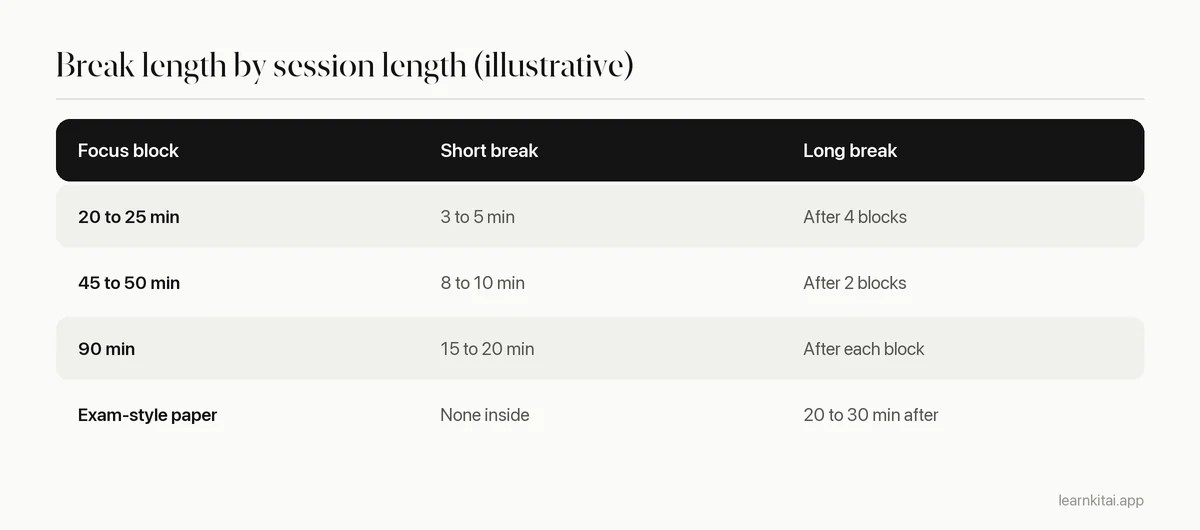
A good default is a 5-minute break after every 25 to 30 minutes of focused study, or about 10 minutes after 50. After two hours, take a longer break of 15 to 30 minutes. Plan breaks in advance instead of waiting until you feel tired, and spend them moving, not scrolling.
Most students take study breaks the same way: keep going until the brain feels like soup, then grab the phone and lose half an hour. Both halves of that habit cost you. This guide covers how long breaks should be, how often to take them, what to do during them, and why deciding the schedule in advance beats waiting until you feel tired.
How long should a study break be?
Short breaks of about 5 minutes suit 25 to 30 minute sessions, and 10 minutes suits sessions of around 50 minutes. Every couple of hours, take a long break of 15 to 30 minutes. After very demanding work, lean toward the longer end.
There is no single magic number, but research gives useful limits. A 2022 meta-analysis of micro-breaks pooled 22 study samples with 2,335 people and looked at breaks of 10 minutes or less. Short breaks reliably raised energy and lowered fatigue, with effect sizes of about d = 0.36 and d = 0.35. Their effect on performance was small and not statistically significant overall, and longer breaks gave bigger performance boosts. The authors suggest that recovering from highly draining tasks may take more than 10 minutes.
In plain terms: a five-minute pause keeps you fresh during normal study, but after an intense problem set or a two-hour block, a five-minute pause will not reset you. Give yourself a real break.
Should you plan breaks or take them when you feel tired?
Plan them. In a study of university students, those who took breaks on a fixed schedule reported less fatigue and distraction and more concentration and motivation than those who decided for themselves, and finished the same work in less time.
That study, by Biwer and colleagues at Maastricht University, compared three groups of students during real self-study. One group took breaks whenever they wanted. The others took a 6-minute break after every 24 minutes or a 3-minute break after every 12 minutes. As the published study reports, the self-regulated group worked and rested in longer stretches, yet felt more tired and distracted. Task completion was about the same across groups, so the scheduled groups got there faster.
The likely reason is simple. When you wait until you feel tired, you are already tired. And deciding when to stop is itself a small effort that pulls attention away from the work. A timer makes the decision for you. That is the core of the Pomodoro technique, and it works whether your blocks are 25 minutes or 50.
Why do breaks help you focus?
Attention on a single task tends to fade over time, even when you are trying hard. A short switch away from the task and back again seems to refresh your hold on the goal. Breaks also lower fatigue and raise energy, which makes the next block easier to start.
One well-known lab study at the University of Illinois tested this with a dull monitoring task. Performance usually sinks over time on tasks like this. In the study by Ariga and Lleras, people who briefly switched to a second small task a couple of times during the session did not show that decline. The authors argue that the drop comes from the brain getting used to the same goal, and a brief switch away resets it. It is one lab task, not a study session, but it fits the everyday experience that a short pause can bring focus back.
What should you do during a study break?
Do something physical and screen-free: stand up, walk, stretch, refill water, look out a window or step outside. Avoid starting anything with no natural end, like social media, a video series or a game. Those make breaks longer and the return harder.
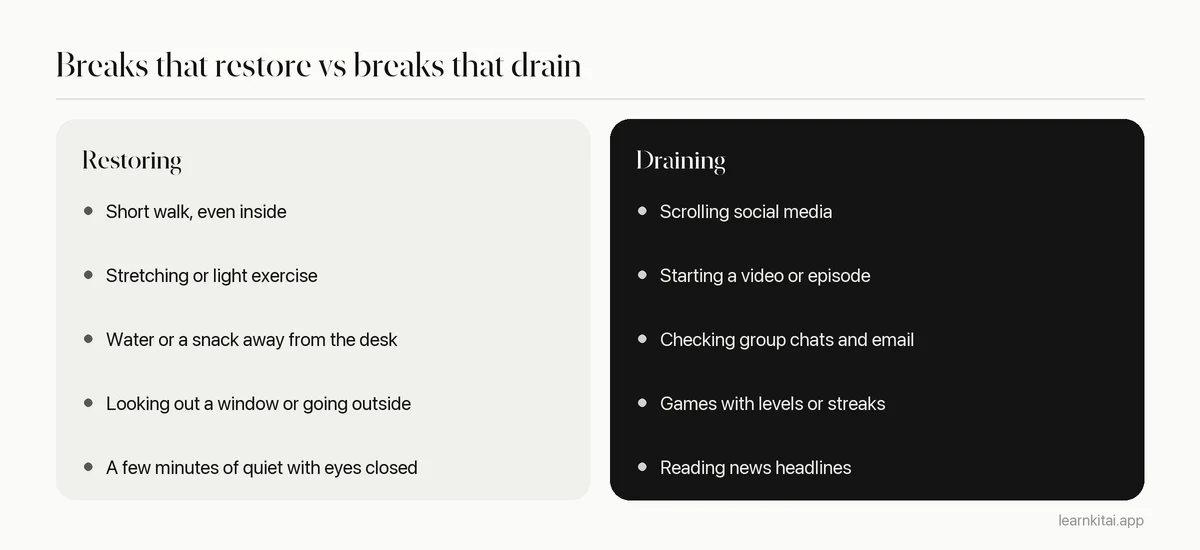
The phone is the main problem because it never ends on its own. A five-minute check easily becomes twenty, and the content pulls your mind away from the topic you were just working on. If you want to see why simply having the phone nearby costs focus, read our guide on phone distraction while studying.
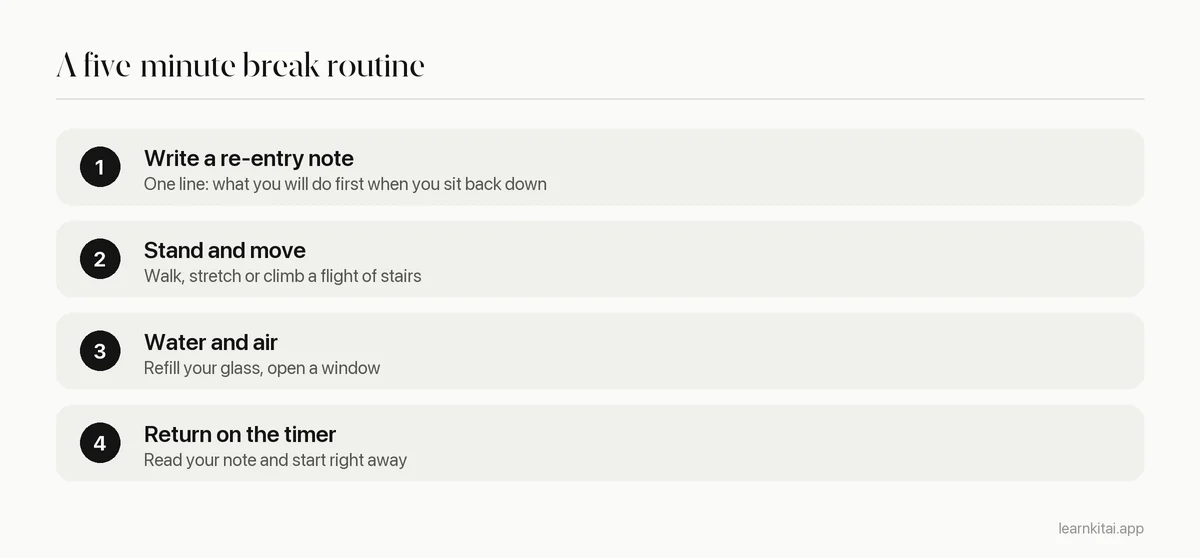
The re-entry note is the trick most people miss. Before you stand up, write the very next action, such as 'finish problem 7, then check answers'. Coming back to a clear instruction removes the small hump of 'where was I', which is often where a break turns into a long one.
How often should you take a long break?
Take a long break of 15 to 30 minutes about every two hours of study. Use it to eat, go outside or do some exercise. If you study in the evening, a real dinner break away from the desk counts.
Long breaks matter more than people think, especially on heavy study days. They are the reset that short breaks cannot give after demanding work. A good long break also has a fixed end time, because an open-ended break is the easiest way for a planned four-hour study day to become a two-hour one.
Exam season changes the math a little. On days with six or more hours of study, plan your study breaks as part of the timetable: a short break every block, a long break every two hours and a proper meal break in the middle. It looks like a lot of rest on paper. In practice it is what keeps the last two hours of the day useful instead of a blur of rereading the same page.
Common mistakes with study breaks
- Skipping breaks to save time. You may gain one block and lose the next two to fatigue.
- Breaks with no end time. Set a timer for the break, not just the work.
- Breaking in the middle of a hard thought. If you are close to solving something, finish the step, then pause.
- Taking the phone with you. Leave it in the other room during the break too.
- Using breaks to study something else. Switching from biology notes to chemistry notes is a task switch, not a rest.
Breaks are not the opposite of studying. They are part of the plan that lets you keep studying. If you want to go further, see how to focus on studying for the rest of the focus toolkit, and how many hours you should study for fitting breaks into a realistic daily total.
Frequently asked questions
Is it bad to take a nap during a study break?
A short nap can help on a long study day, especially after a poor night's sleep. Keep it brief and not too late in the day so it does not hurt your night's sleep. A nap is a long break, not a five-minute one.
Should I take breaks during a timed practice exam?
Not inside the exam if the real one has no breaks. Practice under real conditions, then take a proper long break afterward before you review your answers.
Can I listen to music on a study break?
Yes. Music you enjoy can be a good way to rest, especially combined with a short walk. Just keep the phone use to choosing the music, not opening other apps.
What if I lose focus before the timer rings?
Try a shorter block, such as 15 or 20 minutes, for that task. Losing focus early often means the task is unclear or too big. Rewrite it as a smaller concrete step and restart the timer.
Sources
- Give me a break: A systematic review and meta-analysis on the efficacy of micro-breaks, PLOS ONE (22 samples, N = 2,335; breaks of 10 minutes or less: vigor d = .36, fatigue d = .35, performance not significant; longer breaks bigger performance boost)
- Understanding effort regulation: Comparing 'Pomodoro' breaks and self-regulated breaks, British Journal of Educational Psychology (PubMed) (87 students; scheduled breaks (24/6 and 12/3) versus self-regulated: less fatigue, more concentration, same task completion)
- Brief and rare mental breaks keep you focused, Cognition (PubMed) (Brief task switches during a long vigilance task prevented the usual decline in performance)
Keep reading
Pomodoro Technique for Studying: 25 Minutes, Done Right
A kitchen timer, 25 minutes and a short break. Here is how to use the Pomodoro technique for real study tasks, what the research says and how to adapt it.
Phone Distraction: Why Silent Mode Is Not Enough
Your phone can cost you focus even when it is silent and face down. What the research shows, and a setup that actually keeps it out of your study time.
How to Focus When Your Mind Keeps Leaving the Room
Focus is not a trait you have or lack. It is the skill of noticing drift and coming back, and you can train it.
Deep Work for Students: Fewer Hours, Harder Thinking
A few hours of undistracted, demanding work beat a whole day of half attention. Here is how to plan deep work around classes.
How Many Hours to Study? Start With This Simple Formula
The two-hours-per-credit rule is a good starting point, but how you use the hours matters more than the total. Here is how to set a number that fits you.