Pomodoro Technique for Studying: 25 Minutes, Done Right
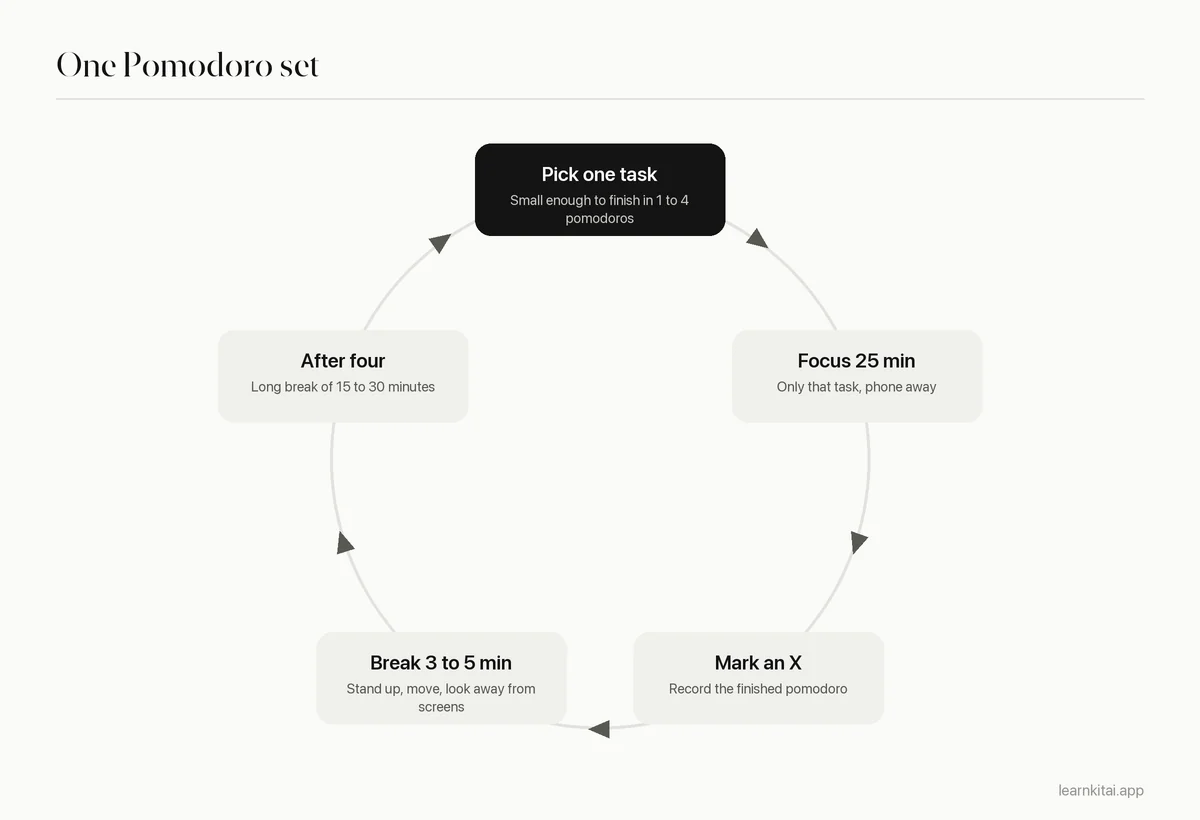
The Pomodoro technique splits study time into focused blocks of 25 minutes, each followed by a short break of about 5 minutes. After four blocks you take a longer break of 15 to 30 minutes. For studying, it works best when each block has one concrete task, such as answering ten practice questions.
The Pomodoro technique is one of the simplest focus methods ever invented: set a timer, work on one thing until it rings, take a short break, repeat. Its simplicity is also why many students try it for a week and drop it. They run the timer but not the method. This guide covers how the technique actually works, how to plan study tasks into pomodoros, what research says about scheduled breaks, and how to adapt the length to your subject.
What is the Pomodoro technique?
It is a time management method created by Francesco Cirillo as a university student. You work in 25-minute intervals called pomodoros, separated by short breaks, with a longer break after every four. The name comes from the tomato-shaped kitchen timer he used.
Cirillo, as the publisher of his book describes, divided his work into 25-minute intervals with 5-minute breaks in between, timed by a kitchen timer shaped like a pomodoro, the Italian word for tomato. In his original guide to the method, the short break is 3 to 5 minutes, and every four pomodoros you stop for a longer break of 15 to 30 minutes.
Two rules make it more than a timer. First, a pomodoro is indivisible: if you stop halfway to do something else, that pomodoro does not count, and you start a fresh one. Second, you record finished pomodoros. Over days, that record shows you how long tasks really take, which is the part most students skip and the part that improves planning the most.
How do you use the Pomodoro technique for studying?
Write a short list of study tasks, estimate how many pomodoros each needs, then start the timer on the first task. Work only on that task until the timer rings, mark it, take a short break and continue. At the end of the day, compare your estimates with your real count.
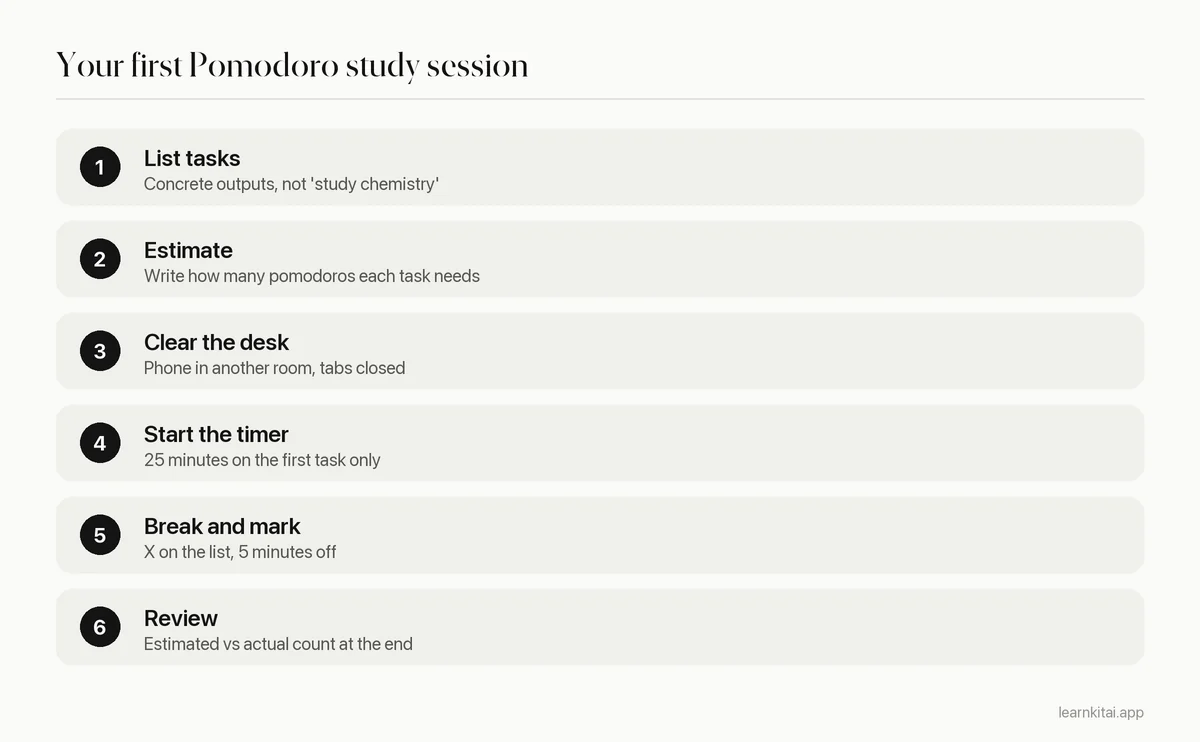
The hardest step is the first one, because 'study biology' is not a task. A good pomodoro task has a visible finish line. Compare these:
- Vague: 'Review chapter 6.' Concrete: 'Answer the 12 end-of-chapter questions for chapter 6 without notes.'
- Vague: 'Work on essay.' Concrete: 'Write the outline for paragraphs 2 and 3.'
- Vague: 'Learn vocab.' Concrete: 'Go through the 40-card Spanish deck once and mark misses.'
- Vague: 'Do math.' Concrete: 'Solve problems 1 to 8 on page 214, then check.'
If a task needs more than four or five pomodoros, split it. If a task needs less than one, group it with similar small tasks, such as answering three short emails to classmates in a single pomodoro.
Does the Pomodoro technique actually work?
The evidence is promising but limited. In one study, students who took scheduled breaks reported less fatigue and distraction and more focus and motivation than students who chose their own breaks, and finished the same work in less time. Research on short breaks also finds they boost energy and reduce tiredness.
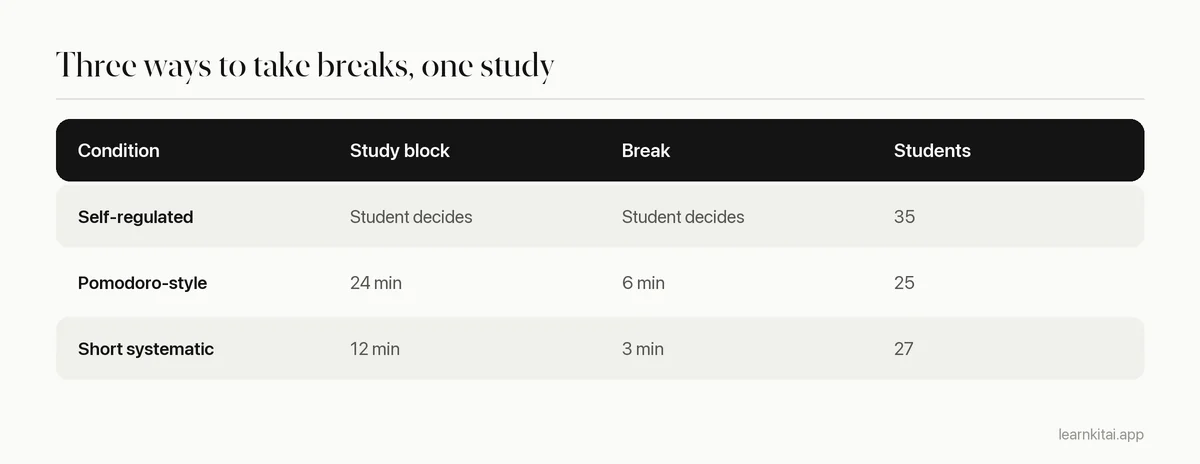
The clearest test with students comes from Maastricht University. Biwer and colleagues had 87 university students study during a real self-study session in one of three conditions: breaks whenever they liked, a 6-minute break after every 24 minutes (a Pomodoro-style schedule), or a 3-minute break after every 12 minutes. In their study of Pomodoro and self-regulated breaks, students who chose their own breaks studied and rested for longer stretches but reported more fatigue and distractedness and less concentration and motivation. Task completion was the same, so the scheduled groups got there in less time.
A wider body of research looks at short breaks in general. A 2022 meta-analysis of micro-breaks pooled 22 study samples with 2,335 participants. Breaks of up to 10 minutes gave small but reliable gains in vigor and reductions in fatigue. Their effect on overall performance was not statistically significant, and showed up mainly on less demanding tasks. Longer breaks gave bigger performance boosts, which suggests that after very demanding study, five minutes may not be enough.
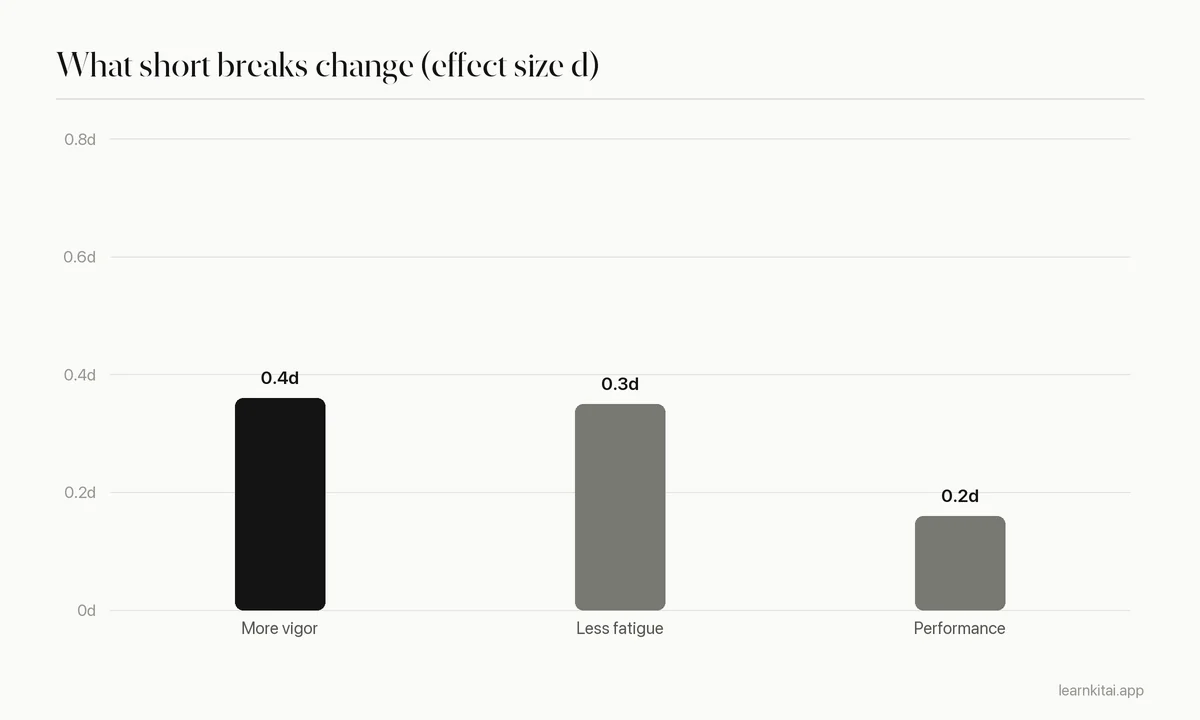
Put together, a fair summary is this: scheduled breaks make long study sessions feel better and keep motivation up, and they can save time. They are not a shortcut to learning on their own. What you do inside the 25 minutes still decides how much you learn.
What should you study inside a pomodoro?
Use pomodoros for active work with a clear output: practice questions, flashcards, problem sets, outlining or explaining a topic from memory. Passive rereading fits the timer badly because it has no finish line, and it is one of the weakest ways to study anyway.
A timer guarantees focus on something. It does not guarantee the something is useful. The strongest pairing is a pomodoro of retrieval practice: close your notes and answer questions, then check. A good pattern for a two-pomodoro topic is one block of answering questions or writing what you remember, and one block of fixing the gaps you found.
If preparing questions eats your study time, generate them first. LearnKit can turn a lecture PDF or a page of notes into flashcards or a quiz, so a whole pomodoro goes to answering rather than writing questions. The iPhone app also has a built-in Pomodoro focus timer that logs your sessions alongside your study stats.
How do you handle interruptions during a pomodoro?
Separate outside interruptions from inside ones. For a thought or urge, write it on a scrap of paper and return to the task. For a person or message, decide whether it can wait 20 minutes; it usually can. If you must stop, void that pomodoro and start a fresh one later.
Most interruptions during study are internal: a sudden need to check a fact, reply to a message or look up something unrelated. Keep a small 'later' list next to you. Writing the urge down satisfies it enough to keep going, and you can deal with the list during a break. External interruptions shrink a lot once the phone is physically out of reach. Our guide to phone distraction while studying explains why silent mode on the desk is not enough.
Is 25 minutes the best length for a study session?
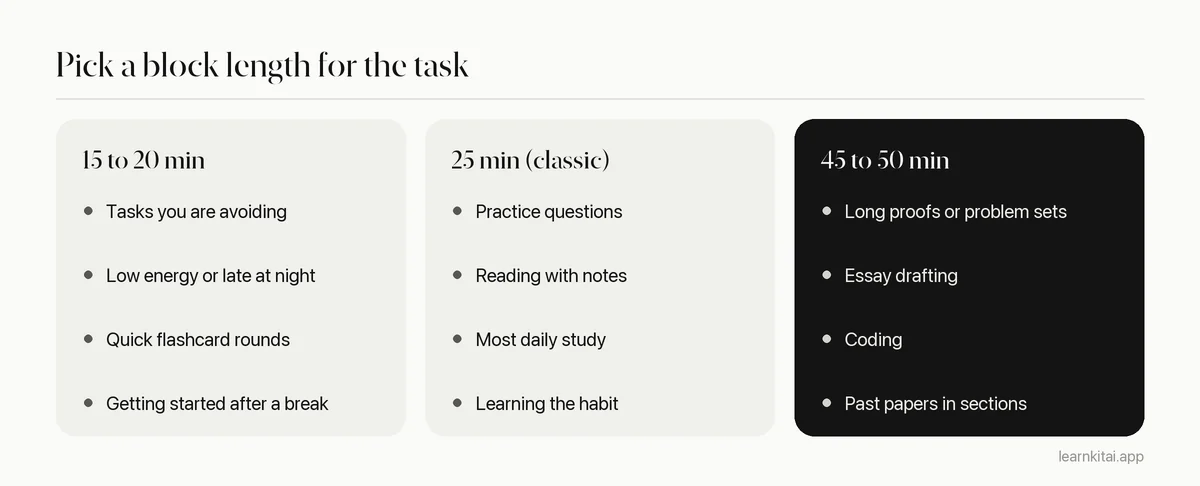
Not for everyone. Twenty-five minutes is a good default for starting, for low-energy days and for tasks you dread. For deep problem solving or writing, many students prefer 45 or 50 minutes with a 10-minute break. Keep the ratio of focus to rest roughly similar and test what works.
Cirillo's own method allows changes. His guide notes that the long break can be adjusted to how tired you feel, and that shorter sets of three pomodoros suit tired days. The Maastricht study used 24 and 12 minutes. The best length is the one you can protect completely. A 50-minute block you keep checking your phone in is worse than a 25-minute block you actually spend on the task.
What should you do during Pomodoro breaks?
Get up, move and rest your eyes. Walk, stretch, refill water or look out a window. Avoid the phone: a five-minute scroll rarely feels like a break and often turns into twenty. On the long break, eat or go outside.
The point of a break is to recover, not to switch to a different kind of screen work. Social media in particular is designed to be hard to stop. If you find breaks stretching, set a second timer for the break itself. For a fuller look at break length and activities, see how long study breaks should be.
Common Pomodoro technique mistakes
- Skipping the plan. Without a task list and estimates, the timer only measures time, not progress.
- Working through breaks. It feels productive for one round and costs you in round four.
- Using breaks for the phone. The break becomes a new distraction and rarely ends on time.
- Treating every task the same. Hard tasks may need longer blocks; dreaded tasks need shorter ones.
- Never reviewing the count. The record of pomodoros per task is what makes your future plans realistic.
How do you plan a study week in pomodoros?
Count how many pomodoros you can realistically finish on a normal day, multiply by your study days, and keep about a fifth in reserve. Then share the rest across subjects by priority, with the hardest subject in your best hours. Adjust next week using your real counts.
Pomodoros turn a fuzzy goal like 'study more' into a budget you can count. Suppose you can manage eight a day on five weekdays. That is 40 pomodoros. Hold back eight for surprises, and you have 32 to share: perhaps 12 for organic chemistry before the midterm, 8 for statistics, 6 for an essay and 6 for language vocabulary. Write those numbers at the top of your week.
At the end of the week, compare the plan with your marks. If chemistry needed 16 instead of 12, you have learned something real about the course, not about your willpower. After two or three weeks, your estimates get much closer, and planning stops feeling like guesswork.
How does the Pomodoro technique fit with other focus habits?
It is the timer that holds the other habits together. A quiet space, a phone out of reach, enough sleep and a regular study time all make each pomodoro more productive. The technique also gives you a simple unit to track, such as eight pomodoros a day.
Think of the Pomodoro technique as the core of a focus system rather than the whole system. These guides cover the pieces around it:
- Stop procrastinating: a single 25-minute block is the smallest possible start.
- Music while studying: what to play during a pomodoro, and what to avoid.
- Sleep and memory: why the best session plan fails on four hours of sleep.
- Deep work for students: when to stack pomodoros into longer focus blocks.
- How many hours should you study: turning a daily pomodoro count into a realistic target.
- Study space setup: building a desk where pomodoros are easy to start.
Start small. Plan three pomodoros for tomorrow, each with a concrete task, and write down how many you actually finish. That record, not the timer itself, is how the method makes you a better planner and a steadier student.
Frequently asked questions
Can I use the Pomodoro technique for reading a textbook?
Yes, if you give each block an output. For example: read one section, then close the book and write three things you learned plus one question. That turns reading into active study with a clear finish line.
What if I finish my task before the timer rings?
Use the remaining minutes to review what you just did: check answers, quiz yourself on the material or tidy your notes. Cirillo recommends overlearning in leftover time rather than starting a new task mid-pomodoro.
How many pomodoros should I do in a day?
It depends on your schedule, but many students find 6 to 10 pomodoros of real focus a solid study day. Start with what you can sustain and raise the count slowly; consistency beats occasional marathons.
Do I need a special app for the Pomodoro technique?
No. Any timer works, including a kitchen timer like the original. An app helps mainly by recording your sessions automatically so you can see patterns over weeks.
Sources
- The Pomodoro Technique by Francesco Cirillo, Penguin Random House (Origin as a college student; 25-minute intervals with 5-minute breaks; tomato-shaped kitchen timer)
- The Pomodoro Technique (original guide), Francesco Cirillo (PDF hosted by FAASTeam) (3 to 5 minute breaks; longer break of 15 to 30 minutes every four pomodoros; adjusting set length when tired)
- Understanding effort regulation: Comparing 'Pomodoro' breaks and self-regulated breaks, British Journal of Educational Psychology (PubMed) (87 students; 24/6 and 12/3 schedules versus self-regulated breaks; less fatigue, more concentration and motivation, same task completion)
- Give me a break: A systematic review and meta-analysis on the efficacy of micro-breaks, PLOS ONE (22 samples, N = 2,335; vigor d = .36, fatigue d = .35, performance d = .16 (not significant))
Keep reading
Study Breaks: How Long, How Often, and What to Do
Five minutes or fifty? Scheduled or whenever you feel tired? What research says about study breaks, plus a simple rule for timing them.
Phone Distraction: Why Silent Mode Is Not Enough
Your phone can cost you focus even when it is silent and face down. What the research shows, and a setup that actually keeps it out of your study time.
Stop Procrastinating on Studying: Fix the Feeling First
Procrastination is less about laziness and more about avoiding a bad feeling. Here is how to find your reason for delaying and start studying in minutes.
Deep Work for Students: Fewer Hours, Harder Thinking
A few hours of undistracted, demanding work beat a whole day of half attention. Here is how to plan deep work around classes.
How to Focus When Your Mind Keeps Leaving the Room
Focus is not a trait you have or lack. It is the skill of noticing drift and coming back, and you can train it.