Sleep and Memory: Why the All-Nighter Backfires
Sleep helps memory in two ways. Sleep after studying helps stabilize what you learned, and sleep before studying prepares your brain to take in new material. Missing a night can make it much harder to form new memories the next day. Teens need 8 to 10 hours a night and adults at least 7.
When exams pile up, sleep is usually the first thing students cut. It feels like free time: eight hours you could spend studying. The research on sleep and memory says that trade is a bad one. Sleep is not a pause in learning. It is part of how learning works, and skipping it can erase much of what the extra hours were meant to buy.
How does sleep help memory?
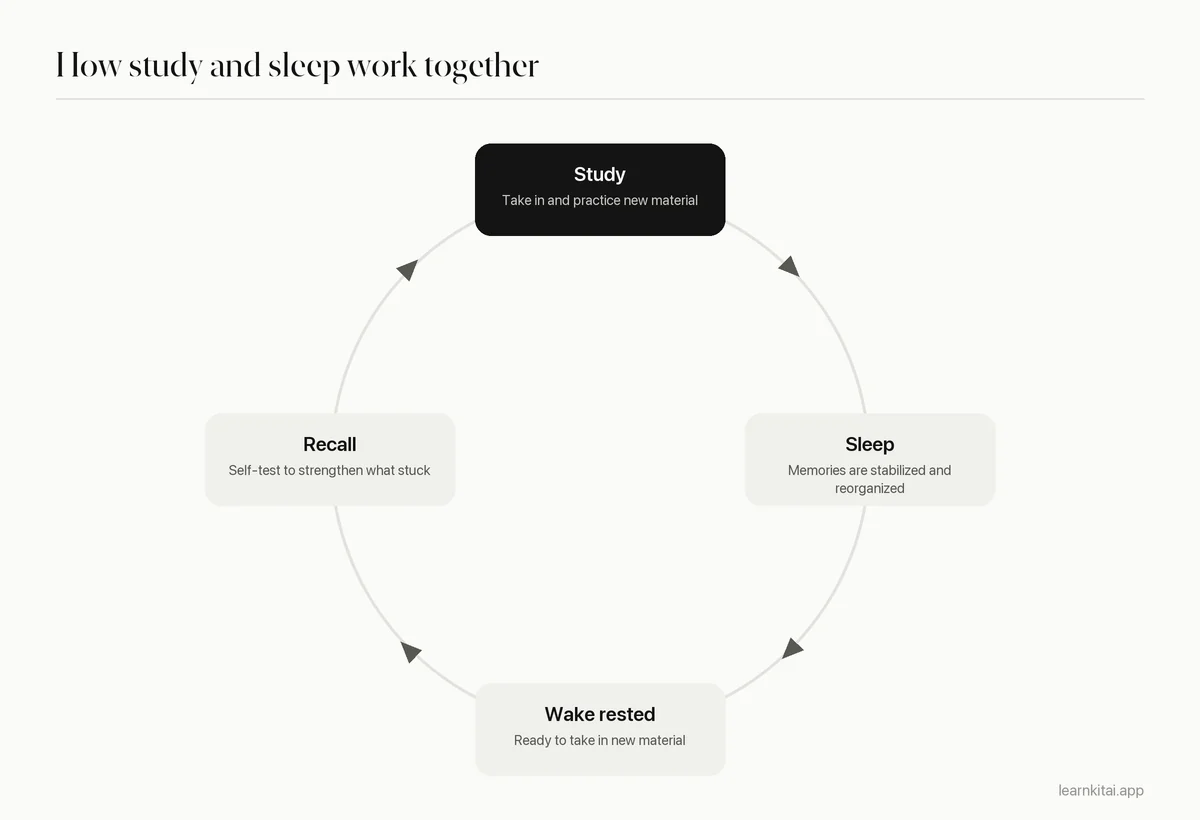
Sleep works on both ends of learning. After you study, sleep helps stabilize and strengthen the new memories. Before you study, a good night prepares the brain to take in new information. Without sleep, the brain has a harder time forming new memories the next day.
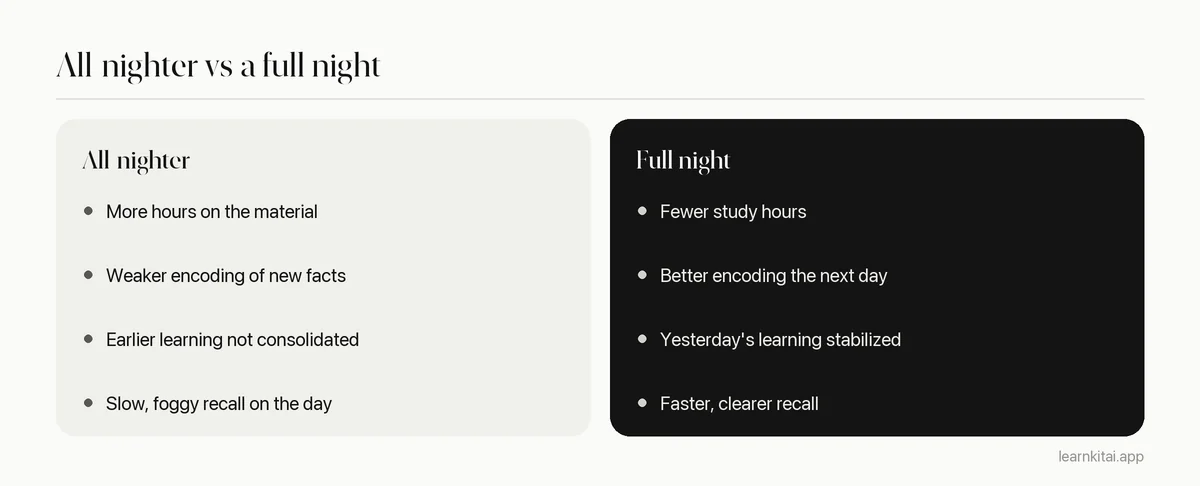
Think of the day as collecting and the night as filing. During the day you take in new material, but the memories are fragile. During sleep, the brain replays and reorganizes them so they last. Then the next morning you start with room to collect again. Skip the night, and you get both problems at once: yesterday's learning is not filed, and today's has nowhere good to go.
Does pulling an all-nighter hurt your memory?
Yes. In a Harvard brain-imaging study, students kept awake for 35 hours before learning a set of images remembered them on average 19 percent worse than students who had slept, and up to 40 percent worse. Their brains showed less activity in the hippocampus, a key memory region.
The study, led by Seung-Schik Yoo and Matthew Walker, was published in Nature Neuroscience as A deficit in the ability to form new human memories without sleep. The Harvard Gazette summary describes the design: volunteers stayed awake for 35 hours, viewed images in a scanner, then were tested two days later, after catching up on sleep. Even after recovery sleep, the sleep-deprived group remembered less, because the memories were never formed well in the first place.
That is the core problem with an all-nighter before an exam. You arrive with tired recall for everything you already knew, and the material you crammed overnight was learned by a brain working at a disadvantage. Our post on cramming the night before an exam covers what a late session can and cannot do.
How much sleep do students need?
The CDC recommends 8 to 10 hours a night for teens aged 13 to 17 and 7 or more hours for adults aged 18 to 60. Many students get much less during exam season, which is exactly when memory needs sleep the most.
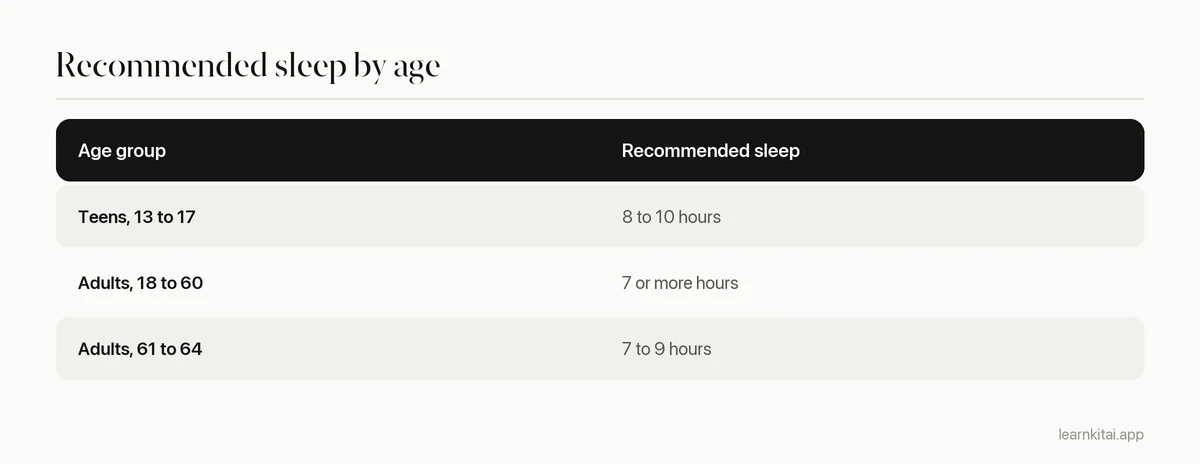
Those figures come from the CDC's guide to sleep. They are not targets for the night before a test only. The study that matters most for students suggests the weeks before count more than any single night.
Does sleep affect grades?
In an MIT study, students' sleep over the weeks and month before a test was linked to better grades, while sleep on the single night before was not. Sleep quality, duration and consistency together accounted for about a quarter of the variation in grades.
In that study, 100 students in an introductory chemistry class wore activity trackers through the semester. As MIT News reports, the night before a test showed no link to scores, but sleep during the days of learning did. Bedtime mattered too: students who went to bed after a certain point, often around 2 a.m., did worse even with the same total hours. It is a correlation, not proof, since stress or workload could affect both sleep and grades. But it fits the lab research well: sleep is a study habit, not a test-day trick.
Sleep and memory tips for exam season
- Keep a steady schedule. Similar bed and wake times every day, weekends included, beat catching up later.
- Protect the hours before the exam week. The weeks of learning matter more than the final night.
- Review, do not learn, before bed. A short round of flashcards on today's material is a good last task. A brand-new chapter is not.
- Stop screens and heavy study a little before bed. Give yourself time to wind down.
- Watch caffeine late in the day. If coffee keeps you up, move it earlier.
- Use short naps carefully. A brief early-afternoon nap can help after a bad night; a long late nap can wreck the next one.
That third tip pairs well with spaced review. Go over the day's material once in the evening, sleep on it, then test yourself again the next morning. The morning test shows what stuck and what needs another pass. The method in spaced repetition explained builds a whole schedule on this rhythm. A small deck of flashcards made from the day's notes is ideal for the evening slot, and LearnKit can generate one from a lecture PDF in a minute so you spend the time reviewing, not writing cards.
What if you cannot sleep before an exam?
Do not panic. One poor night before a test matters less than the weeks before it, and nerves often keep people awake. Rest with the lights off, avoid checking the time, and skip late-night cramming. If sleep problems last for weeks, talk to a doctor or your student health service.
This is where the MIT finding is reassuring. If you have slept reasonably during the semester, one restless night will not undo it. Focus on what you can control on the day: a steady morning, light review and a calm start. Our exam day checklist walks through it. For the bigger focus system around sleep, start with the Pomodoro technique, and see the best time of day to study to line up your hardest work with your most alert hours.
Frequently asked questions
Is it better to sleep or study the night before an exam?
For most students, sleep. Research suggests that sleep deprivation makes it harder to form new memories, and tired recall is slower. A short review followed by a normal bedtime usually beats an extra three hours of tired studying.
Does studying right before bed help you remember?
A short review before bed of material you studied earlier is a sensible habit, and sleep then helps stabilize it. Learning large amounts of brand-new material late at night is less effective, especially if it cuts into sleep.
Can I catch up on sleep at the weekend?
Extra sleep can reduce tiredness, but irregular schedules are linked with worse results than steady ones. Keeping similar bed and wake times through the week is the better habit.
Do naps help memory?
Short naps can help alertness, especially after a short night. Keep them brief and early in the afternoon so they do not make it harder to fall asleep at night.
Sources
- About Sleep, Centers for Disease Control and Prevention (Recommended sleep: teens 13 to 17, 8 to 10 hours; adults 18 to 60, 7 or more hours; adults 61 to 64, 7 to 9 hours)
- Study shows importance of sleep for optimal memory functioning, Harvard Gazette (35 hours awake; sleep-deprived group averaged 19 percent worse and up to 40 percent worse at remembering images)
- A deficit in the ability to form new human memories without sleep, Nature Neuroscience (PubMed) (One night of sleep deprivation reduced hippocampal activity during encoding and worsened retention)
- Study: Better sleep habits lead to better college grades, MIT News (100 students with trackers; sleep over prior weeks, not the night before, linked to grades; about a quarter of grade variation)
Keep reading
Pomodoro Technique for Studying: 25 Minutes, Done Right
A kitchen timer, 25 minutes and a short break. Here is how to use the Pomodoro technique for real study tasks, what the research says and how to adapt it.
Cramming: What Actually Works the Night Before an Exam
Cramming is a poor way to learn, but sometimes it is the only option left. Here is how to spend one evening so it counts, and when to stop.
Best Time to Study: Match Hard Work to Your Body Clock
Morning or night? The research says the right answer depends on your chronotype and on the kind of thinking a task needs.
Exam Day Tips: A Checklist From Wake-Up to Last Answer
The night before, the morning of, the first five minutes and the last ten. A calm, research-backed checklist for the day all your studying pays off.

Spaced Repetition: Why Forgetting Is Part of the Plan
Reviewing right before you forget builds memories that last. Learn how long the gaps should be, with a ready schedule for exams one week to one semester away.