AI Tutor vs Human Tutor: What Each One Does Best
An AI tutor is best for instant, unlimited practice: explanations at 2 a.m., endless quiz questions and step-by-step hints. A human tutor is best for diagnosing why you are stuck, keeping you accountable and coaching skills like essay writing. The research shows AI helps when it guides you and hurts when it just gives answers.
It is 11 p.m., your problem set is due at 9 a.m., and you are stuck on question four. A human tutor is asleep. An AI tutor is right there, endlessly patient and free or close to it. So is the human tutor obsolete? Not quite. The research on AI tutoring tells a more interesting story: the same technology can double what students learn or quietly make them worse, depending on how it is built and how they use it.
This guide compares the two honestly, shows what recent studies found, and gives you a decision rule for when to use each, plus prompts that turn a chatbot into something closer to a real tutor.
Why is one-to-one tutoring so powerful?
A tutor adapts to you in real time: they spot the exact misconception, explain it another way, and make you try again until you get it. Classic research found tutored students far ahead of classroom peers, and modern reviews still show solid gains.
In 1984, Benjamin Bloom reported that students tutored one-to-one performed about two standard deviations above students in a regular class. In his words, the average tutored student was above 98% of the students in the control class. That result came from small studies and is probably on the high side. A large modern review of 89 randomized trials found a smaller but still substantial average effect of 0.29 standard deviations, with stronger results when tutors were teachers or trained staff.
The secret is not magic. Good tutors ask more than they tell. They make you explain, catch errors early, and keep the difficulty just above your comfort zone. Hold onto that idea, because it is exactly what separates good AI tutoring from bad.
Is AI tutoring effective?
It can be. A Harvard trial found students learned more than twice as much with a carefully designed AI tutor as in an active learning class. But a large high school study found that open chatbot access boosted practice scores and then lowered exam scores. Design decides the outcome.
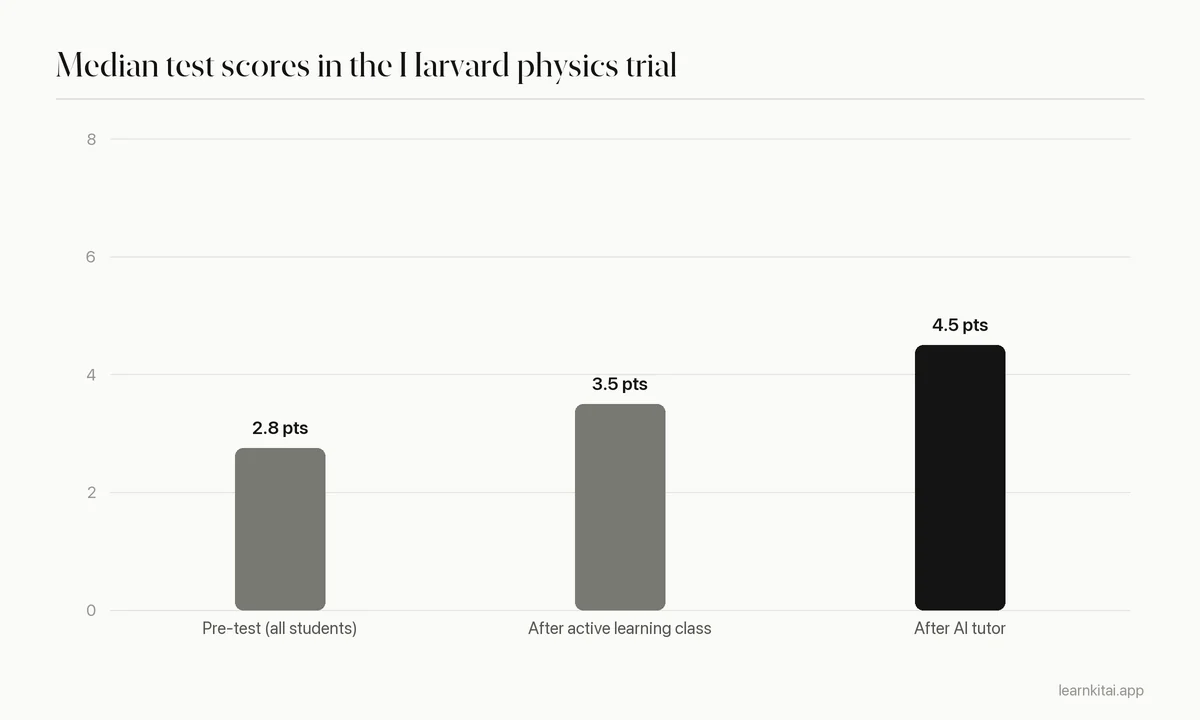
In a 2025 randomized trial in a Harvard physics course, students used an AI tutor built to guide them step by step without giving away answers. Their median learning gains were more than double those from an in-class active learning session, and they spent a median of 49 minutes on the material.
Now the warning. In a field experiment with nearly 1,000 high school math students in Turkey, researchers gave some students a plain ChatGPT-style tool and others a version with guardrails that offered hints, not answers. Wharton's summary of the study reports the results below.
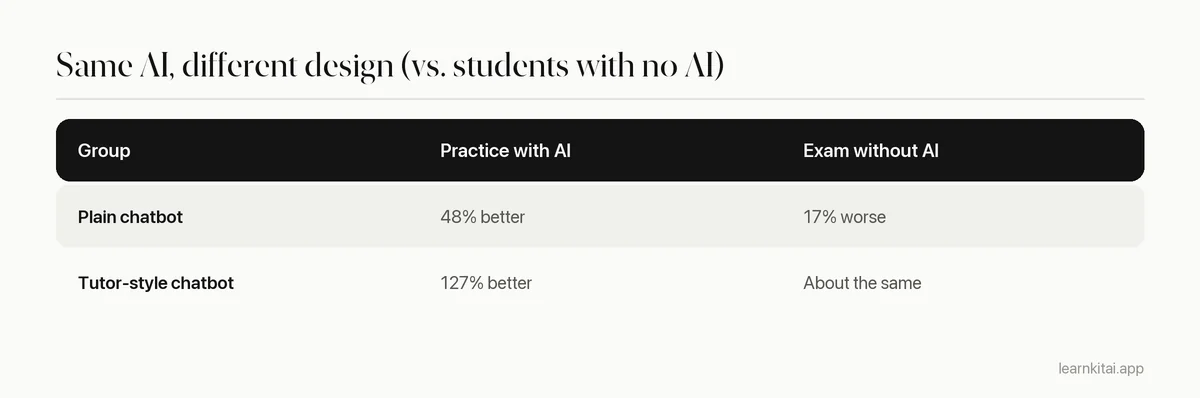
The plain chatbot worked like a crutch. Students leaned on it, got answers, and did worse once it was gone. The tutor-style version avoided that harm. The lesson for you: an AI tutor helps when it makes you think, and hurts when it thinks for you. That is the same principle behind desirable difficulties: effort during practice is what makes learning stick.
Where does each one win?
AI wins on availability, cost, patience and volume of practice. Humans win on diagnosis, motivation, accountability and feedback on complex work like essays, labs and presentations.
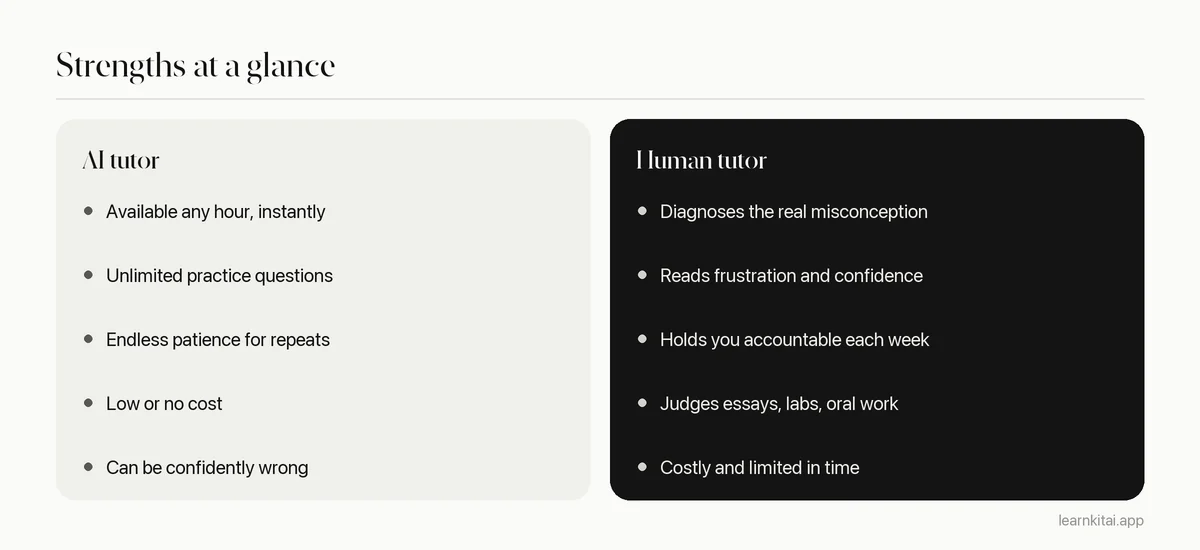
One weakness of AI deserves its own line: it can be wrong in a fluent, convincing way. A human tutor can be wrong too, but is more likely to say "let me check." Treat AI explanations as a draft to verify, especially for numbers and definitions.
When should you choose a human tutor?
Choose a human when you have been stuck on the same topic for weeks, when motivation is the real problem, when you need feedback on writing or speaking, or when a high-stakes exam is coming and you need a plan you will actually follow.
- Repeated failure on one topic. A person can find the hidden gap two levels below the one you think is the problem.
- Motivation and routine. A weekly appointment is a commitment device. AI never notices that you skipped a week.
- Complex output. Essays, lab reports, presentations and language speaking need a judge who understands the context.
- Big exams. Someone who knows the exam format can shape your preparation in ways a general chatbot cannot.
For most students, the best answer is both: a human tutor for an hour a week, and AI practice in between. The human sets direction; the AI provides volume.
Here is what that can look like in a chemistry course. On Monday, your tutor finds that your trouble with equilibrium really comes from shaky algebra with exponents. She sets you two goals for the week. From Tuesday to Saturday, you spend 20 minutes a day with AI: ten practice problems with hints only, then a short quiz. You bring your two worst problems to next Monday's session. The tutor's hour now goes to the hardest 5% of your work instead of routine practice.
How do you make an AI tutor teach instead of tell?
Tell it the rules up front: no final answers, one hint at a time, ask you to explain your reasoning, and quiz you at the end. Then answer before reading further. You are building the guardrails the research says matter.
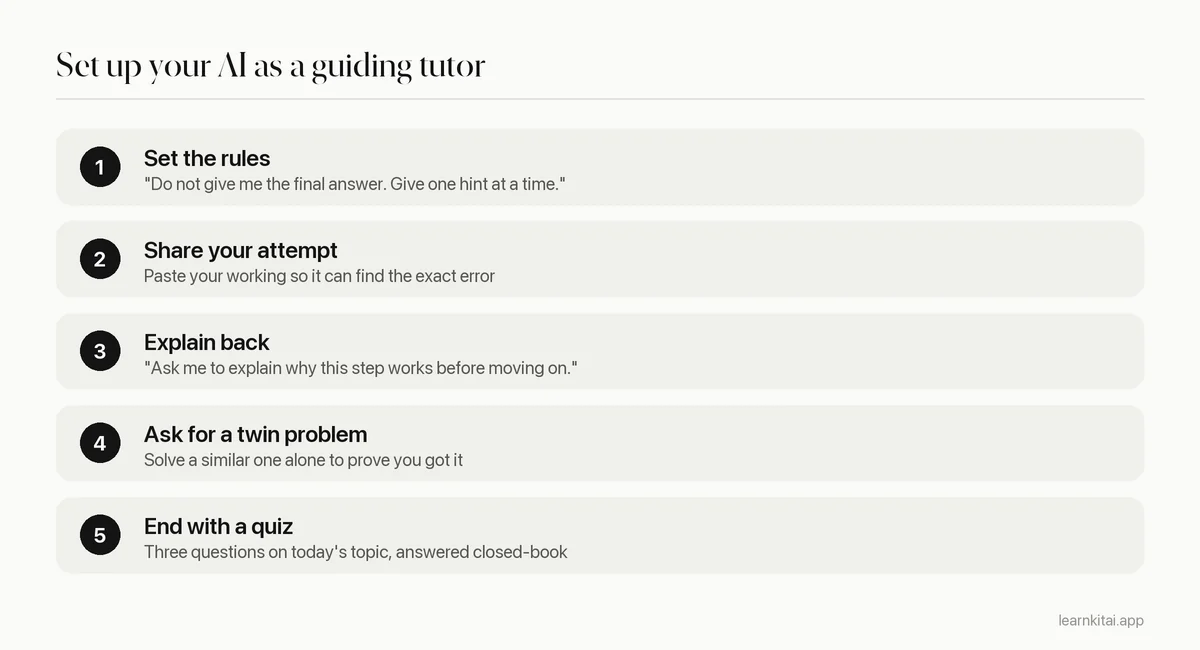
Step three uses self-explanation, one of the better-supported study habits: saying why each step works forces you to connect it to what you know. Step five turns the session into retrieval practice. If you want ready-made questions on your own course material, an AI quiz generator can build them from your notes.
LearnKit takes that last step off your plate. Add your lecture notes or a PDF and it builds a multiple choice quiz with explanations, so you practice on your own course content rather than generic questions.
An AI tutor is not a cheap copy of a human one. It is a different tool with different strengths. Use it for the practice a human could never fit into an hour, and use people for the judgment AI cannot give. For the broader picture, read how to use AI to study.
Frequently asked questions
Can an AI tutor replace a private tutor completely?
For some students and subjects, it can cover most needs, especially for practice and explanations. It struggles with accountability, motivation and feedback on complex work. If those are your problems, a human is still worth it.
Is ChatGPT a good tutor for math?
It can explain steps well, but it can also make calculation errors with confidence. Ask for hints instead of solutions, check each step yourself, and verify final answers with a calculator or textbook.
How much does a human tutor cost compared with AI?
Prices vary widely by country, subject and tutor experience, so there is no single figure. AI tools range from free to a monthly subscription. A common middle path is a few human sessions for direction plus daily AI practice.
Do AI tutors work for younger students?
The guardrails matter even more for younger learners, who may lean on answers. Tools designed to give hints rather than solutions, and adult oversight, help keep the practice honest.
Sources
- The 2 Sigma Problem: The Search for Methods of Group Instruction as Effective as One-to-One Tutoring, Benjamin Bloom, Educational Researcher, 1984 (Average tutored student was about two standard deviations above, and above 98% of, the control class.)
- The Promise of Tutoring for PreK-12 Learning: A Systematic Review and Meta-Analysis of the Experimental Evidence, Nickow, Oreopoulos and Quan, Stanford NSSA (89 randomized trials, pooled effect of 0.288 SD; stronger for teacher and paraprofessional tutors.)
- AI tutoring outperforms in-class active learning: an RCT introducing a novel research-based design in an authentic educational setting, Kestin et al., Scientific Reports, 2025 (via PubMed Central) (Median gains more than double with the AI tutor; median post-test 4.5 vs 3.5 from a 2.75 pre-test; 49 minutes median time.)
- Without Guardrails, Generative AI Can Harm Education, Knowledge at Wharton (Nearly 1,000 students: plain chatbot 48% better in practice and 17% worse on exam; tutor version 127% better in practice, about the same on exam.)
Keep reading
AI for Studying: Make It Quiz You, Not Think for You
AI can make you a stronger student or a more dependent one. The difference is whether it does the thinking or makes you do it.
AI Quiz Generator: Turn Any Chapter Into a Practice Test
Taking a quiz teaches you more than rereading. An AI quiz generator makes practice tests cheap, as long as you use them the right way.
Self Explanation: Talk Yourself Into Understanding
Stopping after each step to ask why it works is one of the simplest study habits with solid research behind it. Here are the prompts and a worked example.
Desirable Difficulties: Why Harder Studying Sticks Longer
Study methods that feel smooth often fade fast, and ones that feel hard often last. How to tell a useful struggle from a pointless one, with a four-question check.
AI Academic Integrity: Where Help Ends and Cheating Starts
The tool is rarely the problem. What you submit as your own thinking is. A simple test for staying honest while studying with AI.