AI Quiz Generator: Turn Any Chapter Into a Practice Test
An AI quiz generator turns your notes or a chapter into practice questions in seconds. To learn from it, answer every question before seeing options or explanations when you can, read the feedback on every item, mix multiple choice with short answers, and retake the questions you missed a few days later.
Practice tests are one of the most reliable ways to learn, and one of the least used, mostly because making good questions takes time. An AI quiz generator removes that cost. Drop in a chapter or your lecture notes and you get a quiz in seconds.
That changes what is possible: a quiz after every lecture, not just before the exam. But a quiz only teaches if you use it well. This guide covers why quizzing works, how to get questions hard enough to matter, what to do with wrong answers, and a weekly routine you can start today.
Why does quizzing yourself beat rereading?
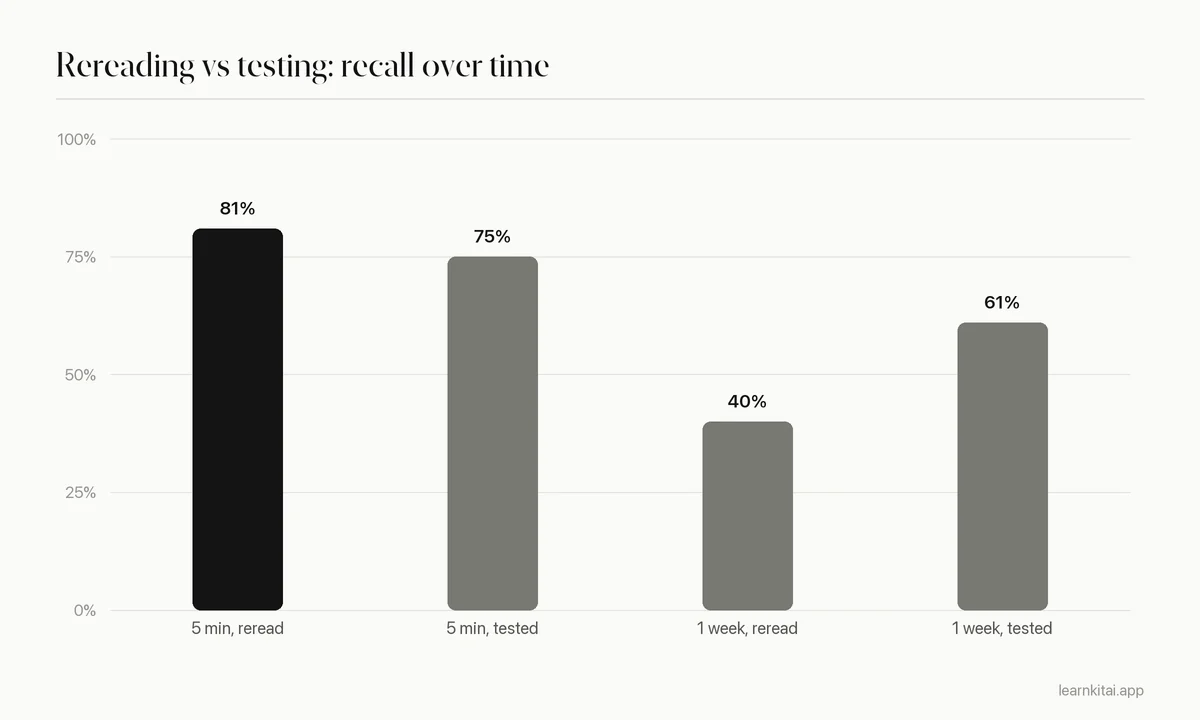
Because pulling an answer out of memory strengthens it more than seeing it again. In a classic study, students who tested themselves recalled 61 percent of a passage a week later, versus 40 percent for students who reread it, even though rereaders did slightly better after five minutes.
The study, by Henry Roediger and Jeffrey Karpicke and summarized by Washington University, shows the trap clearly. Five minutes after studying, rereading looked better. A week later, testing won by a wide margin. Rereaders also felt more confident. If you judge your study method by how it feels right after, you will pick the wrong one.
This is the testing effect, and it holds across ages, subjects and question types. An AI quiz generator is simply a way to get more testing for less effort. For the full method, see our practice testing guide.
Are AI-generated quiz questions accurate?
Mostly, but not always. In one study, ChatGPT wrote exam questions rated about as good as professors' overall, but less relevant and with more variable quality. Expect most questions to be fine and a few to be off topic, too easy, or wrong. Flag and skip those.
In that study of medical exam questions, 50 questions written by ChatGPT and 50 by professors were scored blind by five assessors. The AI took about 20 minutes, the professors about 211. Overall quality was similar, but the AI's questions were rated lower on relevance and ranged more widely in quality.
In practice, that means two habits. Generate from your own course material so questions match what is taught. And if an answer key looks wrong, check your notes before you accept it. Treat a suspect question as a prompt to look something up, which is learning too.
How do you get harder, better questions from an AI quiz generator?
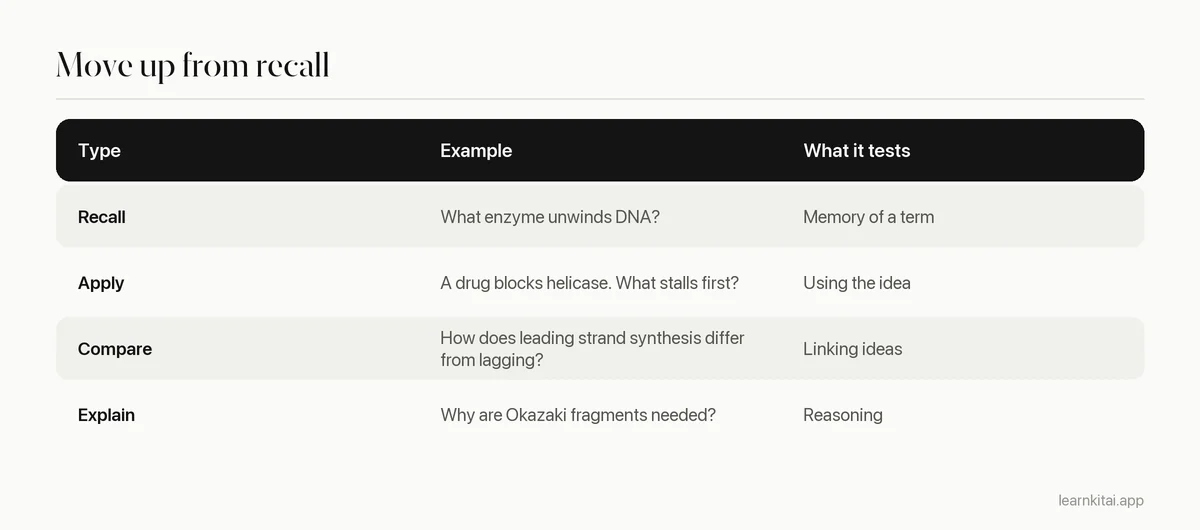
Ask for questions that require applying, comparing and explaining, not just recognizing a definition. Request plausible wrong options based on common mistakes, ask for some short answer items, and specify your level, such as first-year university biology.
Default AI quizzes lean toward easy recall: What is the definition of X? Those are fine for a first pass, but exams often ask you to use an idea. Use prompts like these:
- Write 10 multiple choice questions on these notes for a second-year university course. At least half should require applying a concept to a new example.
- Make the wrong options plausible: base each one on a common misconception, not on an obviously wrong statement.
- Add 3 short answer questions that ask me to explain why or compare two ideas.
- Include one question that combines ideas from two different sections.
- After each answer, explain why the correct option is right and why each wrong option is wrong.
Research also supports mixing formats. A summary of a 2017 meta-analysis of practice testing notes that hybrid tests, with both multiple choice and short answer questions, were the most effective. Our guides to multiple choice strategies and open-ended questions cover each format.
What should you do after you get a quiz question wrong?
Read the explanation, find the exact idea you missed, and write it down in a mistake log. Then retest it later: a few days on, try the same idea in a new question. Feedback is what turns a wrong answer from a bad memory into a correction.
Multiple choice has a hidden risk: the wrong options can stick. Researchers found that students sometimes learn false facts from multiple choice lures, though the overall benefit of testing still outweighed that cost. The fix is feedback. In a follow-up study, feedback after multiple choice tests, whether immediate or delayed, increased correct answers and reduced lure intrusions on a later test.
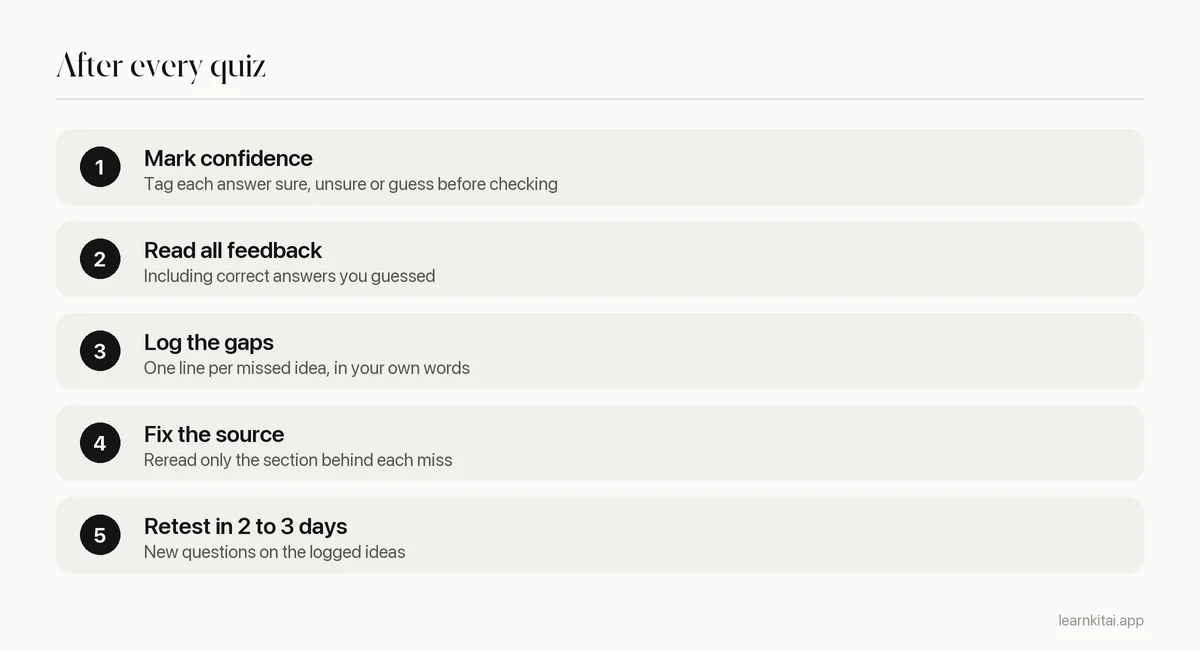
Marking confidence before you check is a small habit with a big payoff. A correct guess is a gap that looks like knowledge. Treat guesses like wrong answers. Our guide to keeping an error log shows a simple format.
A weekly routine with an AI quiz generator
- After each lecture: generate a 5 to 10 question quiz from your notes and take it the same day, without notes.
- Two or three days later: take a fresh quiz on the same lecture, focusing on ideas from your mistake log.
- End of the week: take a mixed quiz across all the week's lectures. Mixing topics makes you choose the right approach, which is what exams demand.
- Before the exam: move to full practice tests under time limits. Our guide on how to make a practice test covers the format.
Mistakes that waste a good quiz
- Quizzing only on what you know. If you score 100 percent every time, ask for harder questions or move on to new material.
- Skipping explanations for right answers. A lucky guess hides a gap until the exam.
- One big quiz the night before. That is cramming in quiz form. Spread smaller quizzes over the week.
- Never changing the questions. After a retake or two, generate fresh items so you test the idea, not your memory of the wording.
An AI quiz generator is one of the best uses of AI in studying, because it makes the most effective technique fast and cheap. Generate from your own material, push for harder questions, read the feedback, and come back to your mistakes. For more ways to use AI that build real learning, see our guide to AI for studying.
Frequently asked questions
How many questions should an AI quiz have?
For a single lecture, 5 to 15 questions is usually enough. Shorter quizzes taken more often beat one long quiz, because you get more spaced retrieval and faster feedback.
Is multiple choice or short answer better for studying?
Both help. Short answer forces fuller recall, while multiple choice is quick and good for spotting confusions between similar ideas. A mix is best, and feedback matters for both.
Can I use an AI quiz generator for math?
Yes, for practice problems and concept checks, but verify worked solutions carefully, since AI can make calculation errors. Ask it to change the numbers so you are practicing the method, not memorizing an answer.
Should I retake the same quiz?
Retaking the same questions works for a while, but you can start remembering the answer pattern instead of the idea. After one retake, switch to new questions on the same concepts.
Sources
- Repeated test-taking better for retention than repeated studying, research shows, Washington University in St. Louis (After 5 minutes 81 vs 75 percent; after 1 week 40 percent reread vs 61 percent tested)
- Test-enhanced learning: taking memory tests improves long-term retention, Psychological Science (PubMed) (Original Roediger and Karpicke (2006) study)
- ChatGPT versus human in generating medical graduate exam multiple choice questions, PLOS ONE (via PubMed Central) (Similar overall quality; AI lower on relevance and more variable; 20 vs 211 minutes)
- The memorial consequences of multiple-choice testing, Psychonomic Bulletin and Review (PubMed) (Students can learn false facts from lures, but testing benefits outweigh the cost)
- Feedback enhances the positive effects and reduces the negative effects of multiple-choice testing, Memory and Cognition (PubMed) (Immediate or delayed feedback increased correct answers and reduced lure intrusions)
- New Meta-analysis of 217 Retrieval Practice Studies, The Learning Scientists (Summary of Adesope et al. (2017): hybrid practice tests most effective)
Keep reading
AI for Studying: Make It Quiz You, Not Think for You
AI can make you a stronger student or a more dependent one. The difference is whether it does the thinking or makes you do it.

Practice Testing: The Study Habit That Beats Rereading
Testing yourself is not just a way to check what you know. It is one of the best-supported ways to learn. Here is how to do it well, week by week.
The Testing Effect: Why a Quiz Beats Another Reread
Taking a test is not just a way to measure memory. It changes memory. Here is what the research shows and how to use it this week.
Multiple Choice Strategies That Beat Guessing
Cover the options, answer first, then eliminate. Plus what the data says about changing answers, and how to study so the right option jumps out.
Error Log Studying: Turn Every Mistake Into Points
An error log is a simple table of every question you got wrong and why. Kept well, it becomes the most targeted study guide you will ever own.