Desirable Difficulties: Why Harder Studying Sticks Longer
Desirable difficulties are study conditions that make learning feel slower and harder in the moment but improve long-term memory and transfer. The main ones are spacing study sessions, mixing topics, testing yourself instead of rereading, and varying how you practice. They only help if you have enough background to meet the challenge.

The study session that feels best is often the one that teaches you least. Rereading a chapter feels smooth. Doing ten problems of the same type feels like progress. Then the exam comes and much of it is gone. The idea of desirable difficulties, introduced by UCLA psychologist Robert Bjork in 1994, explains why: some kinds of struggle during study are exactly what make memories last.
The catch is in the first word. Not every difficulty is desirable. A blurry font, a noisy room or a topic far beyond your level just makes studying harder without making it better. This guide shows how to tell the two apart.
Why does easy studying feel effective but fade fast?
Because what you can do right now is a poor guide to what you will remember later. Easy methods boost how quickly information comes to mind during the session, which feels like learning, but they do little for how deeply it is stored. That gap is called the difference between performance and learning.
In a chapter written for students, Elizabeth and Robert Bjork separate two things. Performance is what you can observe during study: how fast you answer, how many you get right. Learning is the lasting change in what you know, which you can only see after a delay or in a new setting. Their key point is that conditions that make performance improve quickly often fail to support long-term retention, while conditions that slow apparent progress often produce the most durable learning.
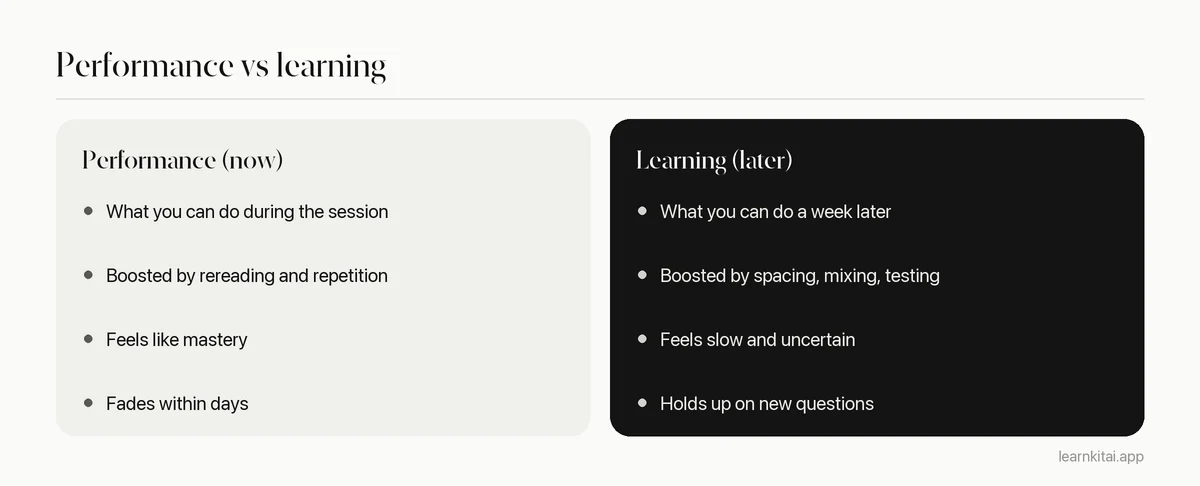
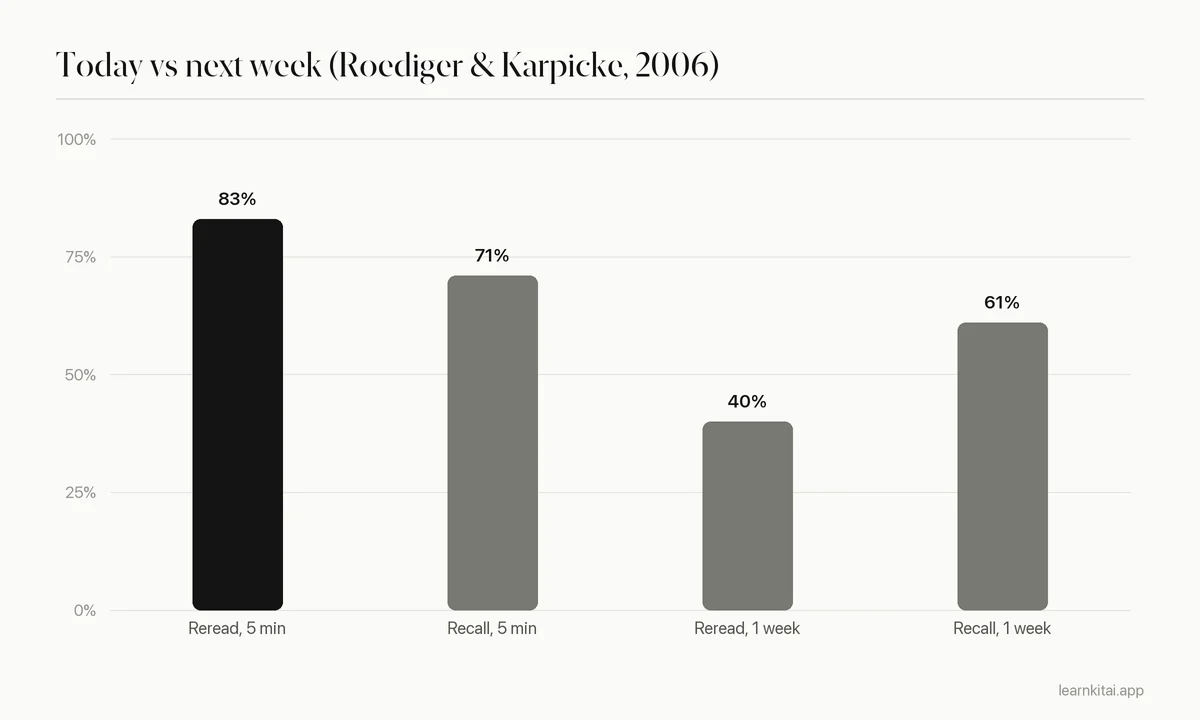
You can see both sides in a single experiment. In the 2006 study by Roediger and Karpicke, students who reread a passage four times beat a recall-practice group on a test five minutes later. One week later the order flipped completely.
What are examples of desirable difficulties?
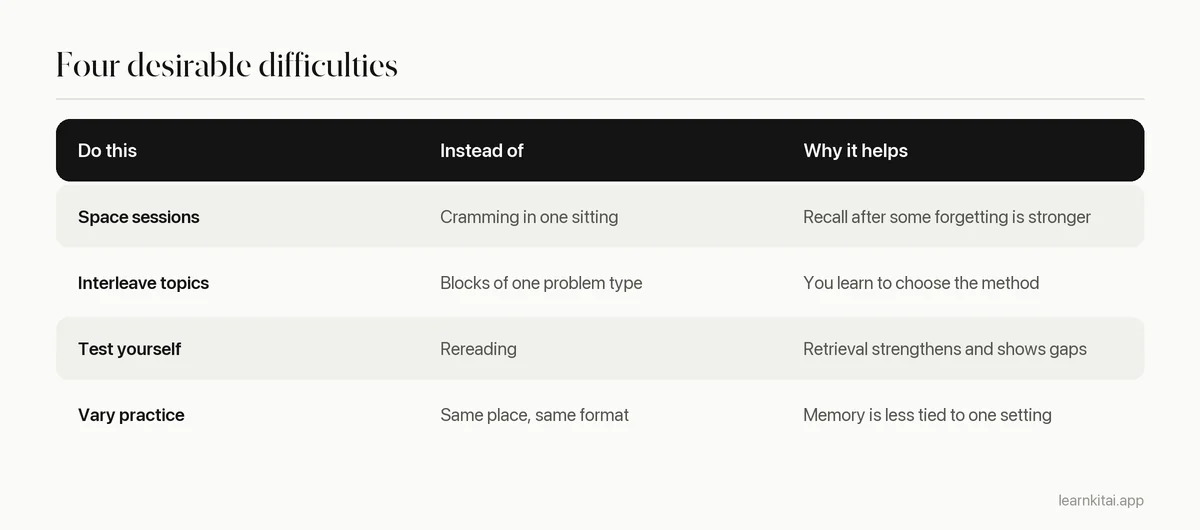
The four best supported are spacing study sessions apart, interleaving different topics or problem types, testing yourself instead of rereading, and varying the conditions of practice. Each one makes study feel harder and each one improves memory or transfer on later tests.
Spacing
Reviewing material after a gap means you have to work harder to recall it, and that work builds a sturdier memory. See spaced repetition for how long the gaps should be.
Interleaving
Mixing problem types forces you to pick the right method each time. The Bjorks cite a math study where students who mixed problem types got 63% of new problems right a week later, against 20% for students who practiced in blocks. Details are in interleaved practice.
Testing and generating
Producing an answer yourself, rather than reading it, is one of the strongest difficulties of all. The Bjorks put it bluntly: whenever you look up an answer you could have generated, you rob yourself of a learning opportunity. This is the heart of active recall.
Varying conditions
Practice in slightly different ways: different rooms, different question formats, problems in a different order. The Bjorks describe a classic finding that studying the same material in two different rooms led to better recall than studying it twice in the same room. It does not mean your study space should be chaotic. It means that some variety helps memories work outside the exact place you learned them.
When does a difficulty become undesirable?
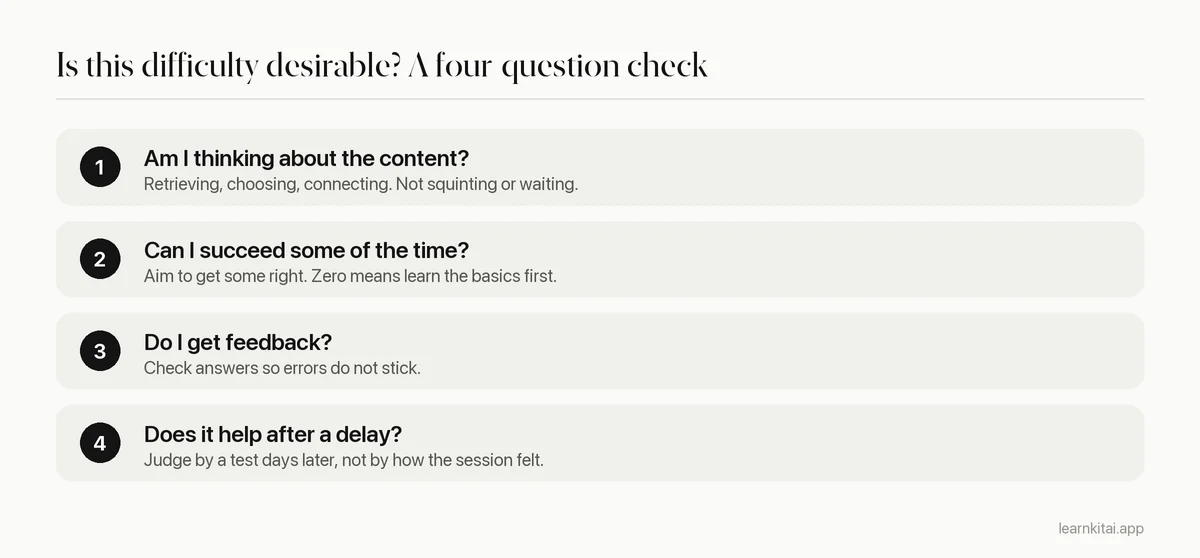
When you lack the background to meet it, or when the struggle does not involve thinking about the material. Testing yourself on a topic you have never studied, or reading a text in a hard-to-read font, adds effort without adding the useful kind of processing.
The Bjorks are explicit: a difficulty is only desirable if you can respond to it successfully. Mixing three methods you have never learned is confusion, not interleaving. Spacing reviews so far apart that nothing is left is just forgetting. The struggle has to be about retrieving and connecting the material itself.
Hard-to-read fonts show how easy it is to get this wrong. A 2011 study reported that students remembered more when material was printed in harder-to-read fonts, and the idea spread quickly. Later studies often failed to find the effect, and a 2018 meta-analysis pooled the results and found the effect on recall and transfer was close to zero, a finding later reanalyzed in detail. Squinting at letters is effort, but it is not effort spent on the ideas.
How do you add desirable difficulties to your study routine?
Start small. Replace one rereading session a day with a self-test, spread each topic over at least three sessions, mix two or three related topics in each problem set, and change the format of your practice now and then. Track results on delayed tests, not on how the session felt.
- Close the book first. Start every session by writing what you remember from last time before you look at any notes. The blurting method is an easy format.
- Split each topic across days. Three 20-minute sessions on different days beat one 60-minute session.
- Mix your problem sets. Once you know each method, combine problems from two to four sections and remove the labels.
- Change the format. Rotate between flashcards, open questions, explaining aloud and past paper questions.
- Expect the dip. Your in-session scores will drop. Write that on a sticky note if you need to.
Here is what one week can look like for a single course. Monday, learn a new topic and end with a two-minute blurt. Wednesday, start with a closed-book quiz on Monday's topic before learning anything new. Friday, do a mixed problem set drawn from this week and last week. Sunday, explain the hardest idea aloud without notes, then check. None of these sessions is longer than usual. Each one simply swaps an easy move for a slightly harder one that pays off later.
Self-testing is the easiest difficulty to add because it takes no planning beyond having questions. If you do not have time to write them, LearnKit can turn your notes or a chapter into a quiz in a minute, so the effort goes into answering rather than preparing. Answer before you reveal anything, and keep the questions you miss for your next spaced session.
Frequently asked questions
Who came up with desirable difficulties?
The term was introduced by Robert Bjork of UCLA in 1994. He and Elizabeth Bjork have since written widely about it, including a chapter for students titled Making Things Hard on Yourself, But in a Good Way.
Does this mean harder is always better?
No. The difficulty has to engage your thinking about the material and be something you can meet with effort. Studying while exhausted, in a noisy room or far above your level makes things harder without making them stick.
How do I stay motivated if studying feels worse?
Measure progress with delayed self-tests, such as a quick quiz on last week's material. Seeing those scores rise is more convincing than any feeling during the session, and it shows the extra effort is paying off.
Sources
- Making Things Hard on Yourself, But in a Good Way: Creating Desirable Difficulties to Enhance Learning, Bjork Learning and Forgetting Lab, UCLA (Bjork & Bjork, 2011) (Defines desirable difficulties, learning vs performance, and the condition that learners must be able to respond; cites 63% vs 20% for interleaved vs blocked math practice.)
- Test-enhanced learning: taking memory tests improves long-term retention, Psychological Science (Roediger & Karpicke, 2006) (Rereading 83% vs recall 71% after 5 minutes; 40% vs 61% after one week.)
- Fortune favors the bold (and the italicized): effects of disfluency on educational outcomes, Cognition (Diemand-Yauman et al., 2011) (Original report that hard-to-read fonts improved memory.)
- Null and Void? Errors in Meta-analysis on Perceptual Disfluency and Recommendations to Improve Meta-analytical Reproducibility, Educational Psychology Review (Weissgerber, Brunmair & Rummer, 2021) (Reanalysis of the 2018 meta-analysis that found near-zero pooled effects of disfluency on recall and transfer.)
Keep reading

Active Recall: Why Closing the Book Beats Rereading
Rereading feels productive but fades fast. Here is how to study by pulling answers out of memory, with a session plan, examples and the mistakes to avoid.
Interleaved Practice: Why Mixed Sets Feel Worse but Work
Doing ten problems of the same type feels great and teaches less than you think. How to mix topics so you learn to choose the right method on exam day.

Spaced Repetition: Why Forgetting Is Part of the Plan
Reviewing right before you forget builds memories that last. Learn how long the gaps should be, with a ready schedule for exams one week to one semester away.

Rereading Notes Feels Like Studying. It Mostly Isn't
Rereading is the most popular study habit and one of the weakest. Here is why it fools you, and a 20-minute swap that works better.

The Testing Effect: Why a Quiz Beats Another Reread
Taking a test is not just a way to measure memory. It changes memory. Here is what the research shows and how to use it this week.