Self Explanation: Talk Yourself Into Understanding
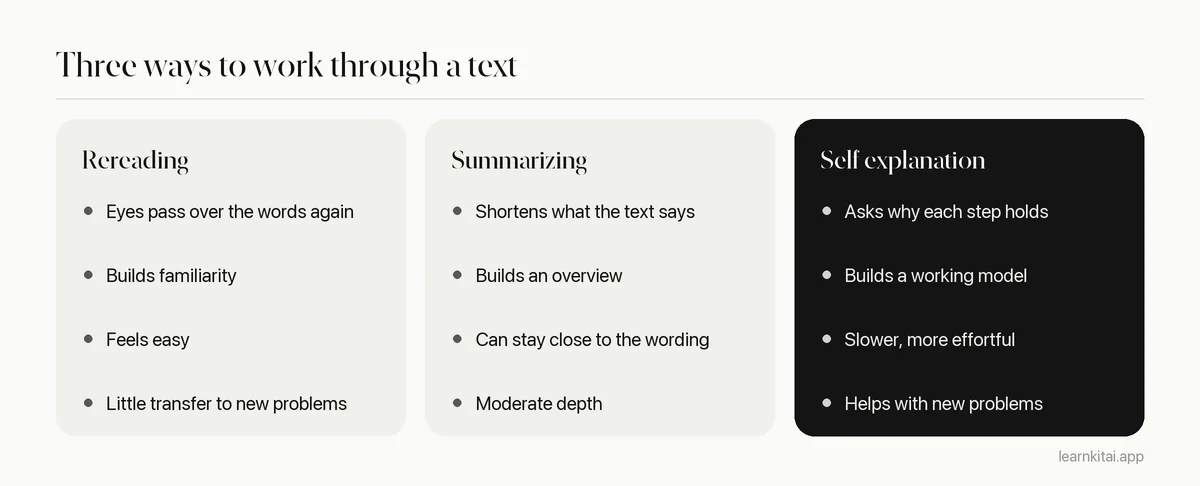
Self explanation is the habit of pausing while you read or work through an example to explain to yourself why each step is true and how it connects to what you already know. A 2018 meta-analysis of 69 effect sizes found a medium sized benefit (g = 0.55) across subjects and ages.
Two students read the same worked example in a chemistry textbook. One reads it through, nods, and moves on. The other stops at each line and asks, "Why did they do that here?" A week later, only the second student can solve a new problem of the same type. That stopping and asking is called self explanation, and it is one of the most practical study habits in the research literature.
This post shows what the evidence says, gives you a set of prompts that work, and walks through a full example. It is part of our practice testing guide, since self explanation pairs naturally with testing yourself.
What is self explanation?
It is explaining new material to yourself as you study it: why a step follows from the one before, how an idea links to what you know, and what would change if a detail were different. It is done for your own understanding, not for an audience.
The idea came from Michelene Chi's research on how strong and weak students learn from worked examples. In a 1994 study, Chi and colleagues gave 24 eighth graders a text about the human circulatory system. Fourteen were simply asked to explain each line to themselves after reading it. Ten read the text twice. The prompted group gained more from pretest to posttest, and the students who explained the most built the most accurate picture of how blood flows through the heart and body.
Does self explanation really work?
Yes. A 2018 meta-analysis pooled 69 effect sizes from 64 research reports with about 5,900 learners and found an average effect of g = 0.55, a medium effect, across many subjects, ages and formats.
Kiran Bisra and colleagues published the meta-analysis in Educational Psychology Review. Learners who were prompted to self-explain outperformed those who were not, and the benefit appeared in sciences, math, social sciences and other areas, with both print and digital material. The authors called prompts to self-explain a potentially powerful intervention across a range of instructional conditions.
One honest caveat: a large 2013 review of study techniques rated self explanation as moderate utility, mainly because fewer studies had tested it in real classrooms over long periods. It is well supported, just less battle tested than practice testing.
What questions should you ask yourself?
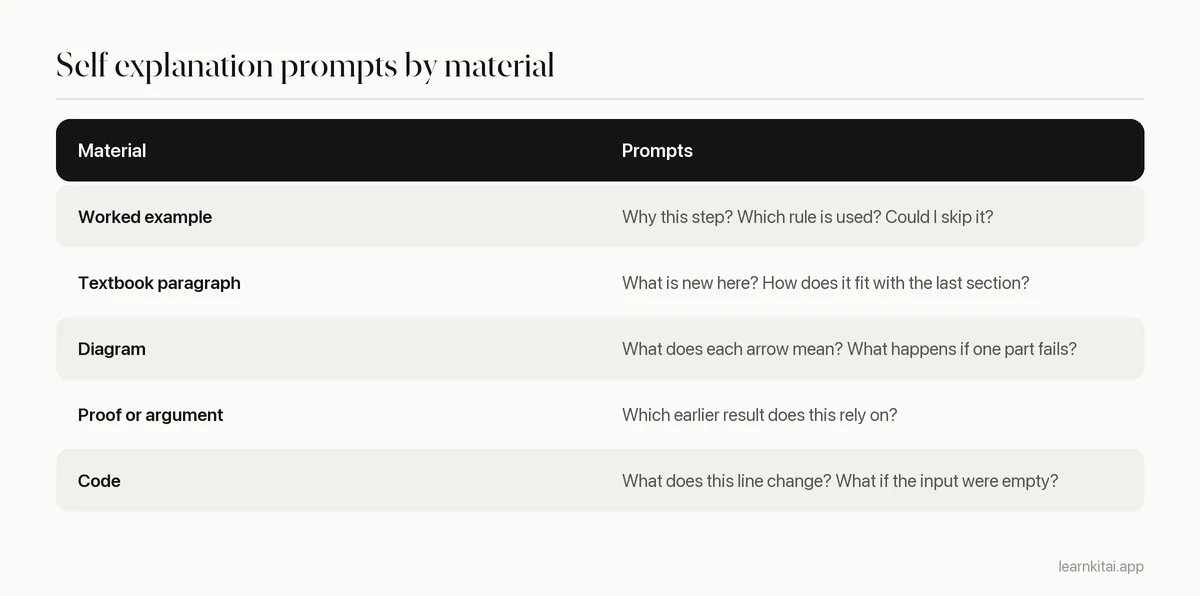
Ask why a step follows, how it links to earlier ideas, what principle it uses, and what would happen if something changed. Keep the prompts short and use the same few every time so the habit becomes automatic.
A worked example from chemistry
Here is a short textbook solution: "How many moles are in 18 g of water? Molar mass of H2O = 18 g/mol. Moles = 18 g divided by 18 g/mol = 1 mol." Reading it takes five seconds. Self-explaining it sounds like this:
- "Why 18 g/mol? Because hydrogen is about 1 and oxygen about 16, and there are two hydrogens, so 2 + 16 = 18."
- "Why divide? Molar mass is grams per mole. To get moles from grams, I divide grams by grams per mole, and the grams cancel."
- "What if it were 9 g? Then it would be half a mole. So the answer scales with the mass."
- "Where else does this show up? Any time I need to go from mass to moles, such as before using a balanced equation."
Notice that the explanation added nothing new to the textbook. It made the reasoning visible, filled in the atomic masses, and tested the idea with a quick "what if". That is what you will need when the exam gives you 36 g of something else.
How do you add self explanation to your study routine?
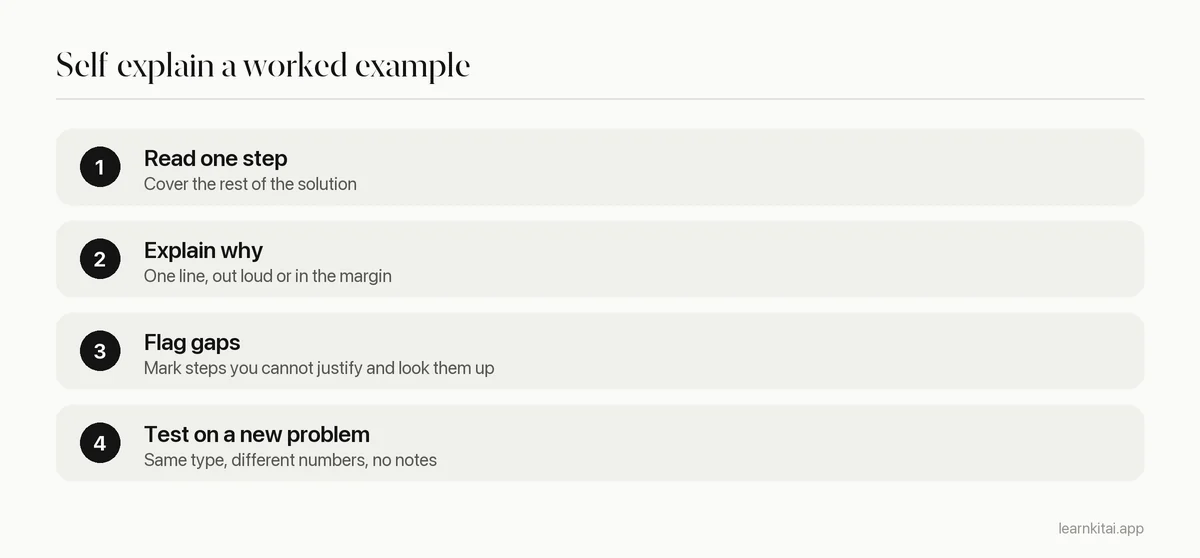
Use it during first contact with new material, especially worked examples. Pause at each step, say or write a one line reason, and mark any step you cannot explain. Then test yourself on the same type of problem later.
When self explanation goes wrong
- Explaining too fast. "That makes sense" is not an explanation. If you cannot say the reason in a full sentence, you have found a gap.
- Explaining only the easy steps. The steps you want to skip are usually the ones you do not understand. Slow down there.
- Never checking. Your explanation can be wrong. Compare it with the textbook or ask your instructor when a step still feels shaky.
Self explanation works best before and alongside testing. Explaining builds the model. Testing later checks that you can rebuild it from memory. The Feynman technique is a close cousin that explains to an imagined listener, and elaborative interrogation focuses on asking why facts are true.
A clear summary of a dense chapter can make self-explaining easier, because you can see the structure before you dig into the details. LearnKit can summarize a PDF or lecture into sections with key terms, which gives you a map to explain your way through.
Frequently asked questions
Do I need to self-explain out loud?
No. Speaking, writing short margin notes or thinking it through silently all work. Speaking or writing is harder to fake, so use it when the material is difficult.
Is self explanation good for memorizing facts?
It helps most with understanding processes, principles and problem solving. For isolated facts such as vocabulary, flashcards and spaced testing are usually more efficient.
How long does self explanation take?
It can double the time you spend on a worked example at first. That time pays off because you need fewer examples to understand a problem type.
Sources
- Inducing Self-Explanation: a Meta-Analysis, Educational Psychology Review (Bisra, Liu, Nesbit, Salimi and Winne, 2018) (69 effect sizes from 64 reports, 5,917 participants; overall g = 0.55)
- Eliciting Self-Explanations Improves Understanding, Cognitive Science (Chi, de Leeuw, Chiu and LaVancher, 1994) (14 prompted vs 10 control eighth graders learning the circulatory system; prompted group gained more)
- Improving Students' Learning With Effective Learning Techniques, Psychological Science in the Public Interest (Dunlosky et al., 2013) (Self-explanation rated moderate utility)
Keep reading

Practice Testing: The Study Habit That Beats Rereading
Testing yourself is not just a way to check what you know. It is one of the best-supported ways to learn. Here is how to do it well, week by week.
Open Ended Questions: Study by Explaining, Not Spotting
Questions with no options to pick from force you to build the answer yourself. Here are 12 question stems, a marking method and a weekly routine.
The Feynman Technique: Find Your Gaps by Teaching
If you cannot explain it simply, you have found what to study next. The four steps of the Feynman technique, a worked example and the traps that make it fail.
Elaborative Interrogation: Ask Why to Make Facts Stick
A single question, why is this true, can turn a loose fact into one you remember. How to use elaborative interrogation, with prompts for every subject.
The Testing Effect: Why a Quiz Beats Another Reread
Taking a test is not just a way to measure memory. It changes memory. Here is what the research shows and how to use it this week.