AI Academic Integrity: Where Help Ends and Cheating Starts
Using AI to study, such as asking for explanations, quizzing yourself or checking your understanding, is rarely a problem because nothing is submitted. Integrity issues start when AI-written words or ideas end up in graded work without your instructor's permission and without disclosure. Your course policy, not the tool, sets the line.
Two students open the same chatbot on the same night for the same essay. One asks it to poke holes in her argument, then rewrites her own draft. The other pastes the prompt and submits what comes back. Same tool, very different outcome. AI academic integrity is not about whether you touched AI. It is about whether the work you hand in shows your own thinking, under the rules your course has set.
This matters more every term. A Pew Research Center survey found that 26% of US teens used ChatGPT for schoolwork in 2024, double the 13% of the year before. Most students are not asking whether to use AI. They are asking where the line is. This guide gives you a clear test, a look at what detectors can and cannot do, and a workflow that keeps you safe.
What does AI academic integrity actually mean?
It means being honest about who did the thinking in graded work and following the AI rules your instructor or school has set. The same use can be fine in one course and misconduct in another, so the course policy is the first thing to check.
Academic integrity has always rested on two ideas: you do the work you claim to have done, and you credit what came from someone else. AI does not change those ideas. It just makes the second one easier to forget, because the text feels like it came from you. You typed the prompt, after all.
The tricky part is that policies differ. One professor encourages AI for brainstorming. Another bans it for any graded task. A third allows it if you disclose it. So good AI academic integrity starts with one habit: read the syllabus first. If it says nothing, ask by email. A written reply protects you far better than a guess.
Is using AI to study considered cheating?
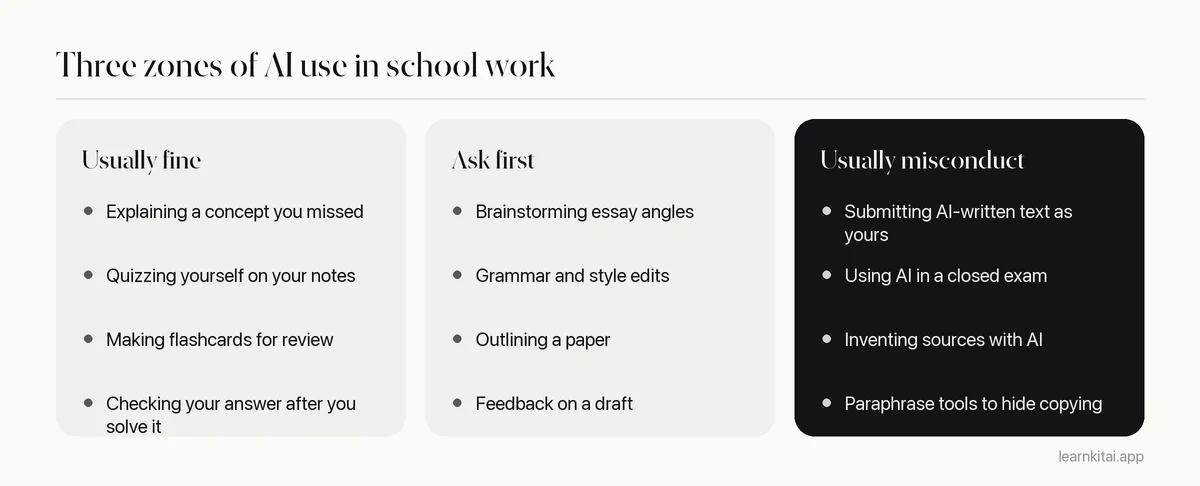
Studying with AI is rarely cheating, because practice is not graded and nothing is submitted. Cheating begins when AI output, or ideas you did not reach yourself, become part of graded work in a way your course does not allow.
Think of AI like a study partner. Asking a friend to explain the Krebs cycle before a test is normal. Asking that friend to sit the test for you is not. When you use AI to explain, quiz or review, the learning happens in your head. That is the whole point of studying, and no policy we know of forbids it outside an exam.
Self-testing is also one of the best uses of AI for learning. Turning your own notes into questions and answering them from memory is a form of practice testing, which builds memory far better than rereading. For a wider tour of good uses, see how to use AI to study.
Where is the line before you submit?
Before you hand anything in, ask four questions: Is AI allowed for this task? Could I explain every sentence without the tool? Did I check every fact and source? Have I disclosed the use the way my course asks? Any no means stop and fix it.
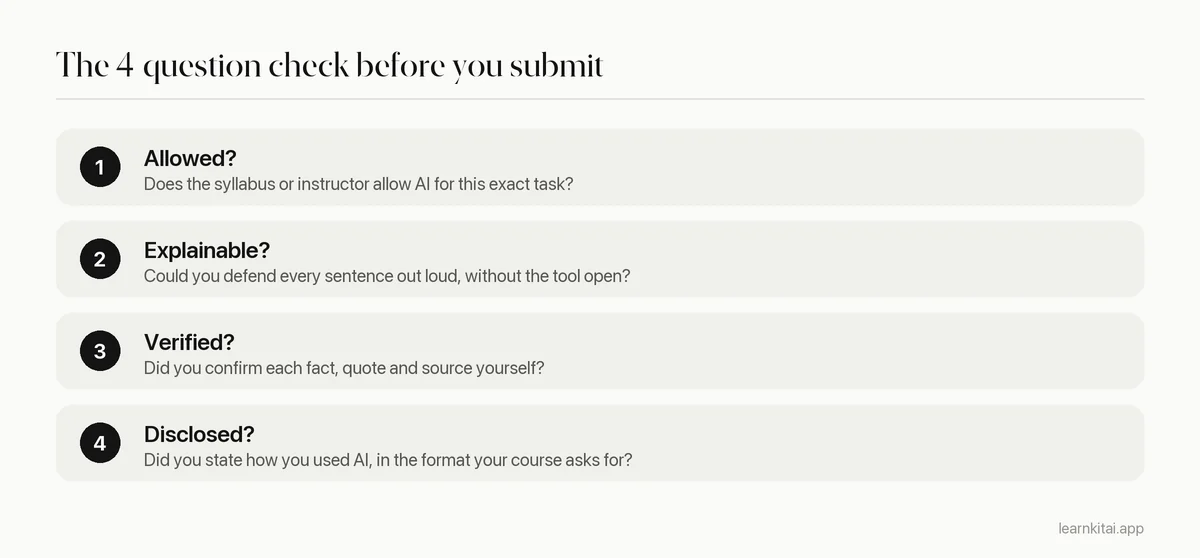
The second question does the most work. If your instructor pointed at a paragraph and asked what you meant, could you answer? If not, the words are not really yours yet, whatever tool produced them. The third question matters because AI tools invent things. Our guide on checking AI notes for errors shows how to catch fake facts and made-up citations before they cost you.
Can teachers tell if you used AI?
Sometimes, but not reliably. AI detectors miss some AI text and wrongly flag some human writing, especially from non-native English writers. Teachers more often notice a mismatch with your usual voice, sources that do not exist, or answers you cannot explain.
Detection tools are widely used. Turnitin reported that in its first year its detector reviewed over 200 million papers, and about 11% contained at least 20% AI writing. But accuracy is a real problem. OpenAI withdrew its own classifier in 2023 after it caught only 26% of AI-written text while flagging 9% of human text. A Stanford-led study of seven detectors found they misclassified about 61% of essays by non-native English writers as AI-generated.
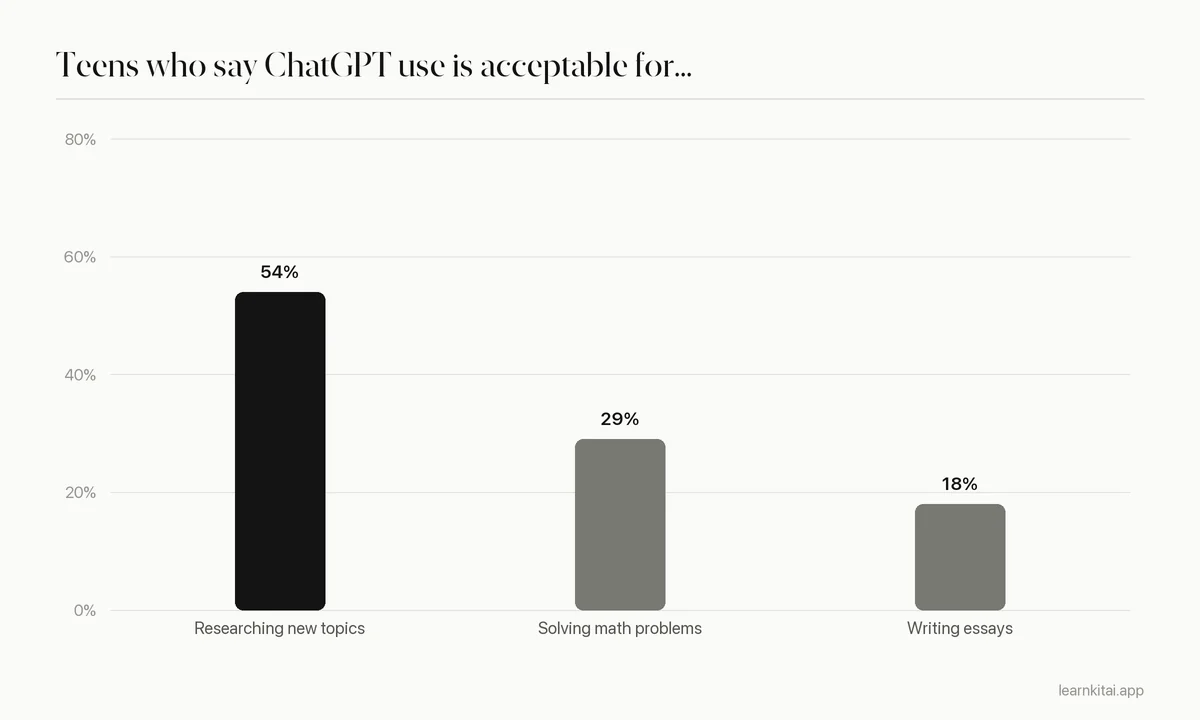
Notice how students themselves draw the line. Most see research help as fine and essay writing as not. That instinct is usually right. The takeaway is not "detectors are useless, so anything goes." It is the reverse: since a false flag can happen to honest students, keep evidence of your process.
Keep a paper trail
- Write in a tool with version history, such as Google Docs or Word online, so your drafts show growth over time.
- Save your outline, rough notes and source list in one folder per assignment.
- If you use AI where allowed, keep a short log: date, prompt, and what you kept or rejected.
- If you are flagged, ask calmly what evidence was used and offer to walk through your draft history.
How should you disclose AI use?
Follow your course's format first. If none is given, add a short note at the end: which tool, what you used it for, and what you changed. Keep it factual and specific, and never disclose less than you actually did.
A clear disclosure turns a gray area into an honest one. Major style guides now include formats for citing AI tools, and your instructor's chosen style decides which one you use. When nothing is specified, a plain statement works:
Be careful with paraphrasing tools. Running someone else's text through a rewriter does not make it yours. It is still their idea, and hiding the source is the problem. If you are unsure of the difference, our piece on summary vs paraphrase explains when you still need a citation.
A study workflow that stays honest
The safest pattern is simple: let AI help you learn, then produce graded work from what you learned. Here is a workflow that fits almost any course policy.
- Gather your own materials: lecture slides, readings, your notes.
- Use AI to turn them into questions, flashcards or short explanations.
- Answer from memory, check, and note what you got wrong.
- Close the tool. Outline and draft your assignment yourself.
- If allowed, ask AI for feedback on the draft, then revise in your own words.
- Run the 4-question check, add a disclosure if needed, and submit.
Steps two and three are where a tool like LearnKit fits. You add your lecture notes and get open questions with sample answers, so you practice writing explanations yourself before an essay or exam.
Common mistakes to avoid
- Assuming one course's AI rules apply to every course.
- Trusting AI citations without opening each source.
- Polishing a draft with AI until it no longer sounds like you.
- Deleting drafts and notes, then having no way to show your process.
- Using AI to get the answer first and calling it "checking" afterward.
Frequently asked questions
Is it cheating to use Grammarly or a grammar checker?
Basic spelling and grammar fixes are allowed in most courses. Tools that rewrite whole sentences or generate text are a different matter, and many instructors treat them like other AI writing tools. If the tool changes your wording, check the policy or ask.
What should I do if an AI detector wrongly flags my essay?
Stay calm and ask what evidence the flag is based on. Share your version history, outline and notes, and offer to explain your argument in person. Detectors are known to produce false positives, so most schools treat a score as a reason to look closer, not as proof.
Can I use AI to make flashcards from my lecture notes?
Yes, in almost every course. Making study materials from your own notes is studying, not submitting work. Just check the cards against your notes, since AI can still misstate a detail.
Do I need to disclose AI if I only used it for ideas?
It depends on the course. Some instructors want any use disclosed, including brainstorming. When in doubt, disclose: a one-line note costs nothing and removes the question.
Sources
- About a quarter of U.S. teens have used ChatGPT for schoolwork, double the share in 2023, Pew Research Center (26% of US teens used ChatGPT for schoolwork in 2024 (13% in 2023); 54%, 29% and 18% find it acceptable for research, math and essays.)
- Turnitin marks one year anniversary of its AI writing detector, Turnitin (Over 200 million papers reviewed; about 11% had at least 20% AI writing.)
- GPT detectors are biased against non-native English writers, Liang et al., arXiv (published in Patterns, 2023) (Seven detectors misclassified on average about 61% of TOEFL essays by non-native writers as AI-generated.)
- New AI classifier for indicating AI-written text, OpenAI (Classifier identified 26% of AI-written text with 9% false positives; withdrawn in July 2023 for low accuracy.)
Keep reading
AI for Studying: Make It Quiz You, Not Think for You
AI can make you a stronger student or a more dependent one. The difference is whether it does the thinking or makes you do it.
AI Hallucinations in Study Notes: A 10-Minute Error Check
AI notes can sound perfect and still be wrong. Learn where errors hide and a quick routine to catch them before they reach your exam.
AI Summarizer Accuracy: What Gets Lost, and How to Check
AI summaries are fluent and fast, and usually mostly right. Here is where they slip, and a five-minute check before you study from one.
Summary vs Paraphrase: Same Source, Different Jobs
A paraphrase keeps every idea of one passage. A summary keeps only the main ones. Here is how to tell which one your assignment, or your study session, needs.
AI Tutor vs Human Tutor: What Each One Does Best
Research shows AI tutoring can double learning gains or quietly harm them. The difference is design, and how you use it. Here is when to pick each.