AI Hallucinations in Study Notes: A 10-Minute Error Check
AI hallucinations are confident statements an AI makes that are not supported by your source or by reality. To catch them in study notes, generate notes from your own material, spot-check every number and name, trace a few key claims back to the page, and quiz yourself so gaps show up early.
A biology student once showed us an AI summary that read beautifully. It said mitochondrial ribosomes are "identical to the ribosomes in the rest of the cell." It sounded right. It was wrong: they resemble bacterial ribosomes, which is part of the evidence that mitochondria were once bacteria. That one sentence would have cost her an exam question. AI hallucinations like this are rarely obvious. They hide inside fluent, confident text, which is exactly why you need a routine to find them.
This guide shows where errors tend to hide in AI notes and gives you a 10-minute check you can run on any summary, flashcard set or quiz before you study from it.
What are AI hallucinations, and why do they happen?
They are outputs that sound confident but are not backed by the source or by fact. Language models predict likely text, and research suggests training rewards a good guess over saying "I am not sure," so a fluent wrong answer can beat an honest gap.
A language model writes one likely word after another. Most of the time, likely and true line up. When they do not, the model still produces something that reads well. A 2025 paper by OpenAI researchers argues that common training and testing methods reward guessing over admitting uncertainty, much like a multiple choice exam with no penalty for wrong answers. A model that guesses scores better on many benchmarks, so it learns to guess.
For you, the practical point is simple: AI hallucinations do not announce themselves. The tone of an answer tells you nothing about its accuracy. A wrong date sounds exactly as sure as a right one.
How often does AI make things up?
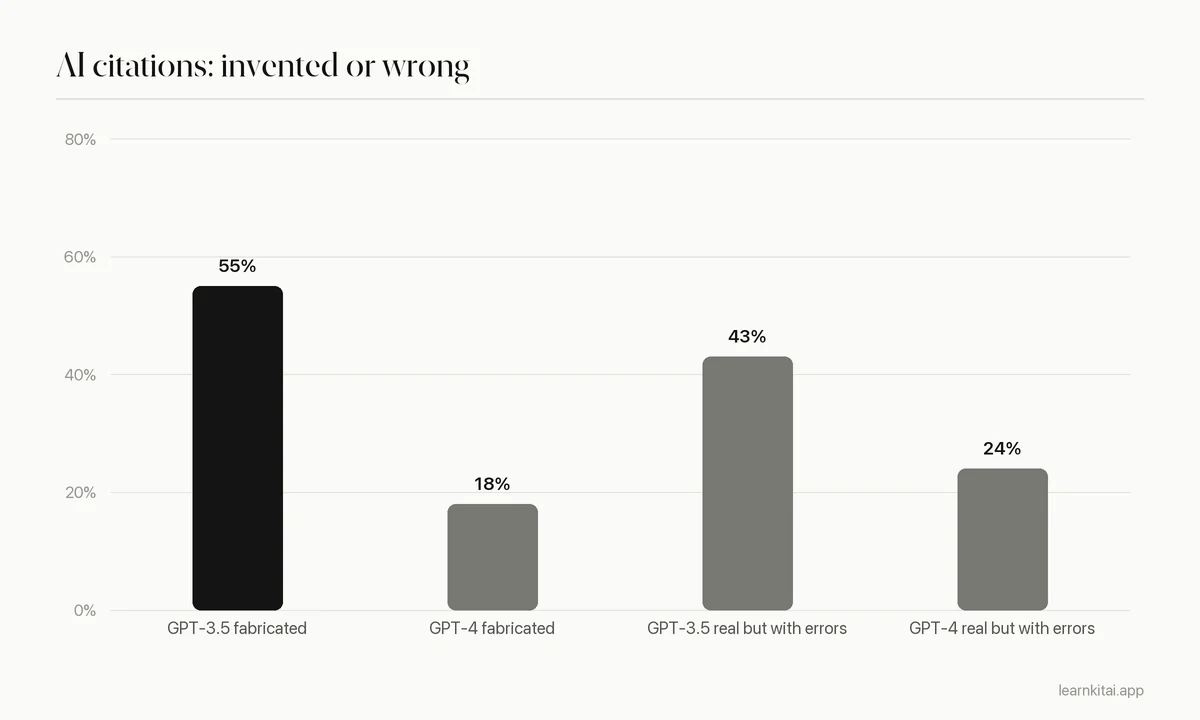
It depends heavily on the model and the task. In one well-known test, older chatbots invented over half of the citations they gave, and newer ones still made up almost one in five. Open questions with no source attached are the riskiest.
Citations are the clearest test, because a reference either exists or it does not. Researchers Walters and Wilder asked ChatGPT to write short literature reviews on 42 topics and checked all 636 references. They found that 55% of GPT-3.5 citations and 18% of GPT-4 citations were fabricated. Even among real references, many had errors in details like page numbers or dates.
Newer models do better, and tools that work from a document you provide usually stay closer to the facts than a chatbot answering from memory. But better is not perfect. The habit of checking costs a few minutes. Skipping it can cost a grade.
Where do errors hide in AI study notes?
Most errors cluster in a few places: numbers and units, names and dates, citations, small words like "not" or "only," and cause-and-effect claims. Check these first and you catch most problems fast.
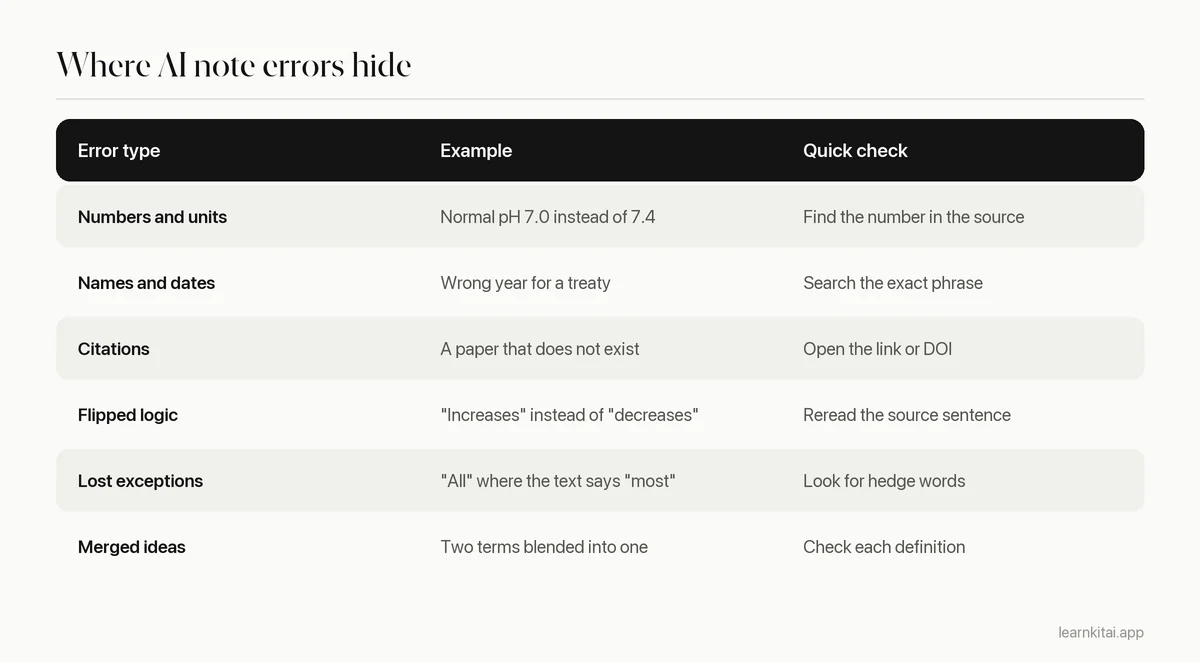
Flipped logic deserves extra attention. Biology and economics notes are full of "increases," "inhibits," and "leads to." A summary that reverses one arrow still reads smoothly, and you will memorize it with full confidence.
How do you check AI notes for errors in 10 minutes?
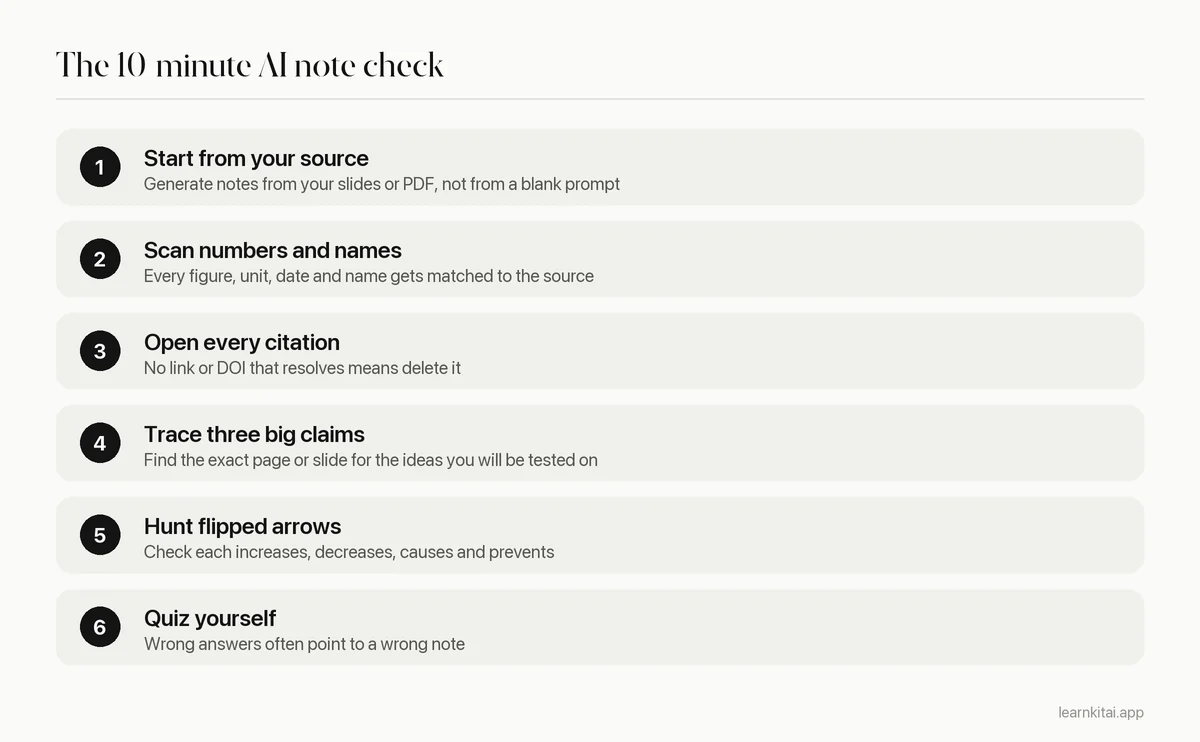
Work from your own source, then check numbers, names and citations against it. Trace three key claims to the exact page, look for flipped logic, and quiz yourself. Mark the notes as checked so you only do it once.
A worked example
Say your AI summary of a physiology lecture includes: "Insulin is released by alpha cells of the pancreas and raises blood glucose." Step two flags "alpha cells." Your slide says beta cells. Step five flags "raises." Insulin lowers blood glucose; glucagon raises it. One sentence, two errors, and both would have looked fine on a quick read. The fix took under a minute because you had the source open.
Step six is the quiet hero. When you quiz yourself from your notes and an answer feels wrong, go back to the source instead of the notes. Many students find errors this way that a careful reread missed. Add each one to a mistake log so you remember the correction, not the error.
Is AI more accurate when it uses your own files?
Usually, yes. When an AI tool works from a document you give it, it has the facts in front of it instead of recalling them, which tends to cut down on invented details. It does not remove errors, so the check still applies.
This is why the first step matters most. Ask a general chatbot about your course and it answers from whatever it absorbed in training, which may not match your syllabus at all. Give it your actual lecture PDF and it can stay close to what your instructor taught. Our deeper look at AI summarizer accuracy covers how summaries drift and what to watch for.
LearnKit works this way: you add your own PDF, notes, page photo or lecture recording, and it builds the summary, flashcards and quiz from that source. Keeping the original next to the summary makes the 10-minute check easy.
What should you never trust AI on without checking?
Never trust unchecked citations, exact numbers, quotes, legal or medical specifics, or anything your exam marks precisely. These are the details AI gets wrong most and the ones that cost the most marks.
- References and quotes. Open each one. If it does not exist, it never goes in your notes or your essay.
- Formulas and constants. One wrong exponent breaks every problem you solve with it.
- Dosages, laws and case names. Precision matters, and AI often blends similar items.
- Your instructor's definitions. Exams often expect the course wording, not a general one.
- Recent events. A model may not know about changes after its training data ends.
Used this way, AI saves you real time. You still get fast summaries and instant quizzes. You just add ten minutes of checking so the speed does not come at the cost of accuracy. For the bigger picture of where AI fits in your routine, read how to use AI to study.
Frequently asked questions
Can I ask the AI to check its own answer?
It can help a little, for example by asking it to quote the source sentence for each claim. But a model can repeat its own error with the same confidence. The real check is comparing against your source yourself.
Are AI flashcards more reliable than AI summaries?
Not by nature. Cards are short, which makes each one easy to check, but a wrong card gets drilled into memory through repetition. Check cards before your first review session, not after.
Do AI hallucinations happen in math too?
Yes. AI can make arithmetic slips, skip steps or state a wrong formula with confidence. Rework any calculation you plan to learn from, and check formulas against your textbook.
How do I report an error I find in AI notes?
Fix it in your notes right away and mark the correction clearly, for example in bold. If the tool lets you regenerate or edit, update the card or summary so you do not review the wrong version later.
Sources
- Fabrication and errors in the bibliographic citations generated by ChatGPT, Walters and Wilder, Scientific Reports (via PubMed Central) (636 citations checked: 55% of GPT-3.5 and 18% of GPT-4 citations fabricated; 43% and 24% of real ones had substantive errors.)
- Why Language Models Hallucinate, Kalai, Nachum, Vempala and Zhang, arXiv (Argues training and evaluation reward guessing over acknowledging uncertainty.)
Keep reading
AI for Studying: Make It Quiz You, Not Think for You
AI can make you a stronger student or a more dependent one. The difference is whether it does the thinking or makes you do it.
AI Summarizer Accuracy: What Gets Lost, and How to Check
AI summaries are fluent and fast, and usually mostly right. Here is where they slip, and a five-minute check before you study from one.
AI Academic Integrity: Where Help Ends and Cheating Starts
The tool is rarely the problem. What you submit as your own thinking is. A simple test for staying honest while studying with AI.
Quiz Yourself From Your Notes in 15 Minutes a Day
Your notes already contain the questions. Here is how to pull them out, five ways to test yourself, and a short daily routine that keeps old topics alive.
Error Log Studying: Turn Every Mistake Into Points
An error log is a simple table of every question you got wrong and why. Kept well, it becomes the most targeted study guide you will ever own.