Quiz Yourself From Your Notes in 15 Minutes a Day
To quiz yourself from notes, turn each heading or key point into a question, cover the notes, and answer from memory in writing or out loud. Check against the notes, mark what you missed, and ask those questions again a few days later. Keep going even after you get an answer right once.
Most students own good notes and use them badly. They read them, highlight them, maybe rewrite them neatly. All of that keeps the answers in view. To quiz yourself is to hide the answers and see what comes out. It is less comfortable and far more useful, and you can do it with nothing but the notes you already have.
This post gives you five ways to test yourself from notes, a daily routine that takes about fifteen minutes, and one rule from the research that most students break. For the wider science of learning with questions, start with our practice testing guide.
Why should you quiz yourself instead of rereading?
Recalling an answer strengthens memory far more than seeing it again. In one study, students who kept testing themselves on word pairs recalled about 80% a week later, while those who kept studying but stopped testing recalled about 36%.
Jeffrey Karpicke and Henry Roediger tested this with 40 Swahili and English word pairs in a 2008 study in Science. Once a student recalled a pair correctly, one group kept testing it in later rounds while another group kept studying it but dropped it from testing. A week later, the groups that kept testing recalled about 80% of the pairs. The groups that dropped items from testing recalled just 36% and 33%.
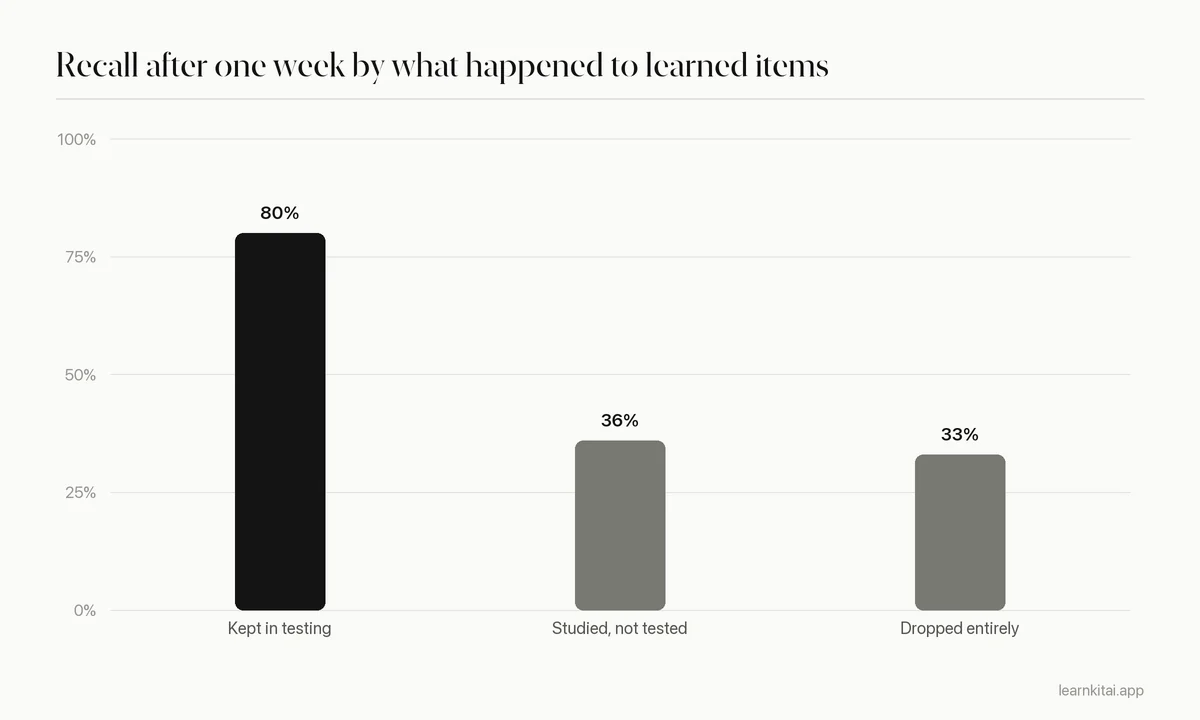
The striking part: repeated studying after the first correct recall added almost nothing. And students could not tell the difference. Their predictions of how much they would remember were about the same in every group. That is the rule most students break: they stop testing an item the moment they get it right once.
How do you turn notes into questions?
Rewrite each heading as a question, turn each bolded term into "what is X and why does it matter", and turn each list into "name the steps of". Write the questions in the margin or on a separate page so the answers can be covered.
- Headings become questions. "Causes of the French Revolution" becomes "What were three causes of the French Revolution, and which mattered most?"
- Terms become definitions plus use. "Opportunity cost" becomes "Define opportunity cost and give an example from your own week."
- Lists become sequences. "Stages of mitosis" becomes "Name the stages of mitosis in order and what happens in each."
- Diagrams become blanks. Copy a diagram without labels and fill them in from memory.
If your notes use the Cornell method, you already have a question column. Cover the right side and work down the left. If not, add questions in the margin the same evening you take the notes. It takes about five minutes per lecture.
What are the best ways to quiz yourself?
Use a mix: cover-and-recall on your notes, a blank page brain dump, flashcards, practice questions and explaining aloud. Each forces recall in a slightly different way, and switching keeps sessions from going stale.
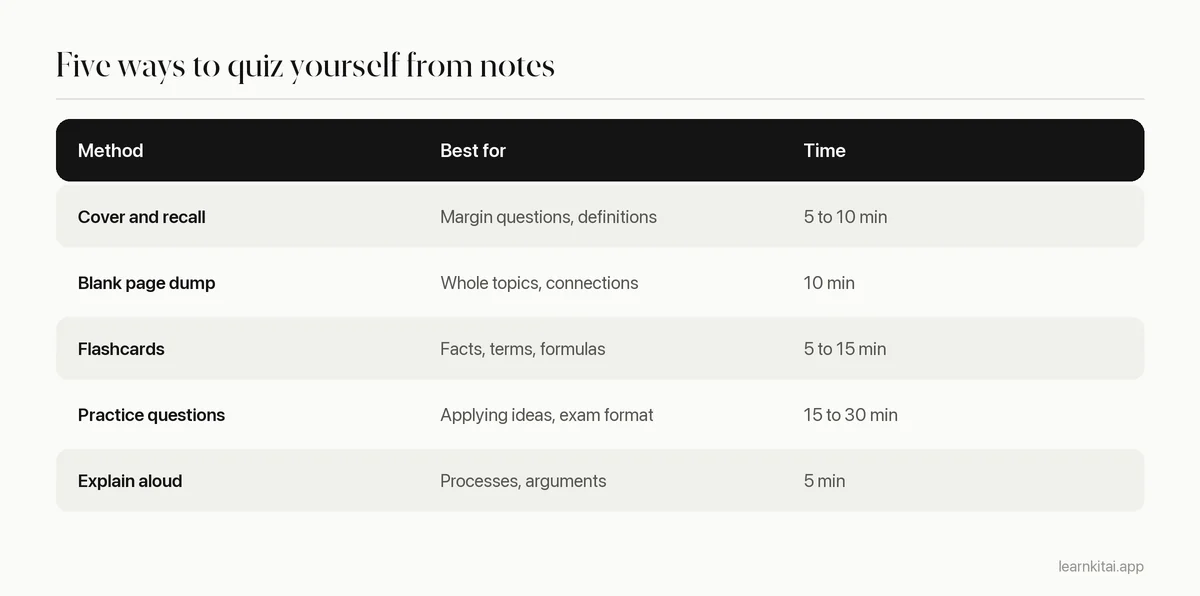
The blank page method has its own name, blurting: write everything you remember about a topic, then check the notes in a different color. Flashcards work best for small, sharp facts, and you can turn notes into flashcards in one sitting. Practice questions are closest to the exam, so save more time for them as the date gets closer.
A 15 minute daily routine
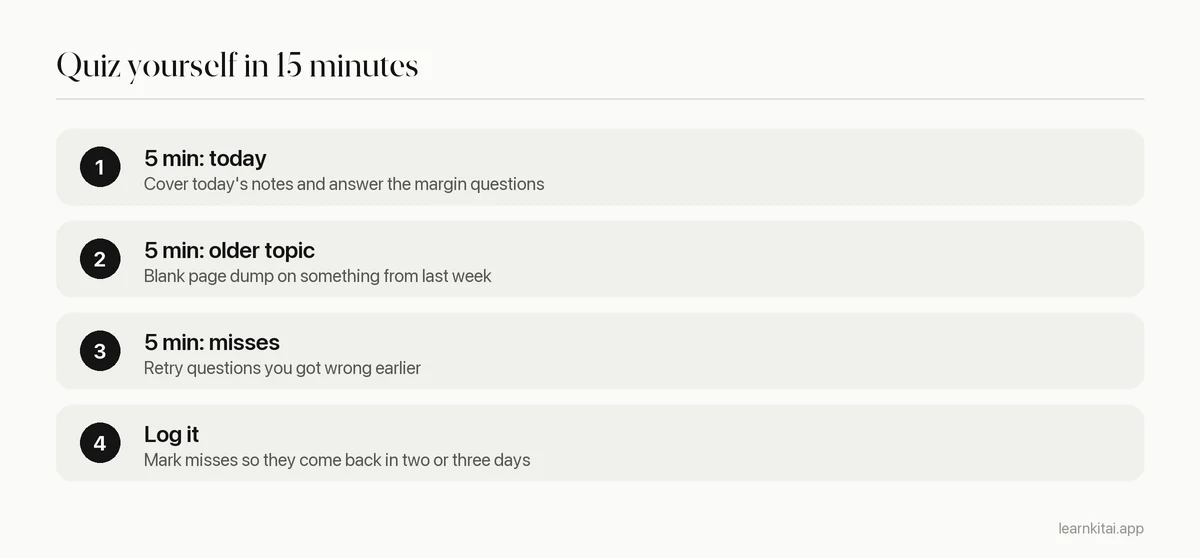
This routine works because it mixes new and old material. Older topics get tested at growing gaps, which fights forgetting, and missed questions get another try before they fade. Fifteen minutes is enough on most days. Add a longer practice test once a week before exams.
If your notes live in a browser, such as an online textbook, slides or a reading on a course site, the LearnKit Chrome extension can make a quiz or flashcards from the page you are on, so the questions are ready when you need them.
How do you know when you have studied a topic enough?
When you can answer its questions correctly from memory on two or three separate days, spread apart. One correct answer in the same session you learned it is not a reliable sign.
Feeling familiar with your notes is not the same as knowing them. The best signal is repeated, spaced success. Aim to get each key question right on at least three different days before the exam. Anything that keeps failing needs a different approach, such as explaining it in your own words before testing it again.
Common mistakes when you quiz yourself
- Writing questions that copy the notes word for word. You end up matching phrases instead of recalling ideas. Reword each question.
- Only quizzing the newest lecture. Old topics fade quietly. Keep a slot in every session for something from last week or earlier.
- Retiring a question after one right answer. As the 2008 study showed, the payoff comes from continued retrieval, not from the first success.
- Saving all testing for the week before the exam. Self quizzing spread across the term does more with the same total time.
None of this is a niche trick. When a team of psychologists rated ten popular study techniques for Psychological Science in the Public Interest, practice testing was one of only two that earned a high utility rating, alongside spreading study over time. Rereading and highlighting were rated low. The good news is that you do not need special materials to use the winner. Your notes, a cover sheet and fifteen minutes are enough.
Frequently asked questions
Should I quiz myself right after taking notes?
A quick check the same day helps you catch gaps while the lecture is fresh. The bigger benefit comes from quizzing again after a gap of a day or more, when recall takes real effort.
Is quizzing yourself useful if you get most answers wrong?
Yes, as long as you check the right answer afterward. Early in a topic a low score is normal, and each attempt with feedback moves you forward.
Can I quiz myself without writing anything?
You can answer out loud or in your head, which is handy on the go. Writing is more honest, though, because vague answers are harder to hide on paper.
Sources
- The Critical Importance of Retrieval for Learning, Science (Karpicke and Roediger, 2008) (40 Swahili-English pairs; about 80% recall after a week with repeated testing vs 36% and 33% when items were dropped from testing)
- Improving Students' Learning With Effective Learning Techniques, Psychological Science in the Public Interest (Dunlosky et al., 2013) (Practice testing rated high utility)
Keep reading

Practice Testing: The Study Habit That Beats Rereading
Testing yourself is not just a way to check what you know. It is one of the best-supported ways to learn. Here is how to do it well, week by week.
The Testing Effect: Why a Quiz Beats Another Reread
Taking a test is not just a way to measure memory. It changes memory. Here is what the research shows and how to use it this week.
The Blurting Method: Empty Your Head to Fill It
Write down everything you remember, then check what is missing. A simple revision method with a step-by-step routine, a worked example and four variations.
Turn Notes Into Flashcards in 20 Minutes After Class
Your lecture notes are a reading pile until you turn them into questions. A simple 20-minute routine converts each class into cards you can actually test yourself with.
Error Log Studying: Turn Every Mistake Into Points
An error log is a simple table of every question you got wrong and why. Kept well, it becomes the most targeted study guide you will ever own.
Study Group Activities That Beat Chatting Over Notes
Most study groups drift into rereading together. These quiz games keep everyone recalling, arguing and correcting each other, and they fit in one hour.