AI Summarizer Accuracy: What Gets Lost, and How to Check
An AI summarizer is usually mostly accurate but not reliably so. On one public benchmark, the share of summaries containing unsupported claims ranged from about 2 to 24 percent across models. Errors cluster in numbers, names, negations and qualifiers. Use summaries as a map, and check any fact you plan to memorize against the source.
An AI summarizer can turn a 40-page reading into a one-page overview in seconds, and most of what it says will be right. The problem is the part that is not, because it looks exactly like the rest. A wrong date, a dropped not, or a confident claim the source never made reads just as smoothly as the truth.
For studying, that matters more than it does for skimming the news. You are going to memorize what the summary says. This guide shows what the measured error rates look like, which details tend to get lost, and a five-minute check that catches most problems.
How accurate are AI summarizers?
It depends heavily on the model. On Vectara's public leaderboard, which checks summaries of short documents against the source, hallucination rates across 108 models ranged from 1.8 to 24.2 percent, with a median near 9.6 percent as of September 2026.
The Vectara hallucination leaderboard asks each model to summarize the same set of documents, then uses a separate model to flag statements not supported by the source. It measures factual consistency, not whether the summary is useful. Here is how the 108 listed models spread out in the September 22, 2026 update.
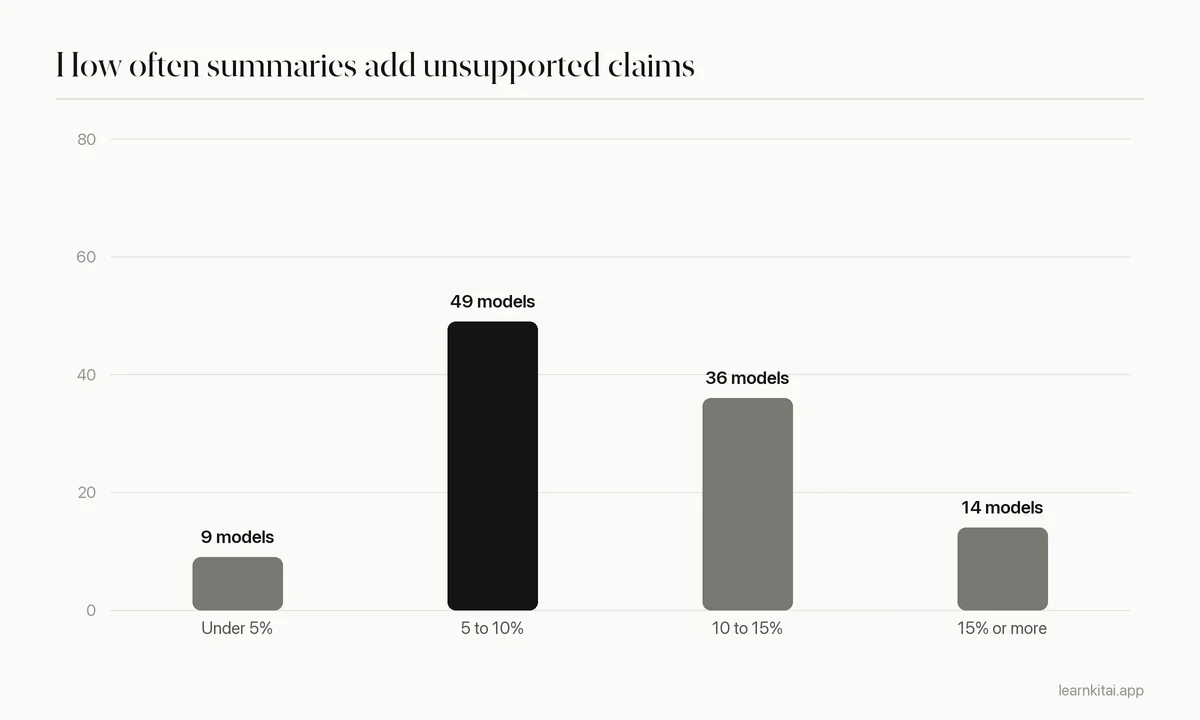
Two things stand out. Even the best models are not perfect, and the typical model adds an unsupported claim to roughly one summary in ten. The benchmark also uses fairly short documents. Long chapters, scanned pages and lecture transcripts give more room for mistakes.
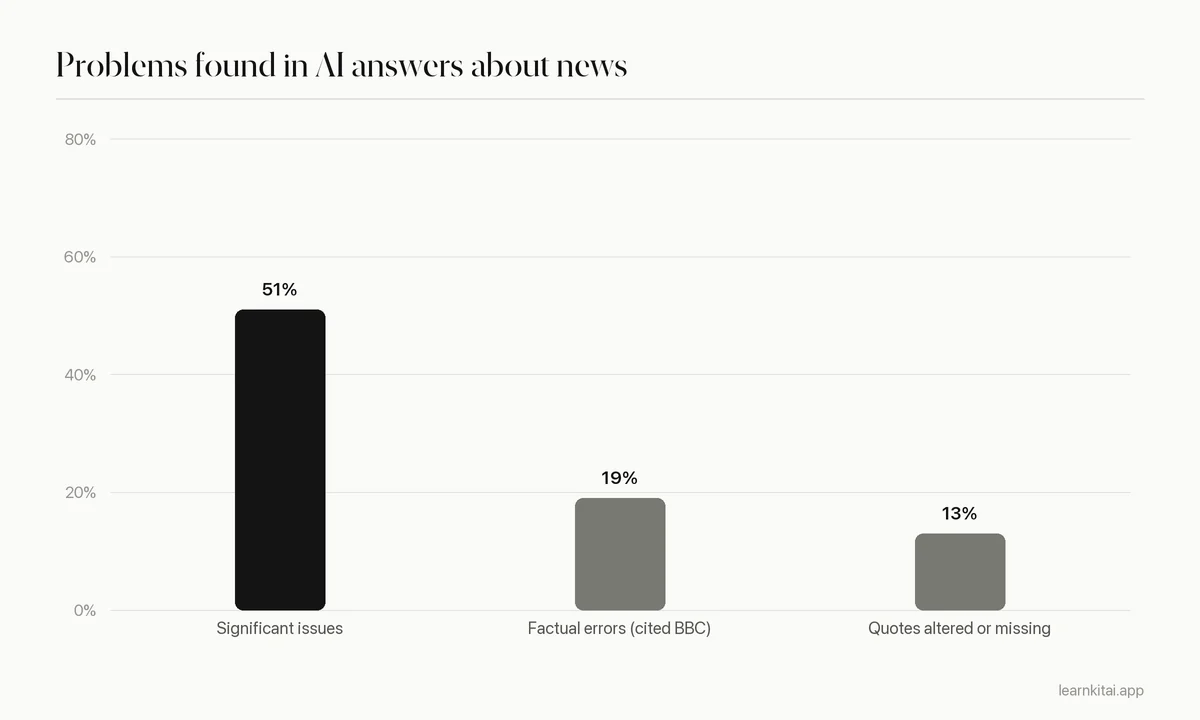
Real-world tests show similar problems. When the BBC had journalists review AI assistants' answers about its news stories, it found that 51 percent had significant issues, 19 percent of answers citing BBC content introduced factual errors such as wrong numbers and dates, and 13 percent of quotes were altered or did not exist in the cited article.
What do AI summaries tend to get wrong?
Small words with big meaning: numbers, dates, names, negations and hedges like may or in some cases. They also flatten exceptions, merge similar terms, under-cover the middle of long texts, and skip what is in tables and figures. The overall story is usually right. The details that exams test are where errors hide.
- Numbers and units. A 15 percent rise becomes 50 percent, or mg becomes g.
- Negations. Does not increase risk loses its not.
- Hedges. May be associated with becomes causes. In science courses, that is a different claim.
- Exceptions. Except in children disappears, so the rule looks universal.
- Similar terms. Two related enzymes, cases or theorists get merged.
- The middle of long texts. Coverage often thins in the middle of a long chapter.
- Tables and diagrams. Information that lives only in a figure may be skipped or guessed.
The middle-of-the-text problem has research behind it. A study titled Lost in the Middle found that language models used information best when it appeared at the beginning or end of a long input, and performance dropped when the relevant part sat in the middle. For a long chapter, that suggests summarizing section by section rather than all at once.
A worked example
Say your pharmacology reading says: In adults with normal kidney function, the drug may lower blood pressure within two hours; it is not recommended in pregnancy. A summary might say: The drug lowers blood pressure within hours and is used in pregnancy. Every word sounds plausible. Yet three details changed: the condition (adults with normal kidney function) vanished, may became a certainty, and the not was lost, flipping the safety advice. This is an illustration, not a quote from a real tool, but it shows the pattern to look for.
Notice that a quick read would not catch it. You only see the problem by putting the two sentences side by side. That is why the check below focuses on specific kinds of words rather than on rereading the whole summary.
How do you check an AI summary in five minutes?
Compare the summary's structure with the source's headings, spot check every number and name, scan for missing negations and hedges, and ask the tool which page supports any claim you doubt. Anything you plan to memorize should be confirmed in the source, not the summary.
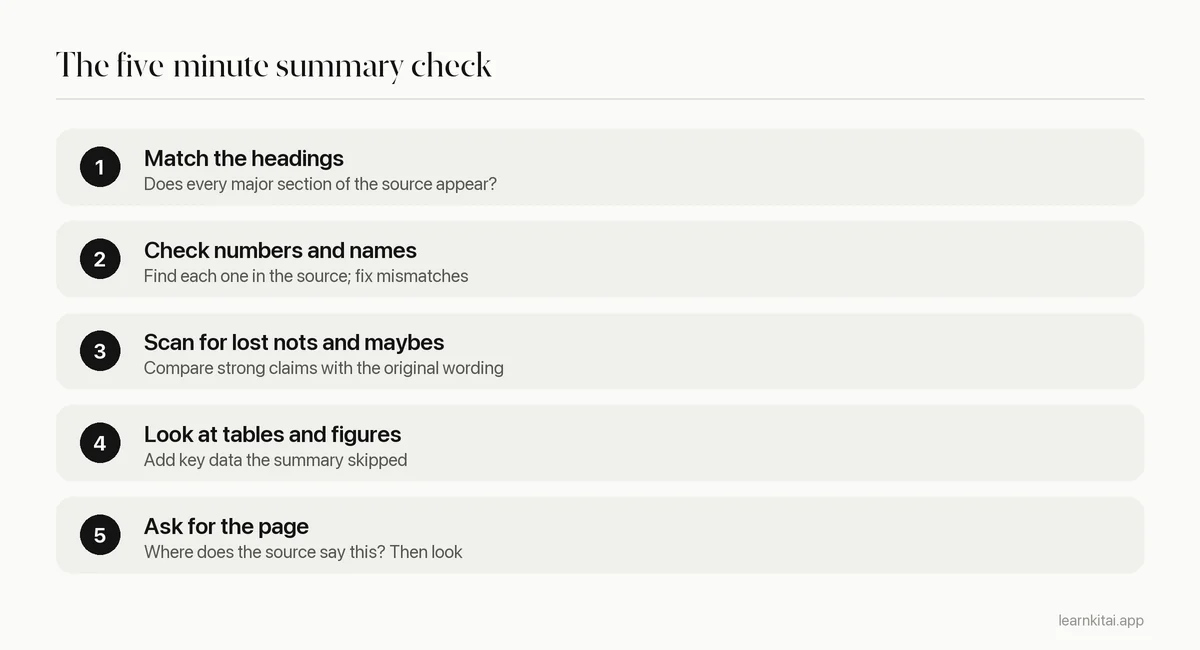
You do not need to verify every sentence. Focus on what you will be tested on: definitions, numbers, steps in a process, and claims with qualifiers. Our guide to spotting AI hallucinations has a longer checklist for high-stakes material such as medicine and law.
Is studying from an AI summary enough?
No. Even a perfect summary is something you read, and reading alone is a weak way to learn. Learning researchers rate rereading and summarizing as low utility compared with practice testing. Use the summary to see the structure, then quiz yourself on the content.
A widely cited review of study techniques rated summarization and rereading as low utility, and practice testing and spaced practice as high utility. An AI summary saves you reading time, but reading it is still a form of rereading. The value comes from what you do next.
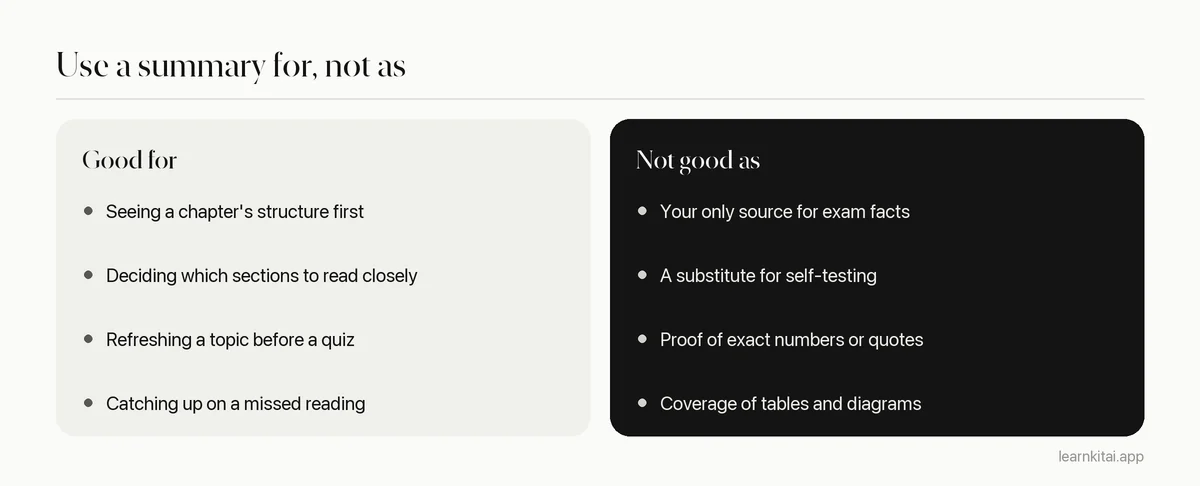
A strong routine: read the summary for two minutes to get the map, read the source with that map in mind, then close both and answer questions. Many tools can turn the same source into a quiz, which gives you the testing step without extra work. Our guide on how to summarize a chapter shows how to write your own summary when the act of summarizing is the point.
How to get more accurate summaries
- Give it clean text. A text PDF beats a blurry photo. If you must use scans, check the extracted text first.
- Summarize in sections. One chapter section at a time keeps the middle from getting lost.
- Ask it to keep numbers and qualifiers. For example: keep all figures, units and hedging words exactly as written.
- Ask for key terms with definitions in the source's own words.
- Choose the length on purpose. Very short summaries drop more. See how long a summary should be for a rule of thumb.
An AI summarizer is a fast, useful map with occasional wrong turns. Know where errors tend to hide, check the details that matter, and move from reading to testing. For the bigger picture, see our guide to AI for studying, and for long documents, our guide to how to summarize a PDF.
Frequently asked questions
Do longer AI summaries have fewer errors?
Not necessarily fewer errors, but they drop fewer details, such as exceptions and qualifiers. Very short summaries have to cut more, so key nuance is more likely to disappear.
Are paid AI summarizers more accurate than free ones?
Accuracy depends mostly on the underlying model and the input quality, not on price alone. Free limits often affect length more than accuracy. Either way, check the details you will memorize.
Can an AI summarizer handle scanned pages and photos?
Yes, but the text has to be read from the image first, and that step can introduce errors in numbers and symbols. Check the extracted text before trusting the summary, especially for formulas and tables.
Is it okay to submit an AI summary as my own work?
Usually not. Most schools treat submitting AI-generated text as your own as a breach of academic rules unless the assignment allows it. Use summaries to study, and write submitted work yourself.
Sources
- Hallucination Leaderboard, Vectara (GitHub) (108 models, hallucination rates 1.8 to 24.2 percent, median about 9.6 percent, updated September 22, 2026)
- BBC research shows issues with answers from artificial intelligence assistants, BBC Media Centre (51 percent significant issues; 19 percent factual errors; 13 percent of quotes altered or not present)
- Lost in the Middle: How Language Models Use Long Contexts, Transactions of the Association for Computational Linguistics (Performance highest when relevant information is at the start or end of long inputs)
- Improving Students' Learning With Effective Learning Techniques, Psychological Science in the Public Interest (PubMed) (Summarization and rereading rated low utility; practice testing high utility)
Keep reading
AI for Studying: Make It Quiz You, Not Think for You
AI can make you a stronger student or a more dependent one. The difference is whether it does the thinking or makes you do it.
AI Hallucinations in Study Notes: A 10-Minute Error Check
AI notes can sound perfect and still be wrong. Learn where errors hide and a quick routine to catch them before they reach your exam.
Summarize PDF Files With AI and Catch What It Gets Wrong
AI can shrink a 60-page PDF in seconds. Here is a workflow that keeps the speed and catches the errors before they end up in your notes.
How to Summarize a Chapter So You Never Reread It
Most chapter summaries are just shorter copies of the book. The closed-book method turns summarizing into practice that sticks, so you can study from your page instead of the chapter.
How Long Should a Summary Be? Let the Job Decide
There is no single right length. There is a ceiling, a purpose, and a quick test that tells you when a summary is short enough.
Dyslexia Study Tools: AI That Reads, Chunks and Quizzes
Dyslexia makes long reading slow and tiring, not learning impossible. These AI tools cut the reading load and shift effort to remembering.