Error Log Studying: Turn Every Mistake Into Points
An error log is a running list of every question you get wrong on quizzes, homework and practice tests, with the correct answer and the reason you missed it. You retest each entry after a few days and retire it only once you answer it correctly on two separate occasions.
Most students look at a wrong answer, wince, read the right one and move on. A week later they make the same mistake. Error log studying breaks that loop. Every miss goes into one place with a short note on why it happened, and the log becomes a personal study guide built entirely from your weakest points.
Below you will find why mistakes are such good study material, a template you can copy, a way to classify errors, and a weekly routine. This post is part of our practice testing guide.
Why are mistakes so useful for learning?
A mistake shows exactly what you do not know yet, and correcting it with feedback produces strong learning. In one study, giving the correct answer after an error raised retention a week later by 494% compared with no feedback.
Harold Pashler and colleagues had people learn foreign word pairs and tested them with different kinds of feedback. In their 2005 paper, showing the correct answer after an incorrect response increased one week retention by 494% compared with no feedback. Feedback after correct answers made little difference. In other words, your study time pays off most on the questions you got wrong.
There is a second, surprising finding. Errors you made with high confidence are more likely to be fixed after feedback than errors you were unsure about. Researchers call this the hypercorrection effect. A study by Lisa Fazio and Elizabeth Marsh suggests the surprise of being confidently wrong grabs your attention and makes the correction stick. So the mistakes that sting most are often the ones you will learn best from, if you look at them closely.
How does error log studying work?
You record each missed question, the correct answer and the reason you missed it. You group errors by type, retest each entry after a gap, and retire it only after two correct answers on different days.
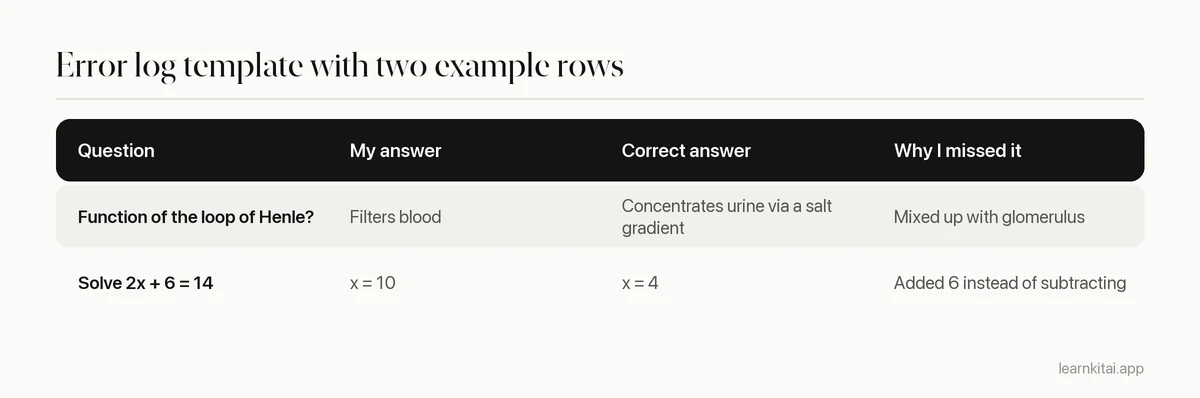
Add two small columns if you like: the date, and a tick each time you get it right on a retest. A paper notebook, a spreadsheet or a notes app all work. What matters is that every miss lands in the same place.
What are the main types of errors?
Most misses fall into four groups: you did not know it, you mixed it up with something similar, you knew it but slipped, or you misread the question. Each type needs a different fix.
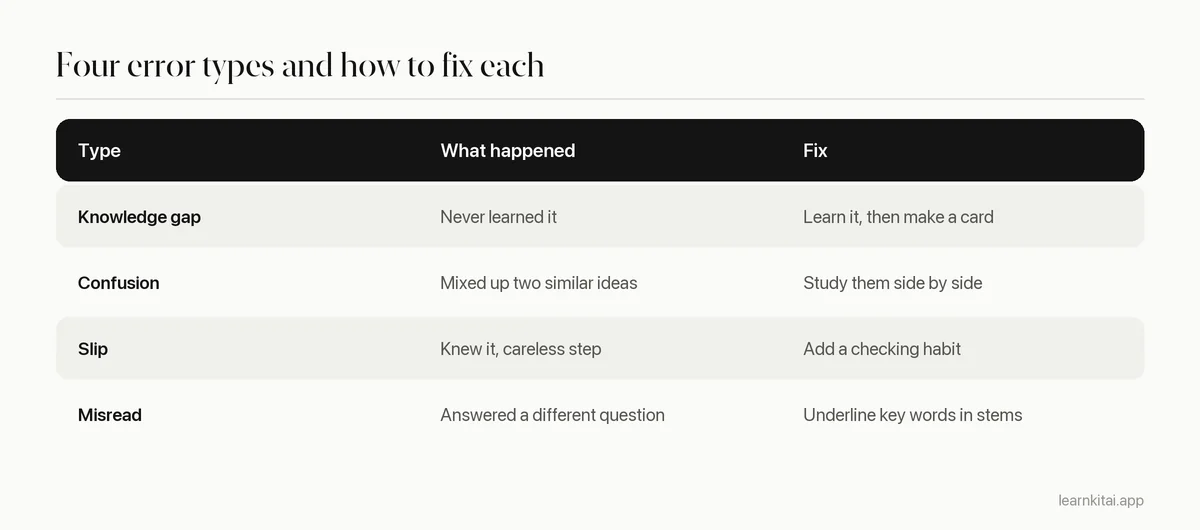
Classifying errors is where the log starts to pay back. If most of your misses are slips, more studying will not help much, but slowing down and checking work will. If most are confusions, you need side by side comparisons of similar terms. After two or three weeks the pattern is usually obvious.
How often should you review your error log?
Retest new entries two to three days after logging them, then again about a week later. Spend a short slot of every study session on the log, and do a full pass before each exam.
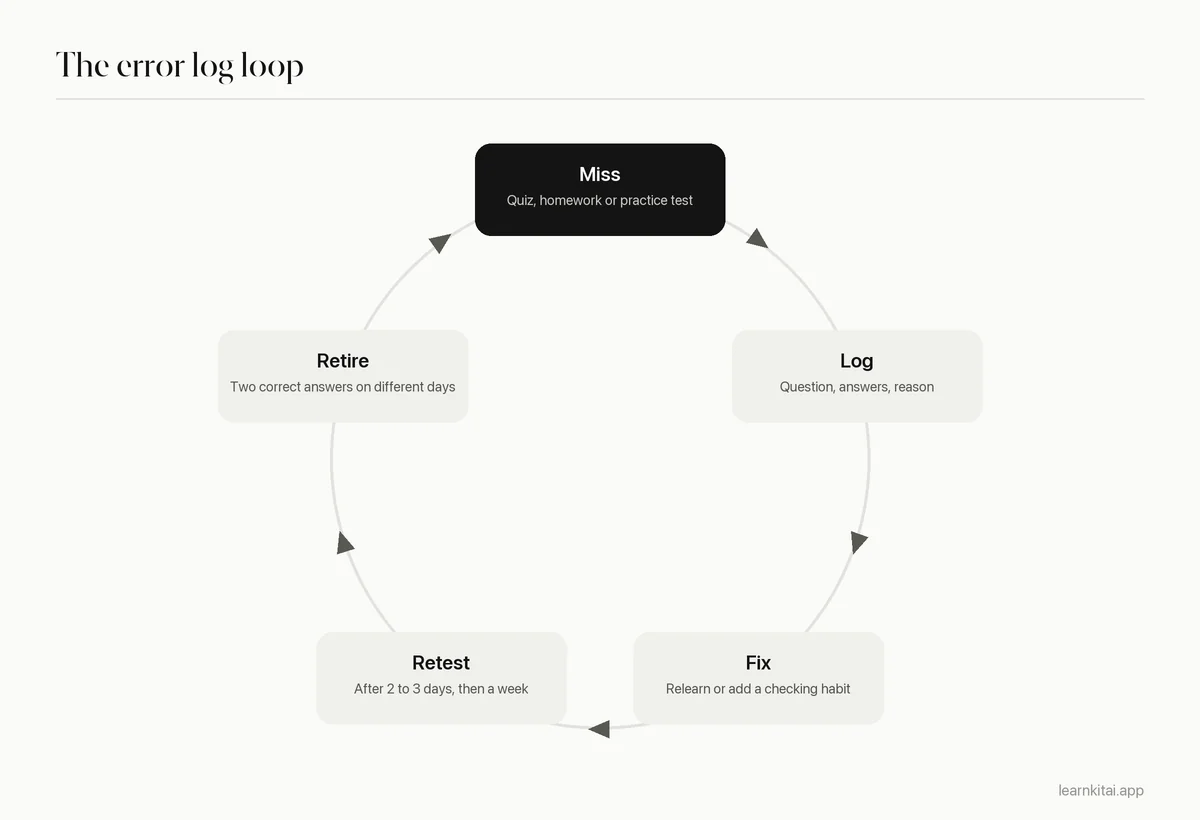
Retest by covering the answer columns and answering the question fresh. Do not just reread the row. If you get it wrong again, reset its ticks and note whether the reason changed. Entries that keep failing need a new approach, such as explaining the idea in your own words or building a flashcard that targets the exact confusion.
What one week of error log studying looks like
- Monday: A biology quiz gives you three misses. You log them: one knowledge gap on the loop of Henle, one confusion between osmosis and diffusion, one misread stem.
- Tuesday: You spend ten minutes on the fixes. You relearn the loop of Henle, write a side by side comparison of osmosis and diffusion, and add "underline NOT" to your exam checklist.
- Thursday: You cover the answer columns and retest all three. Two are right and get a tick. The osmosis question is wrong again, so its ticks reset.
- Next Monday: You retest the two ticked entries and the osmosis one. Both ticked entries are right a second time and retire. Osmosis finally sticks and gets its first tick.
Fifteen to twenty minutes across the week, and every minute went to something you had actually got wrong. That focus is what makes error log studying so efficient compared with rereading a whole chapter.
The log needs a steady flow of fresh mistakes, and quizzes are the easiest source. LearnKit quizzes show an explanation after each answer, which gives you the correct answer and the reasoning to copy straight into your log.
Mistakes people make with error logs
- Logging without a reason. "Got it wrong" teaches nothing. The reason column is the whole point.
- Copying the answer and never retesting. A log you only read is just another set of notes.
- Logging only exam mistakes. By then it is late. Log misses from homework and quizzes all term.
- Letting it grow forever. Retire entries you have answered correctly twice, so the log stays focused on live problems.
After a graded exam, your error log is the natural place for every lost point. Our guide on how to review a graded exam walks through that step, and if a result went badly, what to do after failing an exam shows how to turn it into a plan. Janet Metcalfe's review of learning from errors in the Annual Review of Psychology makes the broader case: mistakes made in low stakes practice, followed by corrective feedback, are a benefit rather than something to avoid.
Frequently asked questions
Should I log questions I guessed right?
Yes. A lucky guess is a hidden gap. Mark it as a guess in the log and retest it like any other miss.
Is an error log useful for essay subjects?
It is. Log feedback points instead of single questions, such as "no counterargument" or "thesis too vague", and check your next essay against the list before you submit.
How long does keeping an error log take?
About one to two minutes per mistake to log it, plus five to ten minutes per session to retest entries. It is some of the most targeted study time you can spend.
Sources
- When Does Feedback Facilitate Learning of Words?, Journal of Experimental Psychology: Learning, Memory, and Cognition (Pashler, Cepeda, Wixted and Rohrer, 2005) (Correct-answer feedback after errors increased one week retention by 494% compared with no feedback)
- Surprising feedback improves later memory, Psychonomic Bulletin and Review (Fazio and Marsh, 2009) (Explains the hypercorrection effect: high-confidence errors are more likely to be corrected)
- Learning from Errors, Annual Review of Psychology (Metcalfe, 2017) (Errorful learning followed by corrective feedback is beneficial)
Keep reading

Practice Testing: The Study Habit That Beats Rereading
Testing yourself is not just a way to check what you know. It is one of the best-supported ways to learn. Here is how to do it well, week by week.
Review a Graded Exam: Your Mistakes Are the Study Guide
Most students glance at the score and file the paper away. A short, structured review turns every lost point into a plan for the next test.

Make a Practice Test That Feels Like the Real Exam
A good practice test copies the real exam's format, mixes topics, and comes with an answer key you check honestly. Here is a step by step build.
Quiz Yourself From Your Notes in 15 Minutes a Day
Your notes already contain the questions. Here is how to pull them out, five ways to test yourself, and a short daily routine that keeps old topics alive.
The Testing Effect: Why a Quiz Beats Another Reread
Taking a test is not just a way to measure memory. It changes memory. Here is what the research shows and how to use it this week.