Chunking Memory: Fit More Into a Mind That Holds Four
Chunking is grouping separate pieces of information into larger, meaningful units, like reading 1945 as one year instead of four digits. Working memory can only hold a few chunks at once, about four by modern estimates, so packing more detail into each chunk lets you handle and remember far more.
Read this once and look away: F B I C I A N A S A. Hard to hold ten letters. Now read it as FBI, CIA, NASA. Suddenly it is three items, and easy. That is chunking memory at work: you did not get a bigger memory, you packed the same letters into fewer, meaningful pieces. Once you know how it works, you can do it on purpose with almost anything you study.
How many things can you hold in working memory?
Fewer than most people think. A famous 1956 paper suggested about seven, plus or minus two, but later work points to about four meaningful chunks for most adults when they cannot rehearse or group items. The limit is in chunks, not in raw details.
In 1956 the psychologist George Miller published a paper titled The magical number seven, plus or minus two. It became one of the most cited ideas in psychology. In 2001 Nelson Cowan reviewed decades of later research and argued that the seven was a rough estimate, and that the real limit is closer to about four chunks when people cannot rehearse or group items. Either way, the key word is chunks. Four chunks can hold four letters or four whole ideas.
This is why a dense lecture slide can feel overwhelming. If every term is new to you, each one takes a slot, and the slots run out after a few. Once a set of terms clicks into one idea, it takes a single slot and leaves room for the next.
What does the research show about chunking?
Experts remember far more in their field because they see meaningful patterns, not more raw items. In one famous study, a student trained for more than 230 hours raised his digit span from 7 to 79 by grouping digits into running times, yet his span for letters stayed around 7.
In a study published in Science in 1980, Anders Ericsson, William Chase and Steve Faloon worked with an undergraduate known as SF. He started with an average digit span of about 7. After more than 230 hours of practice he could recall 79 digits read to him. His secret was chunking. SF was a keen long-distance runner, so he turned groups of three or four digits into running times. In the researchers' own example, 3492 became three forty-nine point two, near world-record mile time.
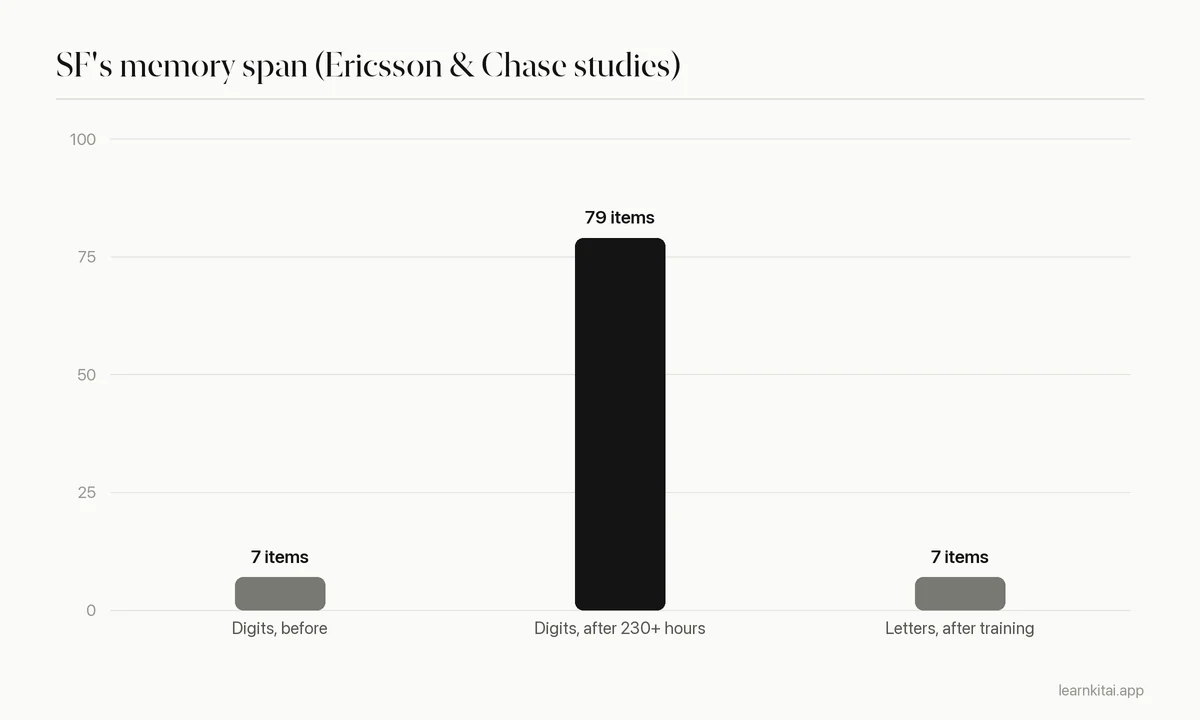
The last bar is the most important lesson. In the researchers' technical report, SF's span for random consonants remained normal, about 7 symbols. His working memory had not grown. He had built chunks that only worked for digits. The same report describes chess research: masters can rebuild most of a 32-piece position after a five-second look, while novices place only three or four pieces. The masters see familiar patterns; the novices see 32 separate pieces.
For students, this means two things. First, you can learn far more than your working memory seems to allow, as long as you build meaningful groups. Second, chunks come from understanding and practice in a subject. You cannot borrow them from a trick. They grow as the material starts to make sense. That is why chunking memory work and understanding go hand in hand: the more sense a topic makes, the bigger each chunk can be.
How do you use chunking memory techniques when studying?
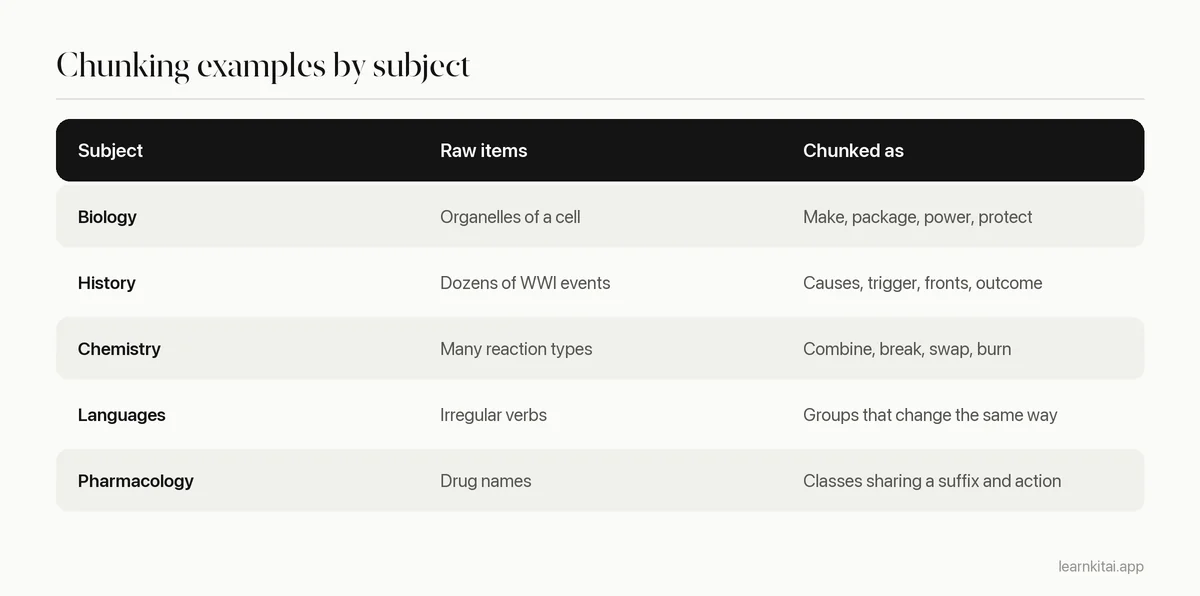
Group related facts under a single idea, give each group a name, keep groups to about three to five items, and nest groups inside bigger groups. Then practice recalling each chunk as a whole, so the group becomes one unit you can pull out at once.
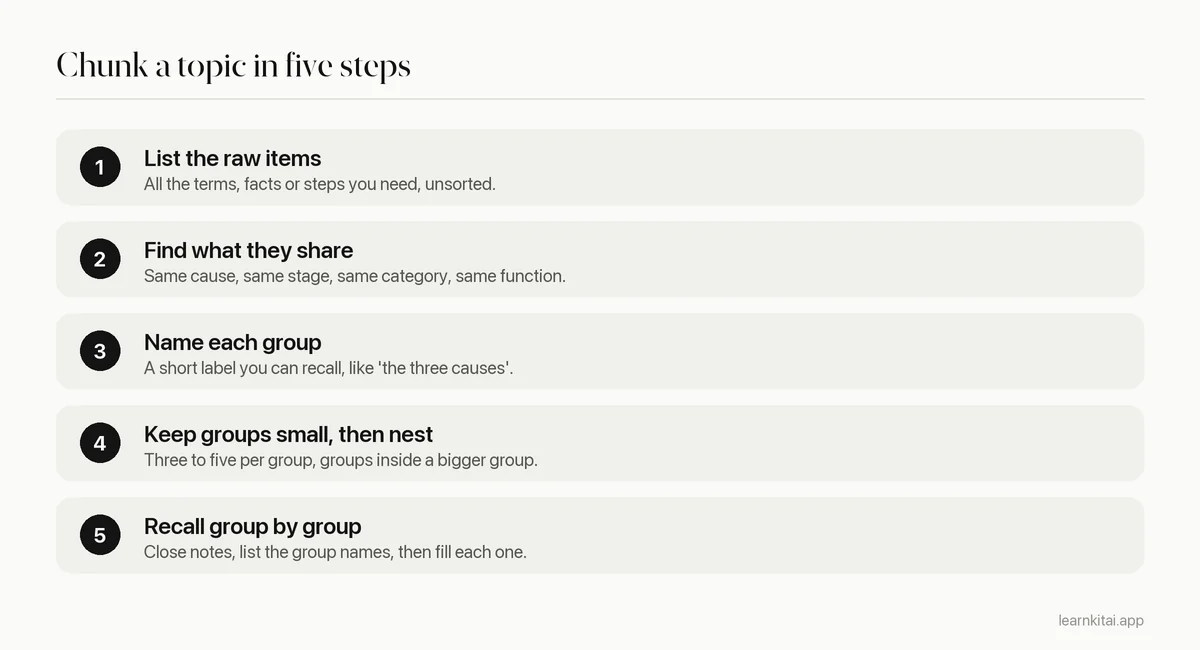
Take the twelve cranial nerves. Twelve unrelated names will not fit in working memory. But you can sort them by job: some are purely sensory, some purely motor, and some do both. Now you have three groups, each small enough to hold, plus a rule that connects them. The same trick works for drug classes, historical events, grammar rules and chemical reactions.
Is chunking the same as a mnemonic?
Not quite. A mnemonic is a memory hook, like an acronym or a rhyme, that can be built from meaningless links. Chunking groups items by real meaning or pattern. Acronyms can be a way to name a chunk, but the strongest chunks rest on understanding why the items belong together.
Acronyms and rhymes have their place, especially for fixed lists. But a chunk built on meaning does more work: it helps you answer questions you did not see coming, because you know how the parts relate. For a vivid hook on top of your chunks, try the memory palace technique. For turning chunks into pictures, see dual coding.
Common chunking mistakes
- Groups that are too big. A chunk of twelve is not a chunk. Split it into smaller named groups.
- Grouping by page order. Chapter order is not meaning. Group by cause, function or category instead.
- Naming without learning. A label you can recall is useless if you cannot unpack it. Practice filling in each group.
- Skipping understanding. Chunks form when ideas make sense. If you cannot explain why items belong together, go back to the concept.
- Never testing the chunks. Recall the group names and their contents from memory, then check. That is active recall applied to structure.
Dates are a classic chunking challenge. Instead of twenty separate years, anchor them to a few eras and place each event inside one, as described in how to memorize history dates. Vocabulary works the same way: learn words in families that share a root or a theme.
Once your chunks are drafted, test them. LearnKit can turn your notes into flashcards, and you can review one group at a time before shuffling them together, which checks both each chunk and the links between them.
Frequently asked questions
Is it seven items or four items in working memory?
Miller's seven was a rough estimate from 1956. Later research, summarized by Nelson Cowan in 2001, suggests the core limit is about four chunks when people cannot rehearse or group items. In everyday study, plan around three to five items per group.
Does chunking work for numbers like phone numbers?
Yes. That is why phone numbers are written in groups. Splitting ten digits into three groups of three or four makes them much easier to hold, and attaching meaning to a group, like a year or an age, makes it easier still.
How long does it take to build good chunks?
For a single lecture, a first set of chunks takes minutes. Deep chunks, the kind experts have, build over months of practice in a subject. Each time you review and connect ideas, your chunks get larger and more useful.
Sources
- The magical number 4 in short-term memory: a reconsideration of mental storage capacity, Behavioral and Brain Sciences (Cowan, 2001) (Capacity limit of about four chunks; Miller's seven described as a rough estimate.)
- Acquisition of a memory skill, Science (Ericsson, Chase & Faloon, 1980) (After more than 230 hours of practice, digit span rose from 7 to 79 digits.)
- The magical number seven plus or minus two: some limits on our capacity for processing information, Psychological Review (Miller, 1956) (Origin of the seven plus or minus two estimate.)
- Skilled Memory (Technical Report No. 5), Carnegie-Mellon University (Chase & Ericsson, 1980), copy of the DTIC report (SF's running-time codes such as 3492; his span for random consonants stayed about 7; chess masters vs novices recalling 32-piece positions.)
Keep reading

Active Recall: Why Closing the Book Beats Rereading
Rereading feels productive but fades fast. Here is how to study by pulling answers out of memory, with a session plan, examples and the mistakes to avoid.

Memory Palace Technique: Store Facts in Rooms You Know
The memory palace turns an ordered list into a walk through a place you already know. Here is how to build one for an exam, and when not to bother.
Dual Coding: Pair Words With Pictures to Remember More
Your memory has a verbal channel and a visual one. Use both and ideas get two routes back. How to dual code your notes, with formats for every kind of topic.

Memorize History Dates by Hanging Them on a Story
Dates slip because they are bare numbers. Give each one an anchor, a neighbor and a reason, and they start to stay.
Minimum Information Principle: Small Cards, Big Recall
One flashcard, one fact. Here is why splitting fat cards into tiny ones makes reviews faster and memories stronger, with worked examples.