Memory Palace Technique: Store Facts in Rooms You Know
The memory palace technique, also called the method of loci, links each item you need to remember to a fixed spot along a route you know well, such as your home. To recall, you walk the route in your mind. It works best for ordered lists and needs practice plus regular review to last.
The memory palace technique sounds like a trick from a detective show, but it is one of the oldest memory methods we have. You take a place you know by heart, like your apartment, pick a fixed path through it, and leave a vivid image of each fact at each stop. Later you walk the path in your head and collect the facts in order.
It is powerful for some exam material and a poor fit for most of it. This guide shows you how to build one, a full worked example, how to review it, and a simple rule for when to use it.
Does the memory palace technique actually work?
Yes, for remembering lists and sequences. Brain imaging studies show trained users recall far more words than untrained people, and novices improve a lot within weeks of daily practice. It does not replace understanding the material.
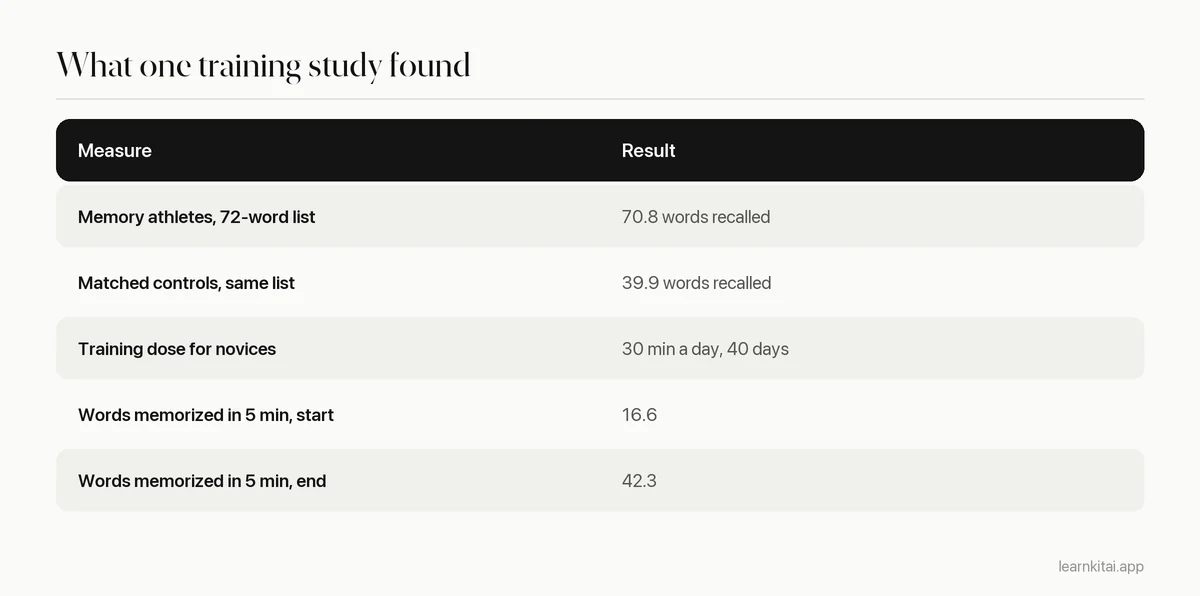
The strongest evidence comes from a 2017 study in Neuron led by Martin Dresler. Memory athletes recalled 70.8 of 72 words on average, against 39.9 for matched controls. Then the team trained ordinary volunteers in the method of loci for 30 minutes a day over 40 days. Their score on a five-minute word task climbed from 16.6 to 42.3 words, and the trained group kept an advantage at a follow-up four months later.
Classroom evidence is smaller but encouraging. In a study with medical students learning insulin and diabetes, the group that built memory palaces scored significantly higher on assessments than the group that used self-directed study after the same lectures.
There is a catch. A major review of study techniques rated imagery-based mnemonics as low utility for general text learning, because they are hard to apply to explanations and long arguments. That is the right frame: the memory palace is a specialist tool.
How do you build a memory palace for an exam?
Choose a familiar place, fix a route with numbered stops, turn each fact into a strange, concrete image, and place one image at each stop. Then walk the route from memory, first the same day and again over the following days.
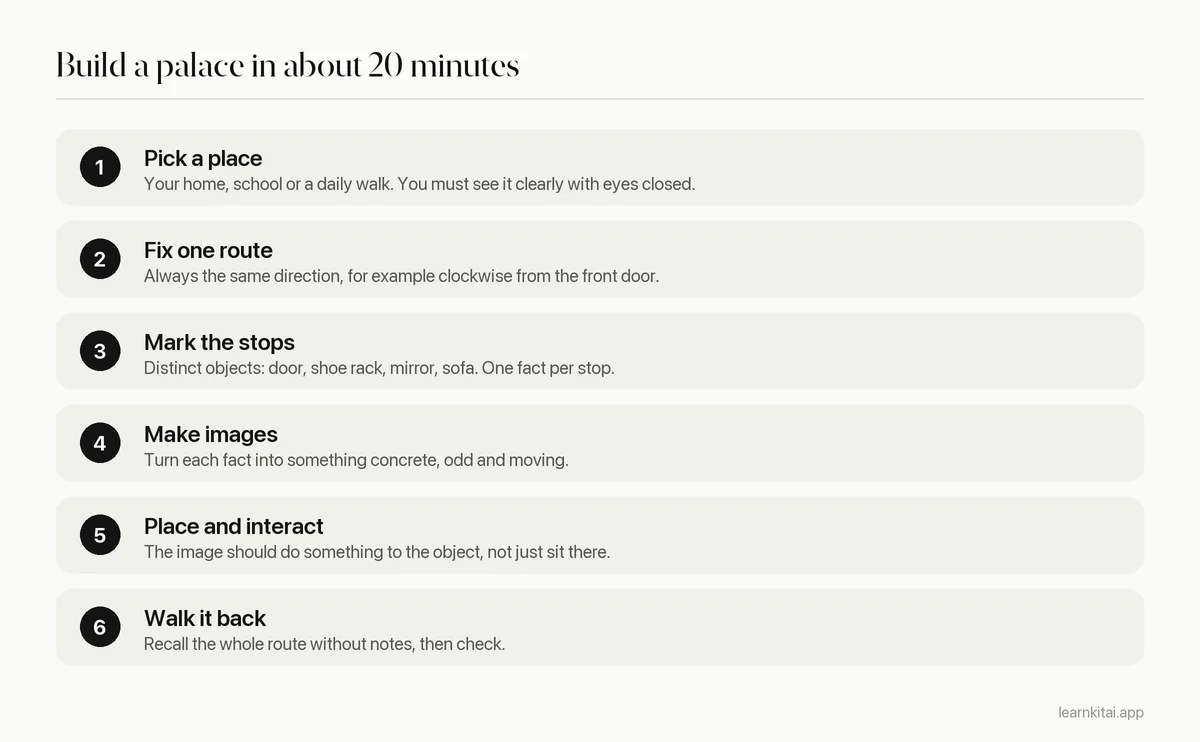
Two rules make or break a palace. First, the stops must be distinct. Five identical kitchen cabinets blur together. Second, the images must be specific and a little absurd. Your brain remembers a smell in the bathroom far better than the word smell written on a door.
A worked example: the 12 cranial nerves
Anatomy students need the 12 cranial nerves in order. Here is how the first six might look in a small apartment, walking clockwise from the front door.
- Front door (I, olfactory): a huge nose is stuck in the door and sniffs you as you enter.
- Shoe rack (II, optic): every shoe has an eye where the laces should be, all staring at you.
- Coat hook (III, oculomotor): an eyeball rides a tiny motorbike in circles around the hook.
- Mirror (IV, trochlear): a truck drives out of the mirror, which helps you think trochlear.
- Sofa (V, trigeminal): triplets jump on the sofa, three of them for the three branches.
- TV (VI, abducens): an eye on screen is abducted sideways by aliens, a nudge that this nerve moves the eye outward.
Notice that the images do two jobs. They hold the name, and where possible they hint at the function, like the sideways eye for abducens. That turns a pure list into something closer to understanding, which links well with dual coding. Finish the other six stops the same way, then walk the whole route from the door. If you want more anatomy strategies, see how to study anatomy.
How often should you review a memory palace?
Walk it the same day, the next day, a few days later and about a week later. Each walk should be from memory, with a check against your notes afterward. Without review, even vivid images fade.
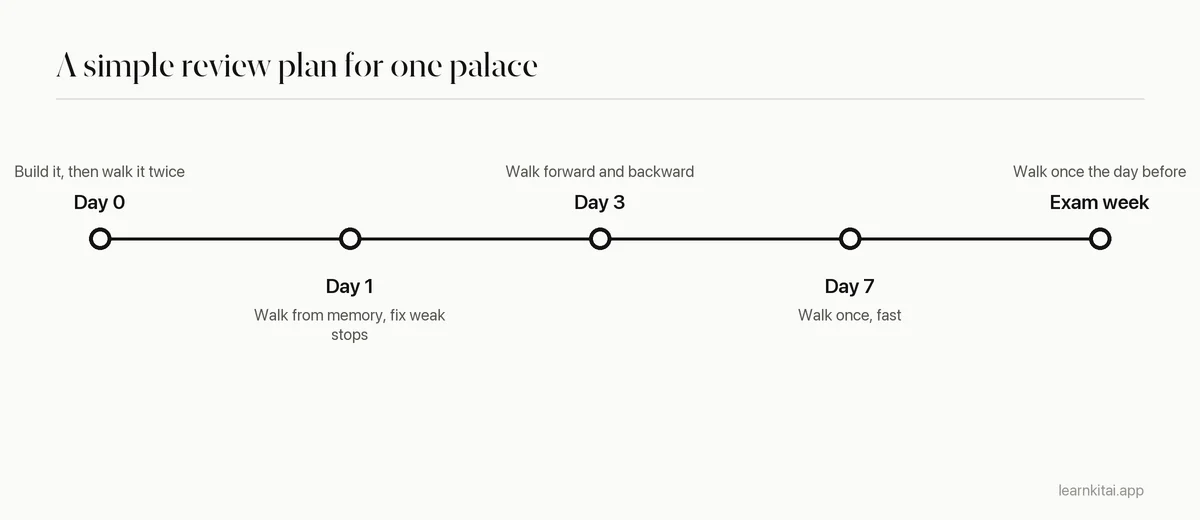
This is spaced repetition applied to a route instead of a deck. Each walk is a recall attempt, so it also gets the benefit of active recall. Walking backward on day 3 is a good test: it proves you know each stop and are not just riding the momentum of the sequence.
When should you not use a memory palace?
Skip it for material you need to explain, apply or calculate, such as proofs, essays or problem sets. Use it for fixed, ordered lists where the exact items and order matter, and where you cannot reason your way to the answer.
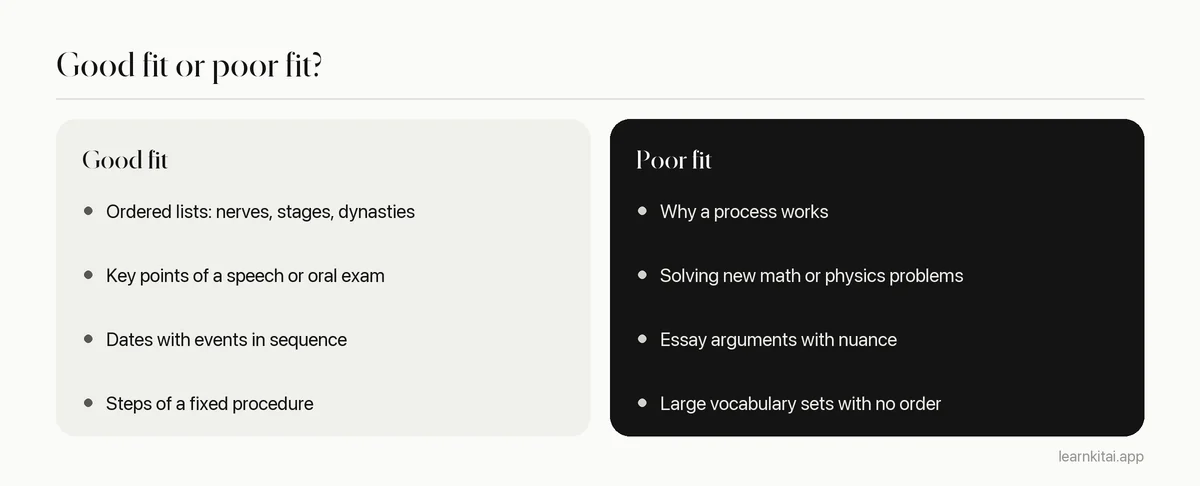
For a long unordered set, such as 400 vocabulary words, flashcards are faster to make and review. For grouping related facts without a route, try chunking. Many students use both: a palace for the five or six lists that keep slipping, and cards or questions for everything else. History students can use the same route idea for remembering dates.
Why do memory palaces fail for some students?
Usually because the route is fuzzy, the images are bland, or the palace is never reviewed. A few people also try to store whole explanations, which the method handles badly. Fix the route first, then the images.
Most problems with the memory palace technique come from setup, not from your memory. Run through this checklist when a stop keeps coming up empty.
- The route changes. If you sometimes go left and sometimes right at the hallway, the order breaks. Walk the real place once and write the stops down.
- The images are abstract. The word mitochondria on a chair is not an image. A tiny power plant puffing smoke on the chair is.
- Two items share one stop. They compete, and you get one or neither. Add a stop instead.
- You never walk it again. A palace you build on Sunday and first test on exam day is a gamble. Follow the review plan above.
- You store sentences. Keep each stop to one item or one key word. Put the explanation in your notes and quiz yourself on it separately.
If a stop still fails after two reviews, do not fight it. Replace the image with a new one that is bigger, louder or more personal, and test that stop again the next day.
Frequently asked questions
How long does it take to learn the memory palace technique?
You can build a useful first palace in one evening. Getting fast takes regular practice; in one study, novices trained 30 minutes a day for 40 days and more than doubled the words they could memorize in five minutes.
Can I use an imaginary place instead of a real one?
You can, but a real place is easier because the layout is already stored in memory. An invented place has to be learned first, which adds work. Video game maps or a campus you know well also work.
How many items can one palace hold?
As many as you have distinct stops. A small apartment might give 15 to 20 clear stops. For longer lists, link rooms together or use a second route rather than squeezing two images onto one object.
Is the method of loci the same as a mind palace?
Yes. Method of loci is the formal name used in research; memory palace and mind palace are popular names for the same idea of placing images along a familiar route.
Sources
- Mnemonic Training Reshapes Brain Networks to Support Superior Memory, Neuron (Dresler et al., 2017) (Athletes 70.8 vs controls 39.9 of 72 words; training 30 min a day for 40 days; 16.6 to 42.3 words memorized in 5 minutes; benefit at 4 months.)
- The method of loci as a mnemonic device to facilitate learning in endocrinology leads to improvement in student performance as measured by assessments, Advances in Physiology Education (Qureshi et al., 2014) (Medical students taught with memory palaces scored significantly higher on assessments than a self-directed learning group.)
- Improving Students' Learning With Effective Learning Techniques, Psychological Science in the Public Interest (Dunlosky et al., 2013) (Rates the keyword mnemonic and imagery for text learning as low utility, limiting where imagery methods help.)
Keep reading

Active Recall: Why Closing the Book Beats Rereading
Rereading feels productive but fades fast. Here is how to study by pulling answers out of memory, with a session plan, examples and the mistakes to avoid.
Chunking Memory: Fit More Into a Mind That Holds Four
Working memory holds only a few items at once. Chunking packs many details into each item. How it works, the research, and how to chunk any topic you study.
Dual Coding: Pair Words With Pictures to Remember More
Your memory has a verbal channel and a visual one. Use both and ideas get two routes back. How to dual code your notes, with formats for every kind of topic.
How to Study Anatomy: Learn the Map Before the Streets
Anatomy feels like thousands of names. Learn the layout first, decode the Latin, and test yourself with images, and it starts to fit together.

Spaced Repetition: Why Forgetting Is Part of the Plan
Reviewing right before you forget builds memories that last. Learn how long the gaps should be, with a ready schedule for exams one week to one semester away.