Active Recall: Why Closing the Book Beats Rereading
Active recall is a study method where you pull information out of memory instead of reading it again. You close your notes, answer a question or write what you remember, then check. The effort of retrieving strengthens memory, and in controlled studies it beats rereading on tests taken days or weeks later.

You read the chapter twice, highlighted the key lines, and it all felt familiar. Then the exam asked the same idea in a slightly different way and your mind went blank. That gap between feeling ready and being ready is exactly what active recall closes. Instead of looking at information again, you make yourself produce it from memory, and only then check what you missed.
This guide explains why it works, how to run a real session, which formats suit which subjects, and the small habits that quietly turn active recall back into passive review. It is also the hub of our study methods series, so you will find links to deeper guides on each related technique along the way.
What is active recall, exactly?
Active recall means retrieving information from memory without looking at it: answering a question, writing down what you know or explaining a topic aloud, then checking against the source. The key ingredient is the attempt to retrieve, not the reading that comes after it.
Psychologists usually call this retrieval practice, and the boost it gives the testing effect. The label matters less than the move itself. The answer has to come from your head before you see it. Reading the front of a flashcard and flipping it straight away is not active recall. Pausing, committing to an answer, and only then flipping is.
Here is a quick test. If you could do the activity half asleep, it is probably passive. Rereading, highlighting, copying notes neatly and watching a lecture at double speed all feel busy, but none of them force you to rebuild anything. That trap is very common. In one survey of 177 college students, 84% listed rereading among their study strategies and 55% ranked it as their number one. We unpack why it fails in why rereading does not work.
Why does active recall work better than rereading?
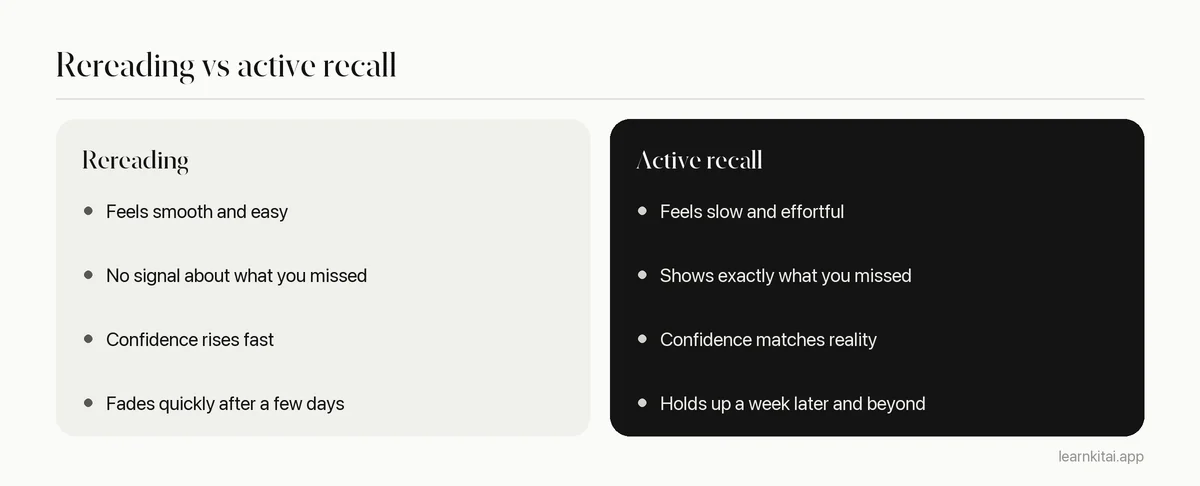
Each time you retrieve a memory, you strengthen the path back to it and you find out which parts you cannot reach yet. Rereading makes material feel familiar, which is easy to mistake for knowing it. Retrieval exposes the gaps that familiarity hides.
The classic demonstration comes from a 2006 study by Henry Roediger and Jeffrey Karpicke at Washington University in St. Louis. Students studied short science passages. One group read a passage in four study periods. Another read it once and then spent three periods writing down everything they could remember, with no feedback at all. Five minutes later the rereaders were slightly ahead. One week later the result flipped: the recall group remembered 61% of the ideas, the rereaders 40%. You can read the study abstract on PubMed.
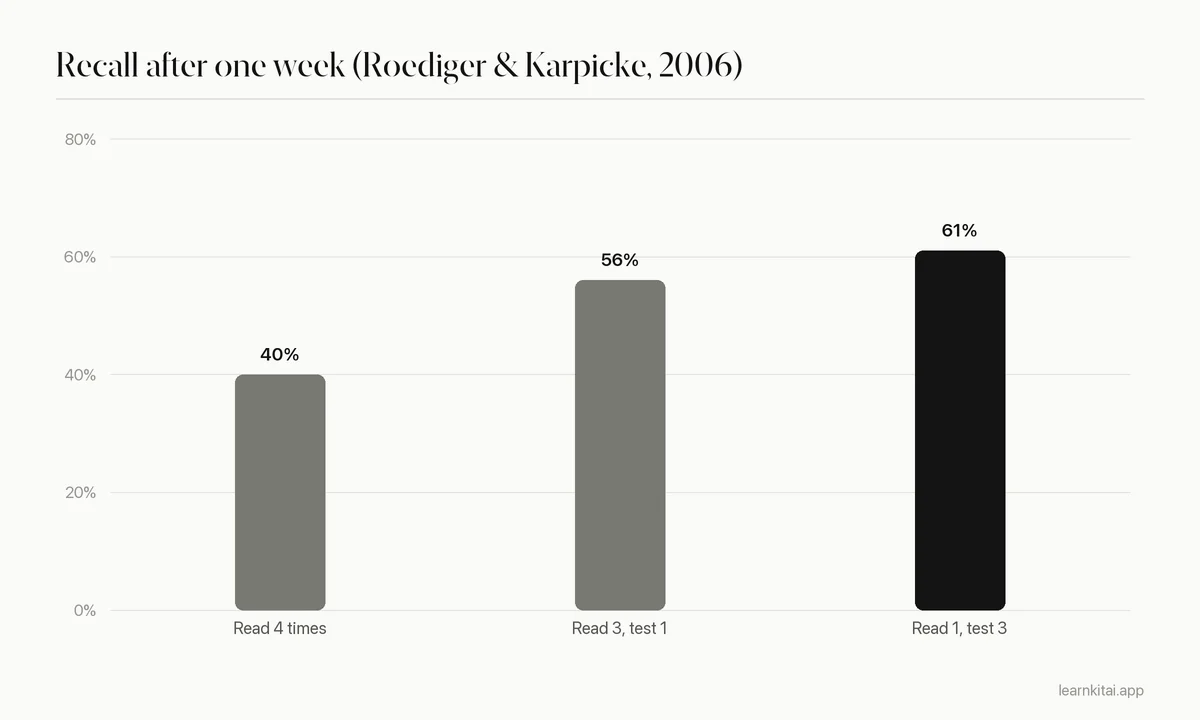
Two details make this result even more striking. The recall group read the passage about 3.4 times in total, while the rereaders went through it about 14 times. And the rereaders felt more confident that they would remember it. That is the core problem with passive review: it produces a feeling of fluency that you read as learning. Active recall feels slower and harder, and that struggle is part of why it works. Researchers call this kind of productive struggle a desirable difficulty.
The effect is not limited to short passages or word lists. In a 2011 study in Science, Karpicke and Janell Blunt found that retrieval practice produced more learning from science texts than building concept maps, even on inference questions. A large review of ten popular techniques by Dunlosky and colleagues (2013) rated practice testing as one of only two techniques with high utility, next to spreading study out over time.
How do you do active recall step by step?
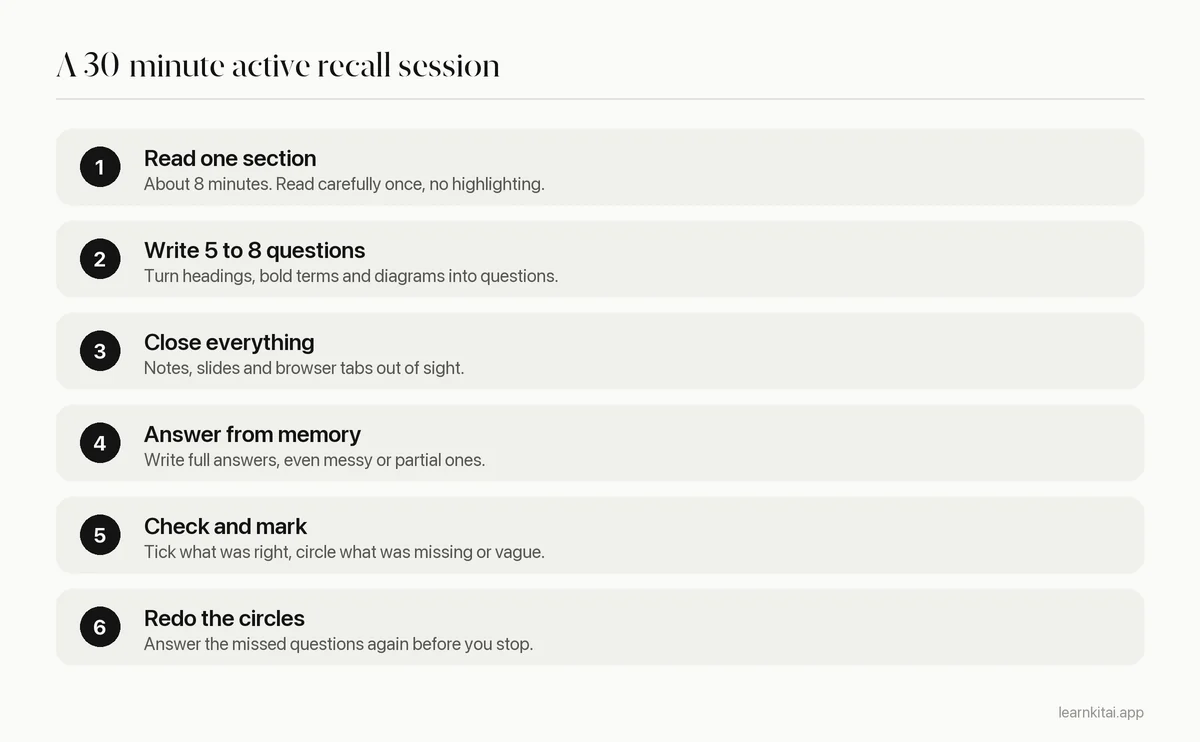
Take one small section, turn it into questions, close the source, answer from memory in writing or aloud, then check and mark what you missed. Redo the misses before you stop, and come back to the same questions on later days.
Turn your notes into questions
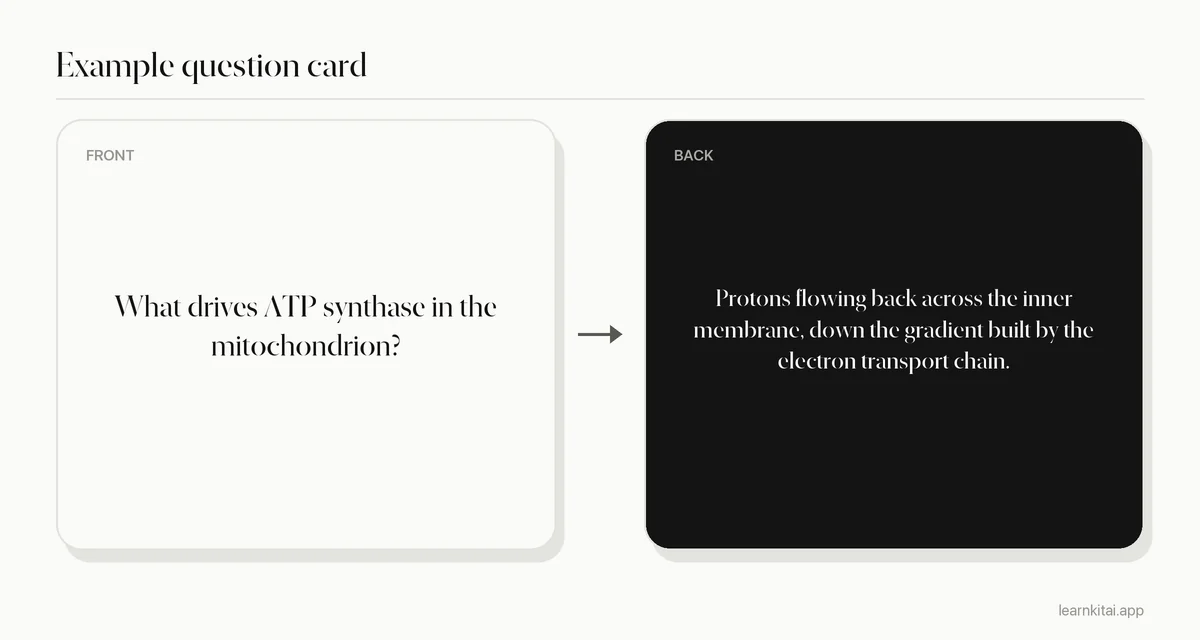
Every heading in a textbook is a question in disguise. Cellular respiration becomes: What are the three main stages, where does each happen, and which one makes most of the ATP? A diagram of the heart becomes: Trace a red blood cell from the vena cava to the aorta. Good questions ask for one clear thing. If the honest answer would be a full page, split it into smaller questions.
Answer before you check
Commit to an answer in writing or out loud before you look. A vague thought like I sort of know this does not count. Writing forces you to notice the step you cannot fill in. If you blank completely, write the first related thing you can remember, then check. A failed attempt followed by the right answer still teaches you more than reading the answer cold.
Score honestly and keep the misses
Be strict when you mark. Half right is wrong for now. Keep a short list of the questions you missed and start your next session with them. That list is the most valuable page you own, because it shows exactly where your understanding breaks.
Which active recall techniques suit which subjects?
Flashcards suit terms, formulas and vocabulary. Blurting suits topics with many linked facts. Practice problems suit math and science. Explaining aloud suits processes and theories. Past papers suit the final weeks, when you need exam format and timing as well as knowledge.
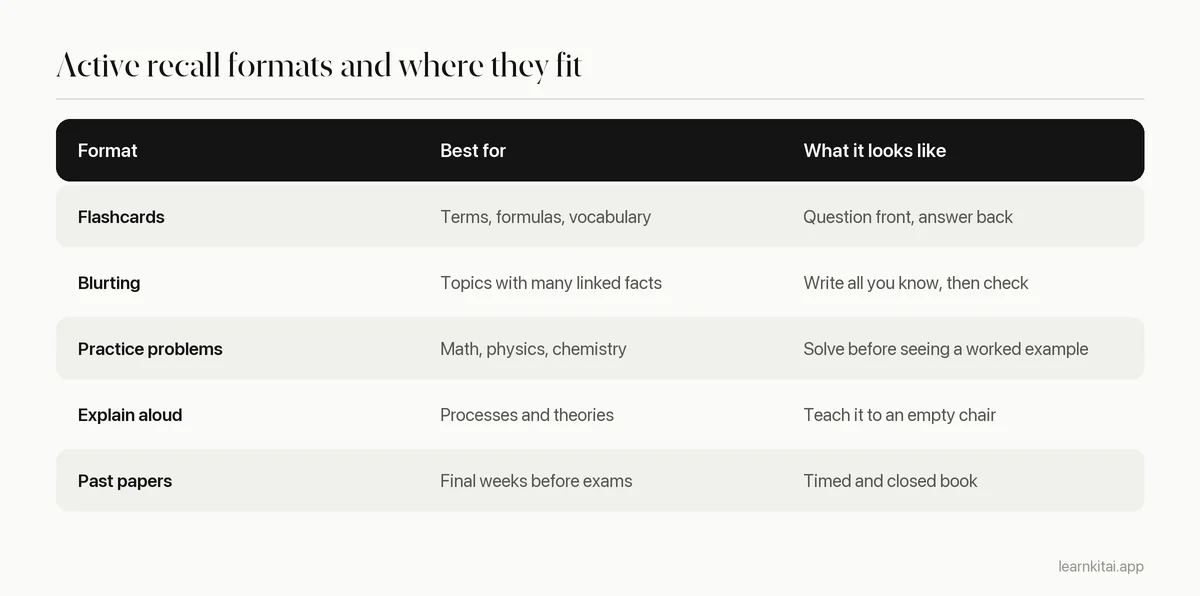
You do not need all of them. Pick one main format per subject and add a second for variety. For card writing, start with how to make effective flashcards. For a fast, low-setup option, try the blurting method. If you can recite facts but struggle with why questions, the Feynman technique and elaborative interrogation push you to explain, not just list. And when you want exam-style questions, our practice testing guide shows how to build them.
How often should you use active recall?
Use it in every study session, but spread repeated attempts across days instead of stacking them in one sitting. A simple start is the same day, two days later, about a week later, then once more before the exam.
Retrieval and spacing are a strong pair. Recalling something you saw five minutes ago is easy and teaches little. Recalling it two days later, when it has started to fade, takes effort and builds a much sturdier memory. That is the idea behind spaced repetition. Mixing topics within a session helps too, because you must first work out which idea a question needs. We cover that in interleaved practice.
- Day 0: learn the section and do a first recall round the same evening.
- Day 2: answer the same questions cold, then fix the misses.
- Day 7: mixed round with questions from other chapters.
- Day 14 or exam week: one timed round, misses only after that.
How do you know active recall is working?
Track how many questions you answer correctly on the first cold attempt each day, not after you reread. If that number climbs across a week, and old questions stay solid when you return to them, the method is doing its job.
Your feelings are a poor guide here, because the method feels worse than rereading while it works better. So measure instead. Keep a simple tally in the margin of your question list: right on the first try, or missed. A first session where you get four out of ten is normal and useful. What matters is the trend. By the third round you want most of the old questions to come back quickly, and the misses to be new material rather than the same stubborn items. If one question keeps failing, it is usually too big or you never really understood it. Rewrite it into two smaller questions, or go back to the source and explain it in your own words before testing again.
What mistakes make active recall stop working?
The usual culprits are peeking too soon, testing recognition instead of recall, asking questions that are far too big, skipping the check, and only reviewing what you already know. Each one keeps the work feeling easy, which is the warning sign.
- Peeking after two seconds. Give yourself a real attempt, at least 10 to 20 seconds of honest effort, before you reveal the answer.
- Only using multiple choice. Picking from options is recognition. It helps, but writing the answer yourself is a stronger workout.
- Questions the size of a chapter. Explain the French Revolution is too big to check. Break it into causes, key events and outcomes.
- No feedback. Recall without checking can lock in errors. Always compare your answer with the source.
- Reviewing the easy cards. It feels good to get things right. Spend most of your time on the questions you missed.
- Making materials instead of using them. Three hours writing beautiful cards and ten minutes reviewing them is backwards.
Can AI help with active recall?
Yes, if the tool writes the questions and you do the remembering. AI can turn a PDF, a lecture or a web page into flashcards or quiz questions in seconds, which removes the slowest step. The learning still happens only when you answer before you look.
The slowest part of active recall is usually writing the questions, and that is where a tool earns its place. With LearnKit you can add a PDF, your notes or a lecture link and get flashcards, a multiple choice quiz or open questions with sample answers. Treat the output like any study material: skim it for errors, delete questions that test trivia, and add your own for anything your teacher stressed.
Mix formats for the best effect. Use quiz questions for a fast first pass, then switch to open questions where you must write the answer in full. The open format is closer to free recall, the kind used in the studies above, and it shows you whether you can explain an idea rather than just spot it.
Frequently asked questions
Is active recall the same as retrieval practice?
Yes, in practice the two terms describe the same thing. Retrieval practice is the term researchers use, while active recall is more common among students. Both mean producing information from memory before checking it.
How long should an active recall session be?
Twenty to forty minutes works well for most students. That is long enough to read a section, answer questions and redo the misses, but short enough to keep your effort high. Several short sessions across a week beat one long one.
Does active recall work for math and problem-solving subjects?
Yes. In math, the recall step is solving a problem without looking at the worked example first. Cover the solution, attempt it fully, then compare. Mixing problem types in one set makes this even more effective.
What if I keep getting everything wrong?
That usually means you are testing yourself too soon or with questions that are too big. Read the section once more, shrink the questions, and try again. Some early mistakes are normal and still help, as long as you check the right answer afterward.
Sources
- Test-enhanced learning: taking memory tests improves long-term retention, Psychological Science (Roediger & Karpicke, 2006) (One-week recall of 61% after repeated testing vs 40% after repeated studying; rereaders felt more confident.)
- Retrieval practice produces more learning than elaborative studying with concept mapping, Science (Karpicke & Blunt, 2011) (Retrieval practice beat concept mapping, including on inference questions.)
- Improving Students' Learning With Effective Learning Techniques, Psychological Science in the Public Interest (Dunlosky et al., 2013) (Practice testing and distributed practice rated high utility; reports that 84% of surveyed students listed rereading and 55% ranked it first.)
- Metacognitive strategies in student learning: do students practise retrieval when they study on their own?, Memory (Karpicke, Butler & Roediger, 2009) (Survey of 177 college students: most reread, few self-test.)
Keep reading

Spaced Repetition: Why Forgetting Is Part of the Plan
Reviewing right before you forget builds memories that last. Learn how long the gaps should be, with a ready schedule for exams one week to one semester away.
The Blurting Method: Empty Your Head to Fill It
Write down everything you remember, then check what is missing. A simple revision method with a step-by-step routine, a worked example and four variations.
The Feynman Technique: Find Your Gaps by Teaching
If you cannot explain it simply, you have found what to study next. The four steps of the Feynman technique, a worked example and the traps that make it fail.
Retrieval Practice vs Review: Why Pulling Beats Looking
Looking over material and pulling it out of memory feel similar. They are not. Here is how to tell them apart and convert any review session into retrieval.

Practice Testing: The Study Habit That Beats Rereading
Testing yourself is not just a way to check what you know. It is one of the best-supported ways to learn. Here is how to do it well, week by week.