Minimum Information Principle: Small Cards, Big Recall
The minimum information principle says each flashcard should ask for the smallest, simplest piece of knowledge possible. Instead of one card that asks for five facts, you write five cards that ask for one each. Small cards are faster to answer, easier to grade honestly, and let spaced repetition target the exact fact you keep forgetting.
You know the card. The front says Explain the Treaty of Versailles. The back is a paragraph. Every time it comes up you mumble half of it, flip, and mark it correct because you got the gist. A week later you still cannot name a single term of the treaty. The fix has a name: the minimum information principle. It is the most useful rule in flashcard writing, and once you see it, you will start splitting cards everywhere.
What is the minimum information principle?
It is a card-writing rule from Piotr Wozniak, the creator of SuperMemo: keep the material on each card as simple as it can be. One card asks for one small fact. Complex knowledge is still allowed, but it is spread across many simple cards instead of packed into one.
Wozniak listed it as rule four in his essay Twenty rules of formulating knowledge, first published in 1999 and still the most cited guide to writing flashcards. He is careful to add that simple does not mean short. You are not trying to cut characters. You are trying to make each question so clear that there is exactly one thing to recall.
Why does the minimum information principle work?
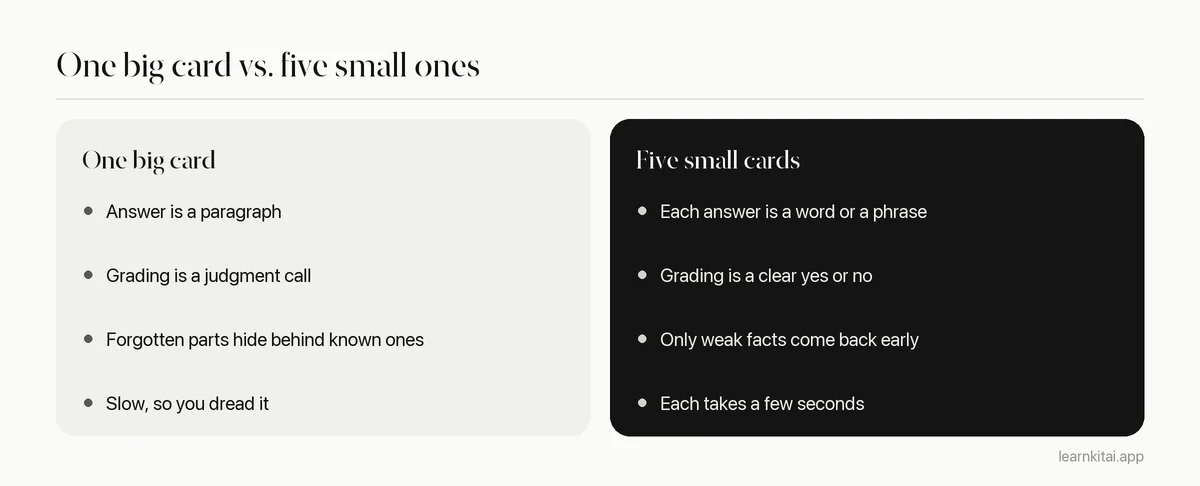
A small card gives a clean yes or no, so your grade is honest and the scheduler can bring back only the fact you missed. A big card hides gaps: you get three parts right, forget the fourth, and mark it passed. Small cards are also faster, so more reviews fit into the same time.
Think about how a review works. You see a question, try to recall, then grade yourself. With a big card the grade is a guess. Did you pass if you remembered four of five causes? Most people say yes, and the forgotten fifth cause never gets extra practice. With five separate cards, the one you missed comes back tomorrow while the other four wait a month.
There is also a limit on how much you can juggle at once. Psychologist Nelson Cowan reviewed the evidence on short-term memory and argued that people can hold about four chunks at a time, not the seven often quoted. A card that asks you to produce five unrelated facts in one go pushes right against that limit. A card that asks for one fact does not. If you want to work with that limit rather than against it, see the chunking memory technique.
A worked example: splitting a fat card
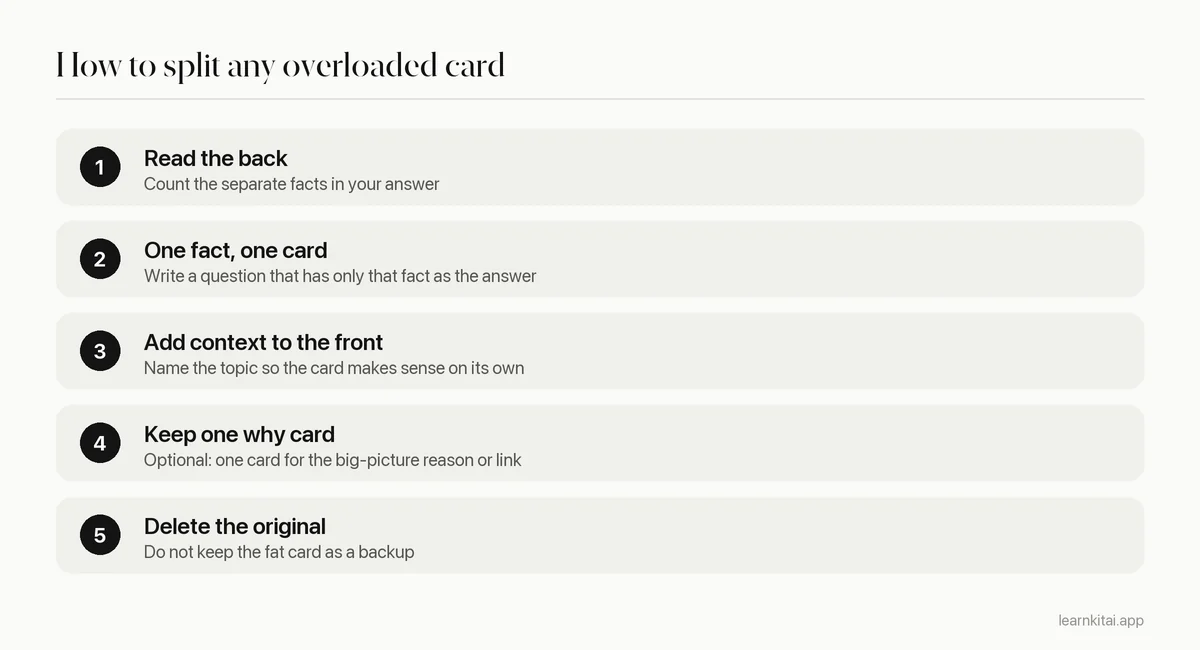
Take the Versailles card from the opening. The back might say the treaty was signed in 1919, made Germany accept blame for the war, limited the German army to 100,000 soldiers, and required reparations. That is four facts. Here is how to split it:
- In what year was the Treaty of Versailles signed? 1919
- Which clause of the Treaty of Versailles made Germany accept responsibility for the war? The war guilt clause (Article 231)
- The Treaty of Versailles limited the German army to how many soldiers? 100,000
- Under the Treaty of Versailles, what payments did Germany have to make to the Allies? Reparations
Each new card names the treaty in the question. That small piece of context stops cards from blurring together when they come up weeks apart. You can keep one extra card that asks Why did many Germans resent the Treaty of Versailles? for the big picture, but now it sits on top of solid facts instead of replacing them.
How should you handle lists you have to memorize?
Avoid asking for a whole list on one card. Wozniak calls unordered lists of more than five items nearly impossible to learn as a single card. Break ordered lists into overlapping fill-in-the-blank cards, and split unordered lists into small groups or into cards that each ask about one member.
Lists are where most fat cards come from. Name the phases of mitosis asks for four things in a set order. Instead, write overlapping cloze cards, each hiding one item while showing its neighbors:
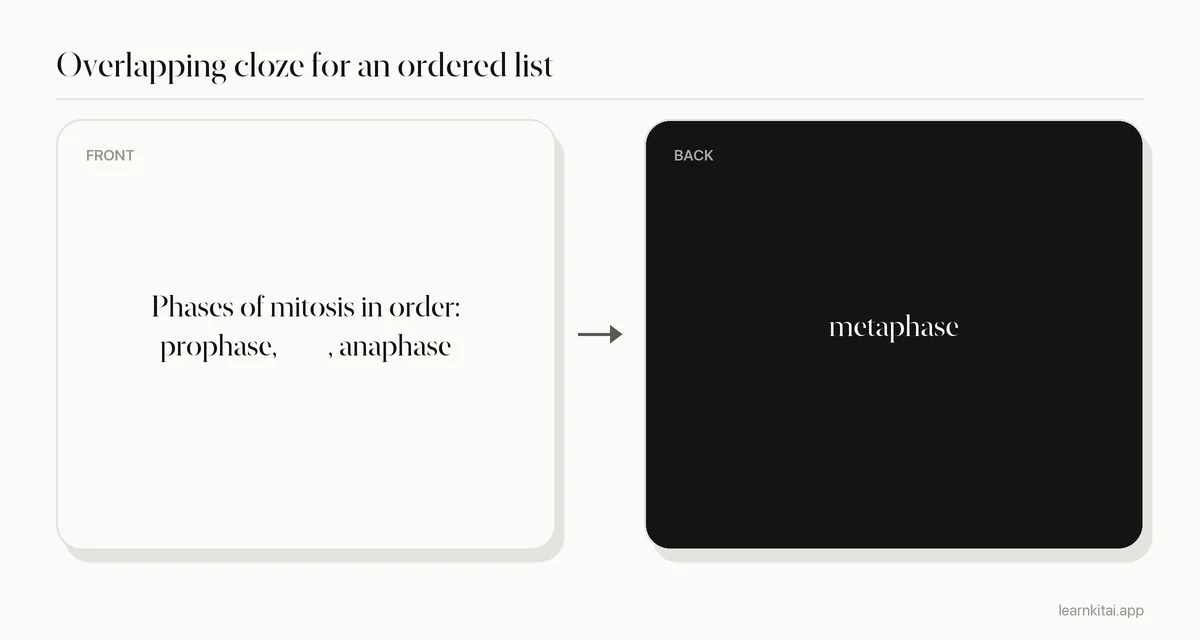
A second card hides anaphase and shows metaphase and telophase on either side, and so on down the list. Each card is tiny, yet together they rebuild the full sequence. The format is covered in more depth in cloze deletion flashcards. For unordered sets, like the bones of the forearm, ask about each member through its own clue: Which forearm bone sits on the thumb side?
Can a flashcard be too small?
Yes. A card is too small when it loses the context you need to know what is being asked, or when you memorize words you do not understand. The principle is about simple questions, not stripped ones. Always understand the idea first, then write cards for its parts.
Wozniak's first two rules come before this one for a reason: do not learn what you do not understand, and learn before you memorize. If you split a concept you have not grasped, you get a pile of disconnected trivia. Read, explain the idea in your own words, then cut it into cards. He also notes that redundancy is fine. Asking the same fact from two directions, or adding a why card next to a what card, does not break the rule.
How can you tell a card breaks the rule?
Watch for these signs: the answer contains the word and, you often grade it as partly right, it takes more than a few seconds to answer, or you recite the answer as a memorized block of text. Any of these means the card is carrying more than one fact.
- The back has a list, a paragraph or a semicolon.
- You find yourself saying close enough before you flip.
- You remember the shape of the answer but not the content.
- The same card keeps failing for different reasons each time.
The minimum information principle matters even more when cards are generated for you. AI tools often produce long answers because they summarize well. When you generate a set with a tool such as LearnKit, read each card once and split any that ask for two things. You can find more pitfalls in common flashcard mistakes and in our review of AI flashcard generators.
Splitting cards feels like extra work at first, because you end up with more of them. In practice the deck becomes faster, since each card takes seconds, and the facts actually stay. For the full set of card-writing rules, start with how to make effective flashcards.
Frequently asked questions
Does the minimum information principle mean more cards to review?
You will have more cards, but each one takes a few seconds and you will fail fewer of them. A deck of small cards usually takes less total time than a smaller deck of fat cards that you keep failing and re-reading.
Does the rule apply to paper flashcards too?
Yes. The benefit of honest grading applies to any card. With paper cards, simple cards also make it easier to sort them into a Leitner box, because each card is clearly known or not known.
What about essay subjects like history or law?
Use small cards for the facts, dates, names and definitions that your arguments rely on. Then practice the essay-level thinking separately, with open questions or outline practice. Flashcards are for the building blocks, not the whole building.
Who invented the minimum information principle?
It was set out by Piotr Wozniak, the Polish researcher who created the SuperMemo spaced repetition software. He described it in his 1999 essay on twenty rules for formulating knowledge, which is still widely read by flashcard users.
Sources
- Effective learning: Twenty rules of formulating knowledge, SuperMemo (Piotr Wozniak, 1999) (Defines the minimum information principle (rule 4) and states that sets of more than five members are nearly impossible to memorize without splitting.)
- The magical number 4 in short-term memory: A reconsideration of mental storage capacity, Behavioral and Brain Sciences (Cowan, 2001), hosted by the University of Missouri (Argues short-term memory capacity averages about four chunks.)
Keep reading
How to Make Flashcards That Still Work Three Weeks Later
Most flashcards fail before you ever study them, because of how they are written. Seven rules, real before and after cards, and a study routine that keeps them working.
Cloze Deletion: Fill-in-the-Blank Cards Done Right
Cloze cards are the fastest way to turn notes into flashcards, and the easiest to get wrong. Rules, examples and the exact Anki syntax.
9 Flashcard Mistakes That Feel Like Progress
Flipping fast, dropping known cards, studying in tidy little stacks: the habits that make flashcards feel productive are often the ones that waste your time.
Chunking Memory: Fit More Into a Mind That Holds Four
Working memory holds only a few items at once. Chunking packs many details into each item. How it works, the research, and how to chunk any topic you study.

AI Flashcard Generator Tips: Make Cards Worth Reviewing
AI can draft a deck in seconds. Whether that deck helps you depends on a ten-minute edit most students skip.