Dual Coding: Pair Words With Pictures to Remember More
Dual coding means learning the same idea through words and through a visual, such as a diagram, timeline or flowchart. The theory, developed by psychologist Allan Paivio, holds that the mind stores verbal and visual information in two linked systems, so an idea coded both ways has two routes back into memory.
Try to remember a paragraph about how the heart pumps blood. Now picture a simple diagram with four chambers and arrows. Most people find the picture easier to call up, and easier still when they can also explain it in words. That is the idea behind dual coding: you study an idea in words and in a visual form, and the two support each other.
It is not about decorating your notes or being a visual learner. It is about choosing a picture that shows the structure of the idea, then linking it tightly to the words. Done well, it is one of the most practical ways to make dense material easier to understand and recall.
What is dual coding theory?
Dual coding theory, proposed by Allan Paivio, says we process information through two connected systems: one for language and one for images. When an idea is stored in both, you can reach it through either route, and each code can help rebuild the other.
Paivio developed the theory from the 1960s onward, and later applied it to schooling with James Clark in a paper called Dual coding theory and education. A concrete word like apple is easy to code twice, because you can picture it. An abstract word like justice is harder, so it often gets only a verbal code. That is one reason concrete examples and diagrams help so much with abstract topics: they give the idea something to picture.
Does combining words and pictures improve learning?
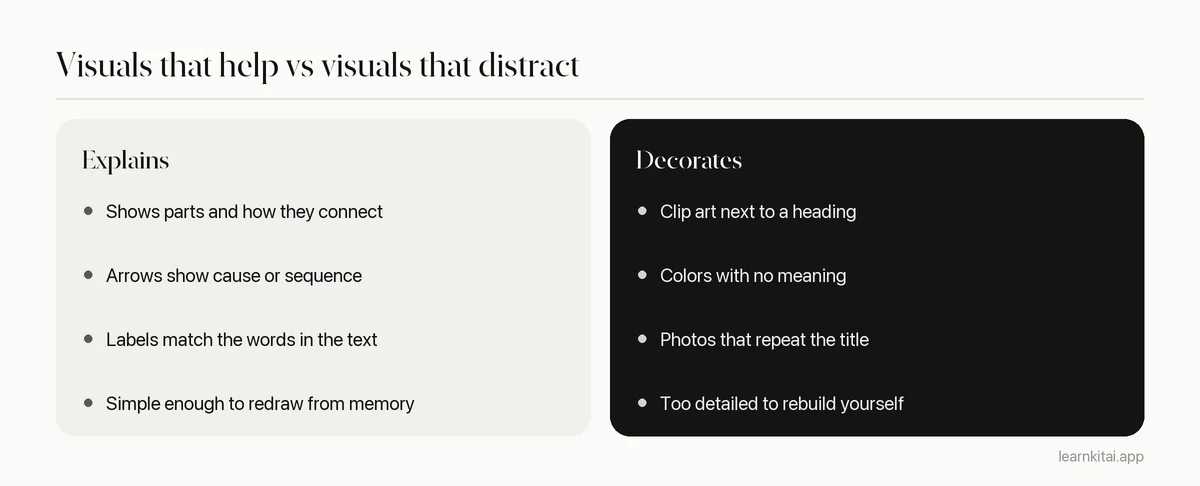
Yes, when the picture explains rather than decorates. In Richard Mayer's experiments on explanations of how things work, students who got words plus pictures did much better on problem-solving tests than those who got words alone, in nine out of nine studies.
Richard Mayer at the University of California, Santa Barbara, built his theory of multimedia learning partly on Paivio's work. In the opening chapter of the Cambridge Handbook of Multimedia Learning, he reports that students who learned from words and pictures together outperformed students who learned from words alone on problem-solving transfer tests in nine out of nine studies, with a median effect size of 1.50. That is a very large effect by education research standards. He calls it the multimedia principle: people learn better from words and pictures than from words alone.
There is an important limit. The 2013 review of study techniques by Dunlosky and colleagues rated imagery for learning text, which means simply asking students to form mental pictures while they read, as low utility. It helped mainly with material that is easy to picture and on memory tests, not on deeper understanding. The lesson: a vague mental image is weak. A concrete visual that maps the structure of the idea, on paper, is much stronger.
Is dual coding the same as being a visual learner?
No. Dual coding helps nearly everyone because it gives memory two routes. The idea of fixed learning styles, where visual learners should only get pictures, has very little support. A careful review found almost no evidence that matching teaching to a preferred style improves results.
This confusion is common, so it is worth being clear. A 2008 review on learning styles by Harold Pashler and colleagues looked for experiments showing that students learn best when teaching matches their preferred style. They found virtually none, and some well-designed studies contradicted the idea. Dual coding does not ask what kind of learner you are. It says that words plus a good visual beat words alone for most people and most topics.
How do you use dual coding in your notes?
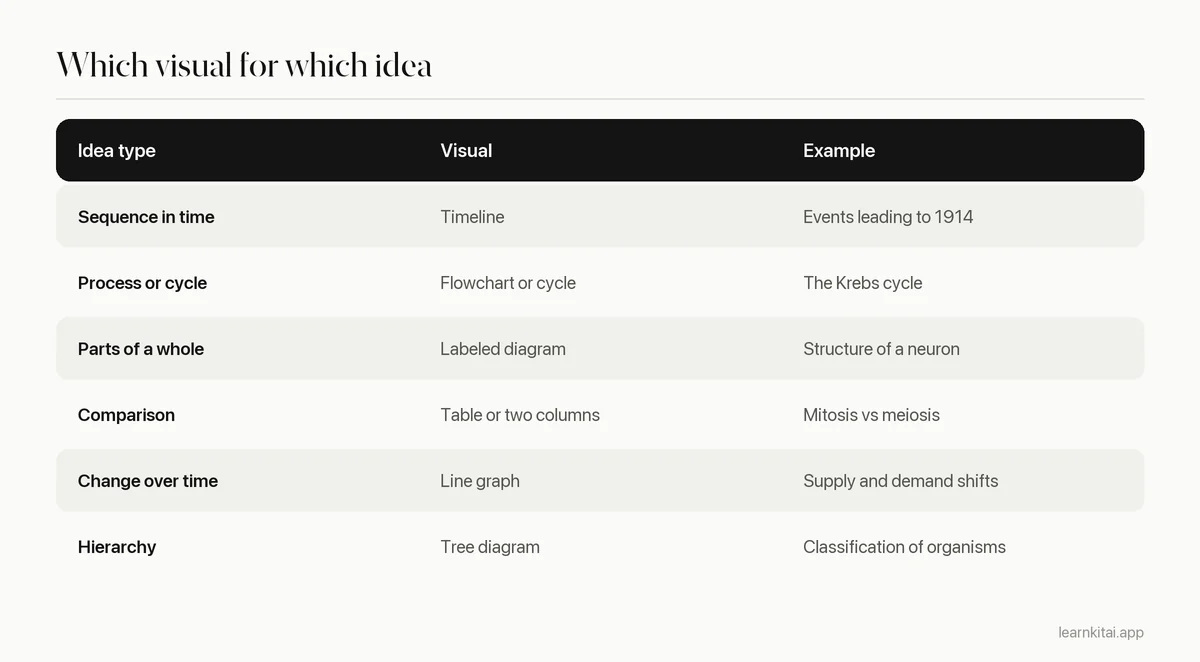
Take one idea, decide what kind of structure it has, and draw the simplest visual that shows that structure: a timeline for sequence, a flowchart for process, a labeled diagram for parts. Then write a short explanation next to it, and later practice redrawing and explaining it from memory.
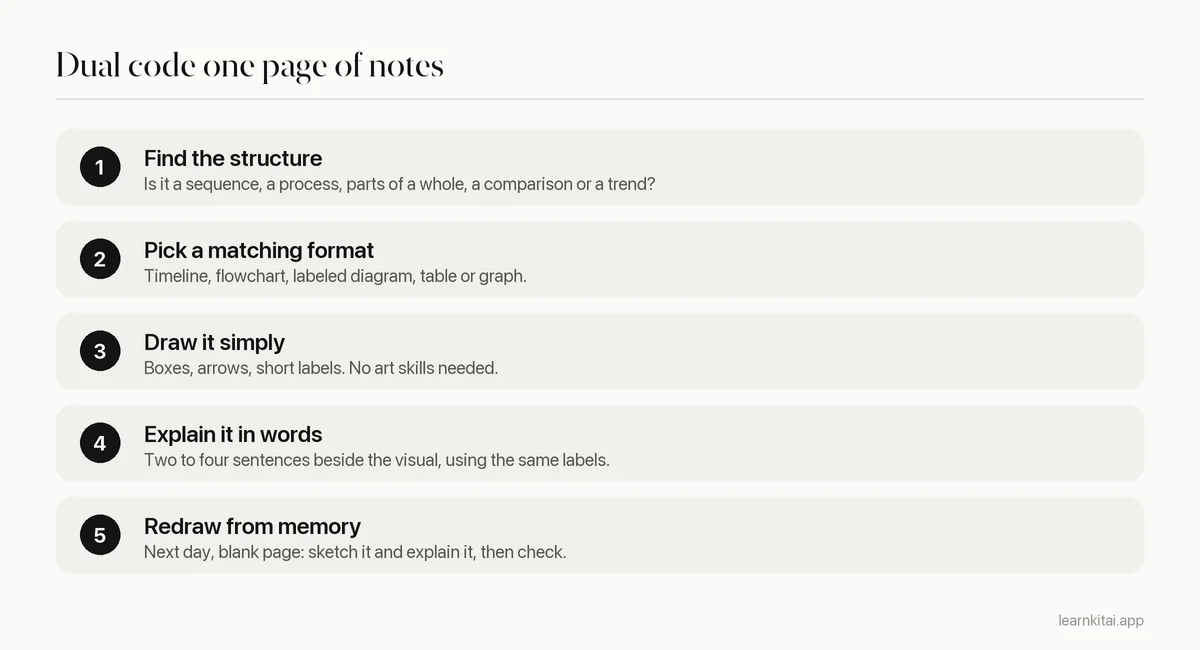
The last step, redrawing from memory, is where dual coding meets active recall. Looking at a diagram is still passive. Rebuilding it on a blank page and explaining each part out loud forces you to retrieve both codes, and shows you exactly which arrow or label you had forgotten. It works especially well for subjects full of structures, like anatomy.
Here is a quick example. Your biology notes say that in the lungs, oxygen moves from the alveoli into the blood while carbon dioxide moves the other way. As words alone, that is easy to mix up. Draw one small circle for an alveolus, a tube beside it for a capillary, and two arrows pointing in opposite directions, labeled O2 and CO2. Under it, write one sentence: each gas moves from where there is more of it to where there is less. Tomorrow, redraw it on a blank page and say the sentence aloud.
Dual coding for abstract subjects
Abstract ideas can be dual coded too. In economics, draw the graph rather than memorize the sentence. In literature, sketch a character map with arrows for relationships. In law, draw a flowchart of the test a court applies, with yes and no branches. In math, pair each formula with a small diagram of what it measures. The visual does not have to be beautiful. It has to show how the parts relate.
Common dual coding mistakes
- Decorating instead of explaining. Icons and colors that mean nothing add clutter, not memory.
- Copying a complex textbook figure. You will spend twenty minutes drawing and learn little. Simplify it to what you could redraw.
- Separating words and pictures. Put the explanation right next to the visual, using the same labels, so the two codes link.
- Only looking. A diagram you never redraw from memory is just another page to reread.
- Forcing it everywhere. A list of vocabulary words does not need a flowchart. Use visuals where there is structure to show.
Visual layouts also pair well with other note systems. A branching page is covered in our guide to mind map notes, and image-based cards are explained in anatomy flashcards. Grouping parts of a diagram into a few clusters also uses chunking, which makes big diagrams easier to hold in mind.
A short, well-structured summary is a good starting point for dual coding, because it already separates a chapter into clear sections with key terms. Generate one with LearnKit, then draw one visual per section and explain it in your own words.
Frequently asked questions
Do I need to be good at drawing to use dual coding?
No. Boxes, arrows, stick figures and short labels are enough. The goal is to show how parts relate, not to make art. Simple visuals are also easier to redraw from memory, which is when they help most.
Do colors help with dual coding?
Only when they carry meaning, such as one color for causes and another for effects. Random colors look nice but add little. Keep a small, consistent color code if you use one.
Are videos a form of dual coding?
They can be, since they combine narration and visuals. But watching is still passive. To get the full benefit, pause and sketch the key diagram yourself, then explain it without the video playing.
Sources
- The Cambridge Handbook of Multimedia Learning, Chapter 1, Cambridge University Press (Mayer, ed.) (Words plus pictures beat words alone on transfer tests in nine of nine studies, median effect size 1.50; links the approach to Paivio's dual-code theory.)
- Dual coding theory and education, Educational Psychology Review (Clark & Paivio, 1991) (Applies dual coding theory to teaching and learning.)
- Learning Styles: Concepts and Evidence, Psychological Science in the Public Interest (Pashler et al., 2008) (Found virtually no evidence that matching instruction to learning styles improves outcomes.)
- Improving Students' Learning With Effective Learning Techniques, Psychological Science in the Public Interest (Dunlosky et al., 2013) (Rated imagery use for text learning as low utility, with benefits limited to imagery-friendly material.)
Keep reading

Active Recall: Why Closing the Book Beats Rereading
Rereading feels productive but fades fast. Here is how to study by pulling answers out of memory, with a session plan, examples and the mistakes to avoid.

Chunking Memory: Fit More Into a Mind That Holds Four
Working memory holds only a few items at once. Chunking packs many details into each item. How it works, the research, and how to chunk any topic you study.
Mind Map Notes vs Linear Notes: Match the Material
Mind maps shine when ideas branch and connect. Linear notes win when ideas follow a sequence. A simple test tells you which one a topic needs.

Memory Palace Technique: Store Facts in Rooms You Know
The memory palace turns an ordered list into a walk through a place you already know. Here is how to build one for an exam, and when not to bother.

Anatomy Flashcards: Hide the Label, Not the Picture
Anatomy exams ask you to name what you see. Image occlusion cards train exactly that, and one good diagram can feed a dozen of them.