Memorize History Dates by Hanging Them on a Story
Pick ten to fifteen anchor dates you know cold, then place every other date relative to an anchor and tie it to a cause or effect. Turn each date into flashcards that ask in both directions, plus ordering questions, and review them at growing intervals before the exam.
A date on its own is just a four digit number, and your memory has no reason to keep it. That is why trying to memorize history dates from a list feels like pouring water into sand. The fix is not more repetition of the list. It is giving each date something to hold on to: an anchor, a neighbor and a reason.
This guide walks you through a system that works for any period, from ancient Rome to the Cold War. You will build a skeleton of anchor dates, link the rest to it with cause and effect, write flashcards that test the right thing, and space your reviews so the dates are still there on exam day.
Why do history dates slip out of your head so fast?
Isolated numbers carry no meaning, look alike, and interfere with each other. 1789 and 1798 are easy to swap because nothing ties either one to an event. Dates stick when they are connected to stories, causes and other dates you already know.
Memory is built on connections. A new fact survives when it links to something already stored. A date like 1789 links to nothing on its own, and similar numbers compete for the same space. The goal of every technique below is to give each date more hooks.
Stories are one of the strongest hooks we know of. In a classic experiment, Gordon Bower and Michael Clark asked one group of students to weave lists of ten nouns into stories while another group simply memorized them. The story builders later recalled about seven times as many words. History is already a story, so you are halfway there.
How to memorize history dates with anchors and chains
Choose a small set of anchor dates that define the course and learn them first. Then attach every other date to the nearest anchor with a short phrase like 13 years after, or a cause like this triggered that. You remember the chain, not a pile of numbers.
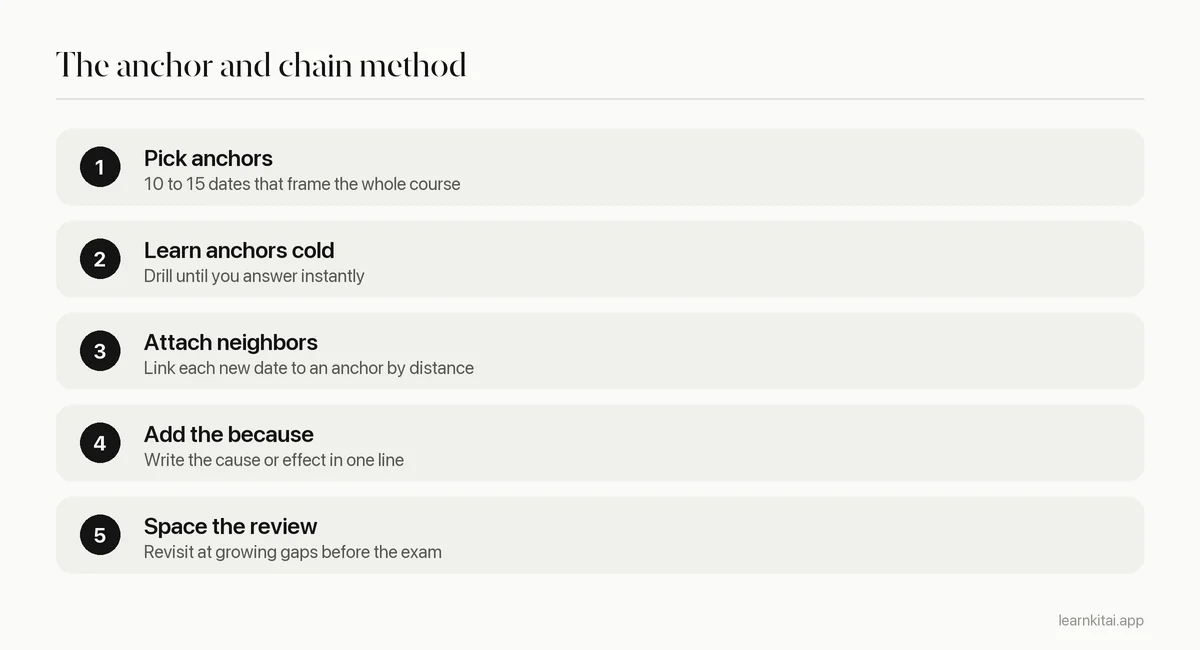
Here is a worked example for a unit on the Age of Revolutions. The anchor is 1789, the start of the French Revolution. Everything else hangs from it:
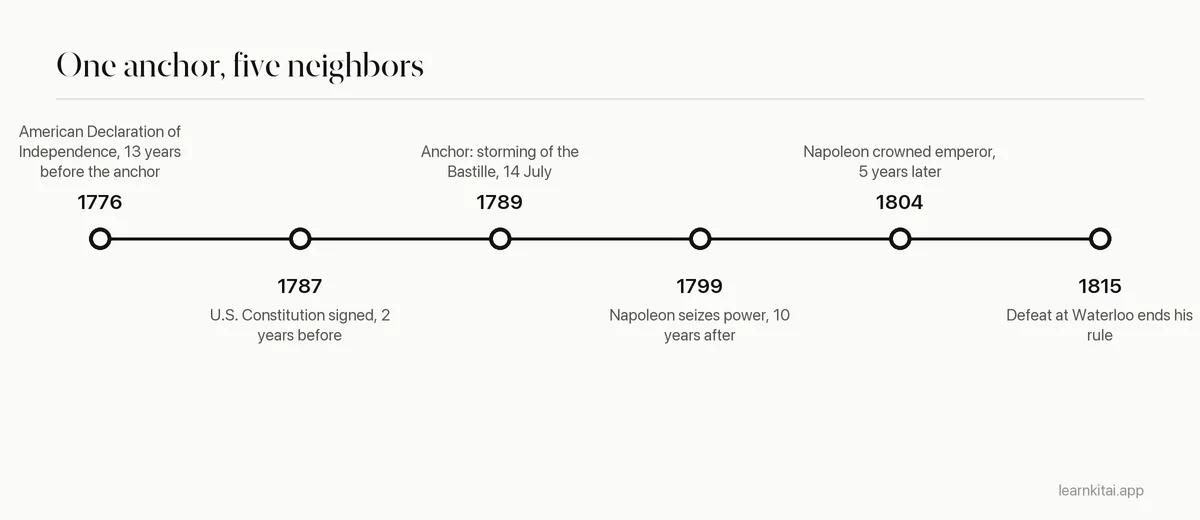
Notice what changed. You no longer hold six numbers. You hold one number and five short distances, each tied to a reason. The American Revolution inspired French reformers. A decade of upheaval opened the door for a general to seize power. That logic is what lets you rebuild a date you half forgot. It is also a version of chunking: six items become one meaningful unit.
Do mnemonics work for remembering dates?
Yes, for a handful of stubborn dates. The major system turns digits into consonant sounds so you can build a word or image, and a memory palace stores a sequence in places you know. Use them as a patch for hard cases, not as your main method.
The major system maps each digit to consonant sounds: 7 is k or g, 8 is f or v, 9 is p or b, and so on. Drop the leading 1 for most dates and 789 becomes k, f, p, which you can turn into the words coffee pie. Picture a crowd storming the Bastille armed with coffee and pie. It sounds silly, and that is the point: odd images are easy to recall.
Building these images takes time, so save them for the five or six dates that keep slipping. For a long ordered sequence, such as the order of English monarchs, a memory palace often works better, because the route through the rooms keeps the order for you.
What makes a good history date flashcard?
A good card asks one thing and works in both directions. Make one card that gives the event and asks for the date, one that gives the date and asks for the event, and ordering cards that ask which of two events came first and why.
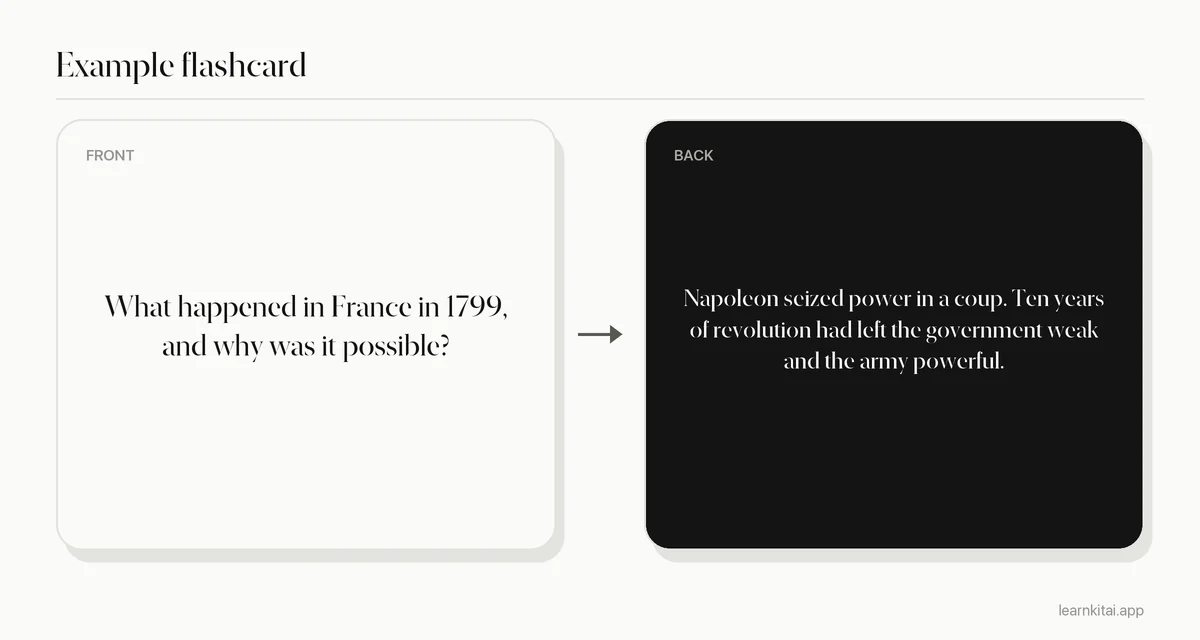
Ordering cards are underrated. Essay questions rarely ask for a date, but they constantly depend on sequence: did the reform come before or after the uprising? A card that asks which came first, and what that order means, trains exactly that. Keep each card focused on one fact, and see our guide to cloze deletion cards for a quick way to blank out dates inside a sentence.
How far apart should you review history dates?
Space reviews in proportion to how far away the exam is. In a large study, the best gap between sessions was about 20 to 40 percent of the time until a test one week out, and about 5 to 10 percent for a test one year out.
That finding comes from a study of more than 1,350 people who learned facts, reviewed them after a gap, and were tested up to a year later. As the test moved further away, the best gap grew in days but shrank as a share of the wait. You can read the abstract of this temporal ridgeline study on PubMed.
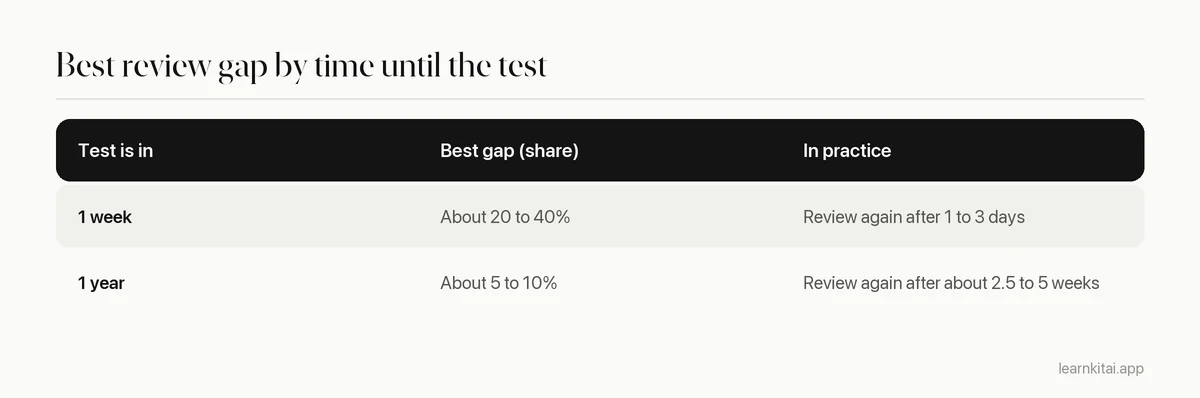
For a typical unit test two or three weeks away, a simple plan works: learn the anchors on day one, review them on day two or three, add neighbors through the first week, and do a full shuffled review every few days after that. Our guide to spaced repetition explains how to let a flashcard app handle the timing.
Common mistakes when memorizing dates
Learning dates from a list in order, testing only one direction, skipping the cause, and cramming all dates in one night. Each of these makes recall feel fine in your room and fall apart in the exam hall.
- Reviewing in the same order every time. You learn the list, not the dates. Shuffle.
- Only asking event to date. Exams also give a date or a quote and ask you to place it.
- Learning dates without the why. A cause gives you a way to rebuild a lost date by logic.
- Trying to learn every date in the textbook. Ask which dates your teacher actually stresses, and anchor those first.
- Saving it all for the last night. Dates crammed in one sitting fade within days, so they are gone for the final.
Dates are only one part of history. Once you memorize history dates for the unit, practice using them in short written answers that explain change over time. The same habits, connecting facts and testing yourself, run through every subject in our guide on how to study science as well.
Frequently asked questions
How many dates do I really need to know for a history exam?
Usually far fewer than the textbook lists. Most courses rest on a short list of key dates, and the rest can be placed roughly by decade or century. Check past papers and your teacher's review sheet to find the ones that matter.
Is it enough to know the approximate date?
Often yes. Many essay questions reward correct order and a sense of the period more than the exact year. Learn anchors precisely and place the rest by decade unless your course tests exact dates.
Should I draw my own timeline or use one from the book?
Draw your own. Choosing what goes on it, and writing the links between events, is part of the learning. A printed timeline is a good reference to check against afterward.
How do I stop mixing up similar dates?
Put the confusable pair on one card and ask which came first and why. Comparing them directly forces you to notice the difference, which is what separates them in memory.
Sources
- Spacing effects in learning: a temporal ridgeline of optimal retention, Psychological Science (Cepeda et al., 2008), via PubMed (More than 1,350 participants; optimal gap about 20 to 40% of a 1-week test delay and 5 to 10% of a 1-year delay.)
- Gordon Bower, Inventive Memory Researcher, Is Dead at 87, Association for Psychological Science (reprinting The New York Times) (Bower and Clark's story method: story builders recalled about seven times as many words as memorizers.)
Keep reading

How to Study Science: Think Like the Exam, Not the Textbook
Science asks for four kinds of knowledge at once: terms, mechanisms, problem skills and data. Here is how to study each one, and how they fit together.

Memory Palace Technique: Store Facts in Rooms You Know
The memory palace turns an ordered list into a walk through a place you already know. Here is how to build one for an exam, and when not to bother.
Chunking Memory: Fit More Into a Mind That Holds Four
Working memory holds only a few items at once. Chunking packs many details into each item. How it works, the research, and how to chunk any topic you study.

Spaced Repetition: Why Forgetting Is Part of the Plan
Reviewing right before you forget builds memories that last. Learn how long the gaps should be, with a ready schedule for exams one week to one semester away.
Essay Exam Prep: Write Your Answers Before You Sit Down
The best essay exam answers are mostly planned before the exam starts. Predict the prompts, build an evidence bank and rehearse outlines from memory.
Learn Programming Concepts by Predicting Before You Run
Watching tutorials feels like learning to code. Predicting output, tracing variables and rewriting from memory is what actually builds the skill.