Elaborative Interrogation: Ask Why to Make Facts Stick
Elaborative interrogation is a study strategy where you ask yourself why a fact is true and then try to answer it from what you already know. Linking the fact to a reason makes it easier to remember. It works best for factual material in a subject where you already have some background knowledge.
Read this fact: the hungry man got into the car. Now read: the hungry man got into the car to drive to a restaurant. The second version is easier to remember, because the action now has a reason. Elaborative interrogation makes you supply that reason yourself. For each fact you study, you ask why would this be true? and answer it from what you already know.
It sounds almost too simple. But it targets a real weakness of reading: facts that sit in your notes as isolated sentences, with nothing tying them to anything else. A why question hooks each new fact onto knowledge you already have, which gives your memory more ways back to it.
How does elaborative interrogation work?
You read a fact, stop, and ask why it makes sense. Then you write or say an answer based on what you know. The effort to explain links the new fact to your existing knowledge, and helps you notice how it differs from similar facts you might confuse it with.
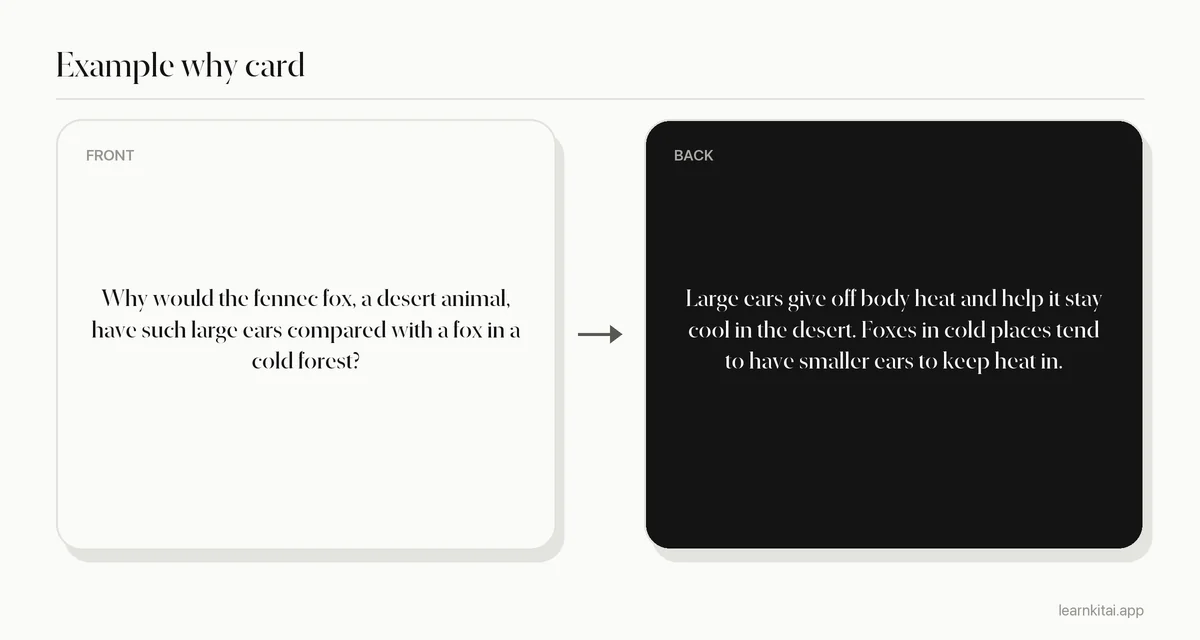
The most common prompt in the research has the form: Why would this fact be true of this X and not of some other X? For example: Why would this animal live in the desert and not in the forest? That second half matters. It pushes you to compare, and comparison is what stops similar facts from blurring together on an exam.
Does asking why actually improve memory?
Yes, for factual material. In an early study, people who asked themselves why for each sentence recalled about 72% correctly, against about 37% for people who simply read the sentences or were given the explanations. A major review rates the technique as moderately useful.
In a classic 1987 experiment led by Michael Pressley, students learned a list of sentences about different men, like the hungry man in the car. One group was asked Why did that man do that? for each sentence. A second group read sentences that already included an explanation. A third group just read. On the test, the group that generated its own explanations was far ahead.
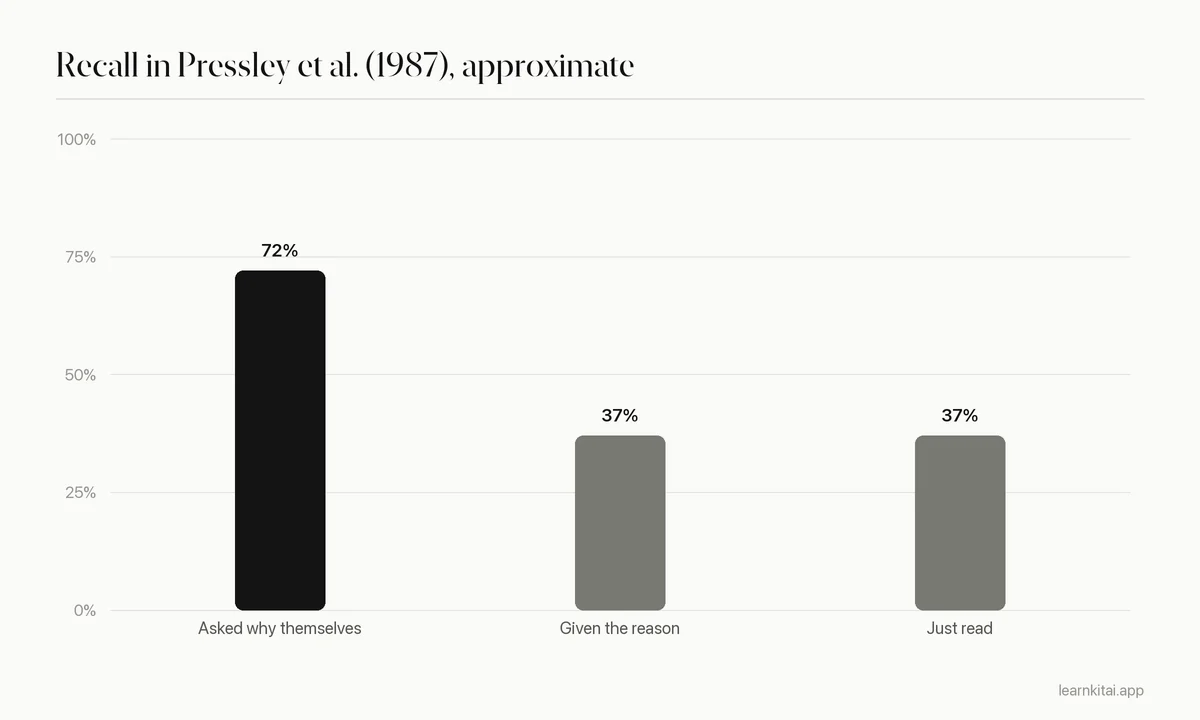
Look at the middle bar. Students who were handed the explanation did no better than those who just read. The benefit came from generating the answer, not from seeing it. That is the same lesson behind active recall: what you produce sticks better than what you receive.
The large 2013 review by Dunlosky and colleagues rated elaborative interrogation as having moderate utility. It has worked for learners from upper elementary school to university, and it needs very little training. The review held back a top rating because most studies used short fact lists and short delays, so less is known about long texts and long-term exams. Dunlosky explains the strategy for teachers in an American Educator article.
Who benefits most from asking why?
Students who already know something about the topic. The technique relies on prior knowledge to build an explanation, so the boost is larger in familiar subjects. In an unfamiliar subject, learn the basics first so you have something to connect new facts to.
One study gave Canadian and German students facts about Canadian provinces and German states. Each group knew more about its own country. Asking why helped everyone, but the boost was about twice as large in the familiar domain: roughly a 24% increase there, compared with about 12% in the unfamiliar one. Your background is the raw material for the explanation.
There is a second caution. When students read long texts and only answered a why prompt every page or two, the benefit shrank or even disappeared. The technique works best when it is applied often, to specific facts, not as an occasional big question at the end of a chapter.
What are good why questions for different subjects?
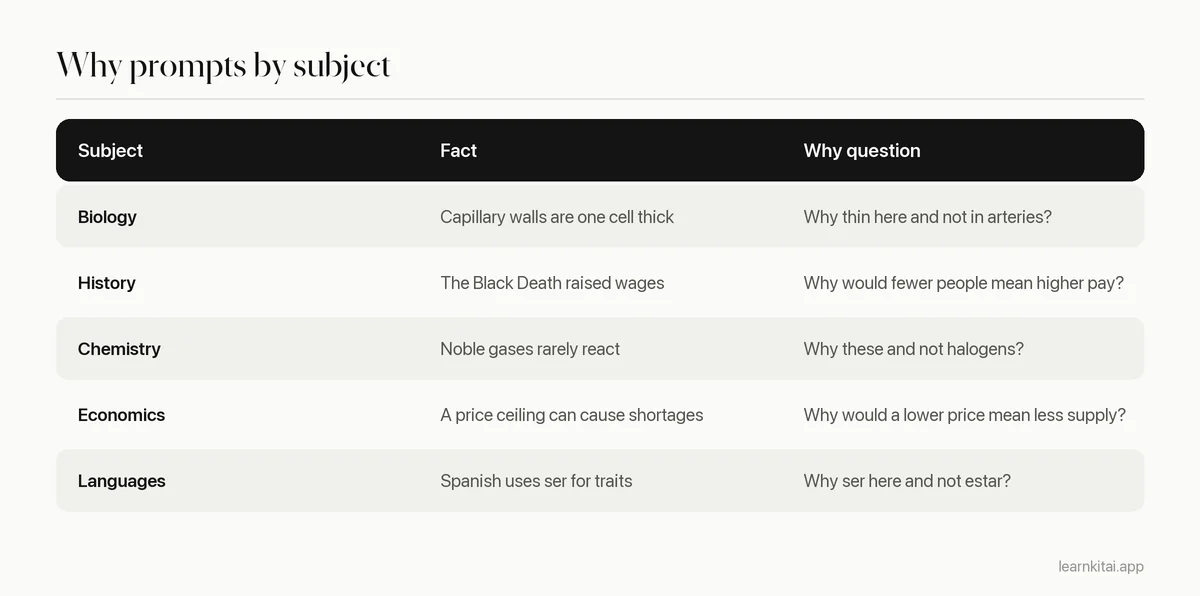
Aim each question at one specific fact and ask for a cause, a purpose or a contrast. Biology asks why a structure fits its function, history asks why something happened then, economics asks why a change follows from a cause, and chemistry asks why a reaction behaves differently from a similar one.
- Pick a fact from your notes. One sentence, one idea.
- Ask why it is true, and add a contrast if you can: why this and not that?
- Answer from memory first, in one or two sentences.
- Check your answer against the textbook or your teacher's notes.
- If your answer was wrong or thin, rewrite it correctly and keep the card for review.
Here is the routine in action. Your notes say that red blood cells have no nucleus. You ask: why would a red blood cell lack a nucleus when almost every other cell has one? From memory you write: more room for hemoglobin, so it can carry more oxygen. You check the textbook, which confirms the extra space for hemoglobin and adds that the cell's flexible disc shape helps it squeeze through narrow capillaries. You add that detail in a different color. The whole loop took about a minute, and the fact is now tied to a reason you can rebuild on an exam even if the exact sentence slips away.
How does elaborative interrogation fit with other methods?
Use it while you first learn a fact to make it meaningful, then turn the why questions into flashcards for spaced review. For processes and complex ideas, step up to self-explanation or the Feynman technique, which ask you to explain a whole chain rather than one fact.
Elaborative interrogation is a close cousin of self-explanation, where you explain the steps of a worked problem or how a new idea links to the last one. For a full concept, the Feynman technique is the bigger tool. And because a why card is still a question you answer from memory, it slots straight into a spaced repetition deck.
Open questions are the easiest way to practice this at scale. LearnKit can generate open questions with sample answers from your notes or a chapter, and many of them naturally take the form of why and how questions. Answer in your own words first, then compare.
Frequently asked questions
Is elaborative interrogation the same as elaborative rehearsal?
They are related. Elaborative rehearsal is the broad idea of linking new information to what you already know. Elaborative interrogation is one specific way to do that: asking why a fact is true and answering it.
How many why questions should I ask per study session?
Ask one for each key fact rather than one per chapter. For a typical page of notes that might be five to ten questions. Short, frequent questions work better than a few large ones.
What if I cannot answer the why question?
Make your best guess, then look it up. A failed attempt followed by the right answer still helps. If you cannot even guess, you may need to learn the background first before the technique can work.
Sources
- Improving Students' Learning With Effective Learning Techniques, Psychological Science in the Public Interest (Dunlosky et al., 2013) (Elaborative interrogation rated moderate utility; Pressley et al. (1987) about 72% vs 37%; larger effects with higher prior knowledge (about 24% vs 12% increase); infrequent prompts dilute the effect.)
- Strengthening the Student Toolbox: Study Strategies to Boost Learning, American Educator, American Federation of Teachers (Dunlosky, 2013) (Defines elaborative interrogation as generating an explanation for why a stated fact is true and describes it as promising.)
Keep reading

Active Recall: Why Closing the Book Beats Rereading
Rereading feels productive but fades fast. Here is how to study by pulling answers out of memory, with a session plan, examples and the mistakes to avoid.
The Feynman Technique: Find Your Gaps by Teaching
If you cannot explain it simply, you have found what to study next. The four steps of the Feynman technique, a worked example and the traps that make it fail.
Self Explanation: Talk Yourself Into Understanding
Stopping after each step to ask why it works is one of the simplest study habits with solid research behind it. Here are the prompts and a worked example.

Spaced Repetition: Why Forgetting Is Part of the Plan
Reviewing right before you forget builds memories that last. Learn how long the gaps should be, with a ready schedule for exams one week to one semester away.
Open Ended Questions: Study by Explaining, Not Spotting
Questions with no options to pick from force you to build the answer yourself. Here are 12 question stems, a marking method and a weekly routine.