Open Ended Questions: Study by Explaining, Not Spotting
Open ended questions ask you to produce an answer in your own words instead of choosing from options. They help you study because building an answer from memory is harder than recognizing one, and that effort strengthens recall. Answer in writing, then compare against a model answer and fix the gaps.
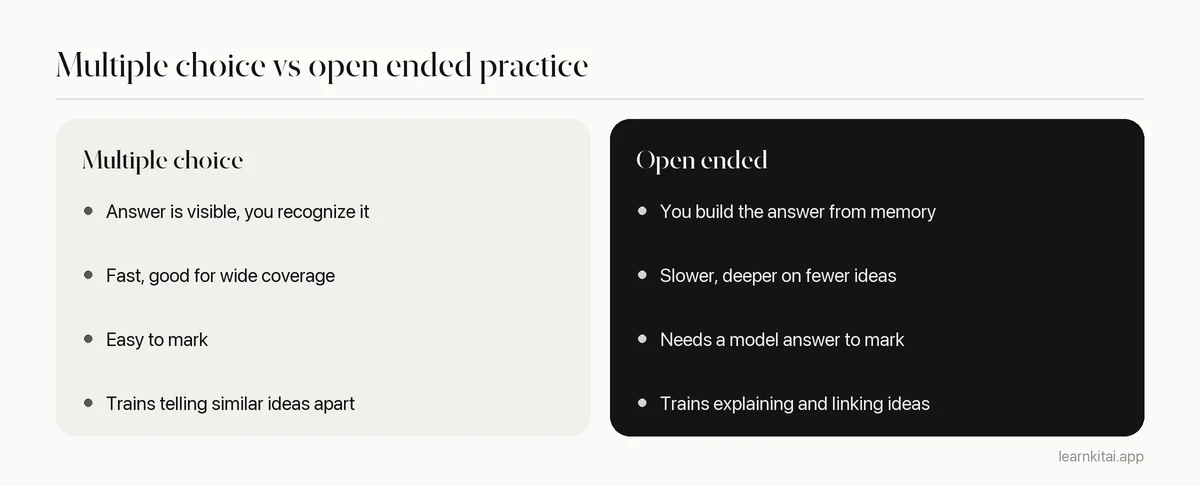
When a quiz gives you four options, part of the work is done for you. The right answer is on the page, and you only need to recognize it. Open ended questions take that support away. You have to pull the idea out of memory, put it in order and say it clearly. That is exactly what essays, oral exams and problem sets will ask of you.
This post covers why open questions are worth the extra effort, a set of question stems you can reuse in any subject, and a simple way to grade yourself honestly. It is part of our practice testing guide.
Why are open ended questions good for studying?
They make you recall and organize information rather than recognize it, which builds stronger memory. With feedback afterward, short answer practice has led to better retention than multiple choice practice or rereading.
Sean Kang, Kathleen McDermott and Henry Roediger compared quiz formats in a 2007 study. Students read short journal articles and took either a multiple choice quiz, a short answer quiz, or read key statements again. When the quizzes came with corrective feedback, the short answer group did best on the final test three days later. The authors concluded that more demanding retrieval brings greater benefit.
There is a catch in the same paper. Without feedback, students got many short answer items wrong at first and benefited less. So open questions work best when you check your answer right after writing it.
What makes a good open question for studying?
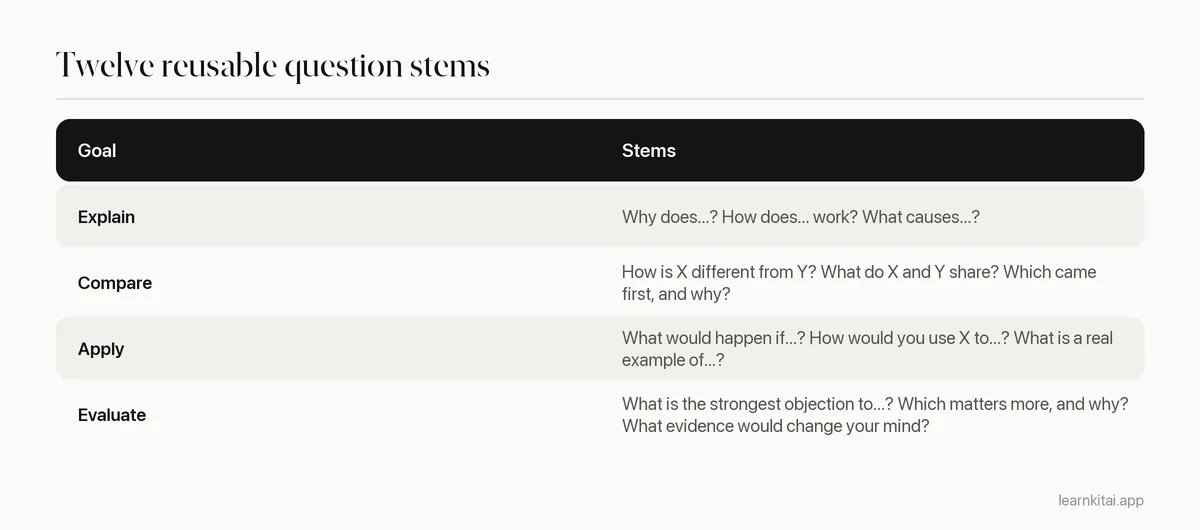
A good study question has one clear focus, cannot be answered with a single word, and asks you to explain, compare, apply or predict. It should match the kind of thinking your exam will reward.
"What is osmosis?" is open, but it mostly asks for a memorized definition. "Why does a red blood cell burst in pure water?" asks you to use the definition. The second question is harder, and it shows whether you actually understand the idea. Aim for a mix: a few recall questions to warm up, then mostly questions that make you reason.
- History: Why did the treaty fail within ten years? What would a critic at the time have said?
- Biology: What would happen to blood glucose if the pancreas stopped making insulin?
- Economics: How is a price ceiling different from a subsidy in its effect on supply?
- Literature: How does the narrator's unreliability change the meaning of the final chapter?
How do you grade your own answers?
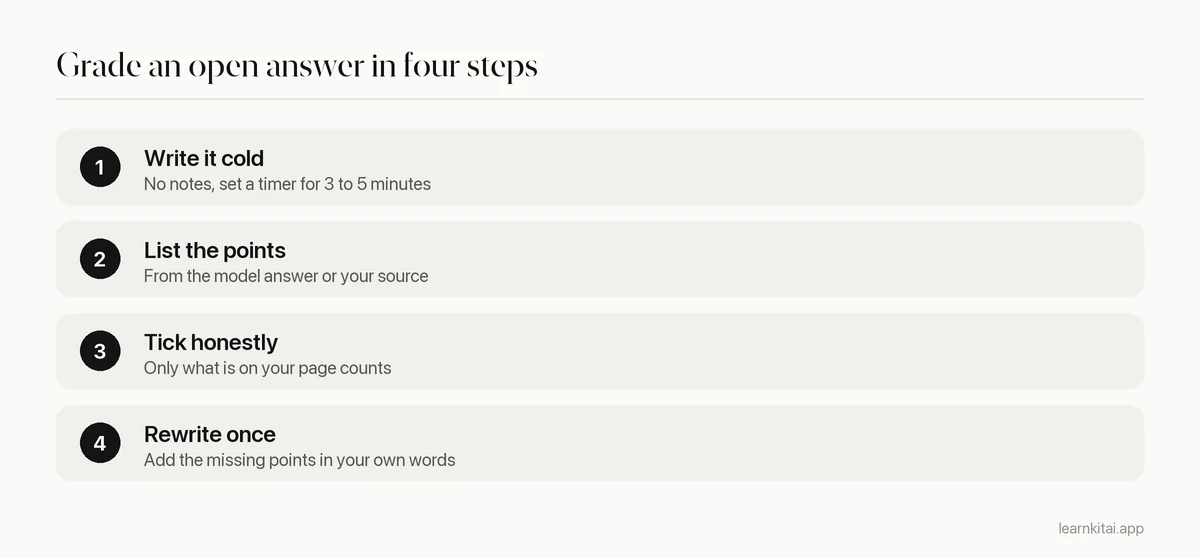
Write your answer first, without notes. Then compare it with a model answer or your source, point by point. Count the key ideas you included, mark anything missing or wrong, and rewrite the answer once.
Self grading fails when you read the model answer and think "yes, that is what I meant". To avoid that, list the marking points before you compare. Three to five points per question is typical. Then tick only the points that are actually in your writing.
A worked example
Question: "Why does a red blood cell burst in pure water?" A first attempt might read: "Because water goes into the cell." The marking points from the textbook are: the cell's inside has more dissolved solutes than pure water, water moves by osmosis toward the higher solute concentration, the cell has no wall to resist the pressure, so it swells and bursts. The first attempt hits one point out of four. The rewrite adds the solute difference, names osmosis, and explains the missing cell wall. That gap, from one point to four, is exactly the learning you would have missed by rereading.
Notice that the weak first answer was not wasted. It showed precisely which links were missing. That is the real value of open ended questions: they make gaps visible in a way that a page of familiar notes never will.
How many open questions should you practice?
Fewer than you would for multiple choice, because each one takes longer. Five to ten good questions per topic, answered and graded, usually beat thirty skimmed ones.
A workable weekly rhythm is to write two or three open questions after each lecture, answer them the next day, and come back to the ones you struggled with a few days later. That spacing matters as much as the questions themselves, which is the core idea of spaced repetition.
If you are short on questions, LearnKit can generate open questions from your notes or a PDF, each with a sample answer. You write your answer first, then reveal the sample to grade yourself.
Mistakes to avoid with open questions
- Reading the sample answer first. Once you have seen it, you are rereading, not recalling.
- Writing only definition questions. Push at least half your questions into why, how and what if.
- Grading on vibes. Without a list of marking points, almost every answer looks good enough.
- Skipping the rewrite. The rewrite is where the missing idea gets stored. It takes two minutes.
Open questions also pair well with other techniques. Asking yourself why a fact is true is the core of elaborative interrogation, and explaining a step in your own words is self explanation. For essay exams in particular, see our guide to essay exam preparation. The broad research picture, summarized in a 2013 review of study techniques, rates practice testing among the most useful methods students can use.
Frequently asked questions
Are open ended questions only useful for essay exams?
No. They help with any exam that rewards understanding, including multiple choice exams with application questions. Being able to explain an idea makes it much easier to spot the right option.
How long should my answer to a study question be?
Usually three to six sentences. Long enough to include the key points and the reasoning that links them, short enough that you can answer several questions in one session.
What if I cannot answer an open question at all?
Write whatever fragments you can, then check the source and write the answer in your own words. Come back to the same question in two or three days. A blank attempt followed by feedback still helps.
Sources
- Test format and corrective feedback modify the effect of testing on long-term retention, European Journal of Cognitive Psychology (Kang, McDermott and Roediger, 2007) (With feedback, short answer quizzes produced the best performance on a final test 3 days later)
- Improving Students' Learning With Effective Learning Techniques, Psychological Science in the Public Interest (Dunlosky et al., 2013) (Practice testing rated high utility among ten techniques)
Keep reading

Practice Testing: The Study Habit That Beats Rereading
Testing yourself is not just a way to check what you know. It is one of the best-supported ways to learn. Here is how to do it well, week by week.
Multiple Choice Strategies That Beat Guessing
Cover the options, answer first, then eliminate. Plus what the data says about changing answers, and how to study so the right option jumps out.
Self Explanation: Talk Yourself Into Understanding
Stopping after each step to ask why it works is one of the simplest study habits with solid research behind it. Here are the prompts and a worked example.
Essay Exam Prep: Write Your Answers Before You Sit Down
The best essay exam answers are mostly planned before the exam starts. Predict the prompts, build an evidence bank and rehearse outlines from memory.
The Testing Effect: Why a Quiz Beats Another Reread
Taking a test is not just a way to measure memory. It changes memory. Here is what the research shows and how to use it this week.