The Feynman Technique: Find Your Gaps by Teaching
The Feynman technique is a way to test your understanding by explaining a topic in plain words, as if to a beginner. You pick a concept, explain it from memory, note where you get stuck or fall back on jargon, return to the source to fix those gaps, then simplify and explain again.
Most students can define a term long before they understand it. You can say that osmosis is the movement of water across a semipermeable membrane and still have no idea which way the water goes or why. The Feynman technique catches that gap. You explain the idea in plain language, as if to someone who has never heard of it, and you watch for the exact moment your explanation turns vague.
The method is named after the physicist Richard Feynman, who was famous for explaining hard ideas in simple words. The four-step recipe that circulates today is a modern summary inspired by his teaching, not a procedure he wrote down himself. It still works well, and the research on explaining and teaching shows why.
What are the four steps of the Feynman technique?
Choose one concept. Explain it in plain words, on paper or aloud, without notes. Mark every spot where you stalled, hand-waved or used jargon, then go back to the source to fix it. Finally, simplify and use an analogy, and explain it again from the start.
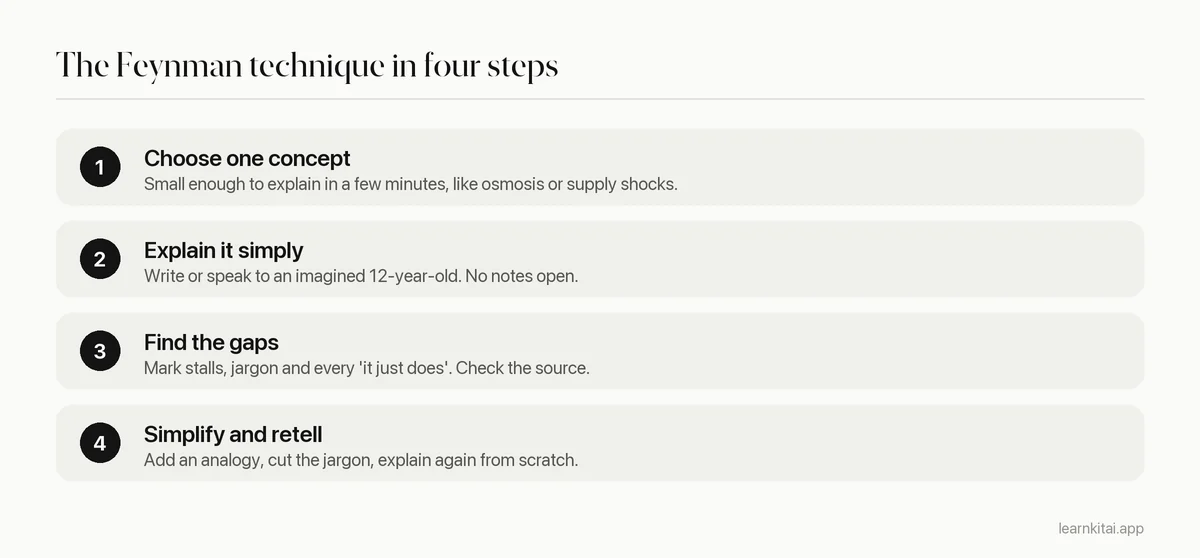
Step 1: Choose a concept you can explain in five minutes
Pick something narrow. Cell biology is a course. Why a cell placed in salt water shrinks is a concept. Write the name at the top of a blank page. If you are working from a long chapter, split it into three to five concepts and run the technique on each.
Step 2: Explain it to a beginner
Close your notes. Write the explanation, or say it out loud while recording on your phone. Imagine a curious 12-year-old who keeps asking why. Use short sentences. Every technical term must be explained the first time you use it. This step is a form of active recall: you are building the idea from memory, not copying it.
Step 3: Find the gaps and fill them
Read your explanation back and mark three kinds of trouble: places you stopped, places you used a big word to cover a fuzzy idea, and places where you wrote something like and then it just happens. Those marks are your study list. Now open the textbook, but only for the marked parts.
Step 4: Simplify and retell
Rewrite the explanation from scratch with the gaps filled. Add one analogy and one concrete example. If the new version is shorter and clearer than the first, you have learned something. If it is longer and full of hedges, go around the loop again.
What does the Feynman technique look like in practice?
Here is a real loop on osmosis. The first draft names the process but cannot say which way water moves or why. Checking the source fixes the direction, and an analogy makes the rule easy to remember on an exam.
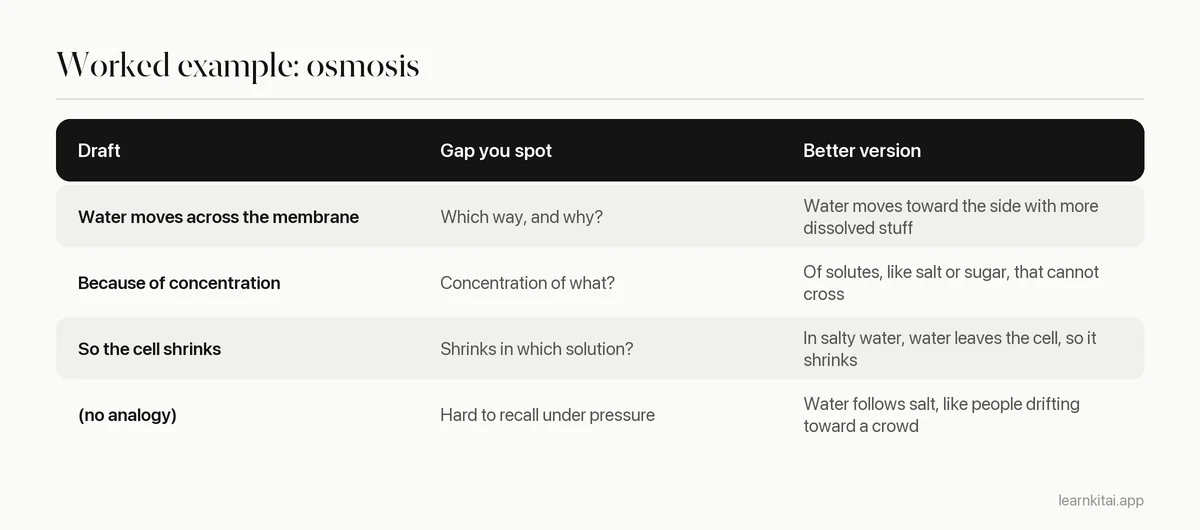
Notice that none of the first draft was wrong. It was just empty. That is the most common finding, and the most useful one, because a vague answer often loses marks on exams that ask you to explain or predict.
Why does explaining something help you learn it?
Explaining forces you to connect ideas into a chain of causes, which exposes missing links that rereading hides. People also overrate how well they understand how things work until they try to explain them, and simply expecting to teach can change how carefully you study.
Researchers at Yale named one part of this the illusion of explanatory depth. In a 2002 series of studies, people rated how well they understood everyday devices, then tried to write step-by-step explanations. Their confidence dropped once they had to explain. The illusion was stronger for explanations than for facts or procedures. The Feynman technique is a deliberate way to pop that illusion before an exam does it for you.
Teaching helps even before you teach. In a 2014 study in Memory & Cognition, students who studied a passage expecting to teach it later recalled more of it, organized their recall better and answered more questions about the main points than students who expected a test. Nobody actually taught. The expectation alone changed how they studied.
There is also a large body of work on self-explanation, where learners explain the steps or reasons as they study. The review of study techniques by Dunlosky and colleagues rated it as moderately useful and described a classic logic study in which all groups scored 90% or better on practice problems, yet students who had explained their reasoning did far better on harder transfer problems. Read more in our guide to self-explanation.
When should you use the Feynman technique?
Use it for concepts and processes that you need to understand, predict or apply, like a biological pathway or an economic model. It is slow for lists of facts, dates and vocabulary, where flashcards and spaced review do the job faster.
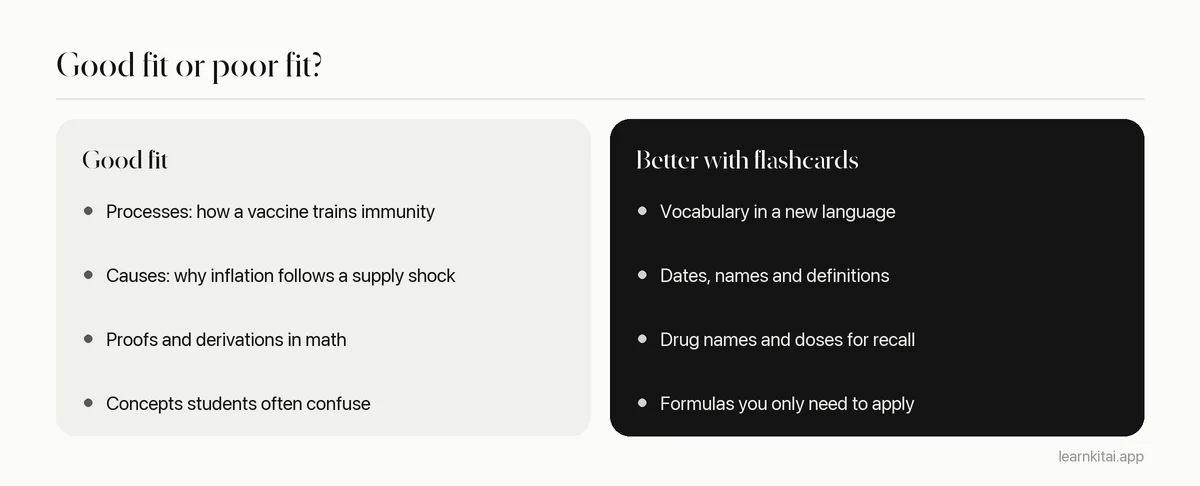
A good rhythm is to use the Feynman technique once when you first study a concept, then switch to quick recall for upkeep. If a question begins with why, our guide to elaborative interrogation shows a faster, lighter version of the same idea for single facts.
Common mistakes that make it fail
- Explaining with the book open. Then you are copying, not testing. Close everything first.
- Choosing a whole chapter. The explanation turns into a summary. Narrow it to one concept.
- Hiding behind jargon. If you write diffusion occurs, ask yourself what that actually means and say it in plain words.
- Skipping the retell. Finding gaps without fixing them only proves you have gaps. The second explanation is where learning locks in.
- Never checking accuracy. A simple explanation can also be simply wrong. Compare your final version against a trusted source.
Can you combine the Feynman technique with other methods?
Yes. Run the Feynman loop once to build understanding, then turn the gaps you found into questions for later review. Open questions with sample answers are especially useful, because you can compare your explanation with a model one.
Open-ended prompts are a natural partner. Write a question like Explain why a red blood cell bursts in pure water, answer it in full, then check. Our guide to open-ended questions shows how to write good ones. If you would rather not write them yourself, LearnKit can generate open questions with sample answers from your notes or a chapter, so you can compare your plain-language version against a model answer.
Frequently asked questions
Did Richard Feynman invent the Feynman technique?
Not as a formal method. The four steps are a modern summary inspired by how Feynman explained physics and how he insisted on understanding over memorized labels. The name stuck because his teaching style is a good model for the idea.
How long does one Feynman technique round take?
For a single concept, plan on 15 to 25 minutes: five to explain, five to ten to check the gaps, and five to retell. Bigger topics should be split into several concepts rather than done in one long round.
Do I have to explain it out loud?
No. Writing works well and leaves a record you can compare later. Speaking is faster and good for practice on the go. Many students write the first draft and speak the final retell.
Sources
- The misunderstood limits of folk science: an illusion of explanatory depth, Cognitive Science (Rozenblit & Keil, 2002) (People overrate their understanding of how things work until asked to explain; the illusion is stronger for explanations than for facts.)
- Expecting to teach enhances learning and organization of knowledge in free recall of text passages, Memory & Cognition (Nestojko et al., 2014) (Students expecting to teach recalled more and better organized information than students expecting a test.)
- Improving Students' Learning With Effective Learning Techniques, Psychological Science in the Public Interest (Dunlosky et al., 2013) (Self-explanation rated moderate utility; in Berry (1983) all groups scored 90% or better on practice problems, but self-explainers did much better on transfer.)
Keep reading

Active Recall: Why Closing the Book Beats Rereading
Rereading feels productive but fades fast. Here is how to study by pulling answers out of memory, with a session plan, examples and the mistakes to avoid.
Elaborative Interrogation: Ask Why to Make Facts Stick
A single question, why is this true, can turn a loose fact into one you remember. How to use elaborative interrogation, with prompts for every subject.
Self Explanation: Talk Yourself Into Understanding
Stopping after each step to ask why it works is one of the simplest study habits with solid research behind it. Here are the prompts and a worked example.
The Blurting Method: Empty Your Head to Fill It
Write down everything you remember, then check what is missing. A simple revision method with a step-by-step routine, a worked example and four variations.
Open Ended Questions: Study by Explaining, Not Spotting
Questions with no options to pick from force you to build the answer yourself. Here are 12 question stems, a marking method and a weekly routine.