Spaced Repetition: Why Forgetting Is Part of the Plan
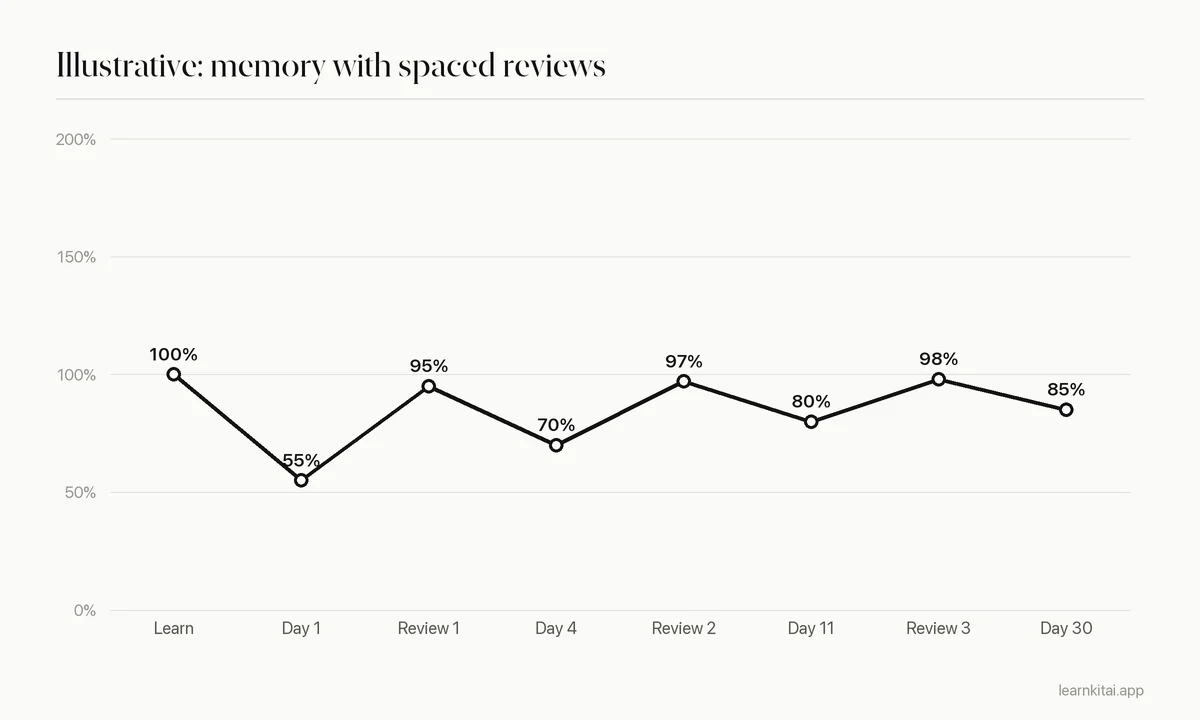
Spaced repetition means reviewing material in several sessions with growing gaps between them, instead of all at once. Each review comes after some forgetting has started, so recalling it takes effort and the memory is rebuilt stronger. The best first gap depends on how far away your test is.

Cramming works, for about a day. You can pour a chapter into your head the night before and hold it until noon. A week later most of it is gone. Spaced repetition flips that pattern. You study the same material in several shorter sessions, separated by gaps, and you let yourself forget a little in between. That forgetting is not a flaw in the plan. It is what makes each review count.
This guide explains why gaps work, how long they should be for your exam date, and how to build a schedule that does not collapse in week two.
Why does spacing out reviews work better than cramming?
When you review something you have half forgotten, you have to work to recall it, and that effort strengthens the memory more than reviewing something still fresh. Cramming keeps everything fresh, so each extra repetition adds very little.
Memory researchers have studied this for more than a century. Hermann Ebbinghaus measured his own forgetting in the 1880s, and in 2015 two researchers at the University of Amsterdam repeated his method over 70 hours of testing and got a very similar forgetting curve: a steep drop in the first hours and days, then a slower decline. We look at that curve in more detail in why you forget after exams.
The practical lesson is simple. A review placed right after learning hits a memory that is still bright, so it barely needs work. A review placed after some fading forces real retrieval. That is why spacing pairs so well with active recall: the gap creates the challenge, and testing yourself turns the challenge into learning.
The evidence base is unusually large. A 2006 review by Nicholas Cepeda and colleagues pulled together 839 comparisons from 317 experiments, and the 2013 review of study techniques by Dunlosky and colleagues rated distributed practice as one of only two techniques with high utility for students.
How long should the gaps between reviews be?
It depends on when you need the memory. In a large study, the best gap was about 20 to 40% of the time until the test when the test was a week away, falling to about 5 to 10% when the test was a year away. Longer horizons call for longer gaps.
The clearest answer comes from a 2008 study by Cepeda and colleagues. More than 1,350 people learned a set of facts, reviewed them after a gap of up to three and a half months, and took a final test up to a year later. For each test date there was a sweet spot. Too short a gap wasted the review. Too long a gap let too much slip away. The best gap grew as the test moved further out, but shrank as a share of the total time.
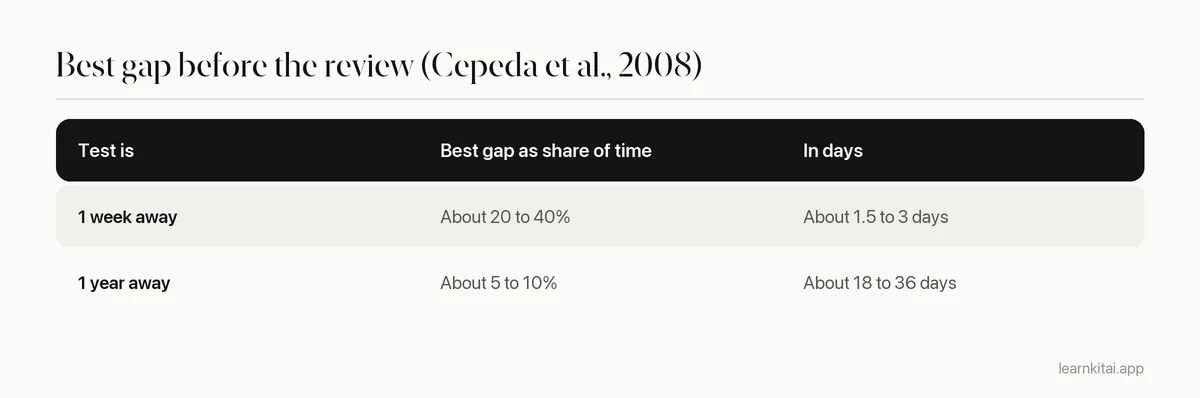
You do not need to calculate percentages for every card. Treat this as a direction, not a formula. If your exam is close, review within a couple of days. If you want to remember something for a career, like anatomy for medicine or vocabulary for a language, let the gaps stretch into weeks and months.
What does a spaced repetition schedule look like for an exam?
For an exam about four weeks away, learn the topic, review it the next day, then after about three days, a week and two weeks. Each review is a short self-test, not a reread. Topics you keep missing get an extra review.
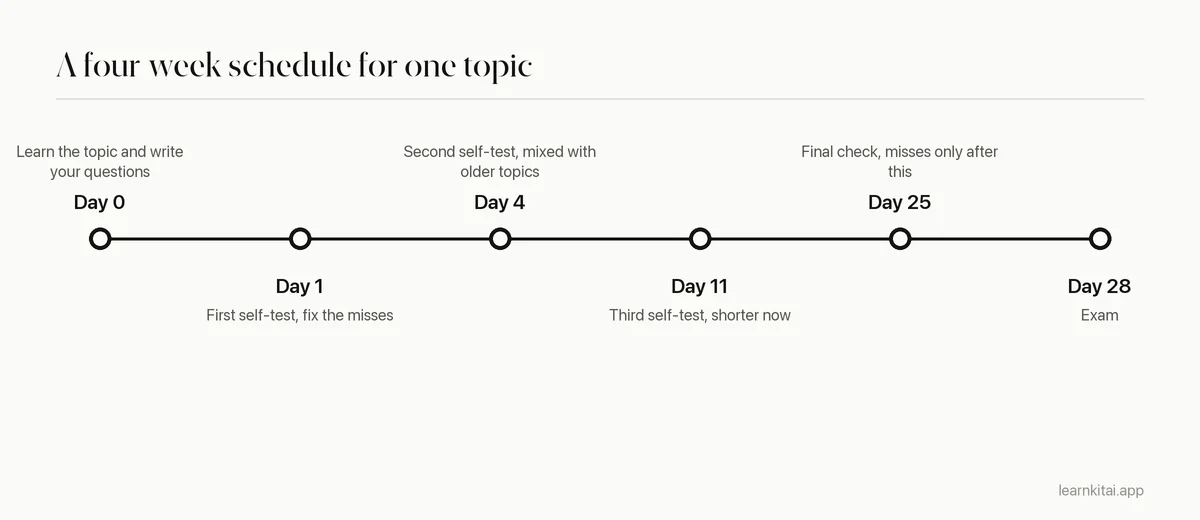
Run this for each new topic as you learn it and the reviews will overlap naturally. On any given day you might learn one new topic and review three older ones. That overlap is a feature: it mixes subjects, which adds the benefits of interleaved practice. For a full term plan, see our guide to building a study schedule.
Expanding or equal gaps?
Many apps use gaps that grow each time, like 1, 3, 7 and 14 days. Research has not crowned a clear winner between growing and equal gaps. What matters more is that gaps exist at all, that each review is a real retrieval attempt, and that the last review lands not too long before you need the knowledge.
How do you run spaced repetition with flashcards?
Use a system that decides what is due for you. With paper cards, the Leitner box moves each card to a slower box when you get it right and back to the first box when you miss it. Digital apps do the same with an algorithm.
- Write cards that ask one clear question each. Big cards are hard to grade honestly.
- Answer each card out loud or on paper before you flip it.
- Mark it right or wrong with no partial credit.
- Right answers wait longer before you see them again. Wrong answers come back soon.
- Cap new cards per day so reviews never pile up beyond what you can finish.
The paper version is explained step by step in the Leitner system. If your deck keeps growing faster than you can review it, our guide on how many flashcards per day shows how to set a sane limit.
Common spaced repetition mistakes
- Rereading instead of recalling. A spaced reread is better than a crammed reread, but a spaced self-test is far better than both.
- Starting too late. You cannot space reviews across a weekend. Begin the first time you meet the material.
- Adding too many new cards. Every new card creates future reviews. Fifty new cards a day becomes hundreds of reviews a week later.
- Skipping days. Missing a day doubles the next one. Short daily sessions are easier to protect than long weekly ones.
- Never stopping to understand. Spacing helps you keep what you know. It cannot fix a concept you never understood, so explain it first.
If writing questions is what stops you from starting, LearnKit can turn a PDF, lecture recording or set of notes into flashcards you can then review on your own schedule. Check the cards against your notes, delete the trivial ones, and keep the deck small enough to finish.
Frequently asked questions
Is spaced repetition only for flashcards?
No. You can space any kind of review: practice problems, blurting sessions, past paper questions or explaining a topic aloud. Flashcards are just the easiest format to schedule because each card is small and easy to grade.
Can I use spaced repetition if my exam is in three days?
You can still space within those days. Study a topic, test yourself that evening, then again the next day and on the morning of the exam. It is less powerful than a longer schedule, but it beats a single cram session.
What happens if I miss a review day?
Nothing breaks. Do the overdue reviews first the next day and add no new material until you catch up. A slightly longer gap is usually fine, and you may find you remember more than you expected.
Sources
- Spacing effects in learning: a temporal ridgeline of optimal retention, Psychological Science (Cepeda et al., 2008) (More than 1,350 participants; the optimal gap fell from about 20 to 40% of a 1-week test delay to about 5 to 10% of a 1-year delay.)
- Distributed practice in verbal recall tasks: A review and quantitative synthesis, Psychological Bulletin (Cepeda et al., 2006) (839 assessments of distributed practice from 317 experiments in 184 articles.)
- Replication and Analysis of Ebbinghaus' Forgetting Curve, PLOS ONE (Murre & Dros, 2015) (A 70-hour replication that reproduced the shape of Ebbinghaus' forgetting curve.)
- Improving Students' Learning With Effective Learning Techniques, Psychological Science in the Public Interest (Dunlosky et al., 2013) (Rated distributed practice as high utility.)
Keep reading

Active Recall: Why Closing the Book Beats Rereading
Rereading feels productive but fades fast. Here is how to study by pulling answers out of memory, with a session plan, examples and the mistakes to avoid.

The Leitner System: Five Boxes That Schedule Your Reviews
A shoebox, some dividers and one simple rule give you spaced repetition without an app. Here is a ready-to-use five-box schedule and how to adapt it to your exam date.
The Forgetting Curve: Why Exam Knowledge Vanishes
You studied hard, passed, and a month later it is mostly gone. The forgetting curve explains why, and what kind of studying makes knowledge last.
Interleaved Practice: Why Mixed Sets Feel Worse but Work
Doing ten problems of the same type feels great and teaches less than you think. How to mix topics so you learn to choose the right method on exam day.
How Many Flashcards per Day? Count Reviews, Not Cards
The right number of new flashcards depends on the reviews they create later. A simple formula, a budget table and the warning signs that you are adding too many.