Test Anxiety: How to Steady Your Mind Before the Exam
To manage test anxiety, practice under exam-like conditions so the real thing feels familiar, sleep well, and in the minutes before the exam write briefly about your worries. Treat a racing heart as energy rather than danger. During the test, skip stuck questions and come back. If anxiety is severe, talk to a counselor.
You studied. You knew the material last night. Then the paper lands on the desk, your heart speeds up, and the first question looks like it is written in another language. That is test anxiety, and it is one of the most frustrating feelings in school because it hides knowledge you actually have.
This guide covers what is going on, the techniques with real evidence behind them, and a short routine for before and during the exam. It is educational, not medical advice. If anxiety is affecting your daily life, a campus counselor or doctor is the right next step.
What is test anxiety, really?
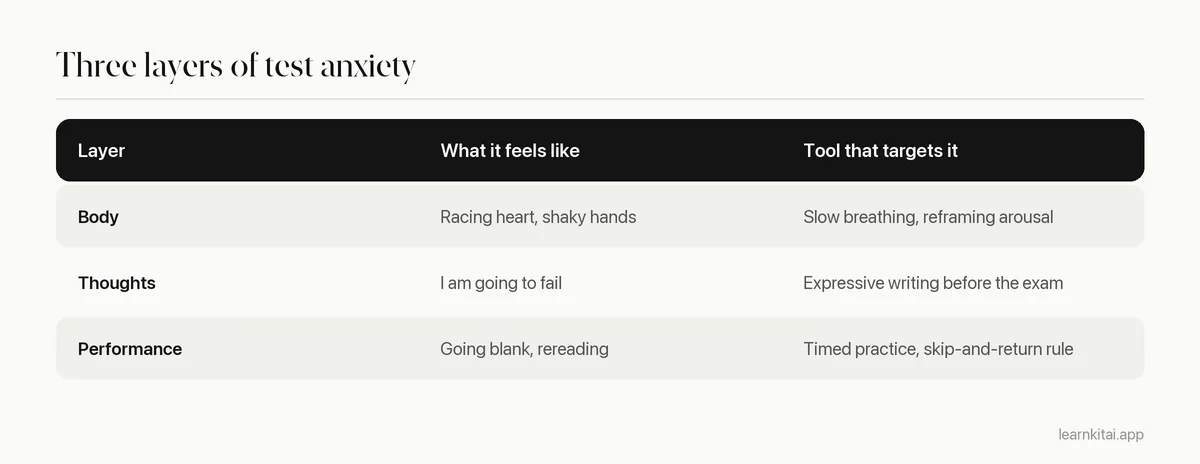
It is a stress response triggered by being evaluated. It shows up in the body (racing heart, sweating, upset stomach), in thoughts (expecting to fail, self-criticism) and in performance (going blank, rereading questions, second-guessing answers).
Counseling centers usually describe it in layers. The Weber State University Counseling Center, for example, lists physical signs like a pounding heart and muscle tension, thoughts like expecting to fail, and test-taking effects like going blank, racing thoughts and changing correct answers. Knowing which layer hits you hardest helps you pick the right tool.
Why does anxiety make your mind go blank?
Worry uses up working memory, the mental space you need to hold a question and reason through it. When part of that space is busy with fears about the result, there is less left for recall and problem solving.
This explains a common pattern: anxious students often do fine on homework and worse on tests of the same material. The knowledge is there, but the worry competes with it for attention. That is also why the most effective techniques aim to clear worry out of the way, not to make you care less about the exam.
Does writing about your worries before a test help?
In several studies, yes. Students who spent ten minutes writing about their feelings about an upcoming exam performed better than students who did not, and the benefit was largest for the most anxious students.
In research at the University of Chicago, Gerardo Ramirez and Sian Beilock asked students to write freely for ten minutes about their thoughts and feelings on an upcoming test. In a lab experiment under pressure, the control group's accuracy dropped by 12 percent, while the writing group's improved by 5 percent. In a ninth-grade biology class, highly anxious students who wrote before their final averaged a B+, while highly anxious students who did not averaged a B- (University of Chicago News).
The idea is that putting worries on paper frees up the working memory they were occupying. You do not need to show anyone the page. Write honestly, then put it away.
Can you turn nerves into an advantage?
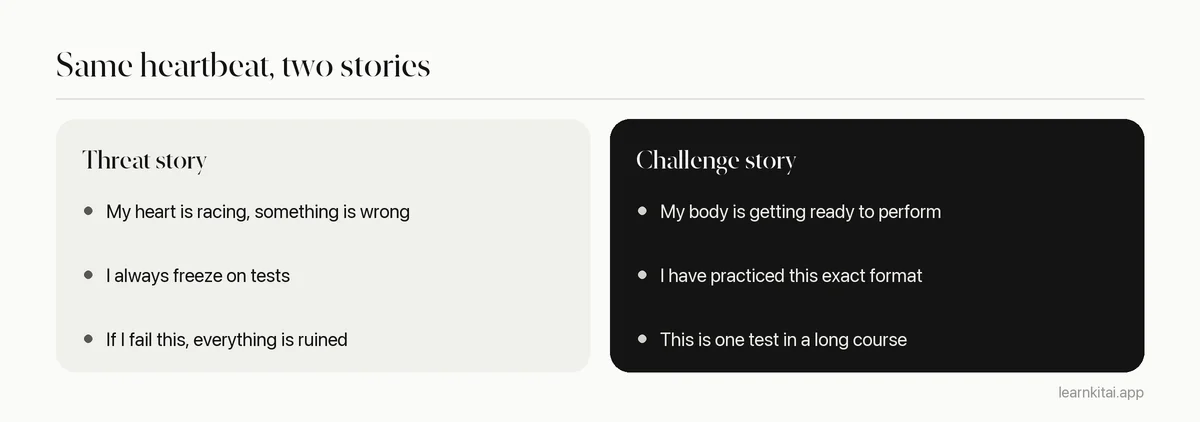
Possibly. In one study, students told that a racing heart can help performance scored higher on the math section of a practice GRE and again on their real GRE. Reframing arousal as energy, rather than fighting it, seems to help some people.
In a study by Jamieson and colleagues, students preparing for the GRE were told before a practice test that physical arousal can improve performance. They outperformed a control group on the math section, and the gap showed up again on their official scores one to three months later. It is a single line of research, so treat it as promising rather than proven, but it costs nothing to try.
How do you prepare in the weeks before?
Make the exam feel familiar. Take practice tests under real conditions, with a timer and no notes. The more times you have sat through the format and survived, the less threatening the real one feels.
Much of test anxiety is fear of the unknown. Timed practice removes some of that unknown. It also gives you real evidence that you know the material, which is a stronger answer to anxious thoughts than any pep talk. Our practice testing guide shows how to set one up, and a steady study schedule keeps you from the last-minute panic that feeds anxiety.
If you do not have past papers, a quiz generator can fill the gap. LearnKit builds multiple choice and open questions from your notes, so you can rehearse the test format at home as many times as you need.
- Sleep normally the week before. Tired brains worry more and recall less.
- Keep exercise in your routine, even a short walk.
- Limit caffeine, especially in the afternoon.
- Know the logistics in advance: room, time, what to bring.
A 10-minute routine for exam day
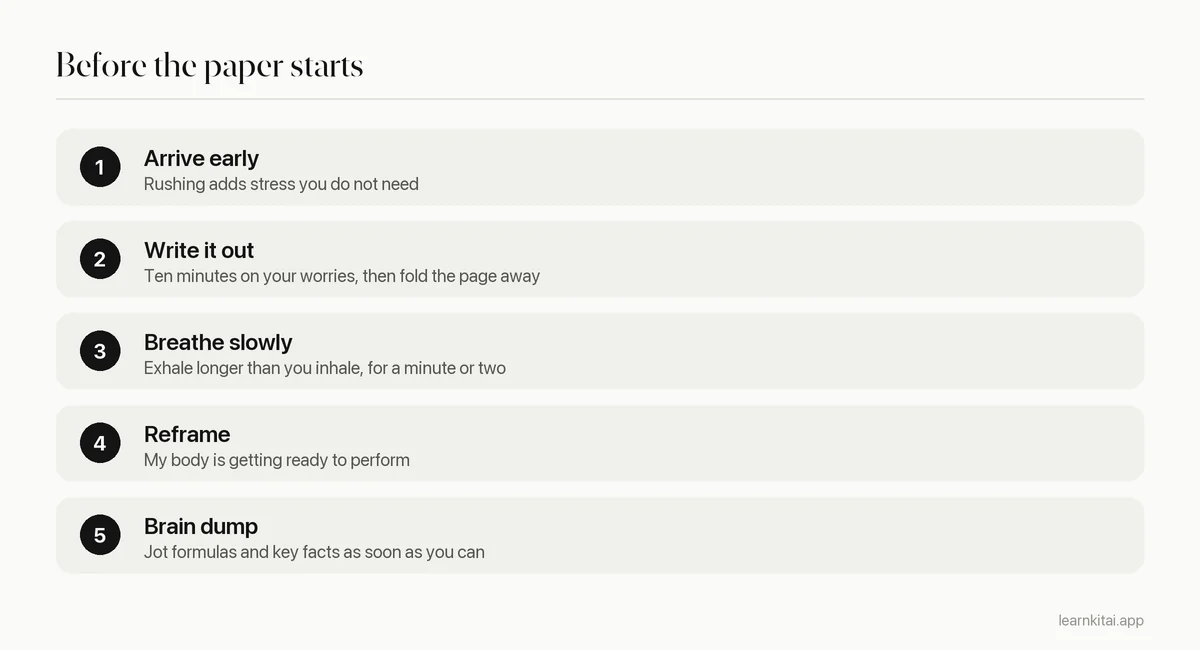
Once the exam starts, use a skip-and-return rule. If a question freezes you for more than a minute, mark it and move on. Later questions often trigger the memory you need, and answering easier ones first rebuilds confidence. Avoid comparing your pace with the person next to you. For more test-day logistics, see our exam day checklist.
What should you do if you go blank in the middle of an exam?
Stop writing, put your pen down, and take three slow breaths. Then move to a question you find easy, or jot down anything at all you remember about the topic. Retrieval often restarts once you produce something on the page.
Going blank feels permanent, but it rarely is. The memory is usually still there, blocked by a spike of stress. Fighting harder to force the answer tends to make the block worse. Instead, lower the stakes for a moment. Write keywords, draw a quick diagram, or list the steps of a related problem you know well. These small acts of recall often pull the missing piece back.
It also helps to have rehearsed this moment. During practice tests, deliberately skip one question and return to it later, so the skip-and-return habit is automatic on the day. Once you have practiced recovering from a blank, the real moment tends to feel less frightening.
Finally, keep each test in proportion. One exam rarely decides a course, let alone a future. If a test does go badly, our guide on what to do after failing an exam offers a calm next step, and the finals guide helps you plan the bigger picture.
Frequently asked questions
Is test anxiety a sign that I am not smart enough?
No. Test anxiety is not related to intelligence. Many strong students experience it, and it usually responds well to practice, preparation routines and, when needed, counseling.
Should I study right up until the exam starts?
It is usually better not to. Last-minute cramming in the hallway tends to raise anxiety. A short look at a one-page summary, followed by a calming routine, works better for most students.
Does deep breathing really help with exam nerves?
Slow breathing with a longer exhale is widely recommended by counseling centers to calm the body's stress response. It works best if you practice it during study weeks, not just on exam day.
Can I get extra time if I have severe test anxiety?
Some schools offer accommodations for documented anxiety. Policies vary, so ask your school's disability services or counseling office well before exam season.
Sources
- Writing about worries eases anxiety and improves test performance, University of Chicago News (Ten minutes of expressive writing; 12 percent accuracy drop for controls versus 5 percent gain for writers; B+ versus B- for anxious ninth graders.)
- Turning the Knots in Your Stomach into Bows: Reappraising Arousal Improves Performance on the GRE, Journal of Experimental Social Psychology (Jamieson et al., 2010), Harvard DASH (Reappraisal of arousal improved GRE math scores on practice and actual tests.)
- Test Anxiety, Weber State University Counseling Center (Physical, emotional and cognitive symptoms of test anxiety and coping strategies.)
Keep reading
How to Study for Finals: A 3-Week Plan That Holds Up
Finals reward the student who starts with a plan, not the one who studies longest. Here is a three-week system for triage, testing and sleep.
Exam Day Tips: A Checklist From Wake-Up to Last Answer
The night before, the morning of, the first five minutes and the last ten. A calm, research-backed checklist for the day all your studying pays off.

Practice Testing: The Study Habit That Beats Rereading
Testing yourself is not just a way to check what you know. It is one of the best-supported ways to learn. Here is how to do it well, week by week.
Failed an Exam? A 7-Day Plan to Find Out Why and Recover
A failing grade is data, not a verdict. Here is a calm seven-day plan to diagnose what went wrong, talk to the right people and change how you study.
The Study Schedule That Works Backward From Exam Day
Most study plans fail because they start from today. Start from the exam date instead, count your real hours, and space every topic at least three times.