Exam Day Tips: A Checklist From Wake-Up to Last Answer
Pack everything the night before and go to bed at your normal time. On the morning, eat a familiar breakfast, do light recall instead of new learning, and arrive early. Before the exam, write your worries down for a few minutes. In the room, scan the whole paper, plan your time and answer the easy questions first.
By exam day, the learning is mostly done. What is left is execution: getting your knowledge onto the paper without losing marks to panic, poor pacing or a forgotten calculator. These exam day tips are arranged in the order you will need them, from the night before to the moment you hand in. Treat the bold items as a checklist you can screenshot.
What should you do the night before an exam?
Pack your bag, check the time and room, do one short round of recall on your weakest topics, and stop studying at least an hour before bed. Then sleep at your usual time. A late cram usually costs more in sleep than it adds in knowledge.
- Pack: ID or student card, pens and a spare, pencil and eraser, calculator with fresh batteries if allowed, watch if allowed, water, and any permitted notes.
- Check: exam time, building and room, and how long the trip takes at that hour.
- Review lightly: 20 to 30 minutes of self-testing on weak spots, not a new chapter.
- Stop: close the books an hour before bed and do something calm.
Sleep in the weeks before matters more than one night. In an MIT study where students wore activity trackers, sleep on the single night before a test did not predict scores, but sleep across the preceding week and month did. MIT News describes the study and its finding that a quarter of the variation in grades tracked sleep measures. So do not panic if you sleep badly from nerves, but do not trade sleep for a late cram either. Our post on cramming the night before explains what a last-minute session can and cannot do.
The exam morning, step by step
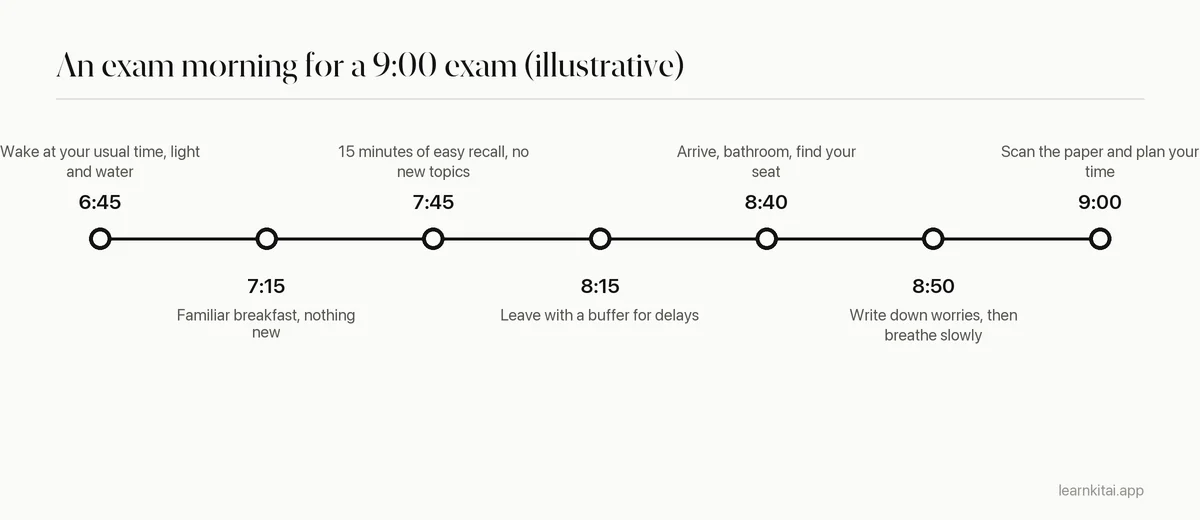
Eat something you know agrees with you. Exam day is not the day to try a new energy drink or skip a meal you normally eat. If you drink coffee every morning, have your usual amount; if you do not, skip it.
For the review slot, flip through flashcards or a short quiz on topics you already know well. The goal is to warm up retrieval and build confidence, not to discover a gap you cannot fix in an hour.
Does writing about your worries before an exam help?
For anxious students, yes. In classroom experiments, students who spent 10 minutes writing about their exam worries just before the test did better than anxious students who did not write. Writing seems to clear worry out of working memory so it stops competing with the questions.
The research comes from Gerardo Ramirez and Sian Beilock at the University of Chicago. As ScienceDaily reports, highly anxious students who wrote about their worries earned an average of B+, while highly anxious students who did not write averaged B-. You do not need ten silent minutes in the hall. Do it on a scrap of paper on the bus or outside the room: what am I worried about, and what is the worst realistic outcome? If test nerves are a regular problem, our guide to test anxiety has more strategies.
What should you do in the first five minutes of an exam?
Read the instructions, scan every page, note the marks for each section and write a rough time budget at the top of the paper. Then start with a question you can answer well. An early success calms nerves and banks marks.
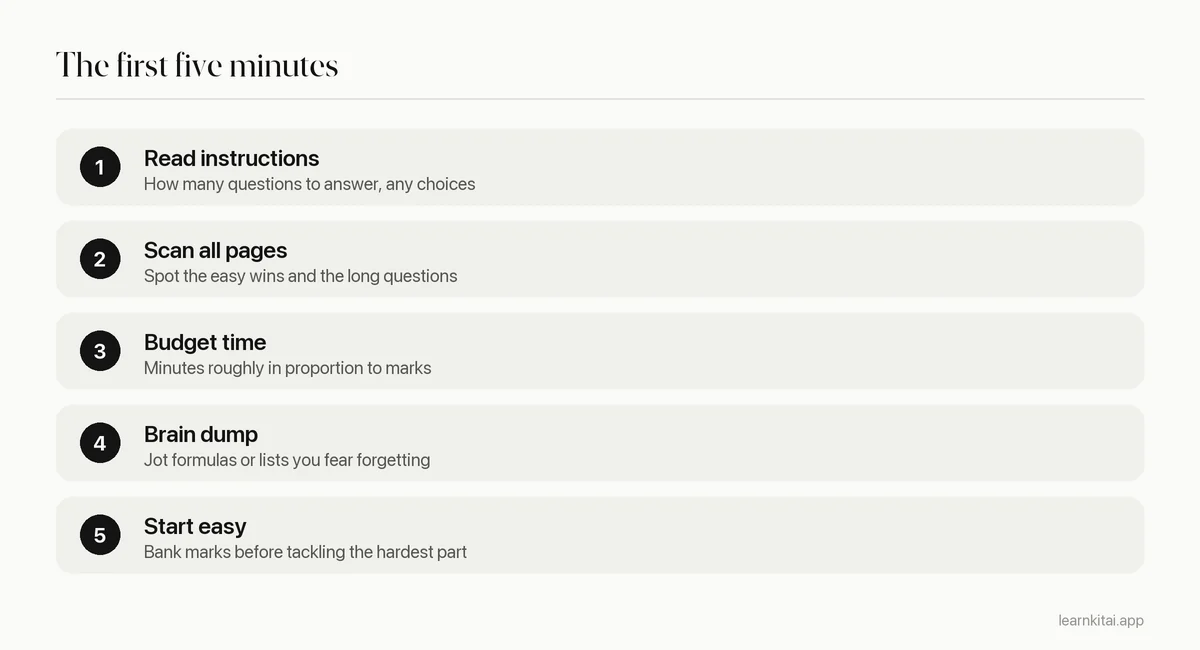
A simple budget: divide the minutes by the total marks, and spend roughly that much time per mark. If a 10-mark question is taking twice its share, write what you have, leave space and move on. Partial answers on every question usually score better than a perfect answer on half of them. For format-specific tactics, see our guides to multiple choice strategies and essay exams.
Should you change your answer on a multiple choice test?
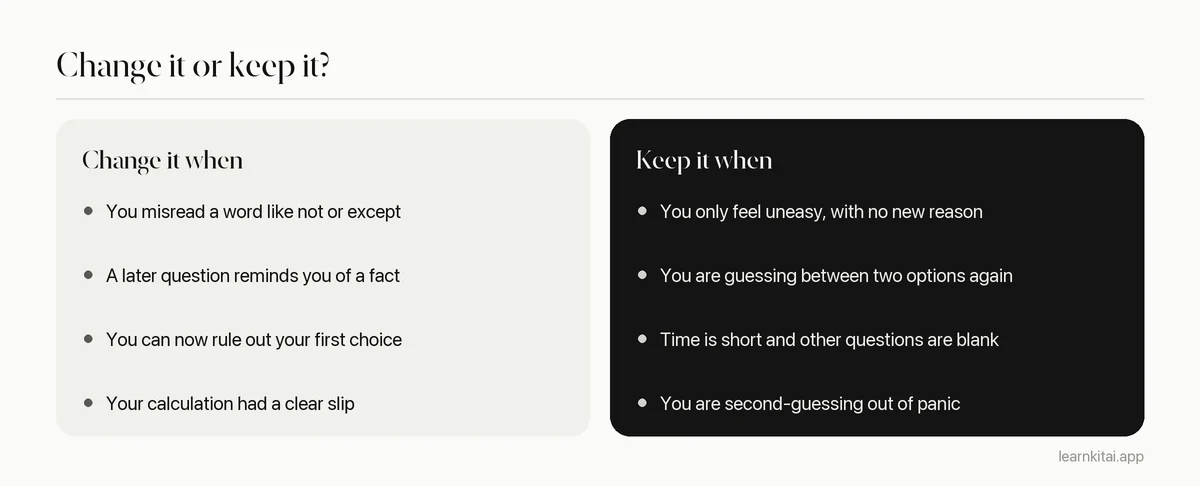
If you have a real reason, yes. Research going back decades finds that most answer changes go from wrong to right, and people who change answers usually improve their scores. The belief that your first instinct is safest is largely a memory illusion.
Kruger, Wirtz and Miller called it the first instinct fallacy. Changing a right answer to a wrong one stings, so you remember it vividly. Sticking with a wrong answer you nearly changed hurts less, so you forget it. The result is a false rule that costs marks. The sensible version: do not change answers on a vague feeling, but do change them when you spot a misread word or remember a fact that settles it.
Exam day tips for the last ten minutes
- Fill every blank on multiple choice if there is no penalty for wrong answers.
- Check your name and student number on every sheet.
- Reread the question, then your answer, for the highest-mark items.
- For calculations, check units and that the size of the answer makes sense.
- If you are out of time on an essay, write the remaining points as a short list.
What if something goes wrong on exam day?
Tell someone official as early as possible. If you are running late, are ill or forgot a required item, contact the exam office or invigilator before or at the start of the exam, not afterward. Most schools have a procedure, but it usually only helps if you use it on the day.
Plans fail sometimes. A bus breaks down, a migraine starts, a calculator dies in the first ten minutes. The worst move is to say nothing and hope for the best. Before the exam season, look up two things in your school's rules: what happens if you arrive late, and how to report illness or a serious problem on the day. Save the exam office phone number in your contacts.
Inside the room, raise your hand early if something is wrong: a missing page, a misprint, noise you cannot work through, or a sudden illness. Invigilators can often fix small problems on the spot, and a note in their record may matter later. The best exam day tips are the boring ones: know the rules before you need them, so a bad morning does not turn into a lost grade.
After the exam, resist the urge to replay every answer with classmates. It changes nothing and fuels worry before your next paper. Eat, rest and then turn to the next subject on your plan. If you have several exams in a row, our guide on how to study for finals shows how to schedule recovery between them.
Frequently asked questions
Is it okay to study the morning of an exam?
Light review is fine and can help you warm up. Keep it to familiar material and self-testing. Learning a new topic that morning tends to raise anxiety without adding many marks.
What should I eat before an exam?
Eat a normal, familiar meal that keeps you full for a few hours. Avoid trying new foods or drinks on the day, and bring water if the exam rules allow it.
What if my mind goes blank during the exam?
Put the pen down and take a few slow breaths. Move to a different question, or write anything related to the topic on scrap paper. Recall often comes back once you start writing nearby facts.
How early should I arrive for an exam?
Aim for about 15 to 20 minutes early. That covers transport delays and a bathroom stop without leaving a long wait in a crowd of nervous classmates.
Sources
- Writing about worries eases anxiety and improves test performance, ScienceDaily (University of Chicago) (10 minutes of writing before an exam; highly anxious writers averaged B+ versus B- for non-writers)
- Counterfactual thinking and the first instinct fallacy, Journal of Personality and Social Psychology (PubMed) (Most answer changes are from incorrect to correct; why people still believe in sticking with the first instinct)
- Study: Better sleep habits lead to better college grades, MIT News (Sleep the night before a test did not predict scores; sleep over the prior week and month did; about a quarter of grade variation tracked sleep)
Keep reading
How to Study for Finals: A 3-Week Plan That Holds Up
Finals reward the student who starts with a plan, not the one who studies longest. Here is a three-week system for triage, testing and sleep.
Test Anxiety: How to Steady Your Mind Before the Exam
Nerves before a test are normal. When they start to crowd out what you know, a few research-backed moves can give your memory room to work again.
Cramming: What Actually Works the Night Before an Exam
Cramming is a poor way to learn, but sometimes it is the only option left. Here is how to spend one evening so it counts, and when to stop.
Multiple Choice Strategies That Beat Guessing
Cover the options, answer first, then eliminate. Plus what the data says about changing answers, and how to study so the right option jumps out.
Sleep and Memory: Why the All-Nighter Backfires
Sleep is when your brain files what you studied, and it gets you ready to learn the next day. What the research shows and how to plan study around it.
IELTS Reading Tips: Beat the Clock on 40 Questions
Sixty minutes, three passages, forty questions. A timing plan, a True/False/Not Given rule and a practice routine that moves your band.