How to Study for Finals: A 3-Week Plan That Holds Up
Start about three weeks out. Rank each course by exam weight and how weak you feel, then give the most time to the riskiest ones. Study by testing yourself, not by rereading, and revisit each topic several times with gaps between sessions. Keep sleeping seven or more hours, especially the night before each exam.
Finals week has a way of turning calm students into frantic ones. Four or five exams land in the same ten days, each covering a whole term, and every course feels urgent at once. The good news is that how to study for finals is a solved problem in most of its parts. Memory research has a clear view on what works, and the rest is planning.
This guide is the hub for our exam prep series. It gives you a three-week plan, a way to decide which course gets your time, the study methods worth using, and how to handle sleep and stress. Each section links to a deeper guide if you need more.
When should you start studying for finals?
About three weeks before your first exam is a good default. That leaves room for at least three spaced passes over each course. If you have only a week, you can still do well, but you need to cut scope and test yourself from day one.
The reason to start early is not to study more hours. It is to study the same material on several different days. In a large study by Cepeda and colleagues, more than 1,350 people learned facts, reviewed them after a gap, and took a final test later. For a test one week away, the best gap between study sessions was about 20 to 40 percent of that week. Squeezing every session into the last two days throws that benefit away.
In practice, three weeks lets you do a first pass on everything, a second pass focused on weak spots, and a final pass of mixed practice. If your timeline is shorter, read our plan for how to study for an exam in a week.
How to study for finals: the three-week plan
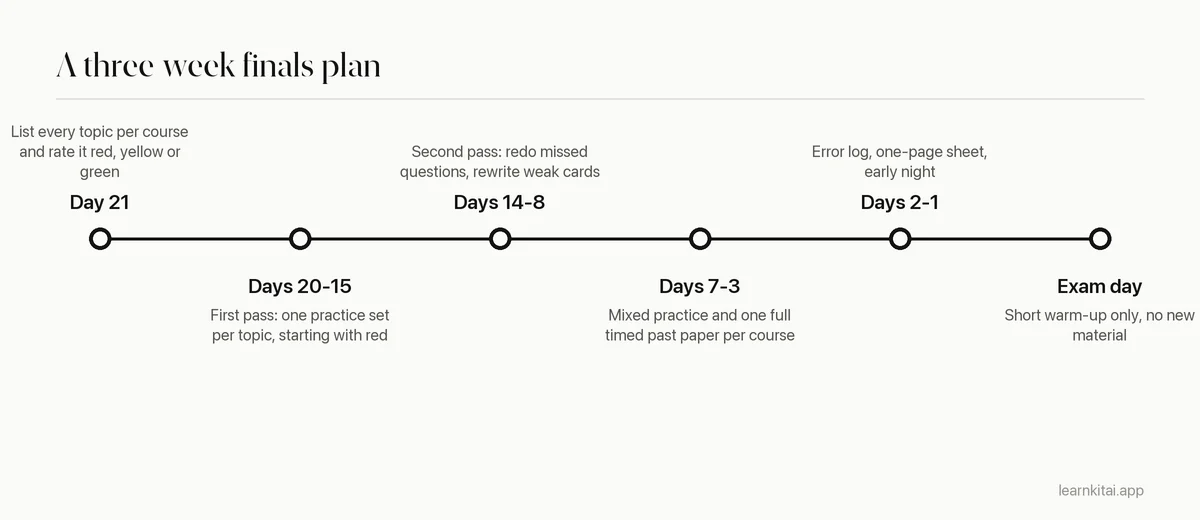
Every pass in this plan starts with a question, not a page. In the first pass, try a few problems or flashcards on a topic before you read about it. The attempt shows you what you already know, so you only reread the parts you missed. In the second pass, you return to those misses. In the third, you mix courses and topics together so the practice looks like the real exam.
Build the day-by-day version on paper or in a calendar. Our guide to building a study schedule shows how to work backward from each exam date and fit the passes around classes and work.
How do you decide what to study first?
Score each course on two things: how much the final counts toward your grade and how unprepared you feel. Multiply them. The highest scores get the most sessions and go first in each day, when your focus is best.
Most students give time to the course they like or the exam that comes first. Both are poor rules. A better one is risk. Give each course a weight score from 1 to 3 (how much the final counts) and a weakness score from 1 to 3 (how lost you feel). Multiply. Here is what that looks like for a typical student with four finals.
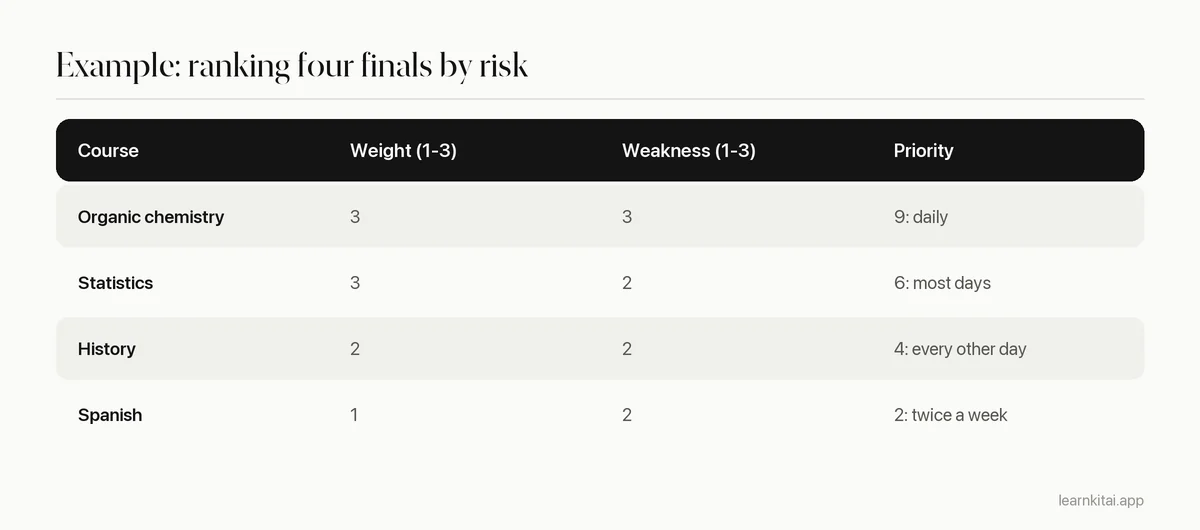
The result is not a rigid timetable. It is a ratio. Organic chemistry gets a session almost every day. Spanish gets two short ones a week. Rescore every few days, because a course you attacked early can drop from red to yellow, and the time should move with it.
Which study methods actually work for finals?
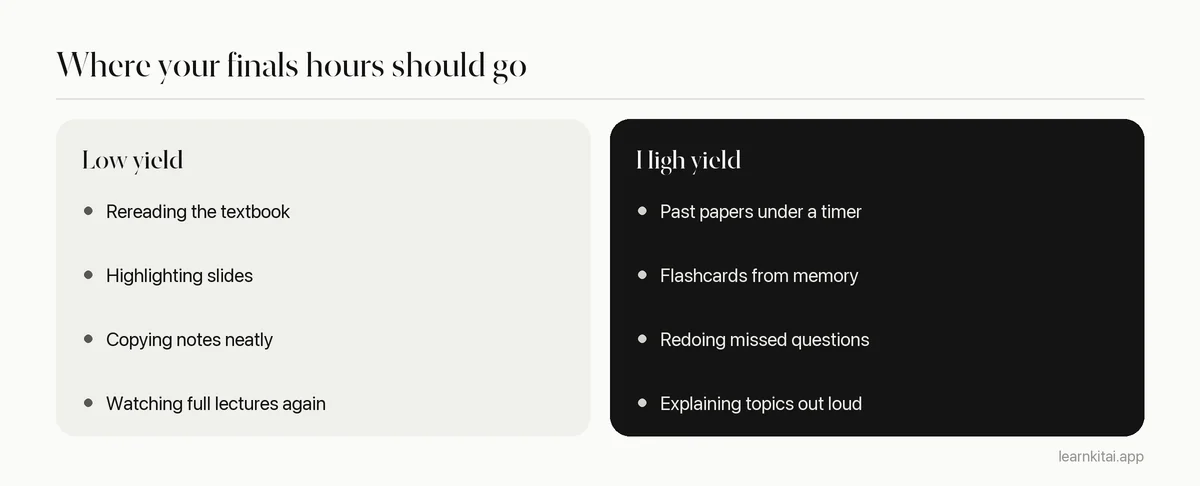
Practice testing and spaced practice. A major review of ten techniques rated these two as high utility, while rereading, highlighting and summarizing were rated low. Spend most of your time answering questions from memory and checking the answers.
In a review of ten common study methods, Dunlosky and colleagues rated two as high utility: practice testing and distributed practice. Rereading, highlighting and summarizing, which many students rely on, were rated low. That does not mean reading is useless. It means reading should support testing, not replace it.
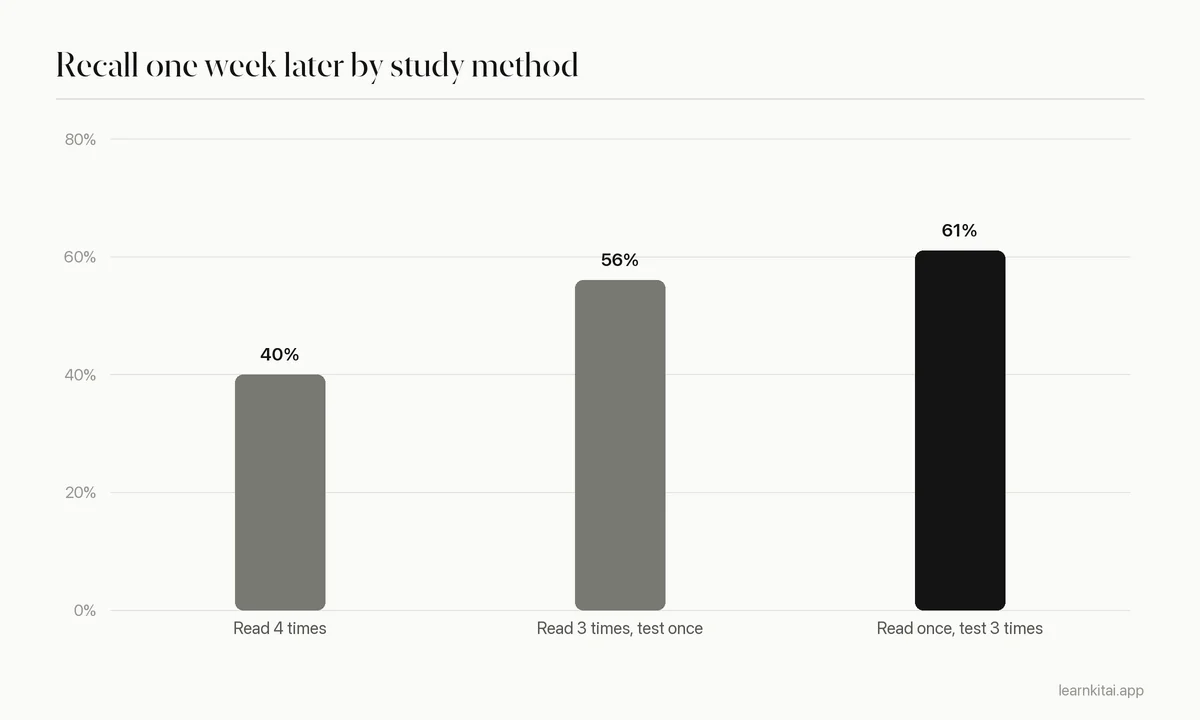
The size of the difference can be large. In a classic experiment, students who read a passage once and then took three recall tests remembered 61 percent of it a week later. Students who read it four times remembered 40 percent. The tested group read the text far less, yet kept more.
For finals, that means four kinds of practice. Use past papers and end-of-chapter problems for problem-heavy courses. Use flashcards for definitions, formulas and vocabulary. Use open questions for essay courses, where you write a short answer from memory and compare it to your notes. And use active recall on lecture slides: cover the slide, say what it covered, then check.
Making practice material takes time, which is why many students skip it. One shortcut is to generate it. LearnKit turns a lecture PDF, your notes or a recorded lecture into flashcards and quiz questions in about a minute, so your hours go into answering questions rather than writing them.
How many hours a day should you study during finals?
Most students do well with four to six focused hours on a full study day, split into blocks of 25 to 50 minutes with real breaks. Past that point, focus drops and mistakes rise, so extra hours buy less than you think.
Focused hours matter more than total hours. Three hours of practice questions with your phone in another room beat eight hours of half-reading at a busy table. Work in timed blocks, such as the Pomodoro technique, and track how many blocks you finish rather than how long you sat at a desk. Our guide on how many hours to study covers the trade-offs in more detail.
- Put your hardest course in your first block of the day.
- Switch courses after two or three blocks to keep attention fresh.
- End each day by writing tomorrow's first task on a sticky note.
- Take one full evening off per week, even in finals season.
A sample finals study day
Plans on paper often fall apart because they never say what a single day looks like. Here is one realistic version for the student in the triage table above, ten days before the first exam. It has five focused blocks and still leaves the evening free.
- 9:00 to 9:50. Organic chemistry: 12 mixed reaction problems from memory, then check answers.
- 10:00 to 10:50. Organic chemistry: redo yesterday's missed problems and rewrite two weak flashcards.
- 11:30 to 12:20. Statistics: one section of a past paper under a timer.
- 14:00 to 14:50. History: write two short outlines for likely essay prompts, then compare with notes.
- 15:00 to 15:30. Spanish: 40 vocabulary flashcards, then stop.
- Evening. Exercise, dinner, a short look at tomorrow's first task, and lights out on time.
Notice what is missing. There is no block called read chapter 7. Reading happens inside the blocks, only when a question shows a gap. That is the core of how to study for finals well: the questions lead, and the textbook follows.
Is pulling an all-nighter ever worth it?
Rarely. Sleep is when the brain stabilizes what you studied, and a tired brain recalls less. Students who pull all-nighters tend to have lower grades. If you are short on time, cut low-value topics, not sleep.
The CDC recommends that adults get seven or more hours of sleep and teens eight to ten. During finals, students often treat sleep as the first thing to cut. A study at St. Lawrence University found that about two-thirds of the students surveyed had pulled at least one all-nighter, and that the habit was linked with lower grades. Correlation is not proof, but no part of memory research suggests that losing sleep helps you recall more.
If you are already behind, read our guide on cramming the night before an exam. It shows how to use a short window well without trading away the sleep you need to recall it.
How should you adjust for different types of finals?
Match practice to the format. Problem-based exams need timed problem sets. Essay exams need outlined answers written from memory. Open book exams need fast navigation of your notes. Cumulative finals need a map of the whole course before you start.
- Cumulative finals: start with a one-page map of every unit, then weight your time by how much of the exam each unit covers. See studying for a cumulative final.
- Essay finals: predict the likely prompts and outline answers in advance. Our essay exam guide walks through it.
- Open book finals: learn the material as if the book were closed, then build a short index. See open book exam preparation.
- Multiple choice finals: practice under time and learn the patterns of wrong options. See multiple choice strategies.
Common finals mistakes to avoid
- Studying in exam order. The first exam gets all the time and the last gets crumbs. Use the risk score instead.
- Waiting to feel ready before testing yourself. Testing is how you get ready, not a reward for being ready.
- Making beautiful notes. Rewriting looks like work but gives little recall practice.
- Ignoring anxiety until exam day. If nerves are a problem for you, practice a calming routine during study weeks. See our test anxiety guide.
- Learning new material the morning of. It crowds out what you know. Warm up with easy questions instead, and check our exam day list.
Frequently asked questions
How do I study for five finals in one week?
Rank the five by weight and weakness, then rotate two or three courses per day so each gets a session every one to two days. Use only practice questions and flashcards, and keep sleep at seven hours or more. Drop low-weight topics before you drop sleep.
Is it better to study one subject per day or mix several?
Mixing two or three subjects per day usually works better. It spreads practice for each course across more days and keeps your attention fresh. Save full single-subject days for timed past papers.
Should I study the day before a final?
Yes, but lightly. Review your error log and a one-page summary, do a short set of mixed questions, and stop early in the evening. The goal is confidence and sleep, not new learning.
What should I do if I am behind on the whole course?
Get the syllabus and the past papers, list the topics that appear most often, and study only those first. Use practice questions to find gaps fast. A partial but tested understanding beats a complete but passive read.
Sources
- Spacing Effects in Learning: A Temporal Ridgeline of Optimal Retention, Psychological Science (Cepeda et al., 2008) (More than 1,350 participants; optimal gap about 20 to 40 percent of a one-week test delay.)
- Test-Enhanced Learning: Taking Memory Tests Improves Long-Term Retention, Psychological Science (Roediger and Karpicke, 2006) (One-week recall: 61 percent after repeated testing, 56 percent after one test, 40 percent after repeated study.)
- Which Study Strategies Make the Grade?, Association for Psychological Science (Practice testing and distributed practice rated high utility; rereading, highlighting and summarizing rated low.)
- About Sleep, Centers for Disease Control and Prevention (Adults 18 to 60 need 7 or more hours; teens 13 to 17 need 8 to 10 hours.)
- All-Nighters Equal Lower Grades, ScienceDaily / St. Lawrence University (About two-thirds of 111 surveyed students reported at least one all-nighter; linked with lower GPA.)
Keep reading
The Study Schedule That Works Backward From Exam Day
Most study plans fail because they start from today. Start from the exam date instead, count your real hours, and space every topic at least three times.
How to Study for an Exam in a Week, Day by Day
Seven days is enough to do well if you start with a diagnosis, revisit every topic every two or three days, and save the last day for rest.
Cramming: What Actually Works the Night Before an Exam
Cramming is a poor way to learn, but sometimes it is the only option left. Here is how to spend one evening so it counts, and when to stop.
Cumulative Final Exam: Review a Whole Semester Calmly
A cumulative final tests week 1 as hard as week 14. Here is how to triage a whole course, rebuild old material and space your review over three weeks.

Practice Testing: The Study Habit That Beats Rereading
Testing yourself is not just a way to check what you know. It is one of the best-supported ways to learn. Here is how to do it well, week by week.
IELTS Reading Tips: Beat the Clock on 40 Questions
Sixty minutes, three passages, forty questions. A timing plan, a True/False/Not Given rule and a practice routine that moves your band.
GCSE Revision: A Month-by-Month Plan for Summer 2027
GCSE exams start on 10 May 2027. Here is how to use the months before them, from autumn flashcards to past papers, without burning out by Easter.
Your AP Exam Study Plan: 12 Weeks to May 2027
AP exams run from May 3 to May 14, 2027. A 12-week plan built on unit weightings and released free-response questions beats a frantic April.