Failed an Exam? A 7-Day Plan to Find Out Why and Recover
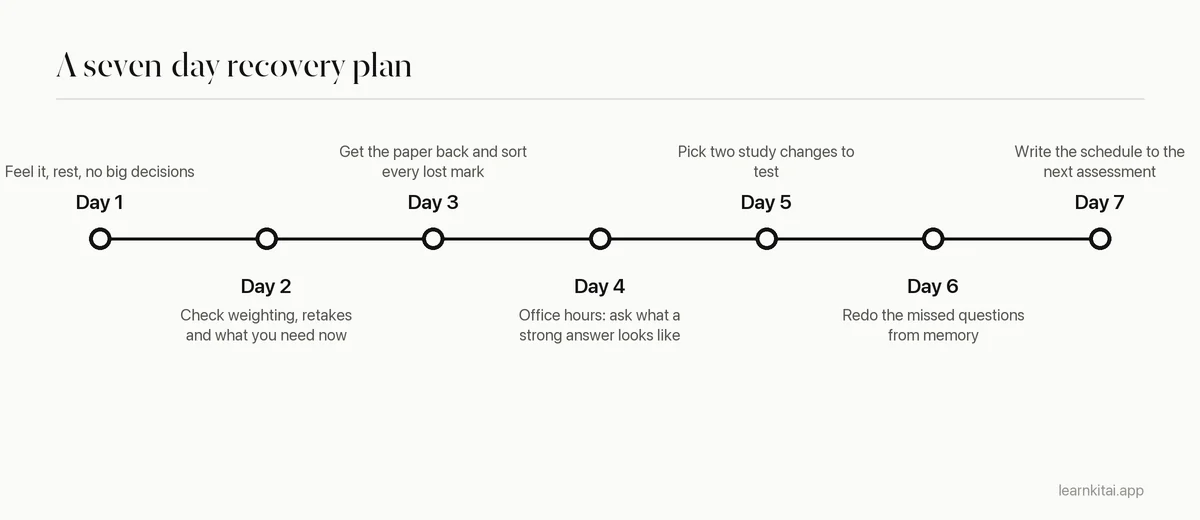
Give yourself a day to feel it, then treat the grade as data. Get the exam back, sort every lost mark by cause, and ask your instructor what a stronger answer looks like. Check your options, such as retakes or grade weighting. Then change the method, not just the hours: replace rereading with self-testing spaced over time.
If you just failed an exam, the first feeling is usually a mix of shock and a story: I am bad at this subject, I am not cut out for this course. That story is understandable, and it is almost always wrong. A single grade tells you how one set of study habits met one test on one day. This plan helps you find out which part broke and fix it, in about a week.
Is failing one exam a big deal?
Usually less than it feels. Many courses weight several assessments, offer retakes or drop the lowest score, and one low mark can be outweighed by stronger work later. The real risk is repeating the same approach on the next exam, not the grade itself.
Before you decide anything, find the facts. How much is this exam worth in your final grade? Is there a resit, a replacement assessment or a grade forgiveness policy? What score do you now need on the remaining work to pass or reach your target? A quick calculation often turns a vague disaster into a clear, reachable number.
Does being hard on yourself help you do better?
Research suggests the opposite. In one experiment, students who failed a difficult test and then read a short self-compassionate message spent more time studying for the retest than students who got a self-esteem boost or no message. Kindness after failure seems to make it easier to face the mistakes.
That experiment is part of a set of four studies by Juliana Breines and Serena Chen, published as Self-compassion increases self-improvement motivation. Self-compassion is not making excuses. It means treating the failure the way you would treat a friend's: it happened, it is common, and it is fixable. Harsh self-talk tends to push you to avoid the subject, and avoidance is exactly what makes the next exam worse. If worry about exams is affecting your sleep or daily life, talk to your school's counseling or student support service; that is what they are there for.
How do you find out why you failed an exam?
Go through the graded paper and label every lost mark with one cause: did not know it, knew it but could not recall it, misread the question, ran out of time, or careless slip. The biggest pile tells you what to fix. Most students guess the cause wrongly until they count.
This is the idea behind exam wrappers, short reflection sheets described by the Eberly Center at Carnegie Mellon University. They ask you to look at three things: where your strengths and weaknesses were, whether your preparation time and methods were adequate, and what kind of errors you made. You can run your own wrapper with the table below. The full process is in our guide to reviewing a graded exam.
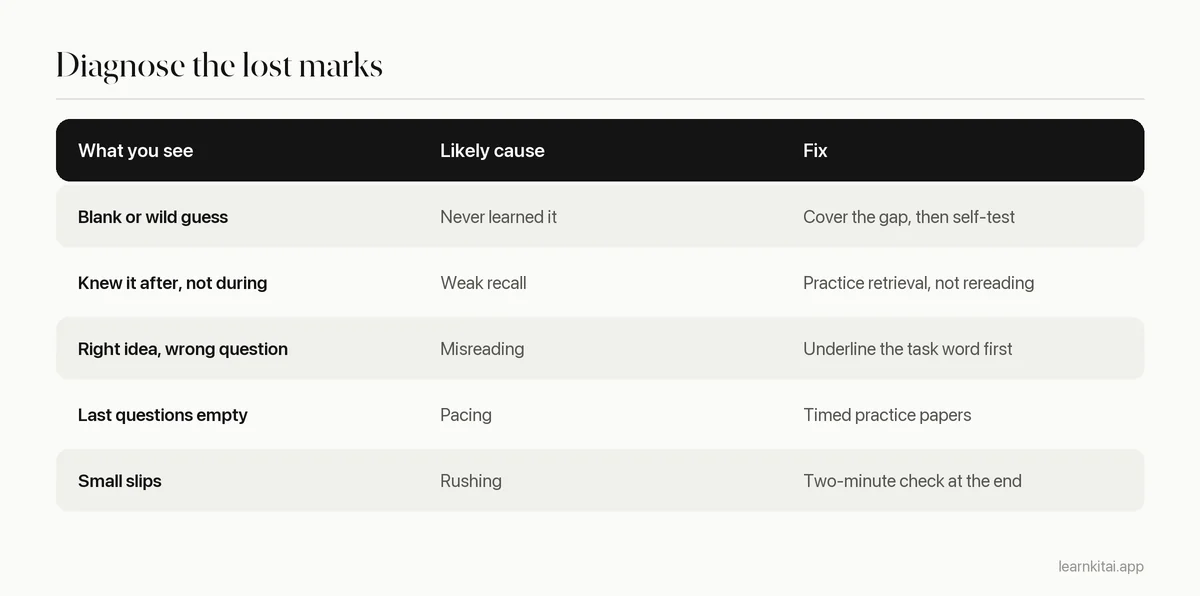
The second row is the most common surprise. You recognize the answer as soon as you see the solutions, so it feels like you knew it. Recognition is not recall. If you studied by reading your notes again and again, you trained recognition, and the exam asked for recall. Our post on why rereading does not work explains the trap in detail.
What should you ask your teacher after failing?
Ask specific questions, not 'how can I do better'. Bring the paper and ask which answer was closest to full marks and why, what a strong answer to your weakest question would include, and which topics matter most for the next assessment. Instructors respond well to students who have already done their own review.
Go after you have sorted your mistakes, not before. Showing up with a labeled paper changes the conversation from a request for points to a request for coaching. Also ask about any options you found on day 2, such as a retake or extra credit, but lead with the learning question.
Failed an exam? Change the method, not just the hours
The most common reaction to a failed exam is to promise to study twice as long. Twice as much of a weak method still gives a weak result. A large review of ten popular study techniques by Dunlosky and colleagues, summarized by the Association for Psychological Science, rated practice testing and distributed practice as the most useful. Rereading, highlighting and summarizing were rated low.
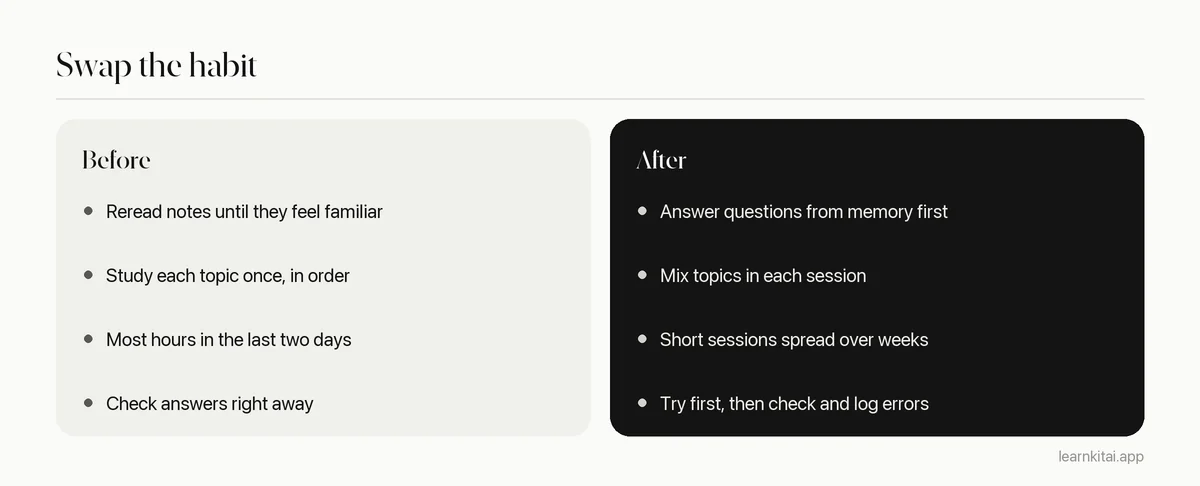
Pick two changes from the right column and test them for the next two weeks. Start with active recall: close the notes and write or say what you remember, then check. Keep a running error log so the same mistake cannot surprise you twice. One fast way to start is to upload the lecture slides behind your weakest topic to LearnKit and answer its open questions in your own words before reading the sample answers.
What if you have to retake the same exam?
A retake is easier to plan than a new exam, because you already know the format and your weak spots. Get the original paper or feedback, practice the same question types under timed conditions, and spend most of your time on the topics where you lost the most marks.
Retakes have one hidden trap: the material feels familiar because you have seen it before, so it is tempting to skim. Familiar is not the same as known. Treat the retake as a fresh exam on your weak topics and a quick check on your strong ones. Write a short list of the five question types you lost most marks on, find or write practice questions for each, and do them without notes until you can answer them cold on two different days.
If the retake comes soon, say within two weeks, focus almost entirely on recall practice and timed papers. If it is months away, use the first weeks to rebuild understanding of the weakest topics, then switch to practice questions.
How do you plan the run-up to the next exam?
Count the days to the next assessment, spread short self-testing sessions across them, and put your weakest topic in the first week. Schedule one timed practice paper about a week before. A plan with dates on it beats a promise to try harder.
Use your diagnosis to set priorities, then build a calendar using the method in our guide to a study schedule for exams. If the next big test is a final, the bigger plan in how to study for finals applies. Then let the result of the next test tell you whether the changes worked. That is what turns a failed exam into the most useful grade of the semester.
Frequently asked questions
Should I drop a course after failing the first exam?
Not before you run the numbers and talk to your instructor or academic advisor. One early exam is often a small share of the final grade, and changing your study method can move later scores a lot. Check withdrawal deadlines so you know your real options.
How do I tell my parents I failed an exam?
Tell them early and lead with your plan: what went wrong, what you are changing, and when the next assessment is. A clear plan usually turns the conversation from blame to support.
Can I ask for my exam to be regraded?
Many schools allow it if you believe a specific answer was marked incorrectly. Read the official policy, point to the exact question and the marking criteria, and keep the request polite and specific.
Why did I fail even though I studied a lot?
Hours do not equal learning if the method is passive. Rereading and highlighting feel productive but build recognition, while exams test recall. Switching to self-testing and spaced review usually helps more than adding hours.
Sources
- Self-compassion increases self-improvement motivation, Personality and Social Psychology Bulletin (PubMed) (Four experiments; in Experiment 3, the self-compassion group spent more time studying for a difficult test after an initial failure)
- Exam Wrappers, Eberly Center, Carnegie Mellon University (Reflection on strengths and weaknesses, preparation, and error patterns after a graded exam)
- Which Study Strategies Make the Grade?, Association for Psychological Science (Review of ten techniques: practice testing and distributed practice high utility; rereading, highlighting, summarization low)
Keep reading
How to Study for Finals: A 3-Week Plan That Holds Up
Finals reward the student who starts with a plan, not the one who studies longest. Here is a three-week system for triage, testing and sleep.
Review a Graded Exam: Your Mistakes Are the Study Guide
Most students glance at the score and file the paper away. A short, structured review turns every lost point into a plan for the next test.
Error Log Studying: Turn Every Mistake Into Points
An error log is a simple table of every question you got wrong and why. Kept well, it becomes the most targeted study guide you will ever own.

Test Anxiety: How to Steady Your Mind Before the Exam
Nerves before a test are normal. When they start to crowd out what you know, a few research-backed moves can give your memory room to work again.
The Study Schedule That Works Backward From Exam Day
Most study plans fail because they start from today. Start from the exam date instead, count your real hours, and space every topic at least three times.
IELTS Reading Tips: Beat the Clock on 40 Questions
Sixty minutes, three passages, forty questions. A timing plan, a True/False/Not Given rule and a practice routine that moves your band.