Practice Testing: The Study Habit That Beats Rereading
Practice testing means answering questions on material from memory before the real exam, using flashcards, quizzes, past papers or your own questions. Pulling information out of memory strengthens it, so testing yourself leads to better long-term recall than rereading the same material, especially when you space sessions out and check your answers.

Most students use tests to find out what they know. Fewer use them to learn, which is a shame, because that is where tests do their best work. Practice testing turns studying from something you look at into something you do: you close the book, try to answer, and only then check. It feels harder than rereading. It also works better, and the evidence for it is unusually strong.
This guide pulls together what you need to start: why it works, how often to do it, which kinds of questions to use, how to build your own tests, and what to do with the answers you get wrong. Each section links to a deeper guide if you want more.
What is practice testing?
It is any low-stakes way of answering questions from memory while you study: flashcards, self-made quizzes, past exam papers, explaining a topic aloud without notes, or writing everything you remember on a blank page. The key is that you retrieve the answer before you look.
The word "testing" can sound stressful, but these tests carry no grade. Their only job is to make you pull information out of memory. Researchers often call this retrieval practice, and the boost to memory that follows is called the testing effect. Practice testing is simply the everyday study habit built on top of it.
It also has a strong rating from researchers. A 2013 review by Dunlosky and colleagues evaluated 10 common study techniques. Only two received the top "high utility" rating: practice testing and distributed practice. Popular habits like rereading and highlighting were rated low utility.
Why does practice testing work better than rereading?
Retrieving an answer strengthens the memory and the path to it, while rereading only makes material feel familiar. In one classic study, students who tested themselves recalled 61% of a passage a week later, versus 40% for students who reread it four times.
The clearest demonstration comes from Roediger and Karpicke. Students read a short prose passage under three plans. One group studied it four times. One studied it three times and took one recall test. One studied it once and took three recall tests. None of the tests came with feedback.
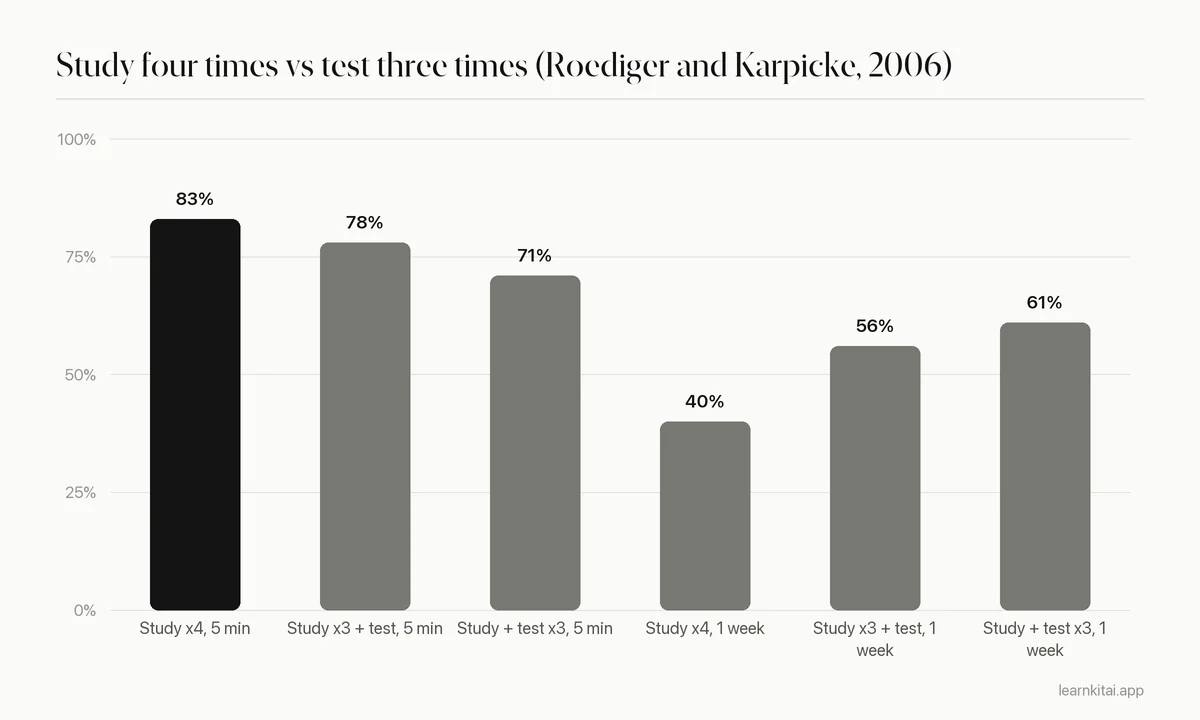
Five minutes later, the rereaders did best. A week later, the order flipped completely: the group that tested most remembered the most. The rereaders also felt more confident about how much they would remember, which is the trap. Rereading creates a feeling of knowing that does not last, which is why it is the habit we take apart in why rereading does not work.
Testing helps more than plain memorization. In a study published in Science, Karpicke and Blunt found that retrieval practice produced more learning than building concept maps, including on questions that required inference. Testing yourself builds understanding, not just recall of isolated facts.
How often should you test yourself?
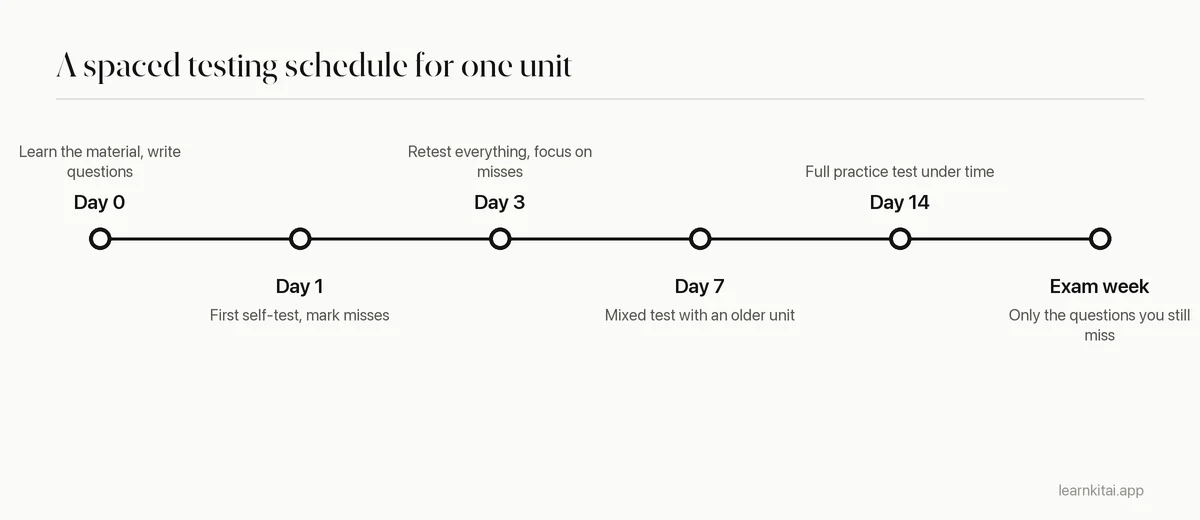
Start within a day of learning something, then test again after a few days and again after a week or two. Spread sessions out instead of testing many times in one sitting, and keep going until you can answer correctly on separate days.
Practice testing and spacing work best together. A test right after reading is easy and teaches little. A test after some forgetting is harder, and that effort is what makes the memory stronger. Here is a simple schedule for one unit, which you can adjust to your exam date. The idea behind it is explained in detail in our guide to the forgetting curve and why you forget after exams.
Which question types work best for practice testing?
Questions that make you produce the answer, such as short answers, explanations and free recall, usually give the strongest workout. Multiple choice is quicker and still useful, especially with good distractors. Mix formats, and match your final practice to the format of your real exam.
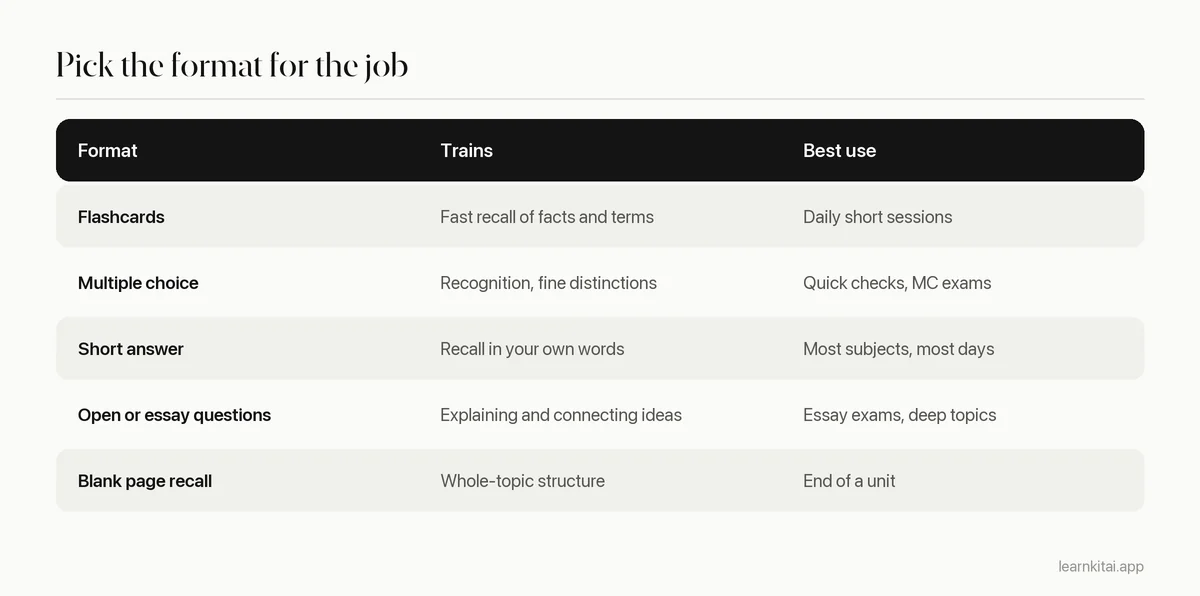
Each format has its own craft. Our guide to open ended questions for studying shows how to write prompts that force real explanations. For exams built on multiple choice, multiple choice strategies covers how to practice with distractors so the format does not trip you up.
How do you make your own practice test?
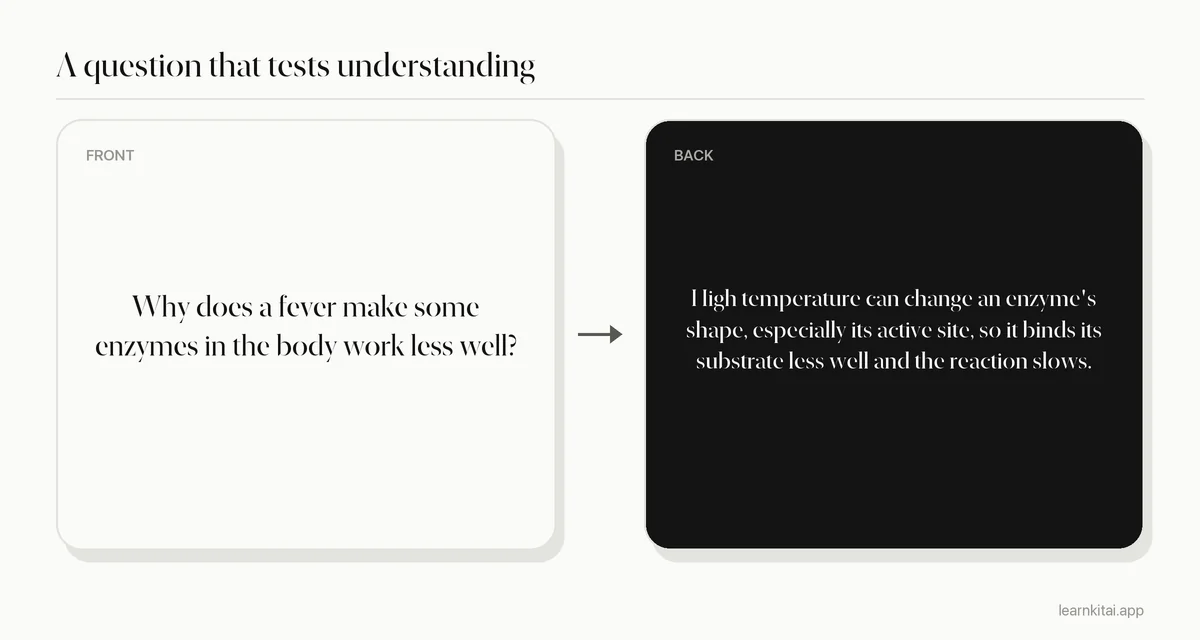
Turn each heading or learning objective into two or three questions, include at least some that ask why or how, write the answers separately, and mix questions from different topics. Then take the test without notes, under a time limit.
- Collect the targets. Use the learning objectives, chapter headings, or the topics your teacher keeps repeating.
- Write questions, not prompts. "Explain how a vaccine trains the immune system" beats "vaccines".
- Vary the depth. Some definitions, some explanations, some applications to a new example.
- Hide the answers. Write them on a separate page or the back of a card.
- Mix topics. Shuffle questions so you have to recognize what each one is about, like on the real exam.
- Time it. A time limit makes the practice closer to the real thing.
Writing questions is itself good studying, because you have to decide what matters. If you are not sure what your teacher will ask, our guide to predicting exam questions shows how to read a syllabus and past papers for clues. For a full walkthrough with templates, see how to make a practice test, and for quick daily versions, how to quiz yourself from notes.
AI tools can speed up the writing step. LearnKit can turn a PDF, your notes or a lecture into a multiple choice quiz or open questions with sample answers. The free web version makes up to five quiz questions at a time, which is enough for a quick daily check. Read the questions before you rely on them, and add your own for anything the course stresses.
What should you do with wrong answers?
Check every answer right away, write down what you got wrong and why, and retest those items within a day or two. Wrong answers are the most useful output of a practice test, because they show exactly where to spend your next session.
Feedback turns a practice test from a check into a lesson. Note the correct answer, but also the reason you missed it: did you not know it, confuse it with something similar, or misread the question? Those are three different problems with three different fixes. A short error log makes the patterns visible after a few weeks.
The same habit applies after real exams. A graded test is a free, detailed practice test, and most students glance at the score and file it away. Our guide on how to review a graded exam shows how to mine it for your next one.
Does practice testing work for every subject?
Yes, but the questions look different. Fact-heavy subjects suit flashcards and short answers. Problem-solving subjects need fresh problems, not remembered solutions. Essay subjects need open questions that ask you to argue and connect ideas.
- Sciences and medicine: mix term cards with "why" and "what happens if" questions. Draw a process from memory, then check it against the diagram.
- Math and physics: do new problems of the same type, not ones you have already solved. Cover the worked example and attempt it before reading the solution.
- History and social sciences: ask about causes, consequences and comparisons, not just dates. Practice outlining an essay answer in five minutes.
- Languages: test both directions, from your language and into it, and practice producing whole sentences, not only single words.
- Law and case-based subjects: state the rule, then apply it to a short new scenario you or a classmate wrote.
Whatever the subject, keep each session short and focused. For most students, twenty to thirty minutes of real recall is a solid session. If you study in focused blocks, put the self-test at the start of a block, when your attention is fresh, and use the end for checking answers and writing new questions.
Common practice testing mistakes
- Peeking too early. If you flip the card after two seconds, you are rereading. Give yourself a real attempt, even if it is a guess.
- Testing only what you know. Easy questions feel good and teach little. Keep the hard ones in rotation.
- Cramming all the tests into one night. Testing works best when spread over days.
- Skipping feedback. A test with no answer check can lock in mistakes.
- Recognizing instead of recalling. "I knew that one" after seeing the answer does not count. Say or write it first.
Can you do practice testing with a study group?
Yes, and it works well when everyone writes questions for each other. Take turns quizzing, explain answers out loud, and argue about the wrong ones. The arguing is often where the learning happens.
Groups add a useful twist: other people ask questions you would not think to ask yourself. Keep it structured, though, or the session drifts into chatting. Our guide to study group activities has formats that keep everyone answering. Explaining your reasoning to others also brings in the benefits of self explanation.
Practice testing is not a special technique for exam week. It is a way of studying every week: learn something, close the book, try to recall it, check, and come back later. Start with one unit and five questions a day. The first few sessions will feel harder than rereading, and that is the sign it is working. For the wider set of methods that pair well with it, start with active recall.
Frequently asked questions
Is practice testing the same as active recall?
They are closely related. Active recall is the mental act of retrieving information from memory. Practice testing is the study habit that makes you do it, using quizzes, flashcards, past papers or blank page recall.
How many practice questions should I do per day?
Quality matters more than volume. Twenty to forty well-chosen questions in a focused session is plenty for most students. Spread them across topics and spend extra time on the ones you miss.
Should I use past exam papers?
Yes, if they are available. They show the format, the difficulty and the topics your teacher favors. Use them late in your preparation, under timed conditions, after you have practiced the topics with shorter quizzes.
Does guessing on practice tests hurt learning?
A genuine attempt, even a wrong guess, followed by checking the right answer, is still useful. The risk comes from guessing and never checking, which can leave a wrong answer in memory. Always look at the feedback.
Sources
- Test-enhanced learning: taking memory tests improves long-term retention, Psychological Science (Roediger and Karpicke, 2006) (Experiment 2: repeated study 83% at 5 minutes but 40% at one week; repeated testing 71% and 61%)
- Improving Students' Learning With Effective Learning Techniques, Psychological Science in the Public Interest (Dunlosky et al., 2013) (Of 10 techniques, only practice testing and distributed practice rated high utility)
- Retrieval practice produces more learning than elaborative studying with concept mapping, Science (Karpicke and Blunt, 2011) (Retrieval practice beat concept mapping, including on inference questions)
Keep reading
The Testing Effect: Why a Quiz Beats Another Reread
Taking a test is not just a way to measure memory. It changes memory. Here is what the research shows and how to use it this week.
Make a Practice Test That Feels Like the Real Exam
A good practice test copies the real exam's format, mixes topics, and comes with an answer key you check honestly. Here is a step by step build.
Quiz Yourself From Your Notes in 15 Minutes a Day
Your notes already contain the questions. Here is how to pull them out, five ways to test yourself, and a short daily routine that keeps old topics alive.
Error Log Studying: Turn Every Mistake Into Points
An error log is a simple table of every question you got wrong and why. Kept well, it becomes the most targeted study guide you will ever own.

Active Recall: Why Closing the Book Beats Rereading
Rereading feels productive but fades fast. Here is how to study by pulling answers out of memory, with a session plan, examples and the mistakes to avoid.