The Blurting Method: Empty Your Head to Fill It
The blurting method is a revision technique where you study a topic, close your notes, and write down everything you can remember on a blank page. Then you compare your page with the source and add what you missed in a different color. The missing parts become your next study target.
The blurting method needs a blank page, a pen and about fifteen minutes. You read a topic, put your notes away, and write everything you can remember as fast as you can. Then you check. The bits you forgot jump out at you, and they tell you exactly what to study next. It is one of the simplest ways to turn revision from looking at notes into testing your memory.
The name is popular with students revising for GCSEs and A levels, but the idea underneath is much older. Psychologists call it free recall, and it is one of the formats used in the best-known studies on active recall.
How do you do the blurting method step by step?
Read one topic for a set time. Close everything. Write all you remember on a blank page for five to ten minutes, in any order. Compare with your notes and add missing points in a different color. Study those gaps, then blurt the topic again a day or two later.
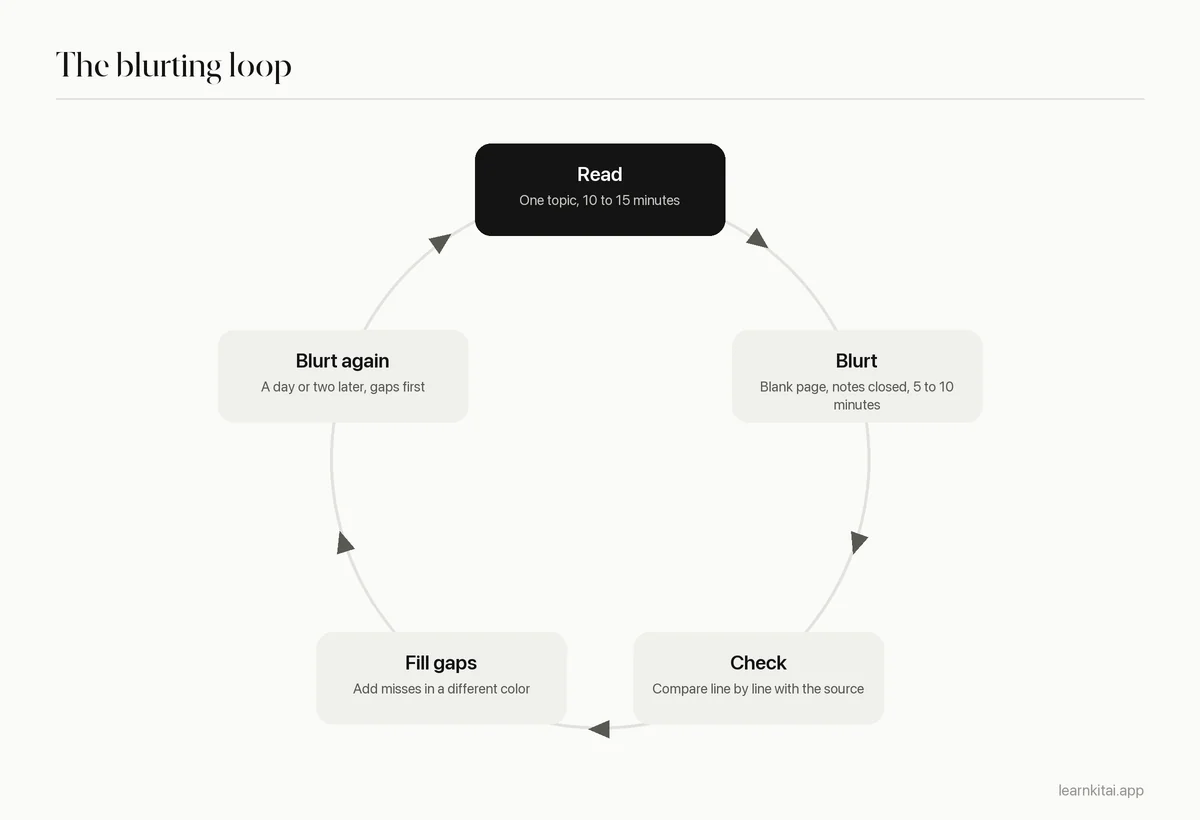
- Pick one topic. Small enough to fit on a page, like one lesson or a textbook subsection.
- Read it once with attention. Set a timer for 10 to 15 minutes. No highlighting.
- Close everything. Notes, textbook and screens out of sight.
- Blurt. Write every fact, term, date, formula and connection you can recall. Bullet points, arrows and sketches are all fine. Keep going until you run dry, then push for one more minute.
- Check. Open the source and go through it line by line. Tick what you got right.
- Fill the gaps in a new color. Write what you missed or got wrong in red or green so it stands out.
- Repeat later. Blurt the same topic again in a day or two. Start with the colored parts.
What does a blurting sheet look like?
It is messy on purpose. Here is a blurt on the causes of the First World War: the first pass in black catches the big ideas, and the colored additions after checking show exactly which details need work.
Imagine a student revising the causes of the First World War. Their first pass, from memory, reads: alliances (two sides), arms race, empires competing for colonies, nationalism, Franz Ferdinand shot in Sarajevo, war starts. That is a good start. After checking the textbook, they add in red: the names of the two alliance blocs, the naval race between Britain and Germany, the date of the assassination (28 June 1914), and the chain of declarations that pulled the alliances in. The red ink is their study plan for the next session.
Notice what blurting reveals. The student knew the shape of the answer but not the specifics that turn a middle-grade essay into a top one. Rereading the chapter would have felt fine, because everything would have looked familiar. Only the blank page showed the gap.
Why does the blurting method work?
Writing from memory is retrieval practice, which strengthens memories more than reading them again. It also gives you honest feedback: the blank spots on your page show what you do not know yet, while rereading makes everything look familiar.
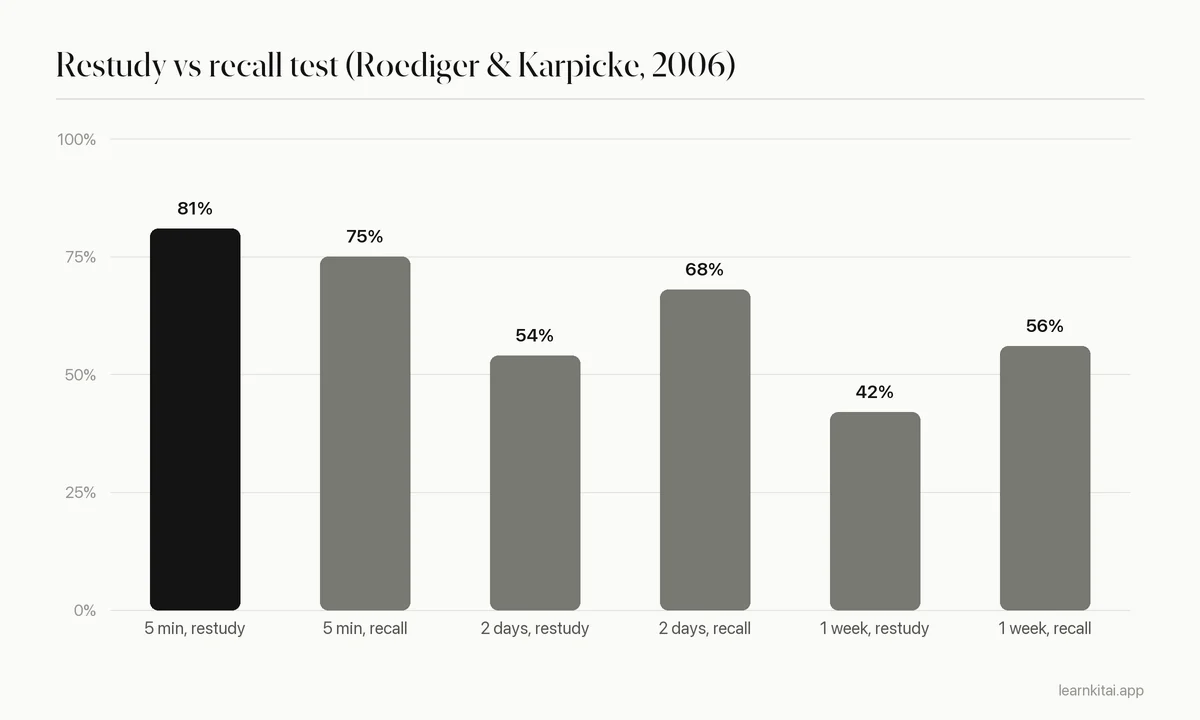
In the 2006 study by Roediger and Karpicke, students read short passages and then either read them again or wrote down everything they could remember, with no feedback. That second activity is essentially a blurt. Five minutes later, rereading looked slightly better. Two days and one week later, the blurting group remembered clearly more.
A related routine called read, recite, review has also been tested. In a 2009 study by Mark McDaniel and colleagues, students who read a text, recited what they could remember, then reviewed the text again recalled more, both right away and a week later, than students who reread or took notes. On longer engineering texts, it matched note-taking on harder questions while taking less study time. Blurting is the written version of that recite step.
What are the best variations of blurting?
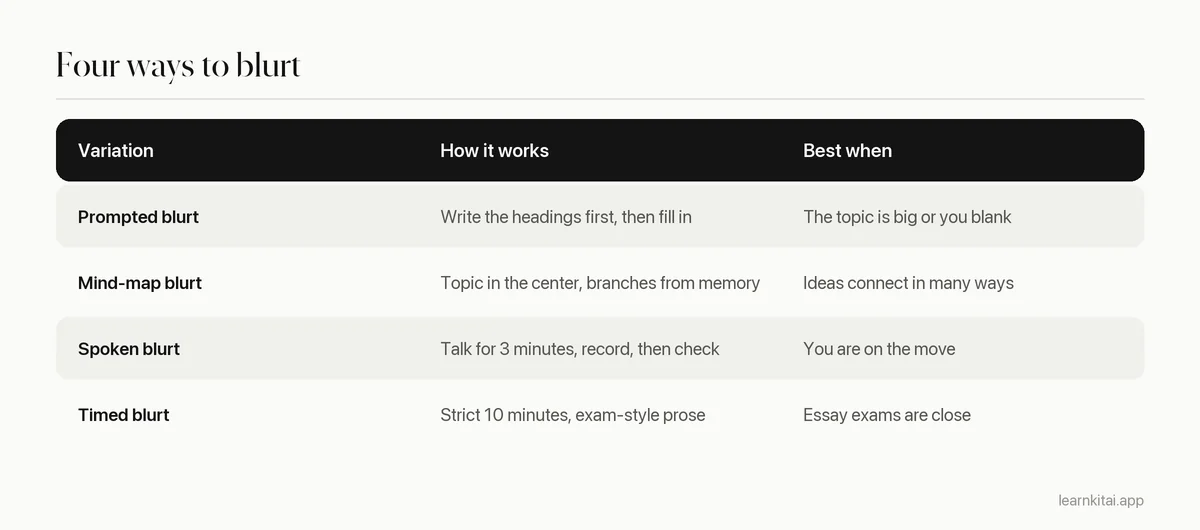
Try a prompted blurt with only the headings visible, a mind-map blurt that puts the topic in the center, a spoken blurt recorded on your phone, or a timed blurt under exam conditions. Choose the one that matches how you will be tested.
If you like visual layouts, our comparison of mind map notes shows when a branching page beats a list. For a deeper check of understanding rather than recall of facts, switch to the Feynman technique, where you explain the topic in plain words.
Blurting fits best at two moments. The first is a day or so after a lesson, when the material has started to fade and a blank page shows what stuck. The second is the start of any revision session, as a two-minute warm-up that tells you where to spend your time. It is less useful the very first time you meet hard material, because you will have little to write. In that case, read and understand first, then blurt.
Common blurting mistakes
- Blurting a whole unit at once. The page fills with vague headlines. Keep it to one topic.
- Checking too loosely. Compare line by line. A vague phrase is not the same as the precise term your exam needs.
- Never repeating it. One blurt finds the gaps. The second one, a day or two later, is where they close. Space them out like spaced repetition reviews.
- Only blurting what you like. Start with the topic you least want to face. That is usually where the marks are.
- Making it pretty. Neatness slows you down. Speed and honesty matter more than layout.
Once a topic blurts cleanly, condense it into one page for final review. Our guide to a one page study guide shows how. And if your notes are long or scattered, a short summary makes the checking step faster: you compare your blurt against a clean list of key points instead of thirty pages of slides.
That is where LearnKit can help. Add your lecture slides or a chapter, get a structured summary with key terms, and use it as your answer sheet after each blurt. The blurting itself still happens on paper, from your own memory.
Frequently asked questions
How long should a blurt take?
Five to ten minutes of writing is enough for one topic, plus about the same time to check. If you are still writing after fifteen minutes, the topic is probably too big and should be split.
Is blurting good for maths?
It works for formulas, definitions and the steps of a method. For problem-solving, it is better to blurt the method and then solve a fresh problem without help, since knowing the steps and applying them are different skills.
Can I blurt by typing instead of writing by hand?
Yes. Typing is faster and easier to compare against digital notes. Handwriting makes sketches and arrows easier. Pick the one that matches your exam format if you can.
Sources
- Test-enhanced learning: taking memory tests improves long-term retention, Psychological Science (Roediger & Karpicke, 2006) (Free recall vs restudy: 75% vs 81% after 5 minutes, 68% vs 54% after 2 days, 56% vs 42% after 1 week.)
- The read-recite-review study strategy: effective and portable, Psychological Science (McDaniel, Howard & Einstein, 2009) (Reciting from memory improved immediate and one-week recall compared with rereading and note-taking.)
Keep reading

Active Recall: Why Closing the Book Beats Rereading
Rereading feels productive but fades fast. Here is how to study by pulling answers out of memory, with a session plan, examples and the mistakes to avoid.
The Feynman Technique: Find Your Gaps by Teaching
If you cannot explain it simply, you have found what to study next. The four steps of the Feynman technique, a worked example and the traps that make it fail.

Spaced Repetition: Why Forgetting Is Part of the Plan
Reviewing right before you forget builds memories that last. Learn how long the gaps should be, with a ready schedule for exams one week to one semester away.
GCSE Revision: A Month-by-Month Plan for Summer 2027
GCSE exams start on 10 May 2027. Here is how to use the months before them, from autumn flashcards to past papers, without burning out by Easter.
One Page Study Guide: Let the Space Limit Teach You
Squeezing a whole unit onto one page forces you to decide what matters. Here is a layout, a build routine, and the step most students skip.