Does Highlighting Help Studying? What 36 Studies Found
Highlighting helps a little, mostly for memory of the marked facts and mostly for college students. A 2022 meta-analysis found a small effect on memory and no reliable effect on comprehension. It works best as a first step: mark sparingly, then turn each highlight into a question you answer from memory.
Open any used textbook and you will see it: pages glowing yellow, sometimes every line. So does highlighting help studying, or does it only make reading feel productive? The honest answer is in between. Highlighting is not useless, but it is weak on its own, and the way most students do it removes most of the small benefit it has.
Below is what the research says, why the effect is small, and a simple method that keeps your highlighter but adds the part that actually builds memory.
Does highlighting help studying at all?
A little. Pooled studies show a small boost to remembering the highlighted facts, a smaller and unreliable effect on understanding, and a clearer benefit for college students than for younger students.
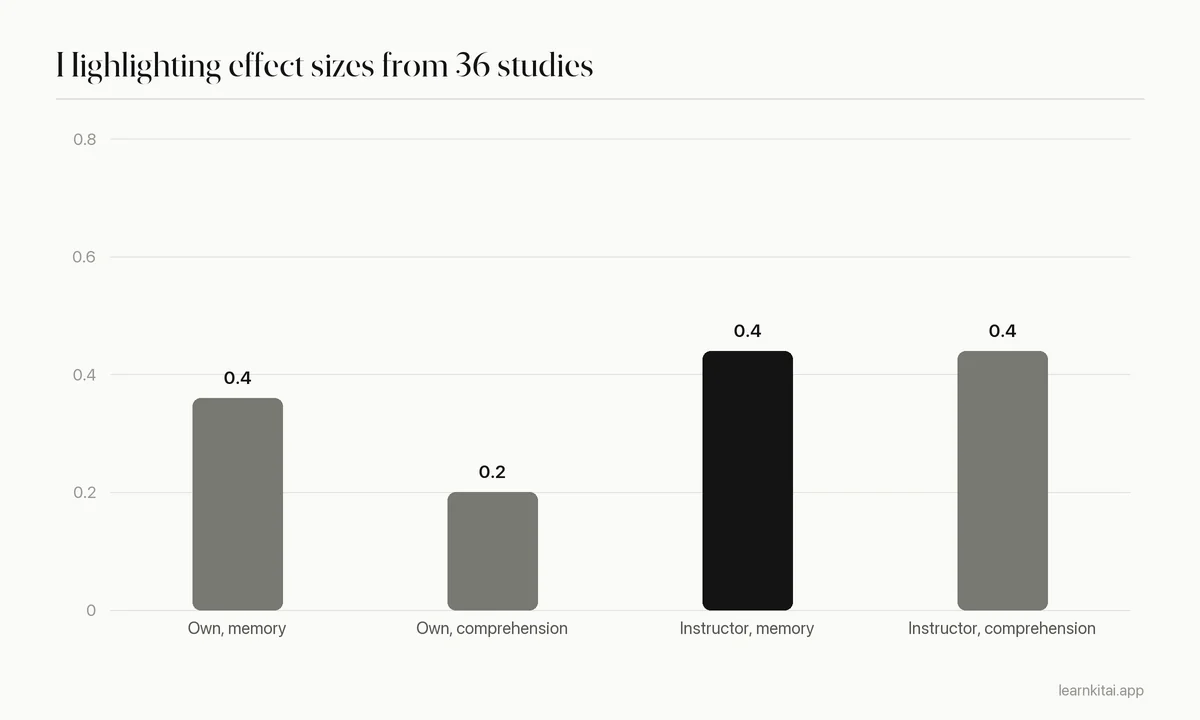
The best summary comes from a 2022 meta-analysis in Educational Psychology Review by Ponce, Mayer and Méndez. They pooled 36 published articles with 85 effect sizes, from studies run between 1938 and 2019. When students did their own highlighting, the average effect on memory was 0.36 and the effect on comprehension was 0.20, which was not a reliable improvement.
Two details matter more than the averages. First, text that an instructor had already highlighted helped more, with an effect of 0.44 on both memory and comprehension. Second, self-highlighting helped college students (0.39) more than school students (0.24). Choosing what to mark is a skill, and beginners mark the wrong things.
An earlier review of ten common techniques reached a similar verdict. It placed highlighting in the low utility group next to rereading, because the benefits are small and inconsistent, while practice testing and spaced practice were rated high.
Why is the effect so small?
Because highlighting happens while you read, with the page in front of you. It asks you to notice and select, not to recall or explain. It also tends to grow until nothing stands out, and it can isolate facts from the reasoning that connects them.
- It is passive at the key moment. Dragging a pen over a sentence takes almost no thought once you decide to mark it.
- Over-marking cancels the signal. If 60% of the page is yellow, the highlight no longer tells you what matters.
- It rewards rereading. Most students later review by rereading their highlights, which is the same familiarity trap as rereading notes.
- It splits ideas apart. Highlights catch definitions and numbers but miss the because and therefore that link them.
Highlighting vs active learning: what is the difference?
Highlighting selects information while it is visible. Active learning makes you produce it: answer a question, explain a step, or rebuild a diagram with the source closed. Producing is harder, and that effort is what makes memory last.
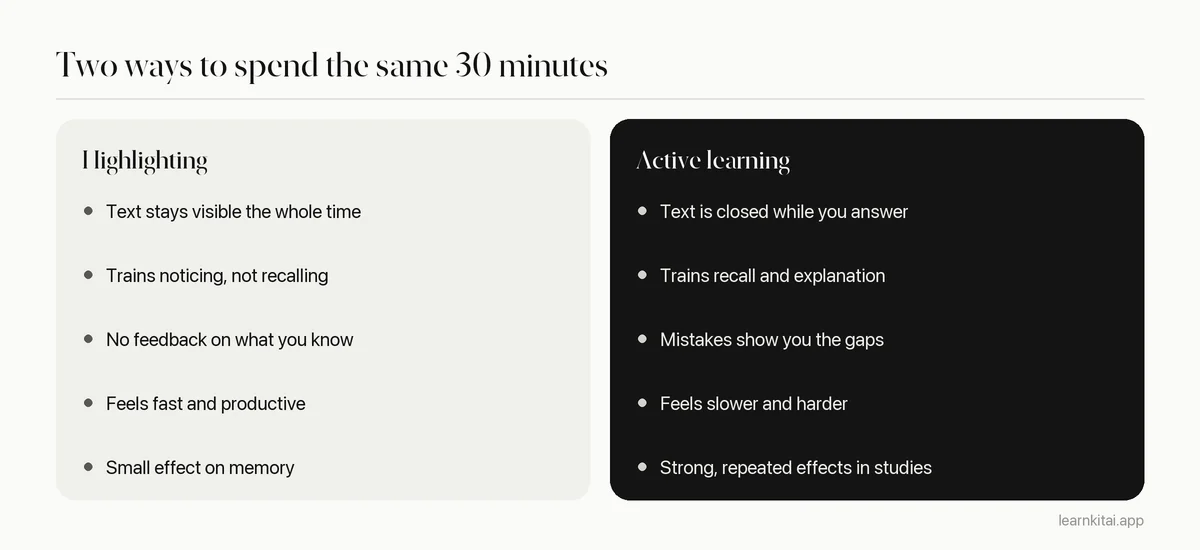
Active learning is a family of methods, not one trick. Active recall is the core. Asking why a fact is true, known as elaborative interrogation, is another. The common thread is that your brain has to generate something instead of recognizing it.
How should you highlight if you keep doing it?
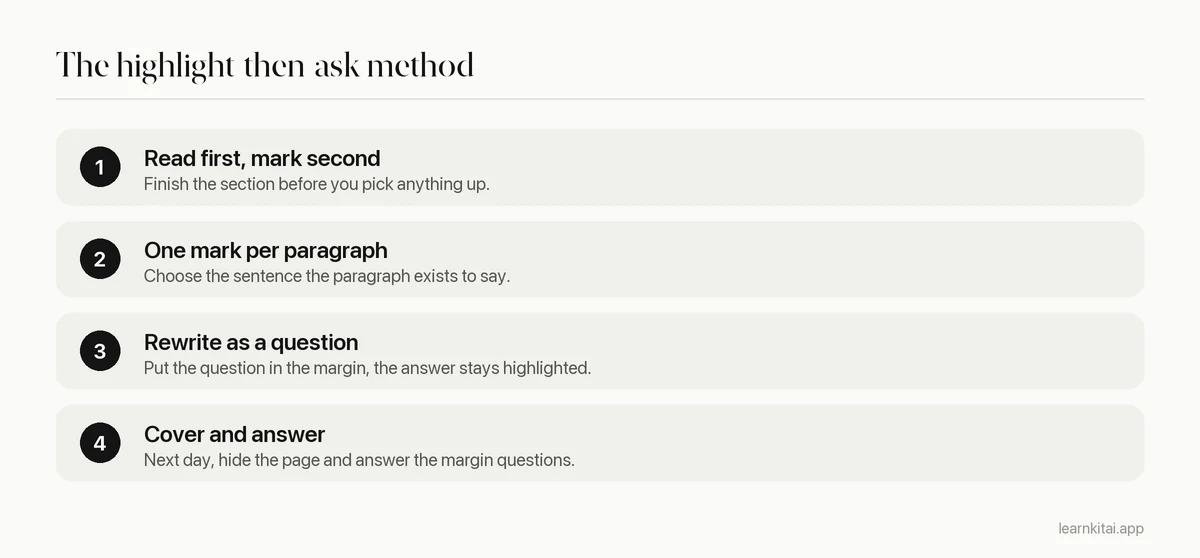
Read a full section first, then mark at most one key sentence per paragraph. Highlight claims and causes, not every number. Within a day, turn each highlight into a question and answer it with the page closed.
A worked example
Say an economics chapter has this sentence: When the price of a good rises, quantity demanded falls, all else equal. A typical student highlights it and moves on. With the method above, you also write in the margin: What happens to quantity demanded when price rises, and what does all else equal rule out? Tomorrow you cover the text and answer. If you cannot explain the second half, you just found a gap the highlighter would have hidden.
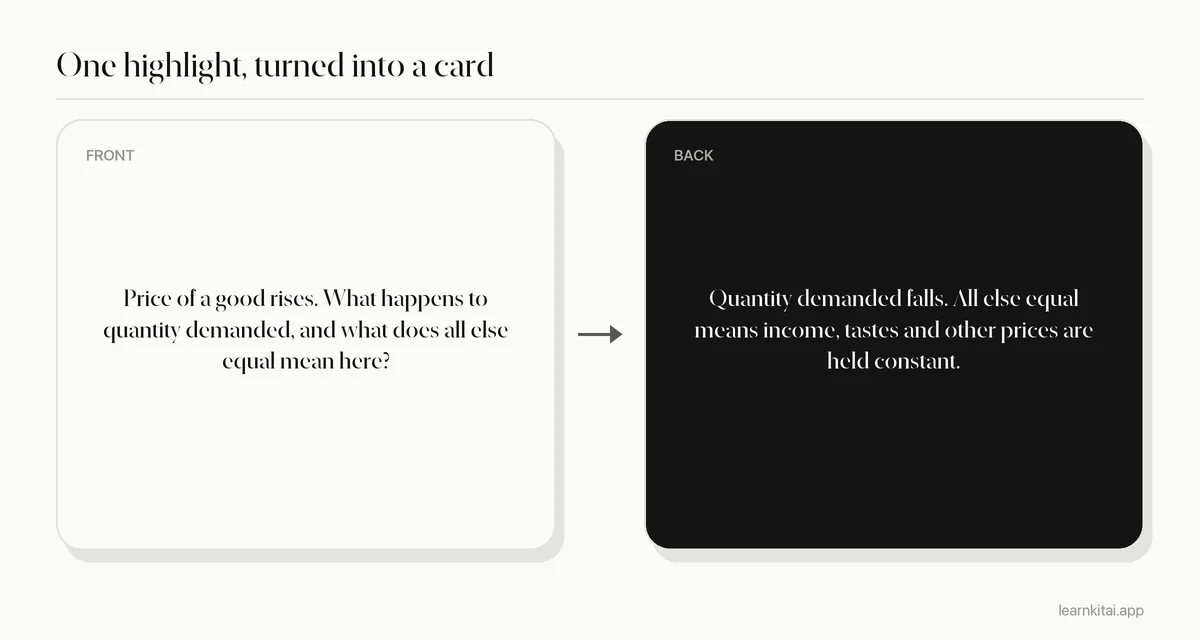
This works with any layout. If you take Cornell notes, the cue column is made for these questions. If you read with SQ3R, the recite step is where your highlights get tested.
What about color coding?
Color coding can help if each color has one fixed meaning, such as definitions in one color and causes in another, because choosing the color forces a small decision. Five colors with no rules is just decoration.
Keep it to two or three colors and write the key on the inside cover. The benefit comes from the decision you make, not from the ink. If picking colors takes longer than reading, drop it and spend the time on questions instead.
On screen, the same rules apply. Digital highlights are even easier to overdo because there is no cost to marking. Copy your highlights into one place, rewrite each as a question, and quiz yourself from that list.
Five highlighting mistakes to drop this week
- Marking on the first read. You do not know yet what the paragraph is for. Wait until the end of the section.
- Highlighting examples instead of the rule. The example helps you understand, but the exam usually asks for the principle behind it.
- Treating marked pages as finished. A yellow page is a to-do list, not a sign that you learned it.
- Reviewing by rereading the yellow parts. Turn them into questions and answer with the page covered.
- Never checking your choices. Compare your marks with the chapter summary or the learning objectives. If they do not overlap, adjust what you select next time.
So, does highlighting help studying? Treat it as a sorting step. It helps you find the ten sentences worth testing. The testing is what makes them stick, so make sure every study session ends with the page closed and you answering questions, not with one more pass of the highlighter.
If you only have twenty minutes, skip the highlighter entirely. Read the section, close the book, write the three main points from memory, and check them. That short loop gives you more than an hour of careful marking, and it tells you exactly what to review next.
Frequently asked questions
Is it bad to highlight a whole textbook page?
It is not harmful, but it wastes the one thing highlighting offers, which is a signal of what matters. If most of a page is marked, go back and choose the single sentence per paragraph you would keep if you could keep only one.
Are pre-highlighted textbooks or notes better?
In the research, highlighting chosen by an instructor helped more than highlighting chosen by students, because experts pick the right parts. Treat those marks as a map of what to quiz yourself on, not as something to reread.
Should I highlight on the first read or the second?
Read the section through once first. On a first pass you cannot yet tell which sentence carries the main idea, so you tend to mark too much. Mark on a quick second pass, then write questions.
Is underlining with a pencil any different from highlighting?
Studies usually treat underlining and highlighting as the same technique. The tool does not matter much. What matters is how selective you are and whether you test yourself on the marked parts later.
Sources
- Effects of Learner-Generated Highlighting and Instructor-Provided Highlighting on Learning from Text: A Meta-Analysis, Educational Psychology Review (Ponce, Mayer and Méndez, 2022) (36 articles, 85 effect sizes. Learner highlighting: 0.36 memory, 0.20 comprehension. Instructor highlighting: 0.44 both. College 0.39 vs school 0.24.)
- Improving Students' Learning With Effective Learning Techniques, Psychological Science in the Public Interest (Dunlosky et al., 2013) (Rates highlighting and rereading as low utility techniques.)
- Metacognitive strategies in student learning: do students practise retrieval when they study on their own?, Memory (Karpicke, Butler and Roediger, 2009) (Survey of 177 students: 6% listed highlighting, 84% listed rereading.)
Keep reading

Active Recall: Why Closing the Book Beats Rereading
Rereading feels productive but fades fast. Here is how to study by pulling answers out of memory, with a session plan, examples and the mistakes to avoid.
Rereading Notes Feels Like Studying. It Mostly Isn't
Rereading is the most popular study habit and one of the weakest. Here is why it fools you, and a 20-minute swap that works better.
Elaborative Interrogation: Ask Why to Make Facts Stick
A single question, why is this true, can turn a loose fact into one you remember. How to use elaborative interrogation, with prompts for every subject.
Cornell Notes: The Page That Quizzes You Back
A Cornell page is not just a neat layout. Its left column turns your notes into a built-in self-test you can run in ten minutes.
The SQ3R Method: Turn Textbook Reading Into Recall
Survey, Question, Read, Recite, Review. How to use the SQ3R method on a real chapter, how long each step should take, and which step does the heavy lifting.