The SQ3R Method: Turn Textbook Reading Into Recall
The SQ3R method is a five-step way to study a textbook: Survey the chapter, turn headings into Questions, Read to answer them, Recite the answers from memory, and Review the whole chapter later. It was described by psychologist Francis P. Robinson in 1946, and its recite step is a form of retrieval practice.
You can read a 30-page chapter from start to finish, turn the last page, and struggle to say what it was about. Your eyes did the work while your mind drifted. The SQ3R method was designed for exactly this. It wraps your reading in a few short steps that make you look ahead, read with a purpose, and then prove to yourself that you remember.
The name stands for Survey, Question, Read, Recite, Review. It was described by Ohio State psychologist Francis P. Robinson in his 1946 book Effective Study, and it has been taught in study skills courses ever since. Some of it holds up very well. Some of it is often done in a way that wastes time. This guide shows both.
What are the five steps of the SQ3R method?
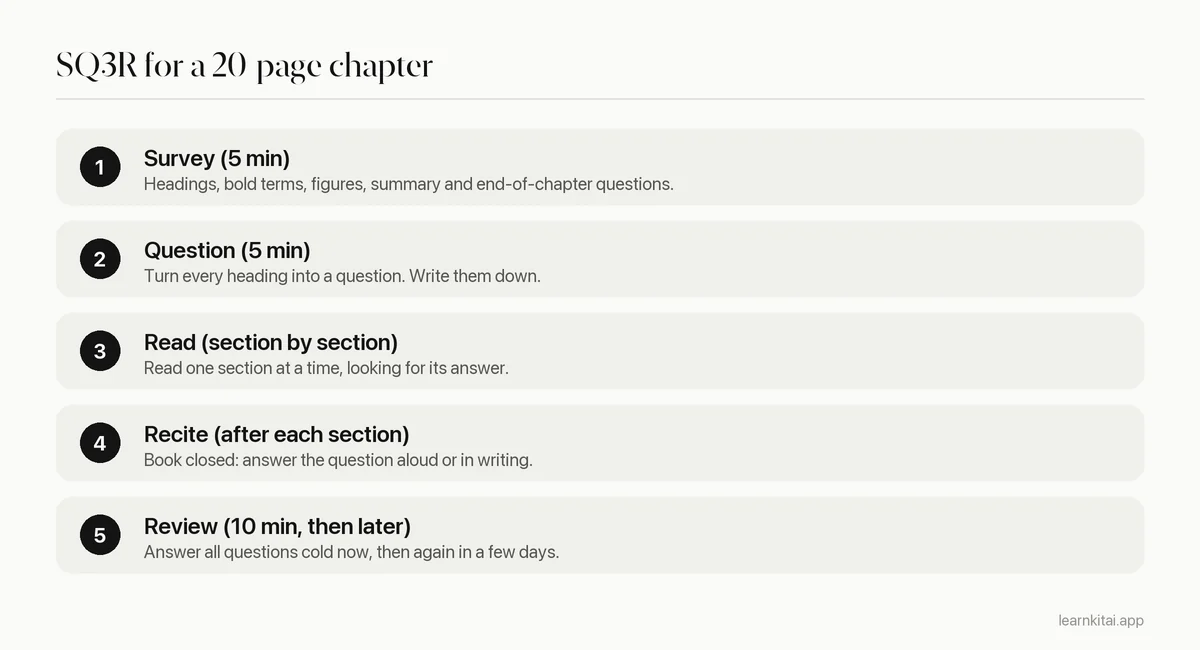
Survey: skim headings, figures and the summary. Question: turn each heading into a question. Read: read one section to answer its question. Recite: close the book and answer from memory. Review: after finishing, and again on later days, go back over all the questions.
Survey
Spend about five minutes flipping through the chapter. Read the title, the introduction, every heading, the captions under figures, any bold terms, and the summary at the end. If there are review questions, read those too. You are building a map, so the details have somewhere to go when you read them.
Question
Turn each heading into a question. Light-dependent reactions becomes What happens in the light-dependent reactions, and what do they produce? Write the questions down, one per section. These questions give your reading a target, and they become your test later.
Read
Read one section, looking for the answer to its question. Do not highlight everything. If you mark anything, mark only the lines that answer your question. Then stop at the end of the section.
Recite
This is the step that matters most. Close the book or cover the page, and answer the section's question from memory, out loud or in a few written lines. Then check. If you could not answer, reread only that section and try again. Only then move to the next section.
Review
When you finish the chapter, go through all your questions without looking. Mark the ones you missed. Repeat the review a couple of days later and again before the exam, starting with the misses.
Does the SQ3R method actually work?
The recite and review steps have strong evidence, because they are retrieval practice. A tested version that kept only read, recite and review beat both rereading and note-taking on recall a week later. The survey and question steps help you focus, but on their own they are not where most of the memory gain comes from.
In a 2009 study by Mark McDaniel and colleagues, college students studied textbook-style passages using one of three methods: read, recite, review; rereading; or note-taking. Read, recite, review improved free recall both right away and after a one-week delay, compared with the other two. On longer engineering passages, it matched note-taking on harder questions while taking less study time.
That fits the wider research on active recall. In a 2006 study by Roediger and Karpicke, students who read a passage once and then practiced recalling it three times remembered 61% a week later, while students who spent the same time rereading remembered 40%. The recite step in SQ3R is exactly that kind of recall.
What does SQ3R look like on a real chapter?
Take a biology section on photosynthesis. The survey shows two main stages. Headings become two questions. You read each part, close the book, and explain it in two or three sentences. Your review the next day is just those questions, answered cold.
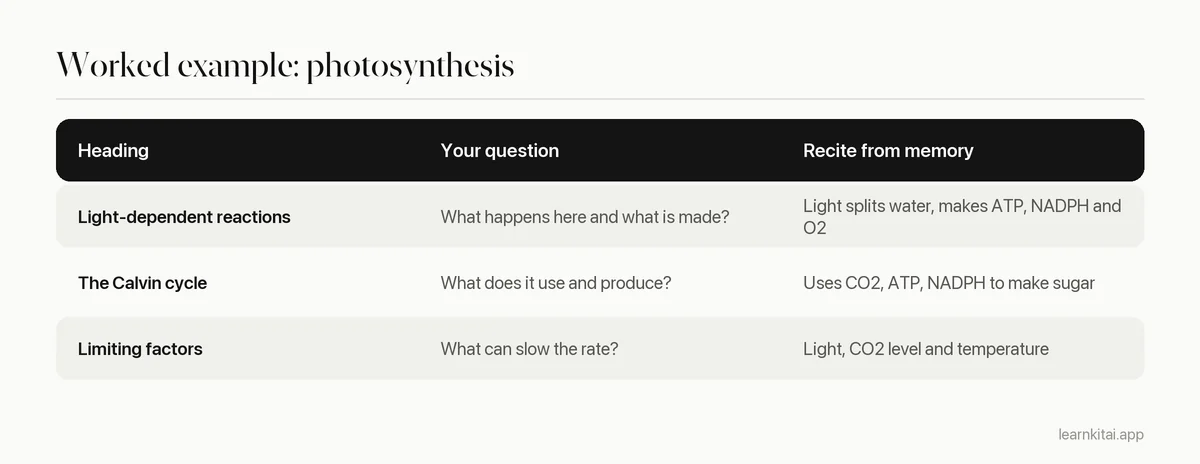
Notice how short the recite answers are. You do not need perfect paragraphs. You need enough to prove you can retrieve the core idea without looking. If you cannot, that is the section to reread.
Adapting SQ3R to different readings
Not every text has neat headings. For a research paper, survey the abstract, figures and conclusion, and turn the research question, method and main result into your three questions. For a dense math or physics chapter, make the recite step a worked problem: close the book and solve an example like the one you just read. For a set of lecture slides, treat each slide title as a heading, but group related slides into one section so you recite every few minutes rather than every few seconds. The shape stays the same in every case: know what you are looking for, read, then prove it from memory.
Common SQ3R mistakes
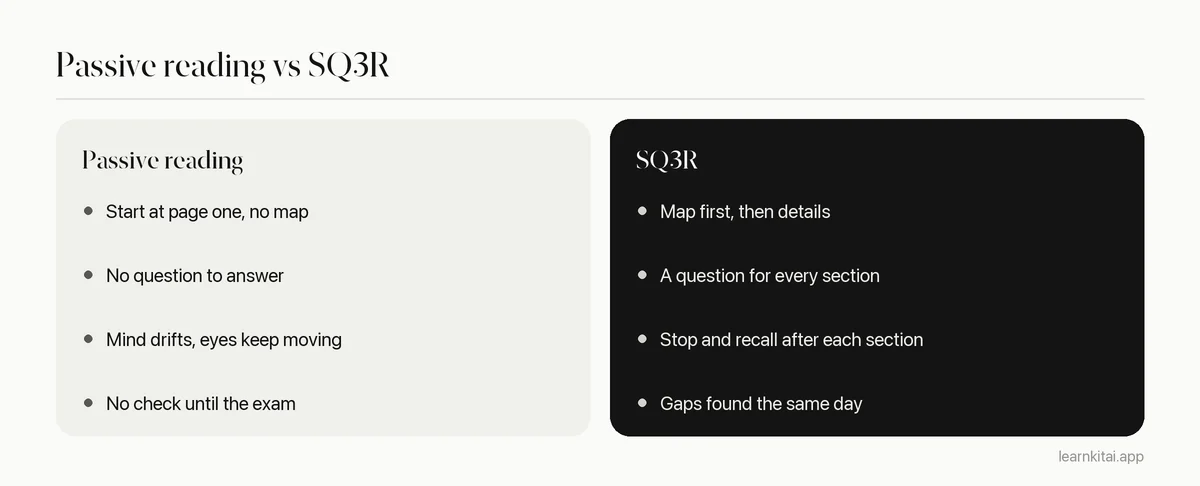
- Surveying for twenty minutes. The survey is a quick map, not a first read. Five minutes is plenty for most chapters.
- Writing questions you never answer. The questions only help if you use them in the recite and review steps.
- Reciting with the book open. Glancing at the page while you answer turns recall back into reading.
- Saving recite for the end of the chapter. Recite after each section, while the gap between reading and recalling is short enough to manage.
- Skipping the later review. One recall on the same day is good. Spacing reviews over the following days is what makes it last, as explained in spaced repetition.
SQ3R combines well with other note systems. The Cornell layout, with a question column on the left, is almost SQ3R on paper; see Cornell notes. If you want to condense a chapter after reading it, our pillar guide on how to summarize a chapter picks up where SQ3R ends. And if you are tempted to highlight as you read, check whether highlighting helps first.
SQ3R also works for online textbooks and articles. The LearnKit Chrome extension opens in the side panel and can turn the page you are reading into questions, which gives you a ready set for the recite and review steps without retyping headings.
Frequently asked questions
Is SQ3R good for novels and literature?
Only partly. SQ3R was designed for textbooks with headings and clear sections. For novels, skip the survey and question steps and instead stop after each chapter to recite the main events and what they reveal about characters.
How long does SQ3R take compared with normal reading?
The first few times it takes longer than plain reading. With practice the survey and question steps shrink to a few minutes, and you save time later because you need much less rereading before the exam.
What is the difference between SQ3R and SQ4R?
SQ4R adds a fourth R, which different sources name Reflect, Relate or wRite, where you connect the material to what you already know or write a short summary. The core idea, reading with questions and reciting from memory, stays the same.
Sources
- The read-recite-review study strategy: effective and portable, Psychological Science (McDaniel, Howard & Einstein, 2009) (Read, recite, review improved immediate and one-week free recall versus rereading and note-taking.)
- Test-enhanced learning: taking memory tests improves long-term retention, Psychological Science (Roediger & Karpicke, 2006) (One-week recall of 61% after repeated recall vs 40% after repeated reading.)
- Improving Students' Learning With Effective Learning Techniques, Psychological Science in the Public Interest (Dunlosky et al., 2013) (Rereading and highlighting rated low utility; practice testing rated high.)
Keep reading

Active Recall: Why Closing the Book Beats Rereading
Rereading feels productive but fades fast. Here is how to study by pulling answers out of memory, with a session plan, examples and the mistakes to avoid.
How to Summarize a Chapter So You Never Reread It
Most chapter summaries are just shorter copies of the book. The closed-book method turns summarizing into practice that sticks, so you can study from your page instead of the chapter.
Cornell Notes: The Page That Quizzes You Back
A Cornell page is not just a neat layout. Its left column turns your notes into a built-in self-test you can run in ten minutes.
Rereading Notes Feels Like Studying. It Mostly Isn't
Rereading is the most popular study habit and one of the weakest. Here is why it fools you, and a 20-minute swap that works better.
Does Highlighting Help Studying? What 36 Studies Found
Highlighting helps a little, for some students, under some conditions. Here is what the evidence says and how to turn your highlights into something that works.