Rereading Notes Feels Like Studying. It Mostly Isn't
Rereading notes builds familiarity, not recall. The text looks known because you just saw it, so it feels learned, but an exam asks you to produce the answer with the page closed. In studies, students who tested themselves remembered far more a week later than students who reread the same passage several times.
Rereading notes is the default study plan for most students. You open the binder, read every page again, and feel calmer by the end. Then the exam asks one question from page four, and the answer will not come. That gap is not bad luck. It is what rereading does, and once you see the mechanism you can fix it without studying longer.
This article explains why the habit is so convincing, what the research found, when a second read is still worth it, and a simple swap you can try tonight.
Why does rereading notes feel like it works?
Because reading the same text again is easy, and your brain treats that ease as a sign of learning. Recognizing a sentence when you see it is a much weaker skill than recalling it from nothing, which is what a test demands.
The second time you read a page, the words flow. You know where the paragraph is going. Psychologists call this processing fluency, and it creates an illusion of competence: the material feels familiar, so you judge it as learned.
But familiarity is recognition. You can recognize a face you could never describe to a sketch artist. Exams mostly ask for recall: write the steps, explain the cause, name the structure. Rereading trains the easy skill and leaves the hard one untouched.
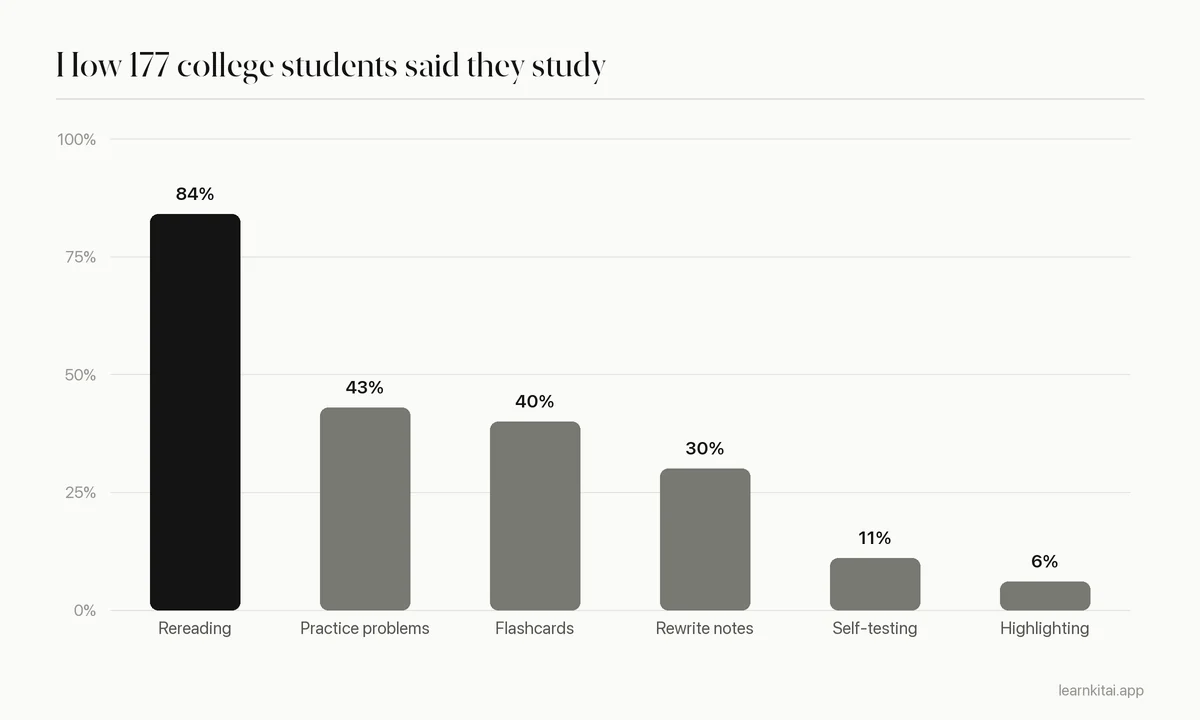
Students sense none of this. In a survey of 177 college students by Karpicke, Butler and Roediger, 84% listed rereading as a strategy and 55% called it their number one method. Only 11% said they practiced recalling information, and just 1% ranked that first.
What does the research actually show?
Rereading helps a little on a test given right away, then fades. Self-testing looks worse at first but wins clearly after days or a week. Big reviews of study methods rate rereading as low utility.
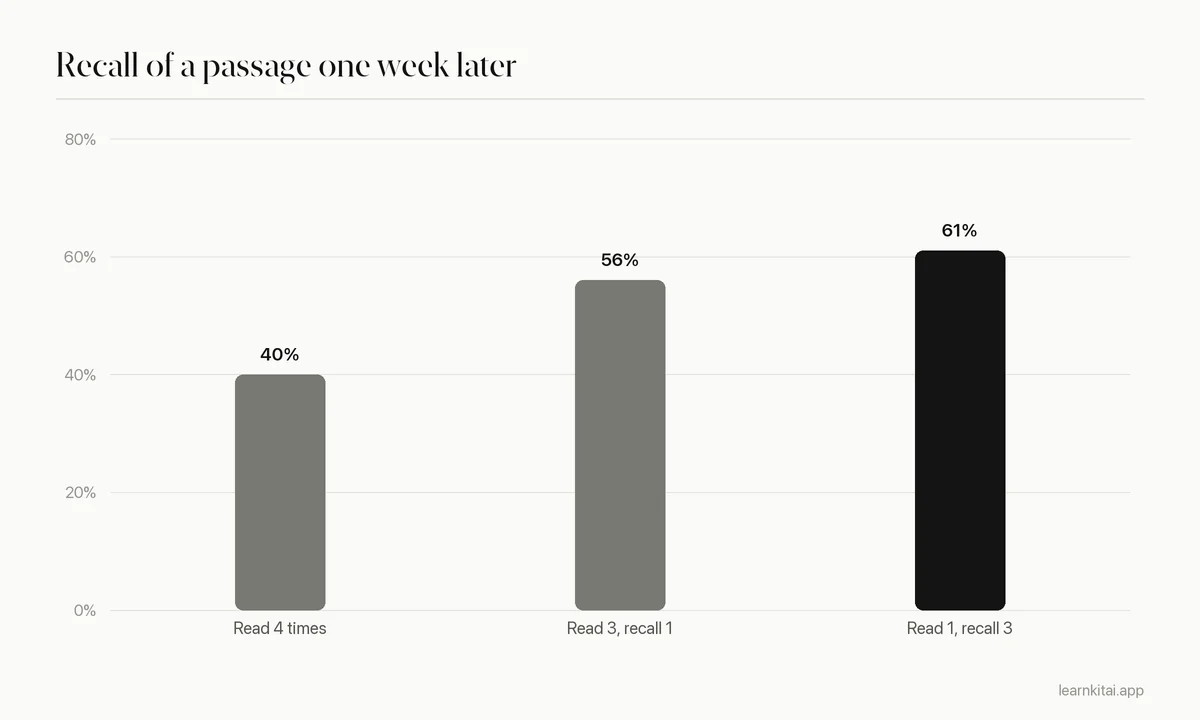
The clearest test comes from a 2006 experiment by Roediger and Karpicke. Students studied a short science passage in four five-minute periods. One group read it four times. Another read it once and then wrote down everything they could remember three times, with no feedback. A third group mixed the two.
Five minutes later, the readers were ahead: 83% recall against 71% for the testers. One week later the picture flipped. The repeated readers recalled 40% of the passage. The group that read once and recalled three times kept 61%. The readers had also seen the text far more often, and they were more confident they would remember it.
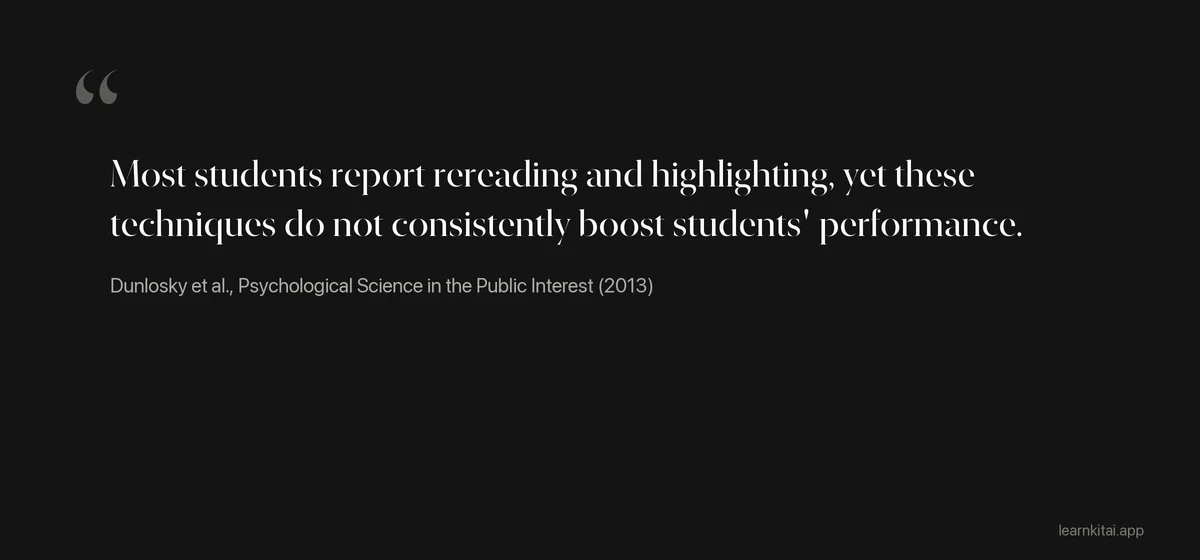
A wider view points the same way. A large review in Psychological Science in the Public Interest rated ten common study techniques and placed rereading and highlighting in the low utility group, while practice testing and spaced practice earned the top rating.
Is rereading ever worth it?
Yes, in three narrow cases: the first full read of new material, a spaced reread days later to rebuild context, and a targeted reread of the exact parts you failed to recall. A massed reread the same evening adds little.
Timing changes the result. In experiments with 423 college students, Rawson and Kintsch found that reading a text twice in a row helped on an immediate test but not on a test two days later. Reading it twice with a week in between did the opposite: little help right away, a real gain after the delay.
- First read: you need to understand the material once before you can recall it. Read slowly and make sure each idea makes sense.
- Spaced reread: if a week has passed and a chapter feels foggy, one fresh read can restore the big picture before you start testing.
- Targeted reread: after a self-test, reread only the paragraph behind each miss. This is rereading with a purpose, and it is short.
The 20-minute swap: what to do instead
Keep your notes, but close them most of the time. Spend a short block reading, a longer block recalling from memory, and a final block checking and fixing gaps. The total time stays the same.
You do not need a new system. Take the same hour you would spend rereading notes and change the order of operations. Here is a version for a 20-minute block on one topic.
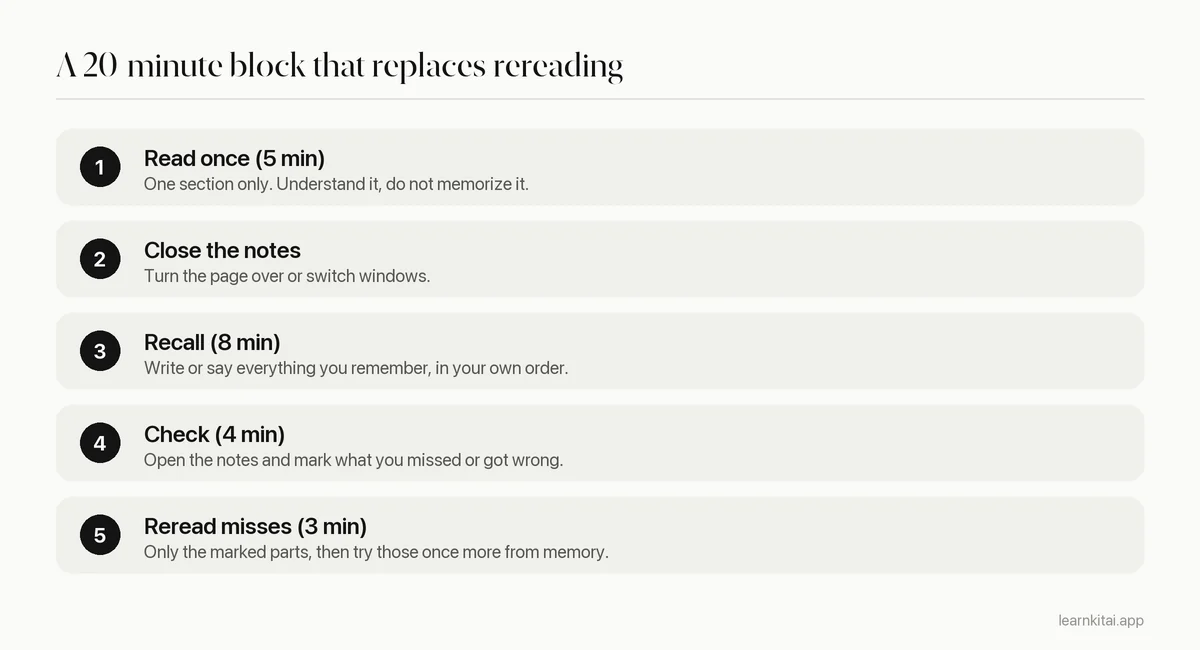
A worked example
Say your biology notes cover cellular respiration. Instead of reading all four pages again, read the glycolysis page once. Close it. On blank paper, write where glycolysis happens, what goes in, what comes out and the net ATP. You get location and inputs right but blank on the net ATP. Now open the page, find that one line, and read it. Ten minutes later, write the answer again without looking. That is one topic, studied in the way the exam will test it.
This is the core of active recall, and it pairs well with spaced repetition: come back to the same questions after a day, then after a few days. If you prefer a single brain dump, the blurting method is the same idea on one sheet of paper.
How can you tell if you actually know it?
Test the skill the exam uses. If you can explain the idea or write the answer with the notes closed, you know it. If you only nod along while reading, you recognize it, which is not the same.
Use a simple rule before you move on: close it, then prove it. Pick three questions from the section. Answer them from memory, out loud or on paper. Two out of three correct means move on and come back tomorrow. Fewer than two means one targeted reread and a second attempt.
Switching feels worse at first. Recalling is slower and you will see more gaps. That discomfort is the point: the effort of pulling information out is what makes it stay. The same logic explains why highlighting falls short too, and why retrieval practice beats simple review.
Frequently asked questions
How many times should I read a chapter before an exam?
Usually once carefully, then switch to self-testing. A second read helps most when it comes days later or when you limit it to parts you could not recall. Reading the same chapter three or four times in one sitting adds very little.
Is rewriting notes better than rereading them?
Copying notes word for word is close to rereading with extra hand work. Rewriting helps more when you do it from memory first and then compare with the original, because that turns it into a recall exercise.
Why do I understand everything in class but forget it at the exam?
Following an explanation is recognition, which feels like understanding. The exam asks you to produce the idea alone. Practice producing it, on paper or out loud, in the days after class.
Does reading notes out loud help?
Reading aloud can help a bit with attention and with remembering the exact wording, but it is still reading. Explaining the idea aloud without looking is a far stronger version of the same habit.
Sources
- Test-enhanced learning: taking memory tests improves long-term retention, Psychological Science (Roediger and Karpicke, 2006) (Experiment 2: one-week recall of 40% after four readings vs 61% after one reading and three recall tests; 83% vs 71% at five minutes.)
- Metacognitive strategies in student learning: do students practise retrieval when they study on their own?, Memory (Karpicke, Butler and Roediger, 2009) (Survey of 177 students: 84% list rereading, 55% rank it first, 11% practice recall, 1% rank it first.)
- Improving Students' Learning With Effective Learning Techniques, Psychological Science in the Public Interest (Dunlosky et al., 2013) (Rates rereading and highlighting as low utility; practice testing and distributed practice as high utility.)
- Rereading effects depend on time of test, Journal of Educational Psychology (Rawson and Kintsch, 2005) (423 students: massed rereading helped only on an immediate test; spaced rereading helped on a delayed test.)
Keep reading

Active Recall: Why Closing the Book Beats Rereading
Rereading feels productive but fades fast. Here is how to study by pulling answers out of memory, with a session plan, examples and the mistakes to avoid.
Retrieval Practice vs Review: Why Pulling Beats Looking
Looking over material and pulling it out of memory feel similar. They are not. Here is how to tell them apart and convert any review session into retrieval.
Does Highlighting Help Studying? What 36 Studies Found
Highlighting helps a little, for some students, under some conditions. Here is what the evidence says and how to turn your highlights into something that works.

Spaced Repetition: Why Forgetting Is Part of the Plan
Reviewing right before you forget builds memories that last. Learn how long the gaps should be, with a ready schedule for exams one week to one semester away.

The Blurting Method: Empty Your Head to Fill It
Write down everything you remember, then check what is missing. A simple revision method with a step-by-step routine, a worked example and four variations.