How Long Should a Summary Be? Let the Job Decide
A summary should be much shorter than its source, and a common writing center rule of thumb is never more than about a quarter of the original. Within that ceiling, the purpose sets the length: one sentence for a quick gist, a paragraph for an essay, and roughly one sentence per section for study notes.
Students ask how long should a summary be because teachers rarely give one number, and the honest answer depends on what the summary is for. The good news is that a few simple rules cover almost every case. You need a ceiling, a length that fits the job, and a way to check whether you cut the right things.
Is there a standard length for a summary?
There is no fixed word count, but there is a ceiling. One writing center rule of thumb says a summary is never more than about one quarter of the original, and in most cases much shorter. Your assignment's instructions always come first.
The Southeastern Louisiana University Writing Center puts it plainly: a good rule of thumb is that a summary is never more than about one quarter the length of the original, though in most cases it is much briefer. The Purdue Online Writing Lab makes the same point in different words: summaries are significantly shorter than the original and give a broad overview.
Treat the quarter as a red line, not a target. A 4,000-word article summarized in 1,000 words is technically within the limit, yet it is probably carrying examples and detail you could drop.
What length fits each kind of summary?
Match the length to the job. A gist is one sentence. A summary inside an essay is usually a few sentences to a paragraph. A study summary of a chapter works well at about one sentence per section, plus key terms. A standalone summary assignment follows the word count you were given.
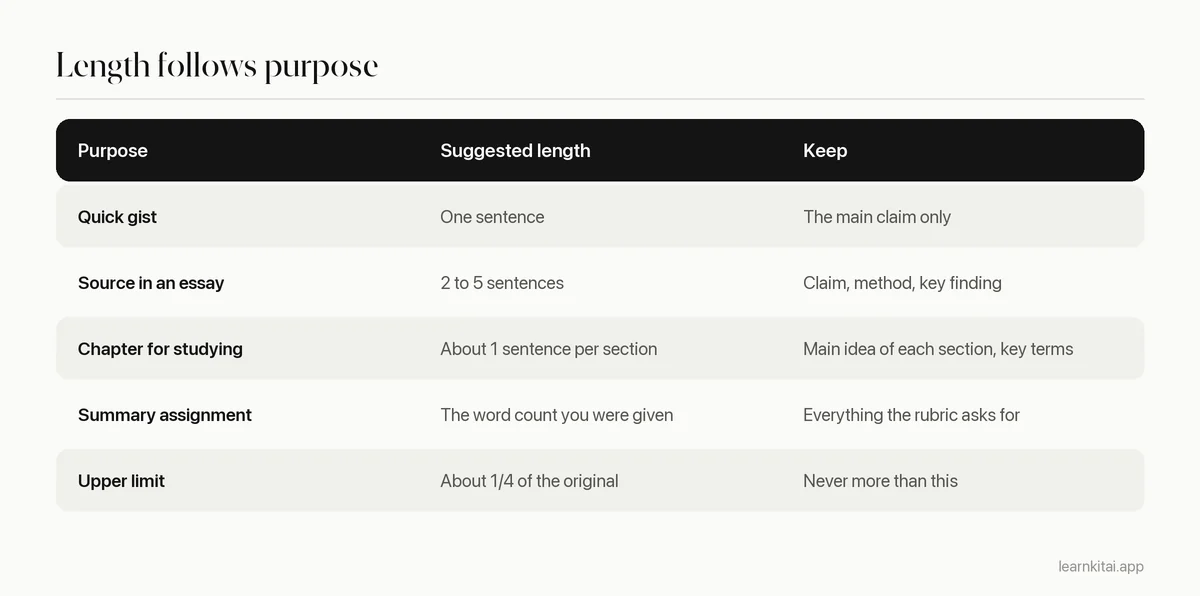
The suggested lengths in the middle rows are our working guidance, not a published standard. They are built around a simple idea: a summary exists to save time. If reading it takes nearly as long as skimming the source, it has failed at its job.
How long should a summary be for studying?
For study notes, aim for about one sentence per section or heading of the source, plus a short list of key terms. A 20-page chapter with eight sections becomes eight to ten sentences that you can read in about a minute.
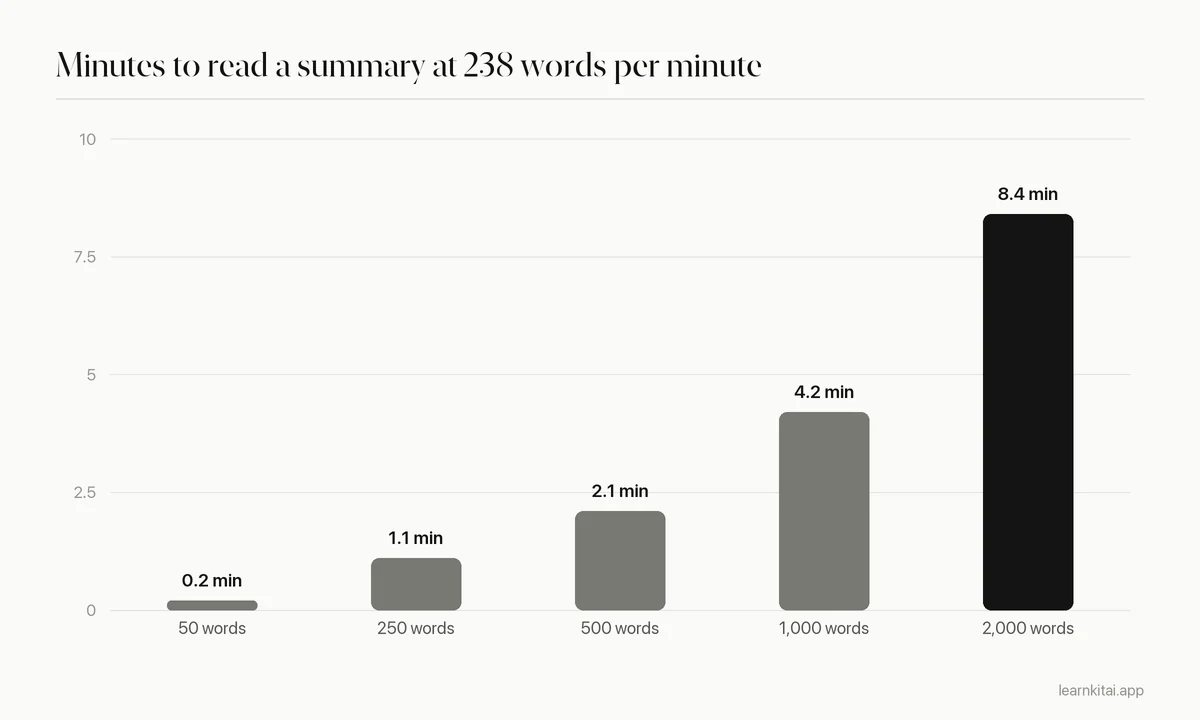
Reading time is a useful check. A large meta-analysis by Marc Brysbaert, covering 190 studies, estimated that adults read English nonfiction silently at about 238 words per minute on average. That means a 240-word study summary takes about a minute to read, while a 2,000-word one takes more than eight. You will reread a study summary many times, so every extra sentence costs you again and again.
A worked example
Take a 6,000-word textbook chapter on the immune system with six sections. A quarter would be 1,500 words, which is a second chapter, not a summary. A good study summary might look like six sentences, one per section, plus eight key terms with short definitions. That is roughly 150 to 200 words. It fits on an index card, reads in under a minute, and still names every main idea.
For the full process of reducing a chapter, including what to keep from figures and boxes, see the guide on how to summarize a textbook chapter. If you want the summary to fit a single sheet with formulas and diagrams too, a one page study guide is the next step up.
Can a summary be too short?
Yes. A summary is too short when someone who has not read the source could not answer its main questions from your summary alone. If it only names topics, like "this chapter covers enzymes", it is a table of contents, not a summary.
A quick test catches this. Write down three questions the source answers, the kind a teacher might ask. Then hide the source and try to answer them using only your summary. If you cannot, add the missing ideas. If you can, try cutting a sentence and test again.
How do you cut a summary down to size?
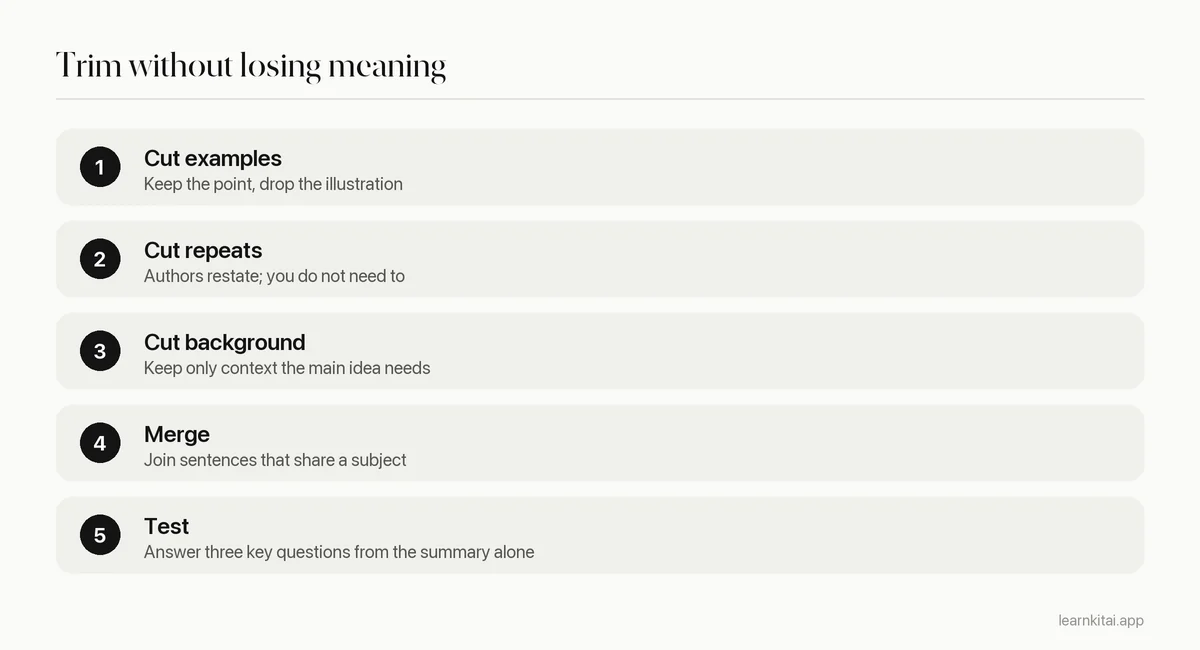
Remove examples, repeated points, background, and anything you already know well. Merge sentences that share a subject. Then run the three-question test to make sure nothing essential was lost.
Remember that a summary keeps only the main ideas, while a paraphrase keeps all the ideas of one passage. If your summary is creeping toward the length of the source, you may be paraphrasing by accident. Our post on summary vs paraphrase shows the difference with one example.
Common length mistakes
- Matching the source paragraph by paragraph. If every paragraph of the source gets a sentence, you are tracking the author's structure, not the ideas. Some paragraphs carry nothing new.
- Keeping every number. Keep a statistic only if the main claim depends on it. One key figure is usually enough.
- Padding to reach a word count. If the assignment asks for 300 words and the ideas fit in 200, add analysis of the main point, not filler.
- Summarizing too early. A summary written halfway through the reading tends to overweight the opening sections. Finish the source first, then decide what matters.
How long should an AI summary be?
Ask for the length you would write yourself for that purpose, and give a number of sentences rather than a percentage. Then check the result against the source, because a shorter summary has more room for an AI to drop or blur a key point.
AI tools are good at producing a first draft quickly. The LearnKit web app makes short summaries for free, and the iPhone app can make longer ones. Either way, read the draft against the source and apply the same three-question test. Our guide to AI summarizer accuracy covers what to check.
So, how long should a summary be? Short enough to save time, long enough to answer the source's main questions, and never more than about a quarter of the original. When in doubt, cut, then test.
Frequently asked questions
How many words should a one-paragraph summary have?
Most one-paragraph summaries run about 100 to 200 words. If your assignment says one paragraph without a word count, stay in that range and focus on the main claim and the key support.
How long should a summary of a research article be?
In an essay, a few sentences usually covers the question, method and main finding. For your own notes, add the sample size and one limitation, which is still well under a page.
Should a summary include my opinion?
No. A summary reports what the source says. If your assignment asks for a response or critique, write that in a separate section after the summary.
How long should a book summary be?
It depends on the purpose. For study notes, one or two sentences per chapter works well. For a written assignment, follow the word count, and keep it well under a quarter of the book.
Sources
- Writing an Academic Summary, Southeastern Louisiana University Writing Center (A summary is never more than about one quarter the length of the original, usually much briefer)
- Quoting, Paraphrasing, and Summarizing, Purdue Online Writing Lab (Summaries are significantly shorter than the original)
- How many words do we read per minute? A review and meta-analysis of reading rate, Journal of Memory and Language (Brysbaert, 2019) (190 studies; average silent reading rate of 238 words per minute for English nonfiction)
Keep reading
How to Summarize a Chapter So You Never Reread It
Most chapter summaries are just shorter copies of the book. The closed-book method turns summarizing into practice that sticks, so you can study from your page instead of the chapter.
Summary vs Paraphrase: Same Source, Different Jobs
A paraphrase keeps every idea of one passage. A summary keeps only the main ones. Here is how to tell which one your assignment, or your study session, needs.
One Page Study Guide: Let the Space Limit Teach You
Squeezing a whole unit onto one page forces you to decide what matters. Here is a layout, a build routine, and the step most students skip.
Summarize an Article Fast: Read Less, Keep More
Reading every word of a long article is the slow way to summarize it. A three-pass method gets you the main points in a fraction of the time.
AI Summarizer Accuracy: What Gets Lost, and How to Check
AI summaries are fluent and fast, and usually mostly right. Here is where they slip, and a five-minute check before you study from one.