Summary vs Paraphrase: Same Source, Different Jobs
A paraphrase restates one specific passage in your own words and keeps all of its ideas, so it ends up about as long as the original. A summary covers a whole source or section and keeps only the main points, so it is much shorter. Both need a citation when you use them in writing.
Students often treat the two words as synonyms, and teachers mark them down for it. The difference in summary vs paraphrase is not about wording at all. It is about scope: how much of the source you cover, and how much detail you keep. Once you see that, choosing the right one for an essay or a study session becomes simple.
What is the difference between a summary and a paraphrase?
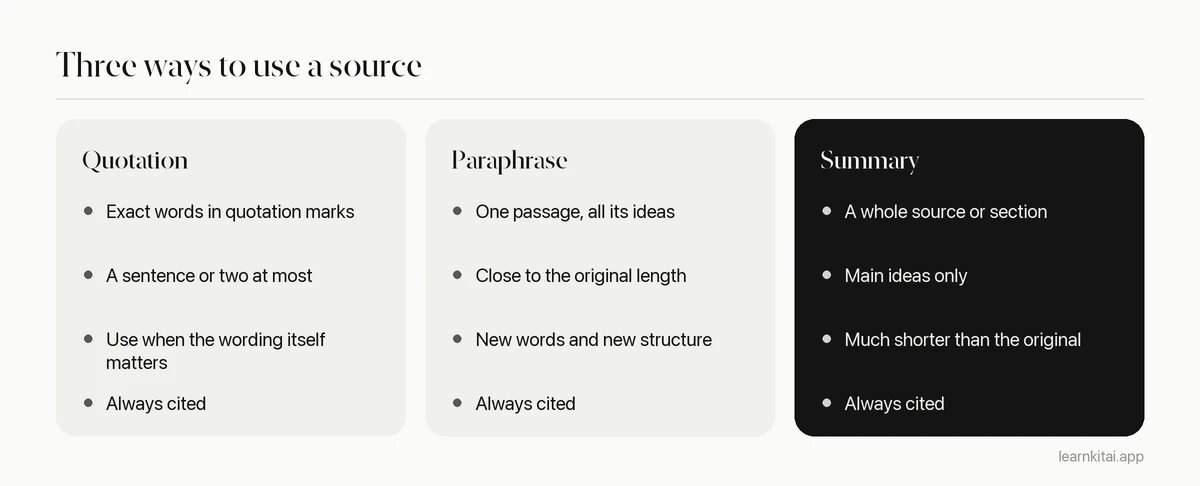
A paraphrase keeps every idea of a short passage and changes the wording and sentence structure. A summary keeps only the main ideas of a longer piece and drops examples and detail. A paraphrase is about as long as its passage; a summary is much shorter.
The Purdue Online Writing Lab puts it clearly: a paraphrase puts a passage into your own words and is usually a little shorter than the original, while a summary includes only the main points and is significantly shorter. Both are different from a quotation, which copies the exact words and puts them in quotation marks.
Summary vs paraphrase: what does each look like on one passage?
Take one paragraph and write both. The paraphrase keeps every claim and example in new words. The summary keeps the single main claim and drops the rest. Seeing them side by side makes the difference obvious.
Here is a short original passage written for this example:
Paraphrase: Although reefs occupy only a small part of the seabed, many ocean species depend on them. Long stretches of unusually warm water make corals push out the algae living inside them, which is what gives corals their color. This bleaching is not instantly fatal, but extended heat leaves the coral without food and may kill it.
Summary: Prolonged ocean heat causes coral bleaching, which can starve and kill reefs that many marine species rely on.
The paraphrase has nearly the same length and every idea is still there, including the detail about color. The summary is one sentence and keeps only what you would need to remember a month from now. Neither copies a phrase from the original, and both would still need a citation in an essay.
When should you summarize instead of paraphrase?
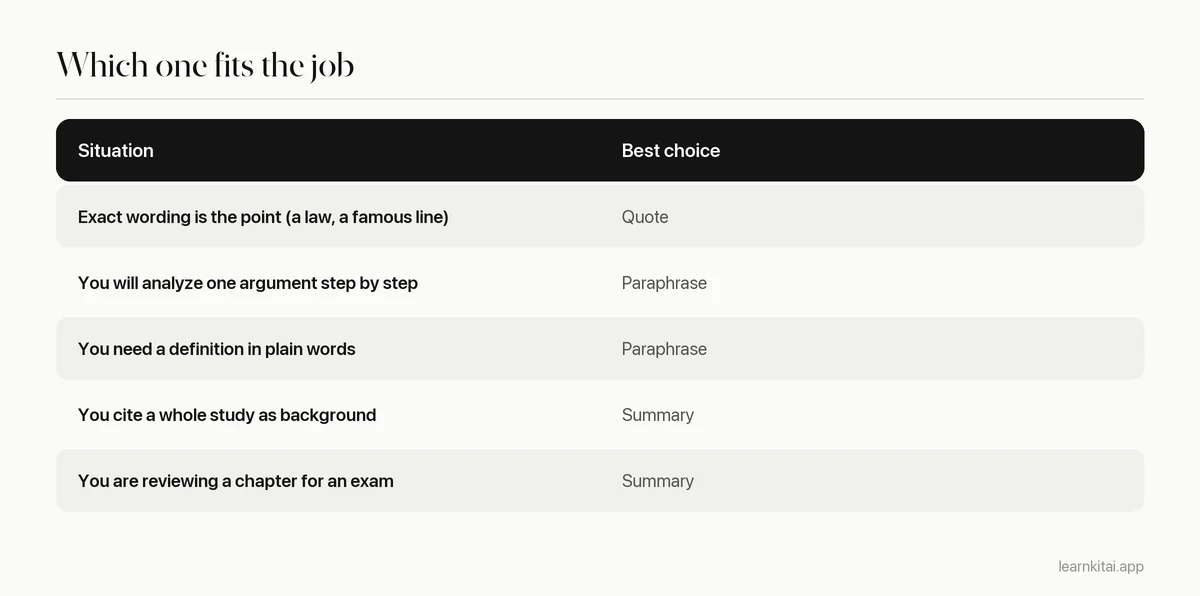
Summarize when you need the big picture of a long source, such as an article you cite in passing or a chapter you are reviewing. Paraphrase when one specific passage matters, such as a definition, a method, or an argument you will analyze closely.
For studying, summaries usually win. You rarely need every detail of a passage in your own words, but you often need the main idea of a chapter in a form you can recall quickly. Our guide on how to summarize a textbook chapter walks through that process section by section, and how long a summary should be covers the length question in more detail.
How do you paraphrase without plagiarizing?
Read the passage until you understand it, then look away and write it from memory. Check it against the original for accuracy and for any borrowed phrases, put unchanged technical terms in context, and add a citation.
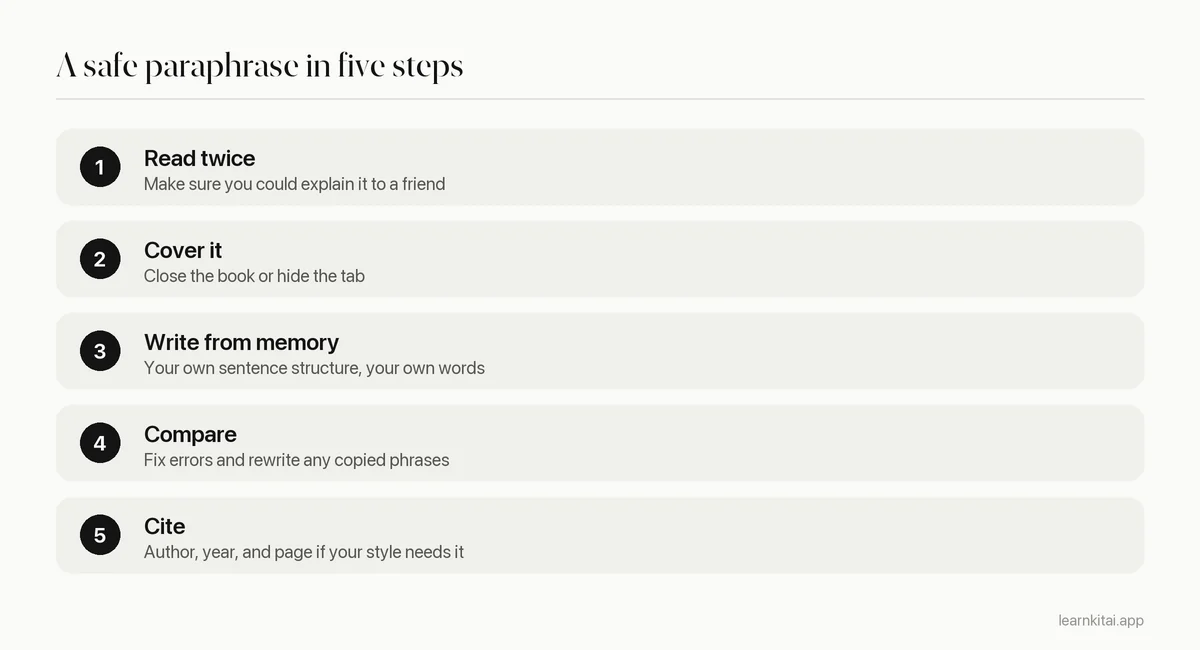
The most common mistake is the "synonym swap": keeping the original sentence and replacing a few words. That is still too close to the source, and plagiarism checkers and teachers both catch it. Writing from memory forces a new structure, because you are rebuilding the idea instead of editing someone else's sentence.
If you use AI tools to help, the same rules apply. An AI rewrite of a passage is still a paraphrase of someone else's work and still needs a citation, and many schools have specific rules about it. See our note on AI and academic integrity before you submit anything.
How long should a summary be compared with a paraphrase?
A paraphrase is roughly the length of its passage, often a bit shorter. A summary should be much shorter. One writing center rule of thumb says a summary is never more than about a quarter of the original, and usually far less.
The Southeastern Louisiana University Writing Center gives a useful ceiling: a summary is never more than about one quarter the length of the original, and in most cases it is much briefer. A 20-page article might get a one-paragraph summary in an essay, while a single paragraph from it might get a paraphrase of similar size.
Does summarizing actually help you learn?
It can, but it depends on how you do it. In a large review of 10 study techniques, summarization was rated low utility because its benefits are limited to some students and tasks. Summaries help most when you write them from memory and then test yourself on them.
A 2013 review by Dunlosky and colleagues rated 10 popular study techniques. Practice testing and distributed (spaced) practice came out on top, while summarization landed in the low utility group, because it helped only some students on some tasks. That does not make summaries useless. It means a summary works best as a step toward testing, not as the final product.
A practical routine is to summarize a section from memory, check it against the text, then turn each main point into a question. That last step is where most of the memory gain comes from, as the practice testing guide explains. LearnKit can draft a summary and questions from a PDF or web page, which gives you something to check your own version against.
To sum up summary vs paraphrase: paraphrase when one passage matters in full, summarize when the whole source matters in brief, and cite both. For exam prep, spend less time polishing summaries and more time testing yourself on what they say.
Frequently asked questions
Is a paraphrase shorter than the original?
Usually only slightly. A paraphrase keeps all the ideas of a passage, so it cannot shrink much. If yours is half the length, you have probably dropped ideas and written a summary instead.
Do I need to cite a summary?
Yes. A summary still presents another author's ideas, so it needs a citation in academic writing. Study notes for yourself do not need formal citations, but writing the source at the top saves trouble later.
Can a summary include quotations?
It can, but sparingly. A short quotation is useful when a key term or phrase is the author's own and hard to restate. Most of a summary should still be in your own words.
Is paraphrasing the same as rewording?
Not quite. Rewording often means swapping a few words while keeping the sentence shape, which is too close to the source. A real paraphrase changes both the words and the structure while keeping the meaning.
Sources
- Quoting, Paraphrasing, and Summarizing, Purdue Online Writing Lab (Definitions: paraphrase usually a little shorter, summary significantly shorter, both in your own words)
- Writing an Academic Summary, Southeastern Louisiana University Writing Center (Rule of thumb that a summary is never more than about one quarter of the original length)
- Improving Students' Learning With Effective Learning Techniques, Psychological Science in the Public Interest (Dunlosky et al., 2013) (Review of 10 techniques; summarization rated low utility, practice testing high)
Keep reading
How to Summarize a Chapter So You Never Reread It
Most chapter summaries are just shorter copies of the book. The closed-book method turns summarizing into practice that sticks, so you can study from your page instead of the chapter.
How Long Should a Summary Be? Let the Job Decide
There is no single right length. There is a ceiling, a purpose, and a quick test that tells you when a summary is short enough.
How to Summarize a Research Paper in Three Passes
You do not read a research paper like a novel. Three quick passes, a five-line template and one worked example get you from abstract to a summary you can use.

AI Academic Integrity: Where Help Ends and Cheating Starts
The tool is rarely the problem. What you submit as your own thinking is. A simple test for staying honest while studying with AI.
Summarize an Article Fast: Read Less, Keep More
Reading every word of a long article is the slow way to summarize it. A three-pass method gets you the main points in a fraction of the time.