How to Summarize a Chapter So You Never Reread It
To summarize a textbook chapter, preview its headings and questions, read one section at a time, then close the book and write two to four sentences per section from memory. Check them against the text and fix errors, compress everything into one paragraph plus key terms, and turn the summary into questions you can test yourself on.
Most students summarize a chapter by reading it with a pen in hand and copying the important sentences into a notebook. The result is a shorter version of the book, and studying from it feels a lot like rereading. This guide shows you how to summarize a chapter in a way that does real work for your memory. The core idea is simple: write the summary with the book closed, then check it. You will get a six-step method, a worked example, a table of what to keep and what to cut, and a plan for studying from the finished page.
Does summarizing a chapter actually help you learn?
It depends on how you do it. A large review of study techniques rated summarization as low utility, mainly because many students summarize poorly. Writing a summary from memory and then checking it adds retrieval practice, one of the best-supported techniques, and makes summarizing far more useful.
In 2013, John Dunlosky and four colleagues reviewed ten popular study techniques in a long report for the Association for Psychological Science. Practice testing and distributed practice got the highest rating. Summarization, highlighting and rereading were among the five rated low. The authors did not say summaries are useless. They noted that summarizing tends to help students who already summarize well, while many others need a lot of training before it pays off.
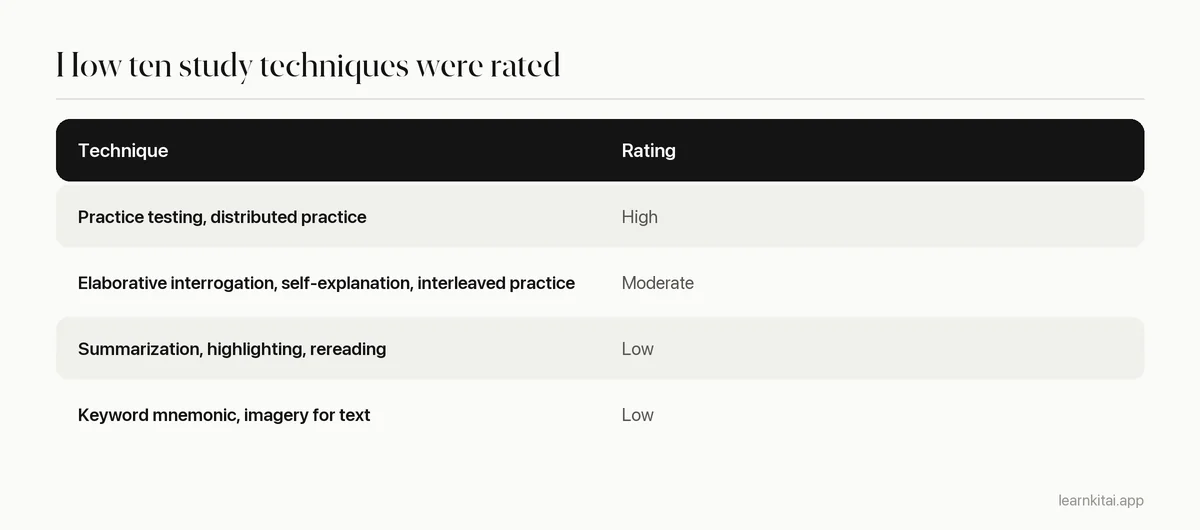
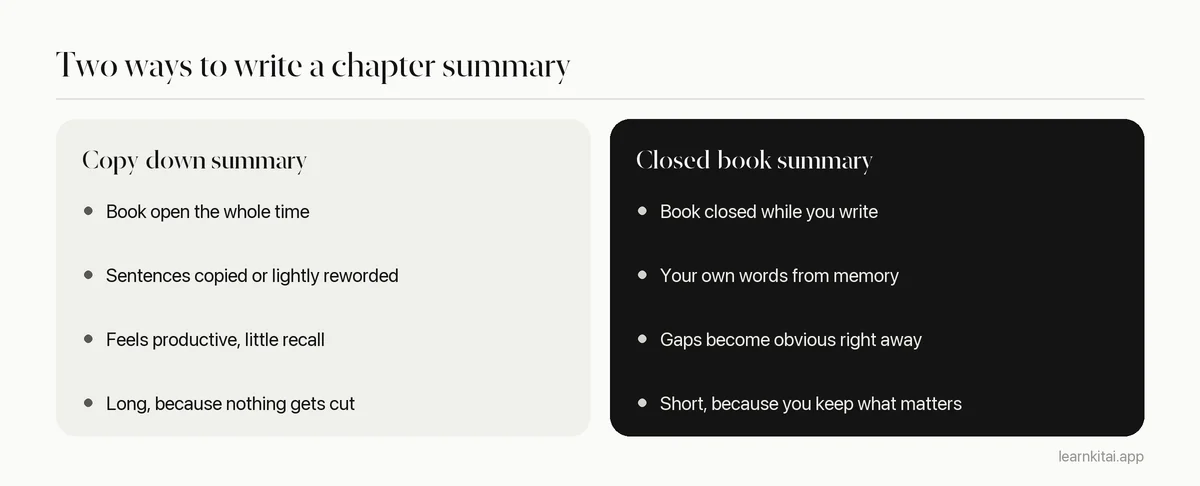
So the question is not whether to summarize but how. A closed-book summary combines the two activities that rate well and poorly: you summarize, but you do it by recalling. That puts your summary on the same side as practice testing.
How to summarize a chapter in six steps
1. Preview the chapter
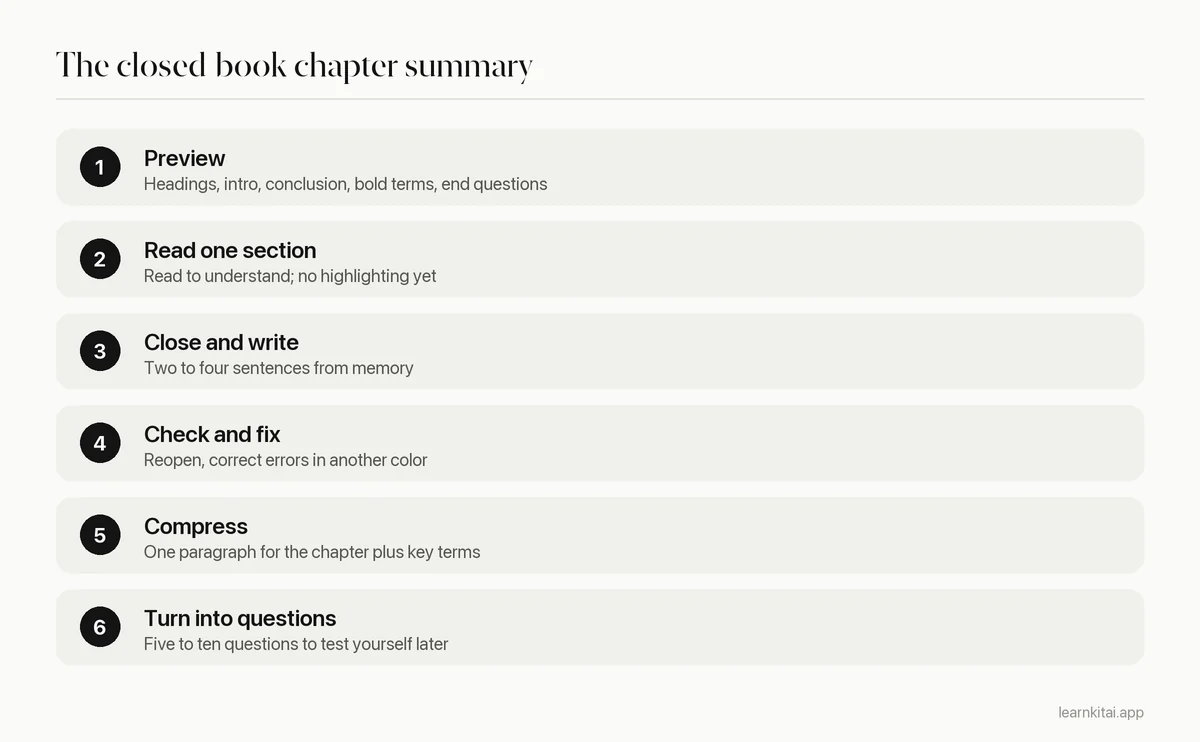
Spend five to ten minutes on the skeleton: the chapter title, every heading, the introduction, the conclusion, the bold terms and the review questions at the end. This gives you a map, so each section has a place to go. The end-of-chapter questions are especially valuable, because they tell you what the authors think matters. This is the survey step of the SQ3R reading method.
2. Read one section at a time
Read a single section, usually a heading and the text under it, with the goal of understanding it well enough to explain. Skip the highlighter on this pass. Highlighting while you read tends to mark too much, and it feels like progress when it is not, as explained in does highlighting help studying.
3. Close the book and write
Now close the book, or cover the page, and write two to four sentences about what the section said. Use your own words. Do not worry about style. If you get stuck, write what you do remember and leave a gap. The gap is useful: it shows you exactly what you did not take in.
4. Check and fix
Open the book and compare. Fix anything wrong and fill the gaps, ideally in a different color so you can see what you missed. Those corrections are your weakest points and the first things to review later.
5. Compress the chapter
When every section is done, read your section summaries and write a single paragraph that captures the chapter's main argument. Under it, list the key terms with a short definition each. This is the version you will study from. Everything else is scaffolding.
6. Turn it into questions
Finally, write five to ten questions that your summary answers. Some should be factual (What is osmosis?) and some should ask why or how (Why does a cell need active transport if diffusion is free?). These questions are what you will actually study with.
What does a good chapter summary look like?
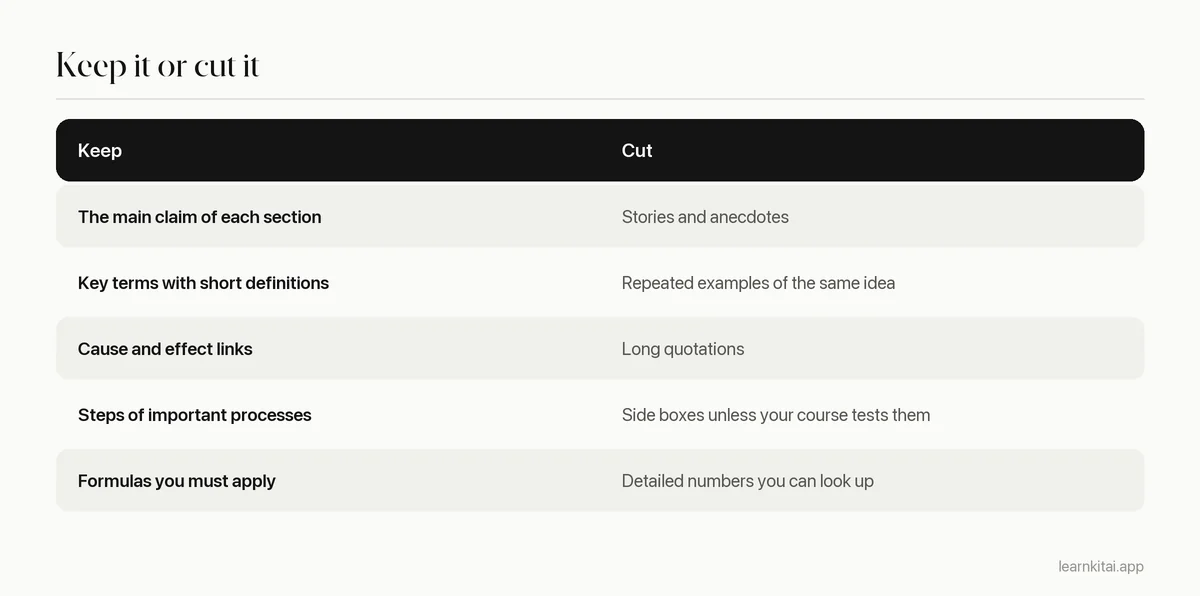
A good summary states the chapter's main idea first, then the few supporting points that explain it, in your own words, with the key terms defined. It leaves out examples, stories and details you can rebuild from the main ideas. It should be short enough to read in a minute or two.
Here is an example for a typical introductory biology chapter on cell membranes, with four sections: membrane structure, passive transport, active transport and bulk transport.
That is about 90 words for a chapter that might run 25 pages. It does not mention every protein or every diagram. It gives you the structure that the details hang on, and every sentence could become a question.
How long should a chapter summary be?
Short enough that you would happily reread it before a test, which for most chapters means about one page or less. A one-paragraph overview plus a list of key terms is often enough. If your summary is more than a few pages, you are copying rather than summarizing.
There is no perfect ratio, because a dense physics chapter and a narrative history chapter compress differently. The more useful test is whether every line earns its place. For more on finding the right length, see how long should a summary be. If you are unsure whether you are summarizing or just rewording, summary vs paraphrase explains the difference.
Which note format works best for a chapter summary?
Pick the format that matches the chapter's shape. Use an outline for chapters built as a hierarchy, a mind map for chapters full of connected ideas, Cornell notes when you want built-in questions, and a one-page study sheet for the final compressed version.
- Outline: best for textbook chapters with clear headings and subheadings. See outline note taking.
- Cornell notes: a page with a cue column for questions and a summary box at the bottom. See Cornell notes.
- Mind map: good for chapters where ideas link across sections. See mind map vs linear notes.
- One-page study sheet: the final compressed version for exam review. See one page study guide.
Can AI summarize a chapter for you?
Yes, and it is fast, but reading an AI summary is closer to rereading than to recalling. Use it as a check after you write your own closed-book summary, or as a preview before you read. Always compare it with the chapter, because AI summaries can drop key points or state things the text never said.
A good way to combine both is to write your own closed-book summary first, then generate an AI summary and compare the two. Anything the AI included that you missed is a gap worth checking in the book. Anything the AI got wrong is a useful lesson in reading critically. LearnKit can summarize a PDF of the chapter or a photo of the pages and then turn the summary into flashcards or a quiz. If your chapter is a scanned PDF or a photo, see notes from scanned pages, and for a full workflow with PDFs read how to summarize a PDF with AI.
How do you study from a summary once it is written?
Do not just reread it. Cover the summary and try to rebuild it from the headings, answer the questions you wrote in step six, and review again after a few days and a week. Rereading the summary is still rereading; testing yourself on it is what makes it last.
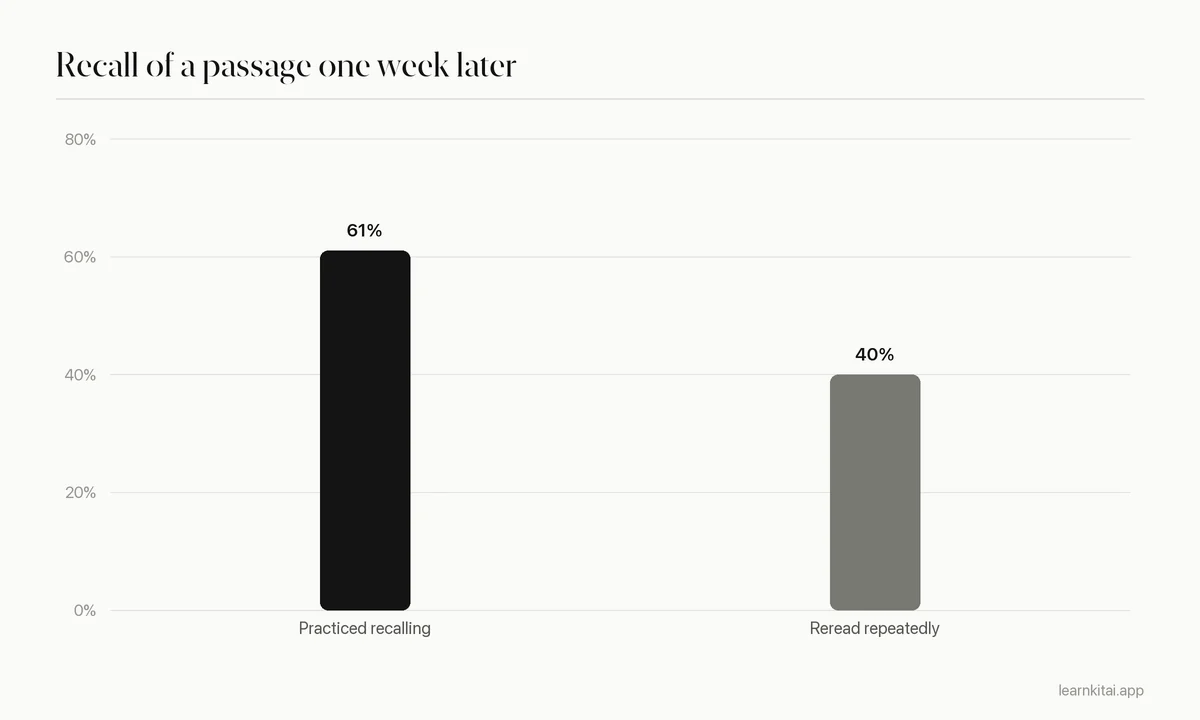
This is where the closed-book method pays off a second time. In Roediger and Karpicke's 2006 experiments, students who practiced recalling a passage remembered 61% of it a week later, while those who reread it remembered 40%. The same logic applies to your summary: treat it as an answer key, not as reading material.
- Same day: answer your step-six questions once without looking.
- Two or three days later: rewrite the one-paragraph summary from memory, then compare.
- One week later: answer the questions again and turn any you missed into flashcards.
- Before the exam: quiz yourself across several chapters at once, mixing topics.
What if you do not understand the chapter well enough to summarize it?
Then the summary has done its job by showing you that. Go back to the section you could not explain, read it slowly, look at its examples and figures, and try a simpler source such as a video or a different textbook. Summarize only after you can explain the idea out loud.
A blank page after a section is not failure. It is information. Usually the cause is one of three things: a term you skipped, a step in reasoning you skimmed, or a figure that carries the real explanation. Find which one it is. Try explaining the section to an imaginary friend, a version of the Feynman technique, and notice exactly where your explanation breaks down. That break is the thing to look up.
Hard chapters also benefit from smaller pieces. Instead of one section at a time, summarize one paragraph at a time until the ideas start to connect. It is slower, but it is still faster than rereading the whole chapter three times and hoping it clicks.
Common mistakes when summarizing a chapter
- Summarizing with the book open the whole time, so nothing is recalled.
- Writing a summary as long as the chapter.
- Copying the author's sentences, which hides whether you understood them.
- Skipping the preview, so sections feel like disconnected facts.
- Leaving the summary in a notebook and never testing yourself on it.
Once you know how to summarize a chapter this way, the same approach works for other material too. Research papers have their own structure, covered in how to summarize a research paper, and video lectures are handled in how to summarize a YouTube video. Whatever the source, the rule holds: summarize from memory, check, then test yourself on what you wrote.
Frequently asked questions
Should I summarize every chapter or only the hard ones?
If you have time, summarize every chapter that will be tested, because the one-page versions become your exam review material. If time is short, do full closed-book summaries for the hardest chapters and a quick one-paragraph version for the rest.
Is it better to summarize by hand or on a computer?
Either works if you write from memory in your own words. Handwriting is slower, which naturally forces you to condense. Typing is faster to edit and easier to turn into flashcards later.
How long should it take to summarize a chapter?
Expect it to take longer than just reading the chapter, especially the first few times. The extra time replaces later rereading, so it usually saves time over the course of a term.
Can I use the end-of-chapter summary in my textbook instead?
Use it as a check, not a replacement. Reading the author's summary is quick review, but writing your own is what tests whether you understood the chapter. Compare the two and note anything the author stressed that you left out.
Sources
- Which study strategies make the grade?, ScienceDaily (Association for Psychological Science release on Dunlosky et al., 2013) (Ten techniques reviewed; practice testing and distributed practice rated high utility; summarization, highlighting and rereading among the five rated low.)
- Test-Enhanced Learning: Taking Memory Tests Improves Long-Term Retention, Psychological Science (Roediger and Karpicke, 2006) (61% vs 40% recall after one week for repeated testing vs repeated study.)
Keep reading

Summarize PDF Files With AI and Catch What It Gets Wrong
AI can shrink a 60-page PDF in seconds. Here is a workflow that keeps the speed and catches the errors before they end up in your notes.
How to Summarize a Research Paper in Three Passes
You do not read a research paper like a novel. Three quick passes, a five-line template and one worked example get you from abstract to a summary you can use.
Cornell Notes: The Page That Quizzes You Back
A Cornell page is not just a neat layout. Its left column turns your notes into a built-in self-test you can run in ten minutes.
One Page Study Guide: Let the Space Limit Teach You
Squeezing a whole unit onto one page forces you to decide what matters. Here is a layout, a build routine, and the step most students skip.
How Long Should a Summary Be? Let the Job Decide
There is no single right length. There is a ceiling, a purpose, and a quick test that tells you when a summary is short enough.