One Page Study Guide: Let the Space Limit Teach You
A one page study guide condenses a unit onto a single sheet: key concepts, formulas or dates, connections between ideas, and the questions you still get wrong. Its value comes from building it from memory and then testing yourself with it, not from rereading the finished page.
Give yourself one sheet of paper for a whole unit and something useful happens: you can no longer copy everything, so you have to decide what matters. A one page study guide is a summary with a hard size limit, and that limit is the point. It turns a passive task, rereading notes, into a series of choices about importance, structure and gaps.
There is a catch, though, and research shows it clearly. This guide covers the layout, the build routine, a worked example, and the step that makes the sheet actually pay off on exam day.
What should go on a one page study guide?
Put the ideas you need to recall, not the ones you already know: core definitions, formulas or dates, how the big ideas connect, worked examples of tricky problems, and a short list of questions you keep getting wrong.
Split the page into zones before you write anything. Zones stop the sheet from becoming a wall of tiny text, and they make it easy to test yourself one area at a time.
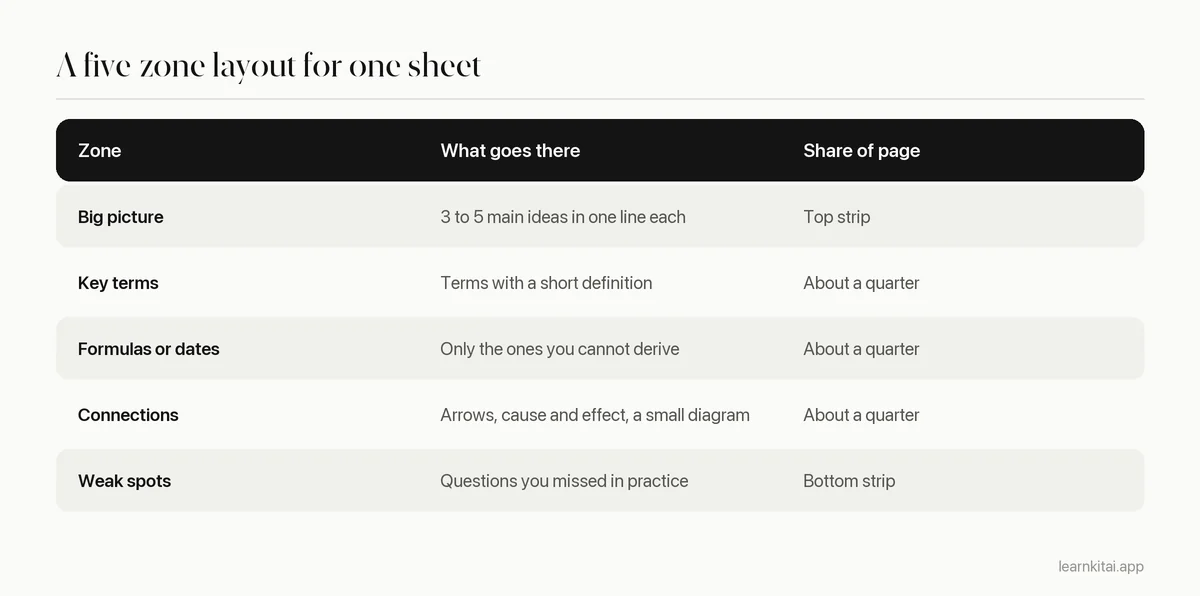
Leave out anything you could explain cold. If you have never missed a question on it, it does not earn space. The sheet is a map of what is hard for you, not a table of contents for the course.
How do you make a one page study guide step by step?
Start from a blank page with your notes closed and write everything you remember. Then open your notes, add what you missed in a different color, cut what you already know, and arrange the rest into zones.
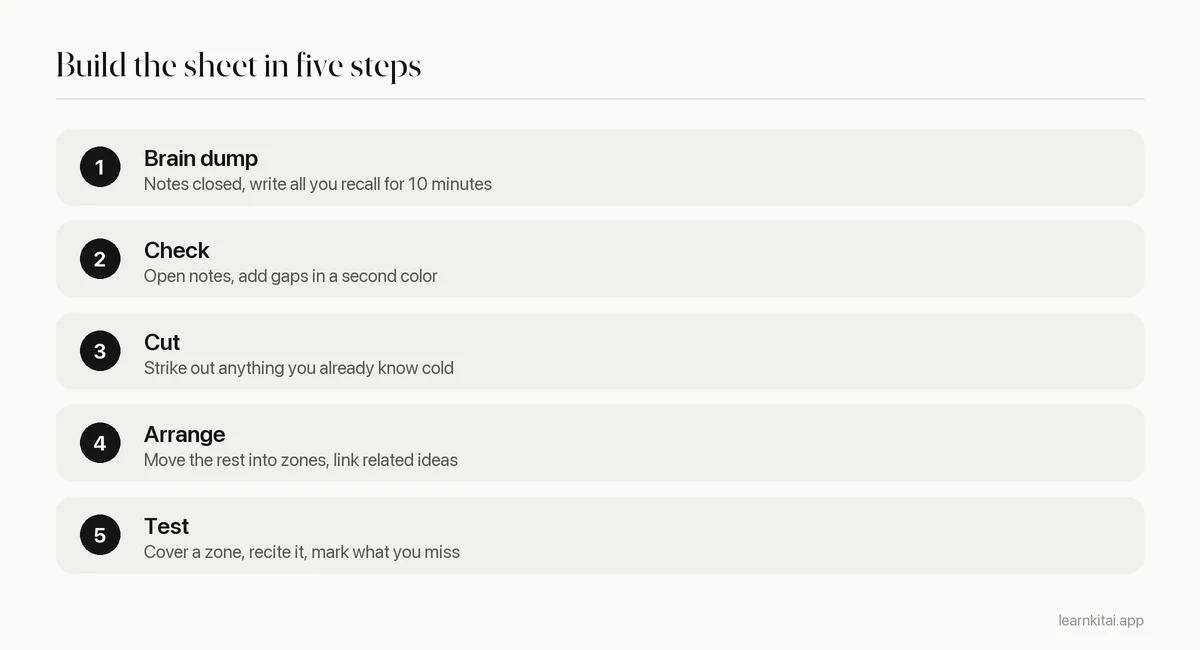
The first step matters most. Writing from memory before you look is a version of the blurting method, and it shows you exactly where your gaps are. Everything you add in the second color is a gap you would otherwise have found in the exam room.
A worked example: a biology cell unit
Say your unit covers cell structure, membranes and cell division. Your big-picture strip might read: cells are organized into compartments; the membrane controls what crosses; division copies DNA before splitting. Key terms might list osmosis, active transport and cytokinesis with five-word definitions. The connections zone could hold a small arrow chain from "DNA replication" to "chromosomes condense" to "sister chromatids separate". The weak-spots strip lists the two questions you missed on the last quiz, such as the difference between hypertonic and hypotonic solutions.
Notice what is missing: the parts of the cell you have known since middle school. Those take up a full page in your notes and zero space on the sheet.
Does making a study sheet actually help you remember?
Only if you use it to test yourself. A classroom study found that crib cards used during exams did not raise scores, and building the card alone did not help either. The memory gain comes from retrieving the content, not from owning a neat summary.
In a study by Dickson and Miller, 54 psychology students were allowed to bring crib cards to two of their four exams. Students expected the cards to raise their scores and calm their nerves. The cards did neither, even on simple factual questions. A follow-up study by the same authors found that making the card did not improve learning on its own.
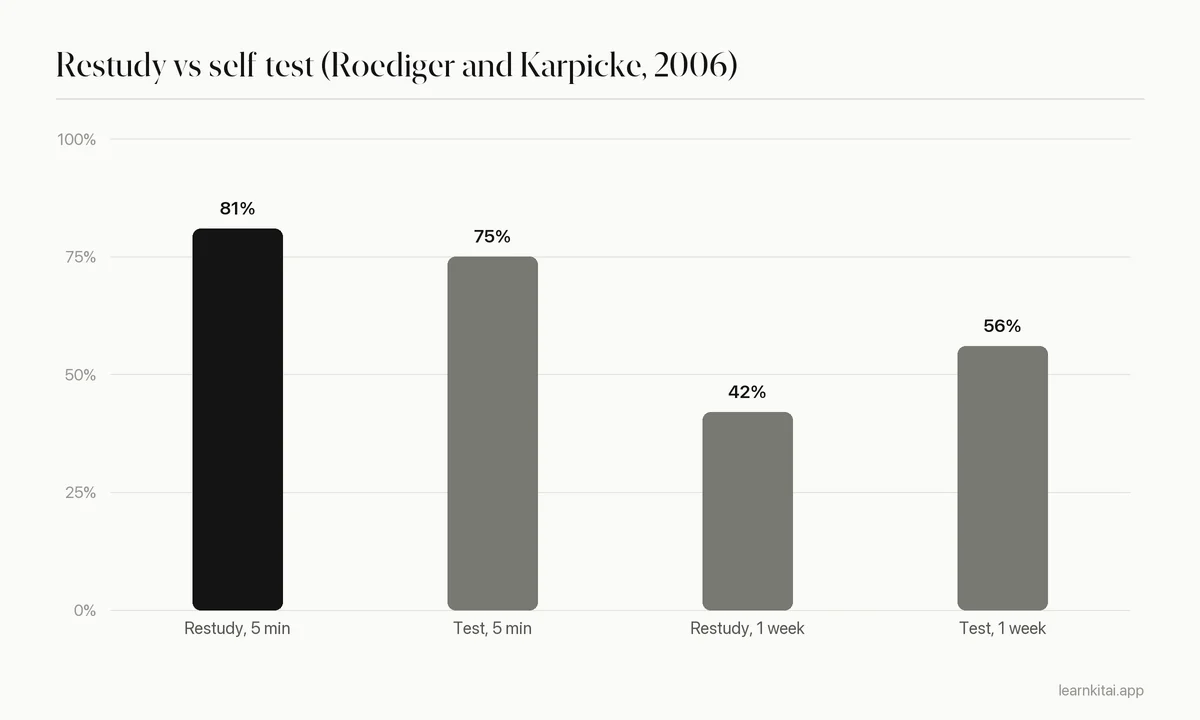
That sounds like bad news for study sheets, but it points to the real lesson. The sheet is a tool for practice, not a product. When you cover a zone and try to rebuild it, you are doing retrieval practice, and that is what moves memory. In a classic experiment by Roediger and Karpicke, students who restudied a passage did slightly better on a test five minutes later, yet a week later the students who had tested themselves recalled far more.
How do you study with a one page study guide?
Cover one zone at a time and recite or rewrite it from memory, then check. Mark anything you miss. A few days later, try rebuilding the whole sheet on a blank page and compare it with the original.
Here is a simple schedule for the week before a test. It spreads your practice out, which is the core idea behind spaced repetition, and it keeps each session short.
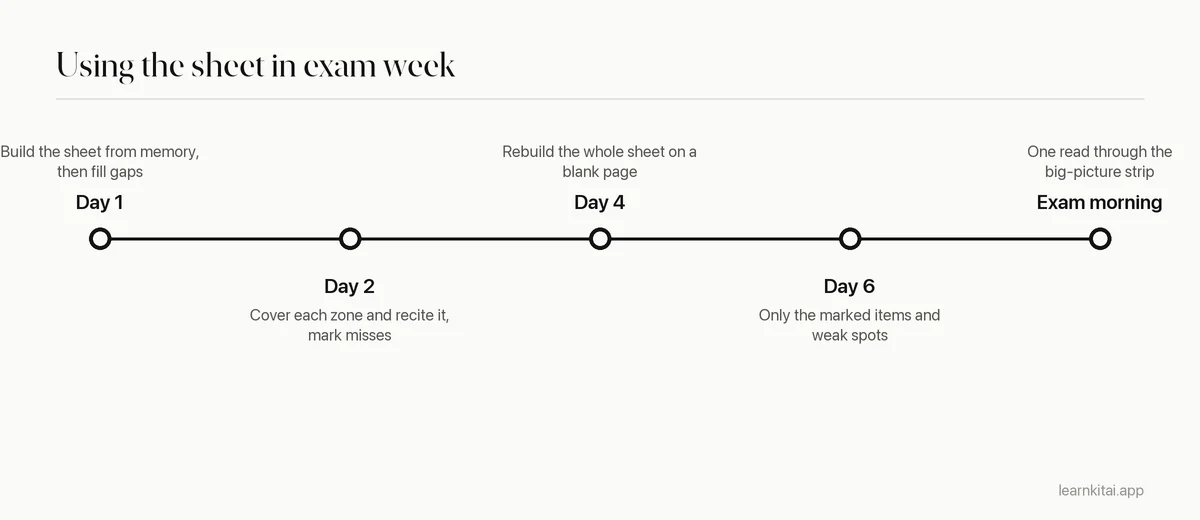
If your teacher allows a sheet in an open-note exam, the same advice holds: the act of building and testing is what prepares you, and the sheet itself is a backup. Our guide to open book exam preparation explains how to organize a sheet so you can find things fast under time pressure.
One page study guide mistakes to avoid
- Copying the textbook in tiny handwriting. If it fits only because the font shrank, you skipped the deciding step.
- Decorating instead of deciding. Colors help to separate zones, but an hour of lettering is an hour of not testing.
- Building it the night before. The sheet needs a few days of practice to do its job.
- Never covering it. A sheet you only reread is a shorter version of rereading, which is one of the weakest ways to study.
A generated summary can help you check your sheet for missing topics. LearnKit can summarize a chapter PDF so you can compare its main points with your big-picture strip. If it lists something you forgot, that item goes in your weak-spots zone. For the full process of condensing a chapter, see how to summarize a textbook chapter.
The best study sheet is the one you could almost rewrite without looking. When you reach that point, the page has done its work, and you can put it away.
Frequently asked questions
Should a study guide be handwritten or typed?
Either works. Handwriting makes it harder to copy large blocks of text, which keeps the sheet short. Typed sheets are easier to edit and reprint. Choose the one you will actually test yourself with.
Can I use both sides of the page?
You can, but try one side first. The tighter limit forces sharper choices. If a unit is truly too big, make one sheet per topic rather than one dense sheet for everything.
How long should it take to make a study sheet?
Plan about 45 to 90 minutes for one unit, including the brain dump and the check against your notes. If it takes much longer, you are probably copying instead of choosing.
Is a study sheet the same as a cheat sheet?
The format is similar, but the purpose differs. A cheat sheet is a reference you look at during an exam, when allowed. A study sheet is a tool you practice with before the exam so you do not need to look.
Sources
- Authorized Crib Cards Do Not Improve Exam Performance, Teaching of Psychology (Dickson and Miller, 2005) (54 students; crib cards on 2 of 4 exams did not improve scores or reduce anxiety)
- Effect of Crib Card Construction and Use on Exam Performance, Teaching of Psychology (Dickson and Miller, 2006) (Constructing crib cards did not facilitate learning; self-made cards did not improve scores)
- Test-enhanced learning: taking memory tests improves long-term retention, Psychological Science (Roediger and Karpicke, 2006) (Experiment 1: restudy 81% vs test 75% at 5 minutes; test 56% vs restudy 42% at one week)
Keep reading
How to Summarize a Chapter So You Never Reread It
Most chapter summaries are just shorter copies of the book. The closed-book method turns summarizing into practice that sticks, so you can study from your page instead of the chapter.
Cornell Notes: The Page That Quizzes You Back
A Cornell page is not just a neat layout. Its left column turns your notes into a built-in self-test you can run in ten minutes.
The Blurting Method: Empty Your Head to Fill It
Write down everything you remember, then check what is missing. A simple revision method with a step-by-step routine, a worked example and four variations.
How to Study for Finals: A 3-Week Plan That Holds Up
Finals reward the student who starts with a plan, not the one who studies longest. Here is a three-week system for triage, testing and sleep.
Open Book Exam Prep: Why the Book Will Not Save You
Open book sounds easy until the clock runs out while you hunt for a page. Prepare as if the book were closed, then build a system to find things fast.