Summarize an Article Fast: Read Less, Keep More
To summarize an article fast, first map it in a few minutes by reading the title, introduction, headings and conclusion. Then read closely only the sections that answer your question. Finally, close the article and write three to five sentences from memory, and check them against the text.
A long article can eat an evening if you read it like a novel, from the first word to the last. You rarely need to. To summarize an article well, you need its main claim, its key support, and its conclusion, and most articles tell you where those are. This guide shows a three-pass method that finds them quickly, plus a time budget so you know when to stop.
How long does it take to read a long article?
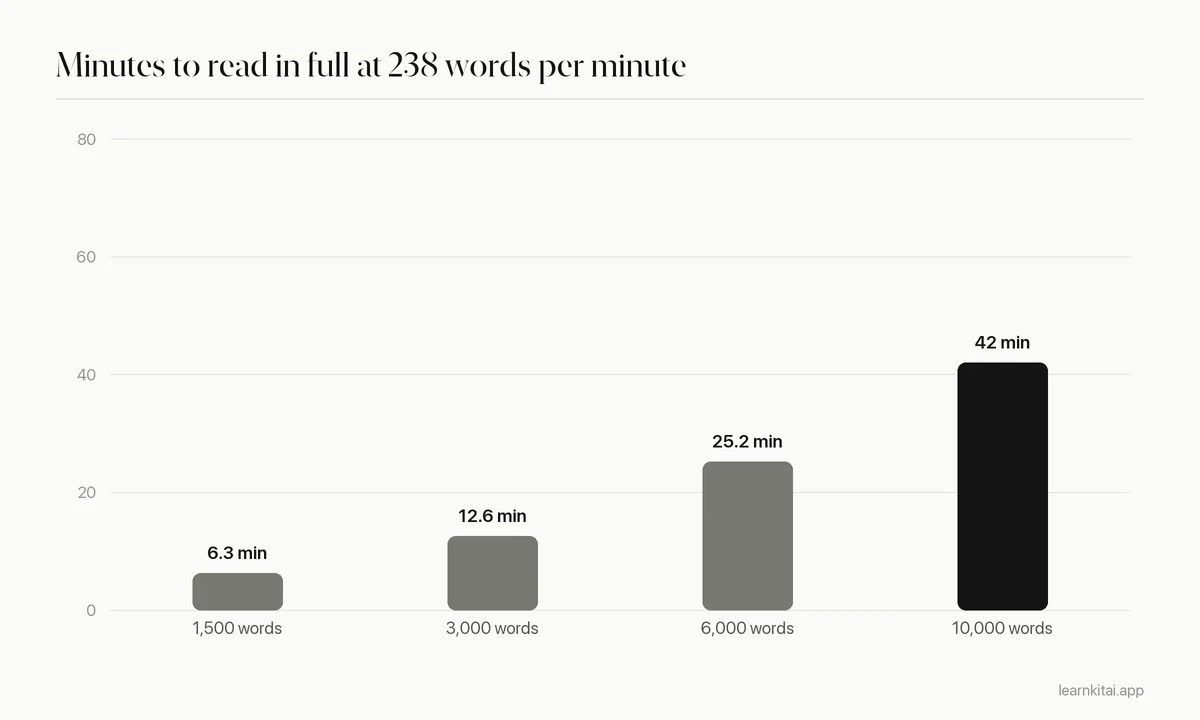
At an average silent reading speed of about 238 words per minute for nonfiction, a 3,000-word article takes about 13 minutes and a 6,000-word article about 25 minutes, before any note-taking. Dense academic writing usually takes longer.
Those figures come from a meta-analysis by Marc Brysbaert that pooled 190 studies. It found most adults read English nonfiction at between 175 and 300 words per minute, with an average of 238. That is slower than many speed-reading claims suggest, and the review explains why those popular numbers run high. The practical lesson is that you cannot read much faster, so you have to read less.
What is the fastest way to summarize an article?
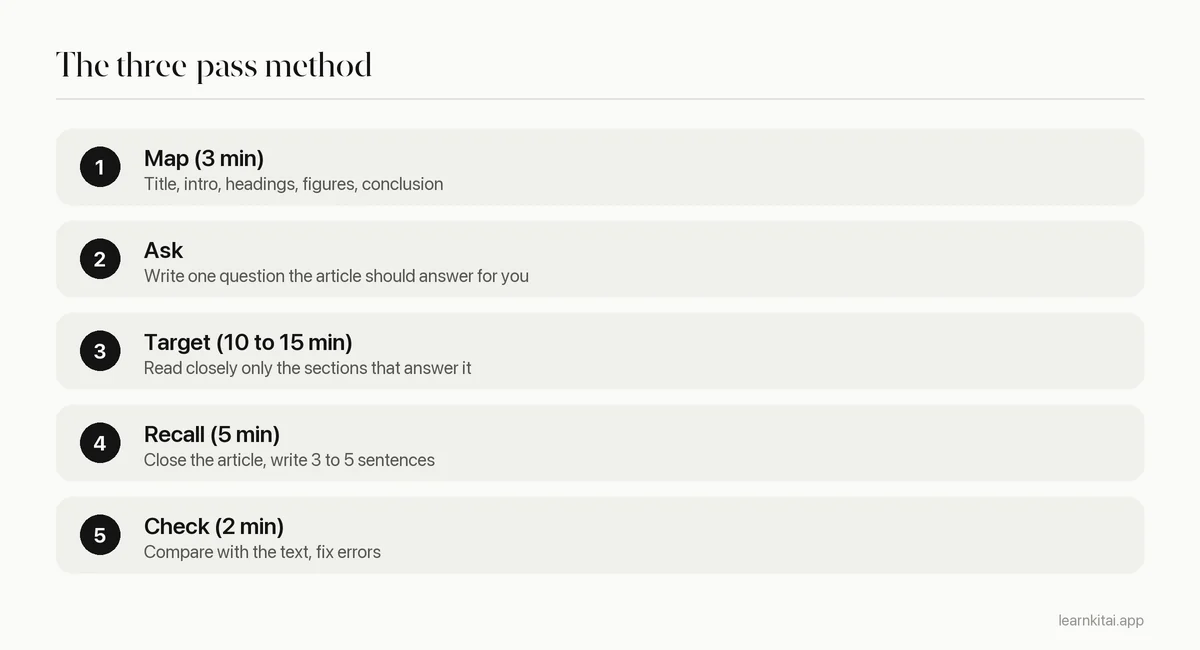
Use three passes. Map the structure in about three minutes, read only the parts that answer your question, then write a short summary from memory. Each pass has a time limit so the reading cannot sprawl.
Pass 1: map the article
Read the title and any subtitle, the first two paragraphs, every heading, the captions of figures, and the last two paragraphs. In most well-edited articles, the introduction states the main claim and the conclusion restates it. By the end of this pass you should be able to say, in one sentence, what the article argues.
Pass 2: read only what answers your question
Before you read closely, write one question. For a history class it might be "What does the author think caused the collapse?" For a science article it might be "What did they measure, and what did they find?" Now read the sections that answer it, and skim the rest. This is the same idea as the question step in the SQ3R method: a question gives your reading a target.
Pass 3: write from memory
Close the tab. Write three to five sentences: the main claim, the two or three strongest pieces of support, and the conclusion or implication. Only then reopen the article and check. Writing from memory is slower than copying, but it is the step that actually puts the ideas in your head.
Summarize an article: a worked example
Say you have a 5,000-word magazine piece about why cities are planting more trees. Your three-minute map shows headings on heat, flooding, health and cost. Your question: "Is it worth the money?" You read the cost section and the conclusion closely and skim the rest. Your summary:
The whole process, summary included, took about twenty minutes. Reading the piece in full would take about 21 minutes before you wrote a single word, and you would finish with a vague memory instead of four clear sentences. Notice that it uses your own words and keeps only main points, which is what the Purdue Online Writing Lab defines as a summary. For how short to go, see how long a summary should be.
Does skimming make you miss important details?
Sometimes, which is why the method uses a question. Skimming misses details you were not looking for. If your question is good, the details that matter for your assignment will sit in the sections you read closely.
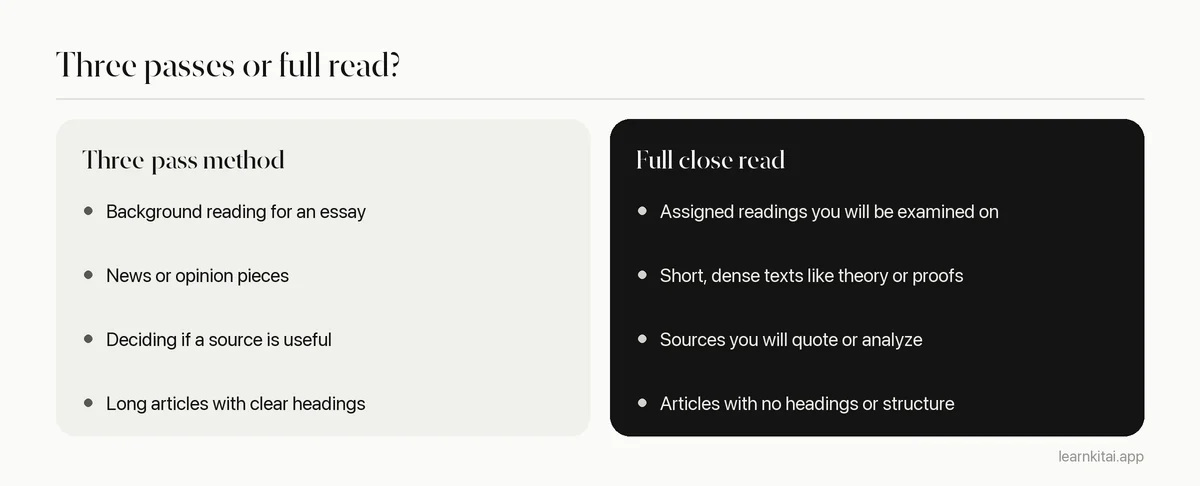
Skimming is a poor way to learn an entire article in depth, and you should not pretend otherwise. If you will be tested on every section, a summary is only the start. Turn its sentences into questions and test yourself on them later. A large review by Dunlosky and colleagues rated summarization as low utility on its own but practice testing as high utility, so the questions are where the learning happens.
How do you summarize several articles for one essay?
Use the same question for every article, so the summaries line up. Keep each one to three sentences in a single document, and add one line on how it agrees or disagrees with the others.
When an essay needs five or six sources, the danger is ending up with six summaries that do not talk to each other. Write your essay question at the top of a single page. For each article, do the three passes with that same question, then add a fourth line: agrees with, disagrees with, or adds to which other source. By the end, the page is a rough map of the debate, and the structure of your essay often falls out of it. Keep the full citation next to each summary so you never have to hunt for it later.
Can AI summarize an article for you?
It can produce a quick draft, which is useful for deciding whether an article is worth reading. Check the draft against the article, because AI summaries can blur or invent details, and write your own short version if you will be tested on it.
A good way to use AI is as a fourth pass. Write your summary from memory first, then compare it with an AI draft. Anything the AI included that you missed is worth a second look. The LearnKit Chrome extension opens beside the article in your browser and can make a summary or quiz from the page you are reading, without copying and pasting. For research papers specifically, with their abstracts and methods sections, use our guide to summarizing a research paper.
Reading fast is mostly about deciding what not to read. Map the article, ask one question, read for the answer, and write before you look back. For condensing longer material, like full chapters, the guide on how to summarize a textbook chapter applies the same ideas at a larger scale.
Frequently asked questions
How many sentences should an article summary have?
For most study and essay purposes, three to five sentences is enough: the main claim, the key support, and the conclusion. Longer assignments may ask for a paragraph or more, so follow the instructions you were given.
Should I highlight while I read?
Light highlighting during the targeted pass is fine if it helps you find things later. Heavy highlighting tends to replace thinking, and research rates it as one of the weaker study habits. Writing a summary from memory does more.
How do I summarize an article with no headings?
Read the first and last paragraphs, then the first sentence of every paragraph in between. Topic sentences often carry the main point. Mark the paragraphs where the argument turns, and read those closely.
Does speed reading help with long articles?
Not much. A large review of reading research found that average adult reading speeds are lower than popular claims suggest, so big gains from reading faster are unlikely. Reading less, with a clear question, saves more time.
Sources
- How many words do we read per minute? A review and meta-analysis of reading rate, Journal of Memory and Language (Brysbaert, 2019) (190 studies; average silent reading of 238 words per minute for nonfiction, most adults between 175 and 300)
- Quoting, Paraphrasing, and Summarizing, Purdue Online Writing Lab (A summary keeps the main points in your own words and is significantly shorter)
- Improving Students' Learning With Effective Learning Techniques, Psychological Science in the Public Interest (Dunlosky et al., 2013) (Summarization and highlighting rated low utility; practice testing rated high)
Keep reading
How to Summarize a Chapter So You Never Reread It
Most chapter summaries are just shorter copies of the book. The closed-book method turns summarizing into practice that sticks, so you can study from your page instead of the chapter.
How to Summarize a Research Paper in Three Passes
You do not read a research paper like a novel. Three quick passes, a five-line template and one worked example get you from abstract to a summary you can use.
How Long Should a Summary Be? Let the Job Decide
There is no single right length. There is a ceiling, a purpose, and a quick test that tells you when a summary is short enough.
The SQ3R Method: Turn Textbook Reading Into Recall
Survey, Question, Read, Recite, Review. How to use the SQ3R method on a real chapter, how long each step should take, and which step does the heavy lifting.
Chrome Extensions for Students: Keep 5, Delete the Rest
Most students run too many extensions and use few of them. Here are the five kinds worth keeping, a safety check, and a study-only browser setup.