How to Focus When Your Mind Keeps Leaving the Room
To focus on studying, shrink the task to one clear next step, remove your phone from the room, and work in timed blocks of 25 to 50 minutes. When your mind drifts, write the stray thought on a parking lot list and return. Short planned breaks keep focus from fading over a long session.
If you are searching for how to focus, you probably already sat down to study today and found yourself, twenty minutes later, reading a news story you did not mean to open. That is not a personal failure. Minds wander by default. The trick is not to stop wandering forever. It is to notice sooner and come back faster.
This guide treats focus as a skill with parts you can practice: starting, staying and returning. You will get a five-minute start routine, a fix for the most common drifts, and a way to measure whether you are getting better.
Why is it so hard to focus on studying?
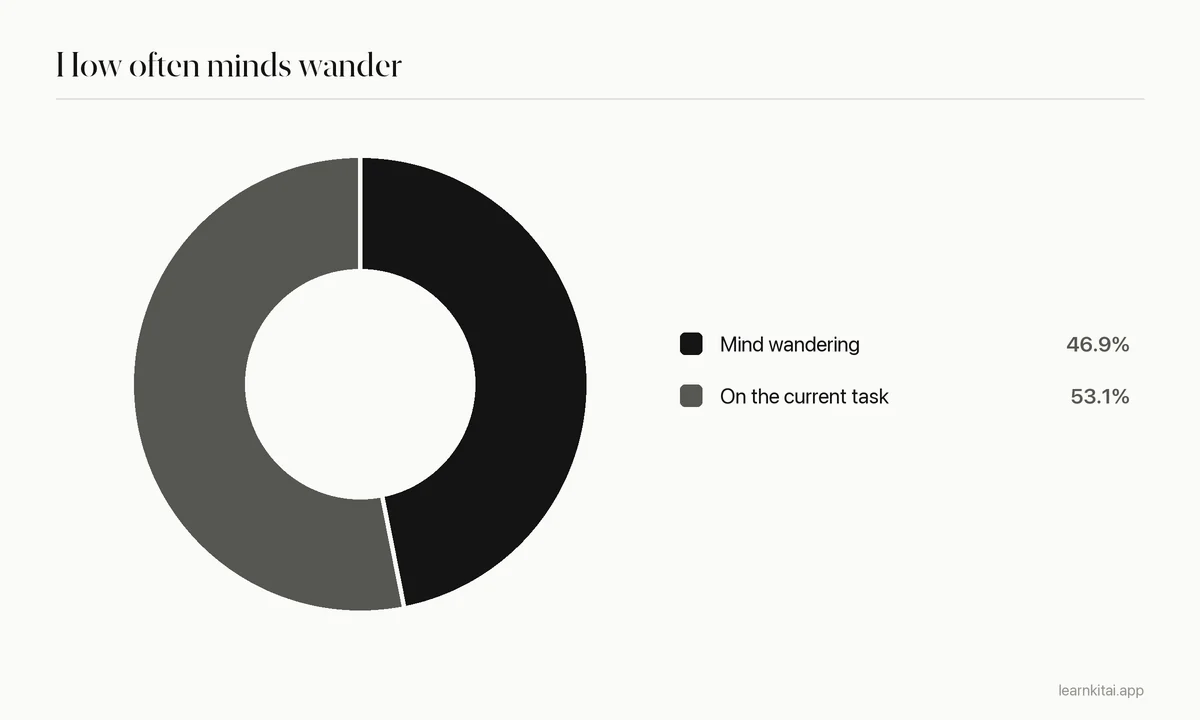
Because wandering is the brain's normal state. People's minds drift for close to half of their waking hours. Studying makes it worse: the material is effortful, the reward is far away, and a phone offers an instant one. Losing focus is expected. The skill is returning.
Harvard researchers used a phone app to ask 2,250 people what they were doing and thinking at random moments. Their study found minds wandered 46.9 percent of the time. That was across all activities, not just hard ones.
Technology speeds up the drift. In a study of about 260 students observed while studying at home for 15 minutes, Florida Tech reports that they stayed on task for less than six minutes on average before switching, mostly to texts and social media. So if your focus feels short, you are in good company. The fixes below are built for that reality.
How do you start focusing quickly?
Use a short start ritual: phone out of the room, one window open, one written next step, and a timer. Making the first step small and specific removes the hardest part of focus, which is deciding what to do and getting going.
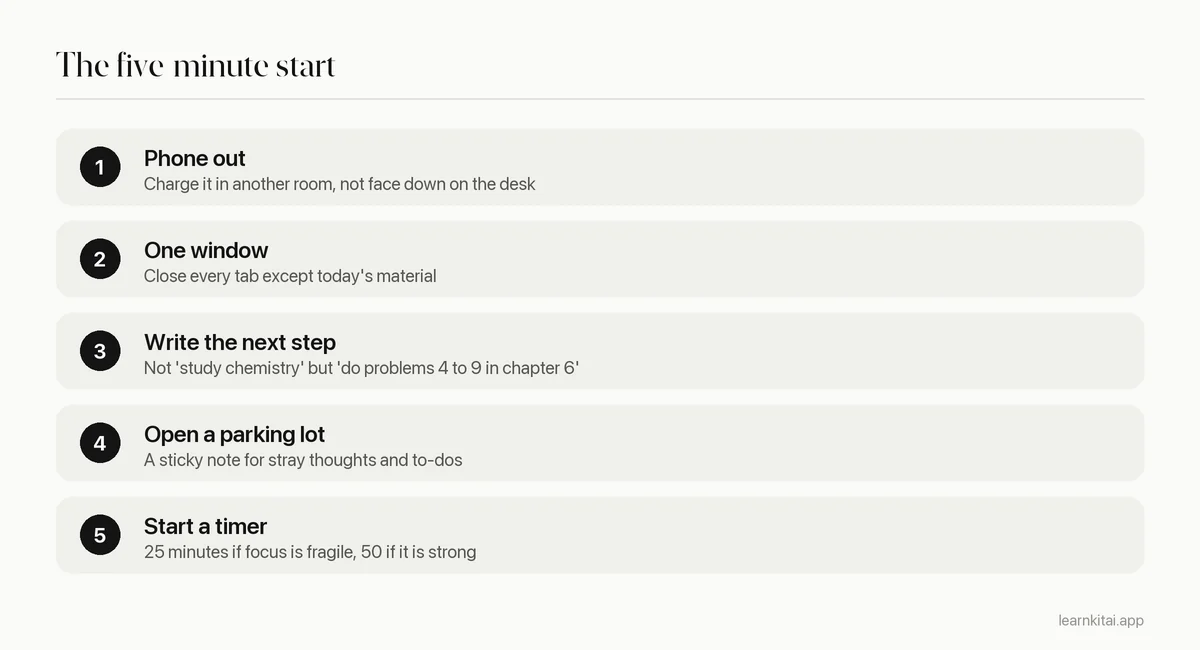
The written next step matters most. Vague goals like review biology give your mind nothing to grip, so it looks for something easier. A specific step, such as answer the five end-of-chapter questions without notes, tells you exactly where to put your attention and when you are done.
Active tasks also hold attention better than passive ones. Rereading a page lets your eyes move while your mind leaves. Answering a question forces you to engage. If you keep drifting while reading, switch to quizzing yourself on the page you just read. Our Pomodoro technique guide shows how to fit these tasks into timed rounds.
What should you do when your mind drifts?
Notice it, name it, park it and return. Write the stray thought on a parking lot note so your brain trusts it will not be lost, then go back to the exact line or problem you left. Do not judge yourself. Each return is one repetition of the skill.
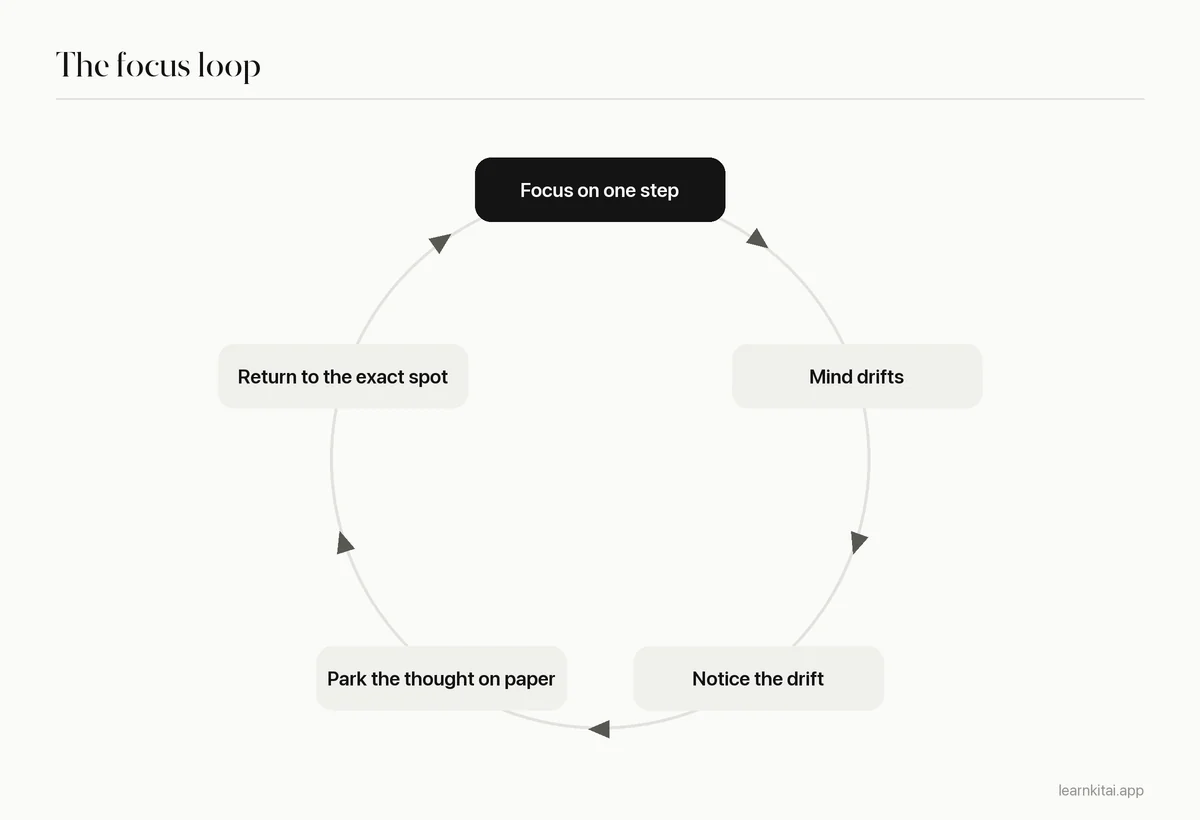
A parking lot works because many drifts are reminders: email the teacher, buy milk, reply to a friend. Your brain keeps raising them because it fears you will forget. Writing them down closes the loop. Handle the list at your next break.
Keep a tally of how many times you caught yourself drifting in a session. It sounds odd, but a high tally early on is good news: it means you are noticing. Over a few weeks, the gaps between drifts tend to grow.
Do breaks help you focus longer?
Yes, if they are planned. In a lab study, people who briefly switched to a different task during a long vigilance task did not show the usual drop in performance. A short, planned switch resets attention. Unplanned breaks to your phone tend to stretch and pull you away.
Ariga and Lleras at the University of Illinois found that brief, rare breaks from a long, dull task kept performance from sliding. Their idea is that the brain stops registering a goal it has held too long, and a quick break lets it notice the goal again.
Good breaks are short and away from screens: stand, drink water, look out a window, walk down the hall. Phone breaks are risky because they open new loops that follow you back. For timing, see our guide to study breaks.
Quick fixes for common focus problems
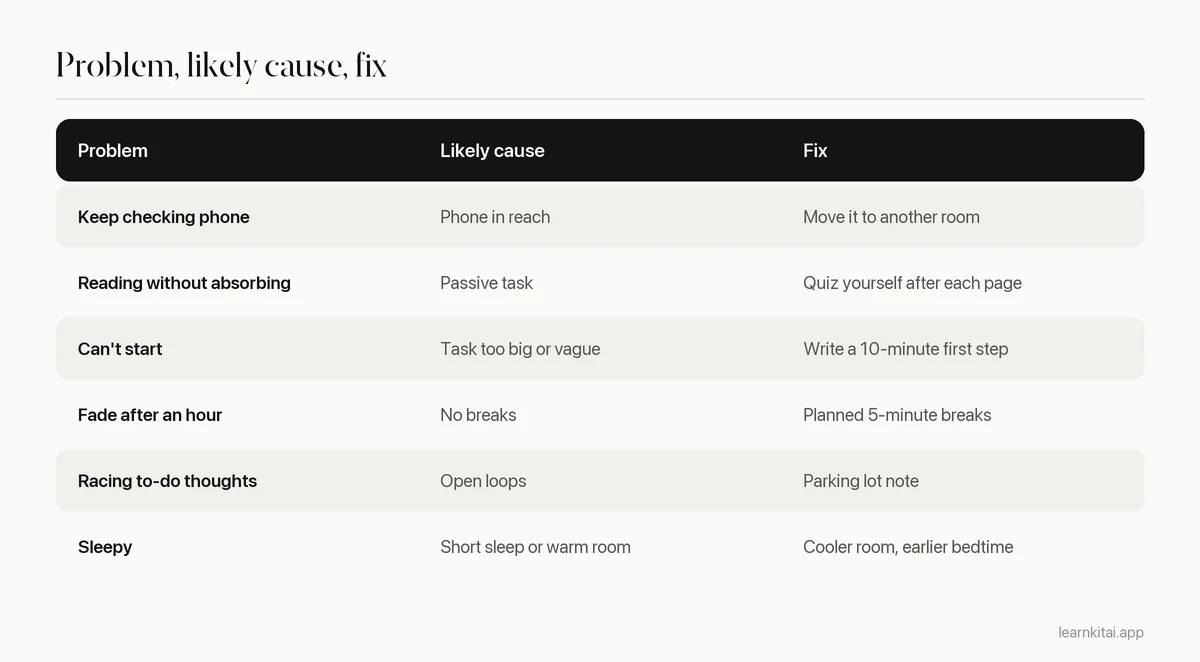
Switching between tasks also costs more than it feels like. A Stanford study found that heavy media multitaskers were more easily pulled off course by irrelevant information and were worse at switching tasks, not better. Doing one thing at a time is not old fashioned. It is efficient.
How to focus better over weeks, not just tonight?
Track focused blocks, not hours. Count how many timed blocks you finish without picking up your phone, and aim to add one block or five minutes per block each week. Steady sleep, a fixed study slot and the same start routine make each session easier than the last.
Most advice on how to focus is about a single evening. The bigger gains come from making focus easier to reach every day. Three habits do most of the work.
- Measure blocks. At the end of each day, write down how many full blocks you completed and how many drifts you caught. Numbers beat vague feelings like I was distracted again.
- Grow slowly. If two 25-minute blocks feel solid, try three, or try 30 minutes. Jumping to a three-hour marathon usually ends in a long phone break.
- Keep the same setup. The same desk, the same start routine and roughly the same hour turn starting into a reflex. Our guide to setting up a study space covers the physical side.
Sleep sits underneath all of this. A short night makes every drift stronger and every return harder. If you keep losing focus in the afternoon despite good habits, look at your bedtime before you look for a new technique.
Focus grows the way fitness does: in small reps, with rest. Remove the big distractions, make each step concrete, and practice the return. Once short blocks feel easy, try longer ones with the ideas in our guide to deep work for students.
Frequently asked questions
How long can a student focus at one time?
It varies by person, task and sleep. Many students work well in blocks of 25 to 50 minutes with short breaks. Start with what you can manage and lengthen blocks gradually.
Does caffeine help with focus?
A moderate amount can make you feel more alert for a few hours, but it does not replace sleep and can disturb it if taken late in the day. Avoid it in the afternoon if you have an early bedtime.
Is it bad to study with the TV on?
Shows with dialogue compete for the same attention you need for reading and writing. If you need some sound, choose steady background noise or music without lyrics.
What if I have ADHD?
The same tools, such as short blocks, external timers and removing the phone, are often helpful, but talk to your school's disability services or a clinician about support that fits you. This article is about study technique, not medical advice.
Sources
- Wandering mind not a happy mind, Harvard Gazette (2,250 people; minds wandered 46.9 percent of the time)
- A wandering mind is an unhappy mind, Science (PubMed) (Original Killingsworth and Gilbert study)
- Psychology Science Minute: Technology distracts, Florida Institute of Technology (Students stayed on task less than six minutes on average while studying)
- Facebook and texting made me do it: Media-induced task-switching while studying, Computers in Human Behavior (Original Rosen, Carrier and Cheever study)
- Brief and rare mental breaks keep you focused, Cognition (PubMed) (Brief task switches prevented the vigilance decrement)
- Cognitive control in media multitaskers, PNAS (PubMed Central) (Heavy media multitaskers more prone to interference and worse at task switching)
Keep reading
Pomodoro Technique for Studying: 25 Minutes, Done Right
A kitchen timer, 25 minutes and a short break. Here is how to use the Pomodoro technique for real study tasks, what the research says and how to adapt it.
Phone Distraction: Why Silent Mode Is Not Enough
Your phone can cost you focus even when it is silent and face down. What the research shows, and a setup that actually keeps it out of your study time.
Study Breaks: How Long, How Often, and What to Do
Five minutes or fifty? Scheduled or whenever you feel tired? What research says about study breaks, plus a simple rule for timing them.
Stop Procrastinating on Studying: Fix the Feeling First
Procrastination is less about laziness and more about avoiding a bad feeling. Here is how to find your reason for delaying and start studying in minutes.
Deep Work for Students: Fewer Hours, Harder Thinking
A few hours of undistracted, demanding work beat a whole day of half attention. Here is how to plan deep work around classes.