Phone Distraction: Why Silent Mode Is Not Enough
Put the phone in another room while you study. In experiments, people whose phones were in a different room did better on memory and reasoning tests than people whose phones sat on the desk, even when the phone was silent, face down or switched off. Distance works better than settings or willpower.
You put your phone on silent, flip it face down and promise yourself you will not touch it. An hour later you have checked it nine times and read the same page three times. Phone distraction is not only about notifications. Research suggests the phone pulls on your attention just by being close, and that changes what actually works to fix it.
Does having your phone nearby really hurt focus?
The evidence says it can. In experiments with nearly 800 smartphone users, people did best on memory and reasoning tests when their phone was in another room, and worst when it was on the desk. It did not matter whether the phone was face up or down, on or off.
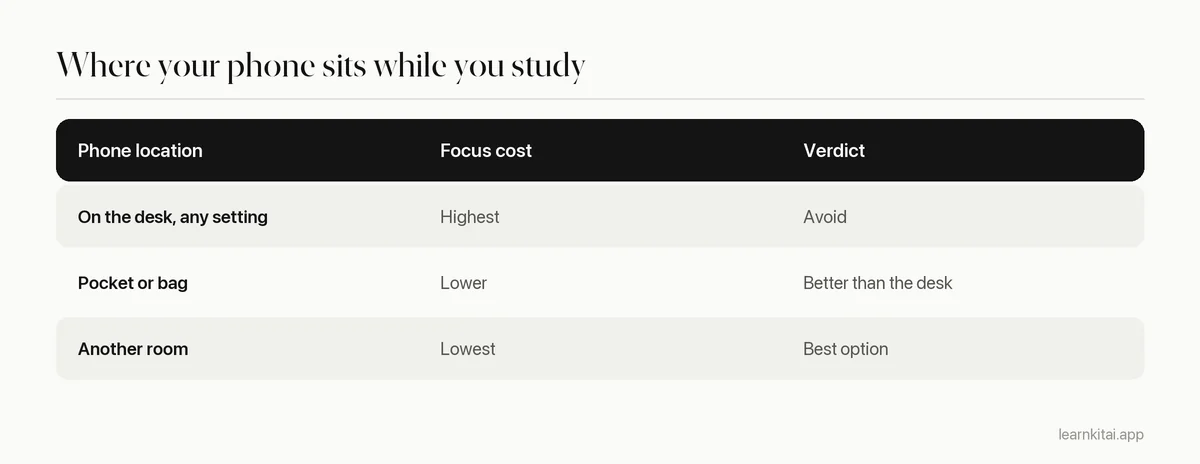
The research is a set of experiments led by Adrian Ward at the University of Texas at Austin. Participants did tests that measure working memory and problem solving while their phones were on the desk, in a pocket or bag, or in another room. As UT Austin's McCombs School reports, people with phones in another room did significantly better than those with phones on the desk, and slightly better than those with phones in a pocket or bag. Ward summed it up this way: the mere presence of their smartphone was enough to reduce their cognitive capacity.
The researchers' explanation is that part of your mind is busy not checking the phone. Resisting the urge takes mental effort, and that effort comes from the same limited pool you need for learning. One set of experiments is not the final word, and the size of the effect is still debated, so treat it as a likely cost rather than a disaster. But it is a cost you can remove for free.
Do phones in class affect grades?
In one classroom experiment, allowing phones and laptops in lectures lowered final exam scores by at least 5 percent, about half a letter grade. Scores in quick in-lecture quizzes did not drop, so the damage showed up later, in what students remembered.
The study, by Arnold Glass and Mengxue Kang at Rutgers, followed 118 students over a term. Devices were banned in half the lectures and allowed in the other half. According to Rutgers' summary, exam performance fell for material taught when devices were allowed, and it fell even for students who did not use a device themselves. Distraction spreads across a room.
The detail about quizzes is the important lesson for solo study. You can feel like you are following along while you glance at your phone, and you may even answer a question right away. The cost appears days later, when the material did not stick. Divided attention feels fine and remembers badly.
Why is phone distraction so hard to resist?
Because checking costs almost nothing and pays off unpredictably. Every check might bring a message, a like or something new, and that uncertainty is exactly what makes a habit sticky. Studying, by contrast, pays off slowly and invisibly. The fight is uneven, so change the setup instead of relying on willpower.
There is good news in recent research too. In a 2025 randomized trial, people had all mobile internet blocked on their phones for two weeks while keeping calls and texts. The results in PNAS Nexus showed improvements in mental health, well-being and an objectively measured ability to sustain attention, and 91 percent of participants improved on at least one of those measures. You do not need to go that far for study sessions, but it shows the effect is reversible.
How do you study without touching your phone?
Put it in another room before you start, tell people when you will be reachable, and keep anything you need for studying on a laptop or on paper. Use a timer that is not your phone, and plan a short phone check into your long break so you are not fighting the urge all session.
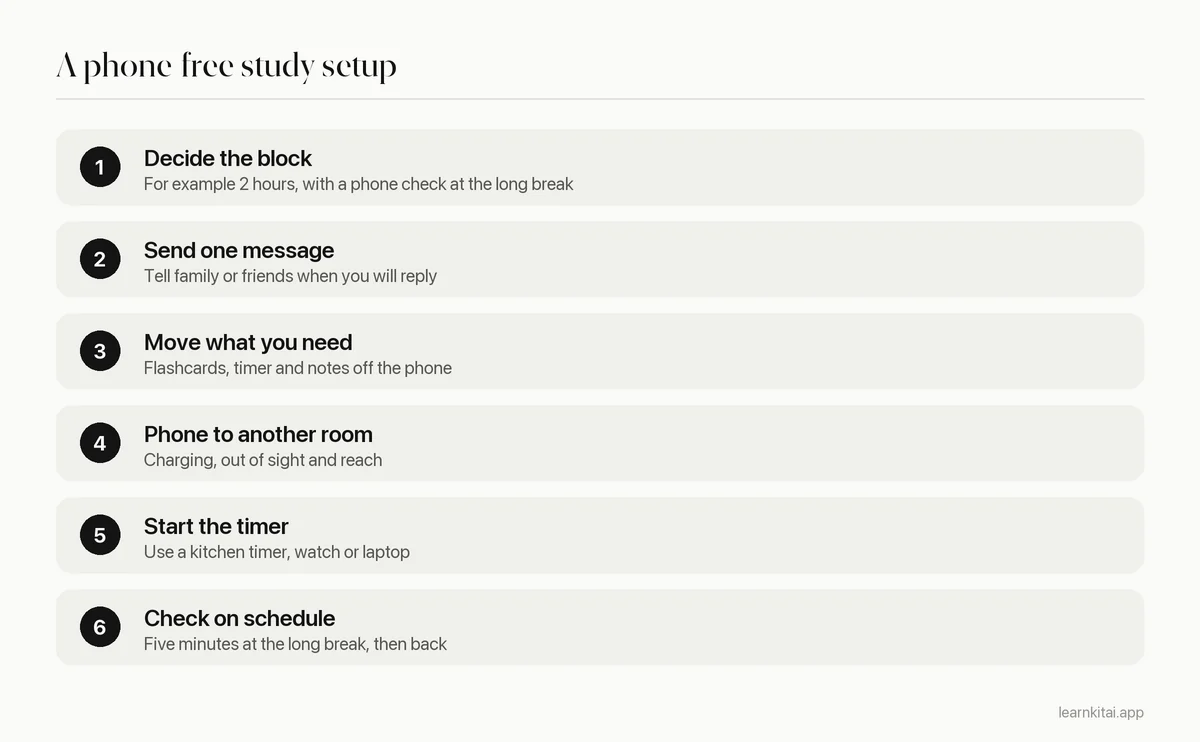
Step three is where most plans fail. If your flashcards, timer or textbook live on the phone, the phone has to stay on the desk, and you are back to the worst row of the table. Move study tools to a laptop or paper. LearnKit's web version runs in any browser, so you can make and review flashcards on a laptop while the phone charges in the kitchen. If you need a timer, a cheap kitchen timer is the original Pomodoro tool and has no apps on it.
When you need your phone nearby
Sometimes you cannot leave it in another room: you are on call for a family member, or you study in a library. Then reduce the pull as much as you can. Put it in a bag, zipped, not in a pocket. Turn on a focus mode that allows only the contacts who truly need you. Remove social apps from the home screen for exam season, or log out so each check takes effort. Small frictions add up.
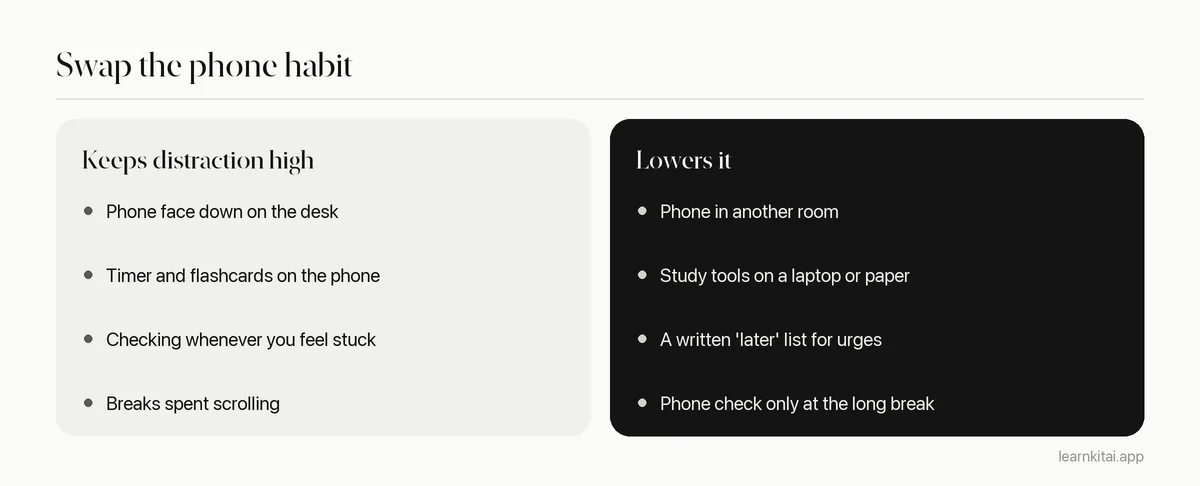
Notice the third row. Many phone checks happen at the moment a problem gets hard. The phone offers an easy exit from a difficult thought. When you feel the urge, write the thought you were stuck on, then stay with it for two more minutes. Often that is when the problem cracks.
Is a laptop just as distracting as a phone?
It can be, which is why the Rutgers result included laptops and tablets. Close all tabs not needed for the task, turn off desktop notifications and use a site blocker during study blocks. The difference is that a laptop is easier to lock down for one task than a phone.
Phone distraction is one piece of a wider focus setup. Pair this with the Pomodoro technique so you know exactly when the next phone check is allowed, use screen-free study breaks, and see how to set up a study space that makes focus the easy option. If the phone is a way to escape a task you are dreading, the guide on how to stop procrastinating tackles the cause directly.
Frequently asked questions
Is it okay to use my phone as a study timer?
It is better than nothing, but the phone on the desk is the setup the research found worst. A cheap kitchen timer, a watch or a timer on your laptop removes the temptation completely.
Do app blockers actually work for studying?
They help by adding friction, especially for social apps. They work best combined with distance, because a blocked phone on the desk still draws attention.
How long does it take to get used to studying without my phone?
The first few sessions often feel uncomfortable, with frequent urges to check. Most students find the urges weaken within a week or two of regular phone-free blocks, especially when a phone check is planned into the long break.
Should I turn my phone off completely?
In the UT Austin experiments, turning the phone off did not help if it stayed on the desk. Off and in another room is the strongest combination.
Sources
- Is Your Smartphone Draining Your Brain?, McCombs School of Business, UT Austin (Nearly 800 participants; phone in another room beat desk and pocket or bag; on/off and face up/down made no difference)
- Cellphone distraction in the classroom can lead to lower grades, Rutgers University (118 students; devices in lectures lowered exam scores by at least 5 percent, also for non-users)
- Blocking mobile internet on smartphones improves sustained attention, mental health, and subjective well-being, PNAS Nexus (PubMed) (Two weeks of blocked mobile internet; 91% improved on at least one outcome including sustained attention)
Keep reading
Pomodoro Technique for Studying: 25 Minutes, Done Right
A kitchen timer, 25 minutes and a short break. Here is how to use the Pomodoro technique for real study tasks, what the research says and how to adapt it.
Your Study Space Is a Memory Cue. Build It on Purpose
Where you study shapes how well you focus and what you remember. Here is how to set up a space that does part of the work for you.
How to Focus When Your Mind Keeps Leaving the Room
Focus is not a trait you have or lack. It is the skill of noticing drift and coming back, and you can train it.
Study Breaks: How Long, How Often, and What to Do
Five minutes or fifty? Scheduled or whenever you feel tired? What research says about study breaks, plus a simple rule for timing them.
Stop Procrastinating on Studying: Fix the Feeling First
Procrastination is less about laziness and more about avoiding a bad feeling. Here is how to find your reason for delaying and start studying in minutes.