Deep Work for Students: Fewer Hours, Harder Thinking
Deep work means long, undistracted blocks spent on your hardest thinking, like problem sets, essays and recall practice. For students, two blocks of 60 to 90 minutes a day, with the phone in another room and shallow tasks batched elsewhere, usually beat a full day of split attention.
Deep work is a term popularized by computer science professor Cal Newport for focused, undistracted effort on cognitively demanding tasks. For students, it is the work that actually moves your grade: solving problems you have not seen before, writing an argument, testing yourself on material you half know. It is also the work most easily crowded out by group chats, email and tidying notes.
This guide shows what counts as deep work in a student's week, how long a block should be, why switching tasks costs more than it seems, and how to fit two deep sessions into a day full of classes.
What counts as deep work for a student?
Any task that strains your current ability and needs full attention: new problem sets, writing a first draft, recalling material without notes, working through a hard proof or case. If you could do it while half watching a video, it is shallow work.
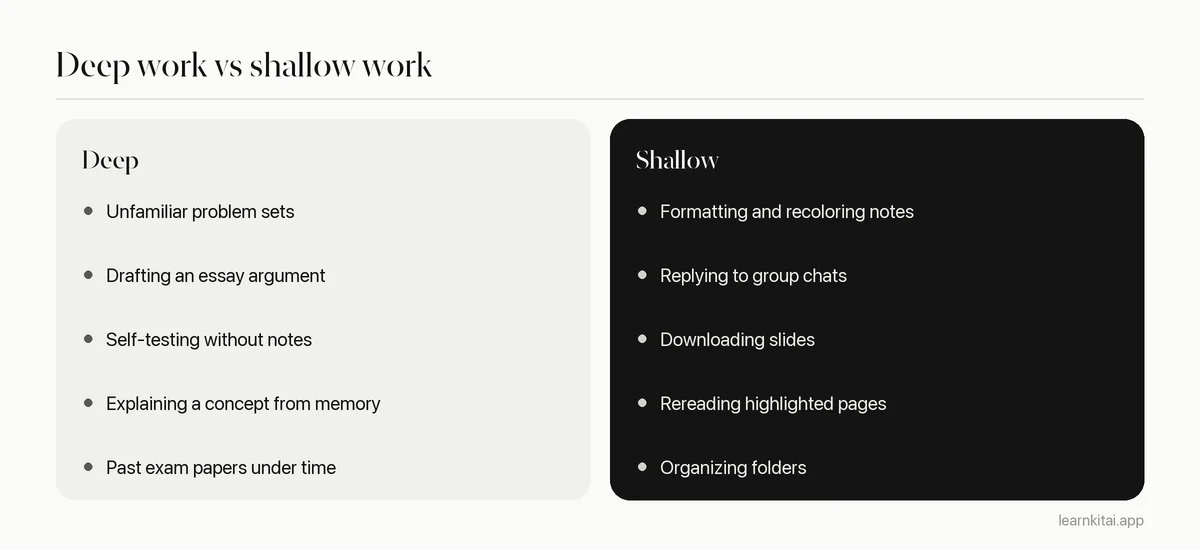
Shallow work is not useless. Slides do need downloading. The problem is that shallow tasks feel productive and are easy to start, so they expand to fill the day. Deep tasks are effortful and easy to postpone. Without a plan, the shallow work wins.
A useful test: does this task produce something you could not do yesterday? A finished problem set, a draft paragraph, a list of things you recalled and missed. If the answer is no, it is probably shallow.
Why does switching tasks hurt deep work?
Because part of your attention stays on the task you left. Researchers call this attention residue. Checking a message mid-session leaves your mind partly on the message, so the hard task gets less of you. Finishing cleanly, or writing down where you stopped, reduces the residue.
Management researcher Sophie Leroy ran two experiments on this. As the BPS Research Digest explains, people who switched to a new task while the first was unfinished showed signs that their minds were still on it, and did worse on the second task. Those who finished the first task under a time limit carried less residue and did better.
Two practical rules come out of this. First, do not check messages during a deep block, because each check plants new residue. Second, end each block cleanly: either finish a unit, or write a two-line note on exactly where you stopped and what comes next. That note lets your mind let go.
Habitual multitasking may also make filtering harder. A Stanford study found that heavy media multitaskers were more distracted by irrelevant information and slower to switch tasks than light multitaskers. Practicing single-tasking is practicing focus.
How many hours of deep work can a student do a day?
Fewer than you might think. Two to four hours of truly focused work is a strong day for most people. Even elite music students in one study averaged about three to four and a half hours of solo practice a day. Start with one or two 60 to 90 minute blocks and build up.
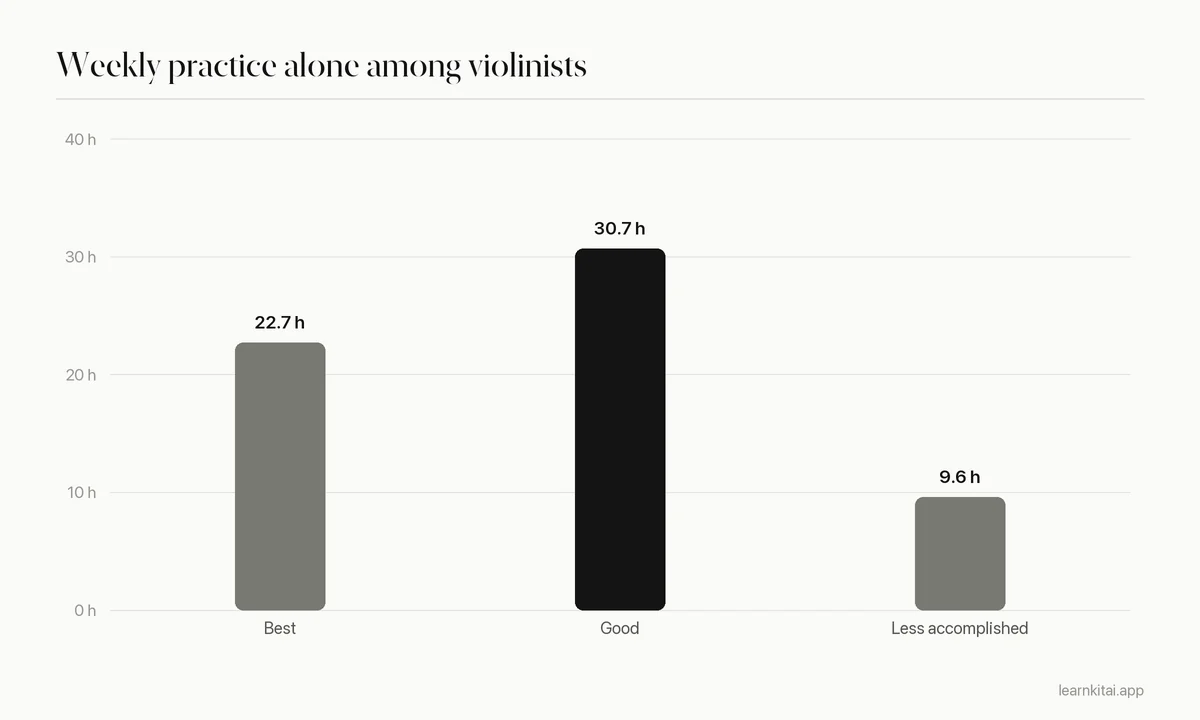
Deliberate practice research gives a useful benchmark. In a 2019 replication study of violinists at a top conservatory, the best players reported about 22.7 hours a week of practice alone, and good players about 30.7 hours. That is roughly 3.2 to 4.4 hours a day for people whose career depends on it. Notice too that the best players did not practice the most. Quality mattered, not just time.
For students with classes, labs and jobs, a realistic target is one deep block on busy days and two on lighter ones. If you are wondering how this fits into a full weekly load, our guide on how many hours to study helps you set a total.
How do you schedule deep work around classes?
Block it on your calendar like a class, ideally at your sharpest time of day. Keep the same slot most days, batch shallow tasks into one short window, and protect the block from meetings. A fixed time removes the daily decision to start.
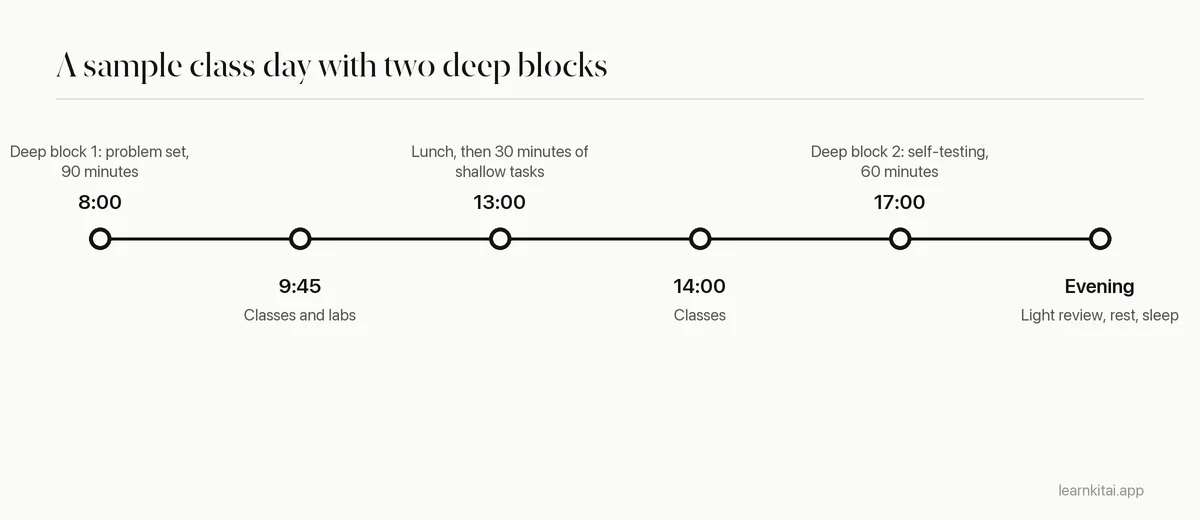
- Choose the task the night before. Write it in one line: Finish problems 1 to 6 in the thermodynamics set. Waking up to a decided task saves the first 15 minutes.
- Set the room. Phone in another room, one window open, materials ready.
- Use a timer. Work in two 45-minute halves with a five-minute break, or one 60 to 90 minute stretch if your focus allows. The Pomodoro technique is a good way to start shorter and build up.
- Batch the shallow work. Answer messages and handle admin in a fixed 30-minute slot, not between deep tasks.
- Close the block. Write where you stopped and the next step.
What should you do inside a deep work block?
Do the hardest active task you have: practice problems without the solutions, recall without notes, or drafting. Check your work only at the end of a chunk. Rereading and copying notes rarely need deep focus, so leave them for shallow time.
Deep work pairs naturally with active recall. Close the book and write everything you can remember about a topic, then check. Or answer open questions in full sentences before looking at a model answer. These tasks are uncomfortable, which is the point. Effort that feels hard is often the effort that sticks, a pattern researchers call desirable difficulties.
Deep work is a small daily commitment with large returns. Protect one or two blocks, fill them with your hardest active tasks, keep the phone out, and close each block cleanly. Over a semester, those hours add up to the real difference. For help keeping attention inside the block, read our guide on how to focus.
Frequently asked questions
Is deep work the same as the Pomodoro technique?
Not exactly. Pomodoro is a timing method with short work rounds and breaks. Deep work is about the kind of task and the absence of distraction. You can do deep work inside Pomodoro rounds, and many students start that way.
Can I do deep work in a group study session?
Sometimes. Silent group sessions where everyone works alone can help with accountability. Discussion-heavy sessions are useful but different, so schedule your own deep block separately.
What if I get stuck during a deep work block?
Stay with the problem for a set time, such as ten minutes, and try a different approach. If you are still stuck, note the exact question to ask your teacher and move to the next problem rather than switching to your phone.
Should I do deep work on weekends?
One or two weekend blocks can help with large projects. Keep at least some time fully off, because rest supports the next week's focus.
Sources
- The surprising benefits of time pressure at work, BPS Research Digest (Summary of Leroy (2009) attention residue experiments with 84 and 78 undergraduates)
- Why is it so hard to do my work? The challenge of attention residue when switching between work tasks, Organizational Behavior and Human Decision Processes (Original Leroy study)
- The role of deliberate practice in expert performance: revisiting Ericsson, Krampe and Tesch-Romer (1993), Royal Society Open Science (via PubMed Central) (Best violinists 22.69 h/week, good 30.65 h/week, less accomplished 9.58 h/week of practice alone)
- Cognitive control in media multitaskers, PNAS (via PubMed Central) (Heavy media multitaskers more susceptible to interference)
Keep reading
Pomodoro Technique for Studying: 25 Minutes, Done Right
A kitchen timer, 25 minutes and a short break. Here is how to use the Pomodoro technique for real study tasks, what the research says and how to adapt it.
How to Focus When Your Mind Keeps Leaving the Room
Focus is not a trait you have or lack. It is the skill of noticing drift and coming back, and you can train it.
How Many Hours to Study? Start With This Simple Formula
The two-hours-per-credit rule is a good starting point, but how you use the hours matters more than the total. Here is how to set a number that fits you.
Phone Distraction: Why Silent Mode Is Not Enough
Your phone can cost you focus even when it is silent and face down. What the research shows, and a setup that actually keeps it out of your study time.

Active Recall: Why Closing the Book Beats Rereading
Rereading feels productive but fades fast. Here is how to study by pulling answers out of memory, with a session plan, examples and the mistakes to avoid.