How Many Hours to Study? Start With This Simple Formula
A common college benchmark is two hours of study outside class for every credit hour, so a 15-credit semester means about 30 hours a week. Treat that as a starting point. Add time for hard courses, cut it where you are strong, and measure focused hours rather than hours spent sitting at a desk.
Asking how many hours to study is a fair question with an unsatisfying honest answer: it depends. But it does not depend on nothing. There is a widely used benchmark, a reason most students fall short of it, and a better way to think about the hours you do put in.
This guide gives you the formula, worked examples, rules for adjusting it, and the signs that more hours will not help. By the end you will know how many hours to study for your own course load, not an imaginary average student's.
How many hours should a college student study per week?
The standard benchmark is about two hours outside class for each credit hour. US federal rules define one semester credit as roughly one hour of class plus at least two hours of out-of-class work each week. For 15 credits, that is about 30 study hours a week.
The rule is not just tradition. The US Department of Education's definition of a credit hour says one semester credit should reasonably approximate at least one hour of classroom instruction and a minimum of two hours of out-of-class student work each week for about fifteen weeks. Colleges design course loads around that assumption.
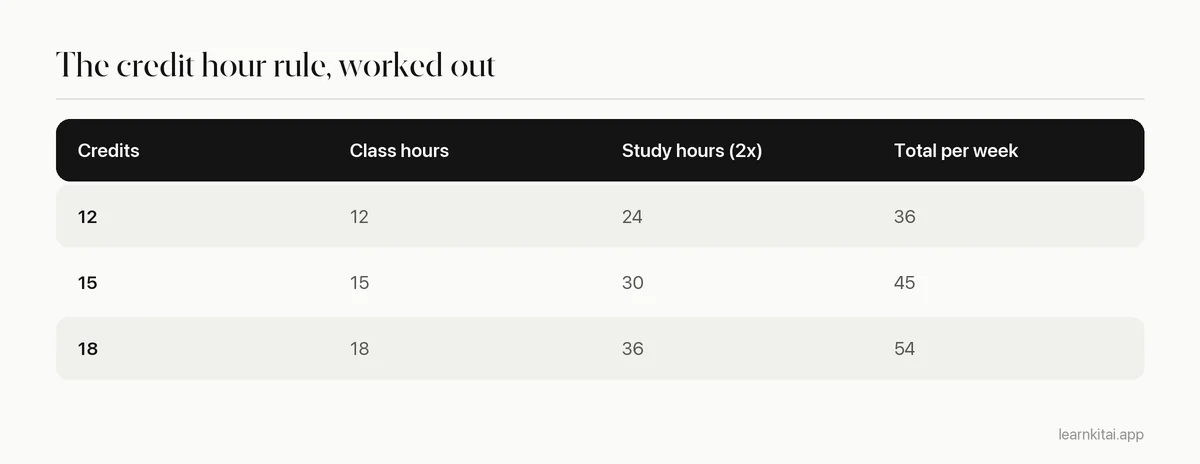
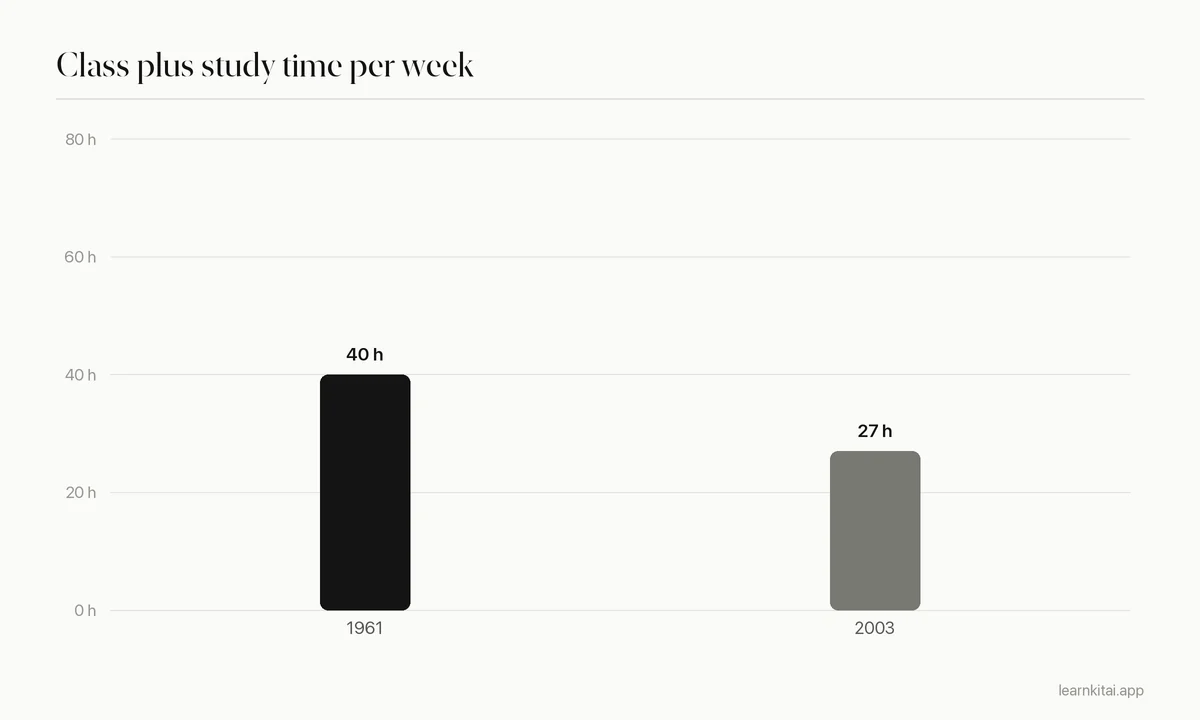
A full load, then, is designed to be roughly a full-time job. If that sounds like a lot, it is, and most students study far less. Economists Philip Babcock and Mindy Marks found that full-time US students spent about 40 hours a week on class and studying in 1961, but only about 27 hours by 2003, and the drop showed up across majors and types of colleges.
How many hours a day should you study?
Divide your weekly target by the days you plan to study. Thirty hours over six days is five hours a day, split into focused blocks and lighter review. Even elite musicians in one study averaged only three to four and a half hours of solo practice a day, so keep the most intense work to a few hours.
Five hours a day sounds heavy, but not all of it has to be intense. A realistic mix is two hours of focused work on hard material, an hour of review such as flashcards, and time for reading and assignments. The hardest hours belong in your sharpest window. Our guide to deep work for students explains why two strong blocks beat a long scattered day.
Why cap the intense part? A study of conservatory violinists found the best players reported about 22.7 hours a week of practice alone, roughly three hours a day, and they were not the group that practiced the most. Focused effort is tiring, and past a point extra time adds fatigue rather than skill. Plan your day so the hardest work comes first and lighter tasks fill the rest.
High school students have no federal rule, and loads vary widely. A sensible approach is to start with your homework, add 20 to 30 minutes of daily review for each core subject before tests, and increase before exams rather than keeping a high load all year.
Should you study the same amount for every class?
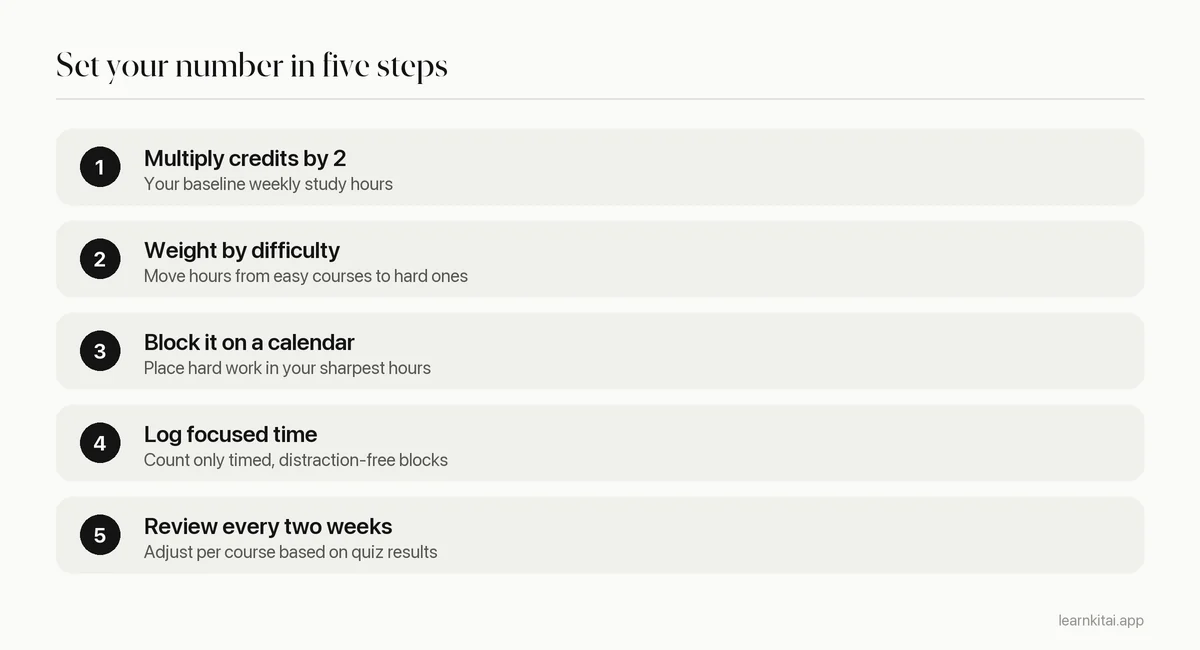
No. Weight your hours by difficulty and stakes. A hard, high-credit course where you are behind may need three hours per credit. A course you find easy may need one. Keep the weekly total, but move hours to where they produce the most learning.
- Start with the formula. Two hours per credit for each course.
- Rate each course easy, medium or hard for you, not for the average student.
- Shift hours. Take time from easy courses and add it to hard ones. A 3-credit hard course might get 8 to 9 hours instead of 6.
- Check after two weeks. If quiz scores are fine in a course, try trimming it. If you are lost, add time or seek help early.
Labs, writing-heavy courses and cumulative subjects like math and languages usually need more than the formula. Survey courses with a final based on lecture slides often need less, provided you keep up.
Why do more study hours not always mean better grades?
Because hours measure time spent, not learning done. A large meta-analysis found that study habits and skills predict college grades about as well as admissions tests and high school grades. Two focused hours of self-testing can beat five hours of rereading with a phone nearby.
A large meta-analysis by Crede and Kuncel, covering more than 72,000 students, found that study habits, skills and attitudes rival test scores and high school grades as predictors of college performance. How you study carries much of the weight.
That points to a simple upgrade: count focused hours. An hour with the phone in another room spent answering questions or using spaced repetition is worth far more than an hour of highlighting. If your focused hours are lower than you thought, that is useful information, not a failure.
A quick check: are your hours working?
- Can you answer last week's practice questions without your notes?
- Do your quiz scores in each course match the time you give it?
- Do you finish most planned blocks, or do they dissolve into phone time?
- Are you sleeping at least seven to eight hours on most nights?
If you answer no to two or more, change the method before adding hours. Switch rereading for self-testing, move the phone out of the room, and put the hardest course earlier in the day.
How to decide how many hours to study each week
Before finals, the weekly total usually rises for two or three weeks. Build that ramp into your exam study schedule instead of cramming the extra hours into the last days. Spreading them out helps memory and protects sleep.
Use the formula to set your weekly target, then spend most of your effort on making each hour count. Steady daily sessions, built with the ideas in our guide to study habits, make a large weekly total feel normal instead of heroic. For the session format itself, the Pomodoro technique is a good place to start.
Frequently asked questions
How many hours should I study for a final exam?
There is no fixed number, but most students do better spreading 10 to 20 hours of review per exam across two or three weeks than doing the same hours in the final days. Prioritize practice questions and weak topics.
Does time in class count as study time?
No. The credit hour rule counts class time separately. The two-hours-per-credit figure is for reading, assignments and review outside class.
Is it bad to study more than eight hours a day?
It is rarely efficient. Focus drops sharply after several hours, and long days often cut into sleep. If you must, mix in light review and real breaks, and keep it to short periods like the week before exams.
What if I work a job while studying?
Count your work hours honestly and adjust your credit load or expectations. A lighter credit load with real study time often leads to better results than a full load with too little time for any course.
Sources
- 34 CFR 600.2 Definitions (Credit hour), Electronic Code of Federal Regulations, US Department of Education (One hour of class and at least two hours of out-of-class work per credit each week)
- The Falling Time Cost of College: Evidence from Half a Century of Time Use Data, National Bureau of Economic Research (Class plus study time fell from 40 hours per week in 1961 to about 27 in 2003)
- Study Habits, Skills, and Attitudes: The Third Pillar Supporting Collegiate Academic Performance, Perspectives on Psychological Science (PubMed) (Meta-analysis, N = 72,431; study habits and skills rival test scores as predictors)
- The role of deliberate practice in expert performance: revisiting Ericsson, Krampe and Tesch-Romer (1993), Royal Society Open Science (via PubMed Central) (Best violinists reported 22.69 hours per week of practice alone)
Keep reading
Pomodoro Technique for Studying: 25 Minutes, Done Right
A kitchen timer, 25 minutes and a short break. Here is how to use the Pomodoro technique for real study tasks, what the research says and how to adapt it.
Deep Work for Students: Fewer Hours, Harder Thinking
A few hours of undistracted, demanding work beat a whole day of half attention. Here is how to plan deep work around classes.

The Study Schedule That Works Backward From Exam Day
Most study plans fail because they start from today. Start from the exam date instead, count your real hours, and space every topic at least three times.
Study Habits That Stick: Why Streaks Beat Willpower
Habits take longer to form than the 21-day myth suggests, but one missed day does not ruin them. Here is how to build a study streak that survives real life.
How to Study for Finals: A 3-Week Plan That Holds Up
Finals reward the student who starts with a plan, not the one who studies longest. Here is a three-week system for triage, testing and sleep.