Review a Graded Exam: Your Mistakes Are the Study Guide
To review a graded exam, go through every lost point within a day or two, label each mistake by type (knowledge gap, misread question, careless slip, time pressure or weak strategy), rewrite each miss as a fresh practice question, and write one concrete change to how you will study for the next test.
The moment a graded test comes back, most students do the same three things. They look at the score. They feel something about it. Then they put the paper in a folder and never open it again. That is a waste, because a marked exam is the most honest feedback you will get all term. If you learn how to review a graded exam properly, each lost point becomes a short, specific study task instead of a vague bad feeling.
This guide gives you a 30-minute routine you can run after any test, a way to sort mistakes so you fix the right thing, and a worked example from a real-looking chemistry exam.
Why should you review a graded exam at all?
Because the score only tells you how you did, not why. A review shows which errors came from missing knowledge and which came from habits like rushing or misreading, and those need very different fixes before the next exam.
Teaching centers have a name for this step. At Carnegie Mellon, instructors hand out short sheets called exam wrappers when tests come back. The sheets ask students to look past the grade, spot patterns in their errors, and judge whether their study time and methods were enough. You do not need a teacher to give you a wrapper. You can run the same process on your own.
There is also a memory reason. Research on the hypercorrection effect found that errors made with high confidence are more likely to be corrected after feedback than errors made while unsure. In other words, the answers that surprised you most are the ones you are primed to fix, as Fazio and Marsh describe. That surprise fades fast, so review while it is fresh.
What should you do in the first 24 hours?
Read the whole paper once without judging yourself, then mark every question where you lost points. Note your confidence on each one from memory: were you sure, unsure or guessing? Do not start re-studying yet.
The first pass is about facts, not feelings. Go question by question and put a small mark next to each lost point. Next to it, write S (sure), U (unsure) or G (guessed), based on how you felt while answering. Be honest. A wrong answer you were sure about is a different problem from a lucky guess you got right.
If the teacher left comments, copy the key phrase next to the mark. If you do not understand a comment, write it down as a question to ask in office hours. Many students skip this and lose the most useful feedback on the page.
How do you sort exam mistakes into types?
Give every lost point one label: knowledge gap, misread question, careless slip, time pressure or weak strategy. Count the labels. The biggest pile tells you what to change first, and it is often not more content study.
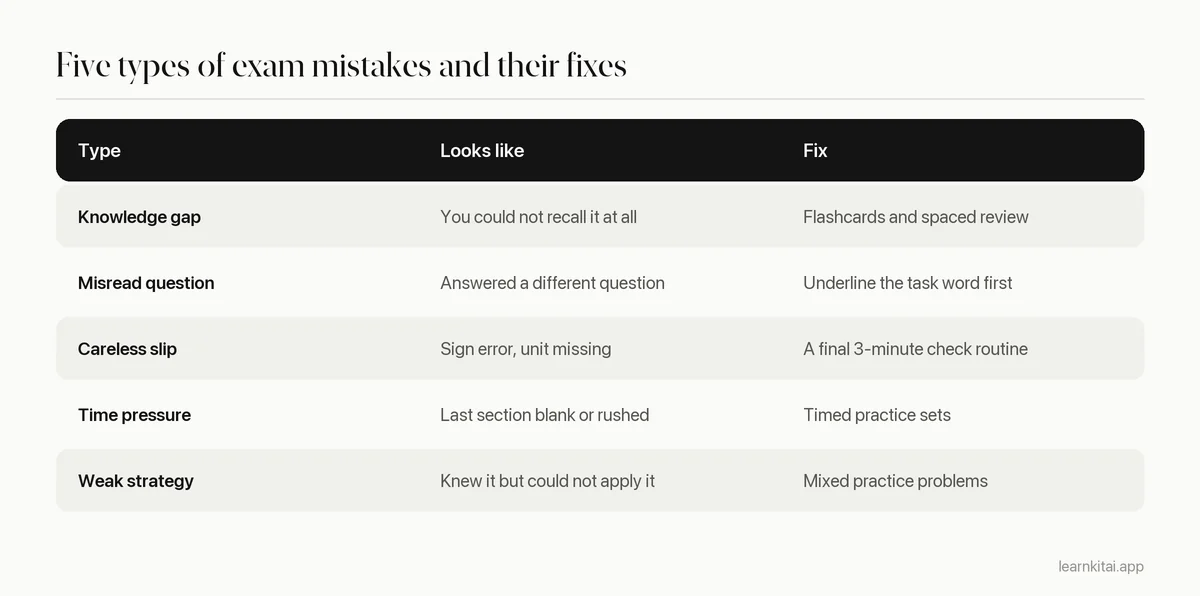
This sorting step matters more than anything else in the review. A student who loses 20 points to careless slips does not need to reread the textbook. They need a checking habit. A student who lost the same 20 points to knowledge gaps needs the opposite. Without labels, both students tend to do the same thing: study harder in a general way, which fixes neither.
The 30-minute exam review routine
Here is the full routine to review a graded exam in about half an hour. Do it at a desk, with the paper, a pen and a blank page.
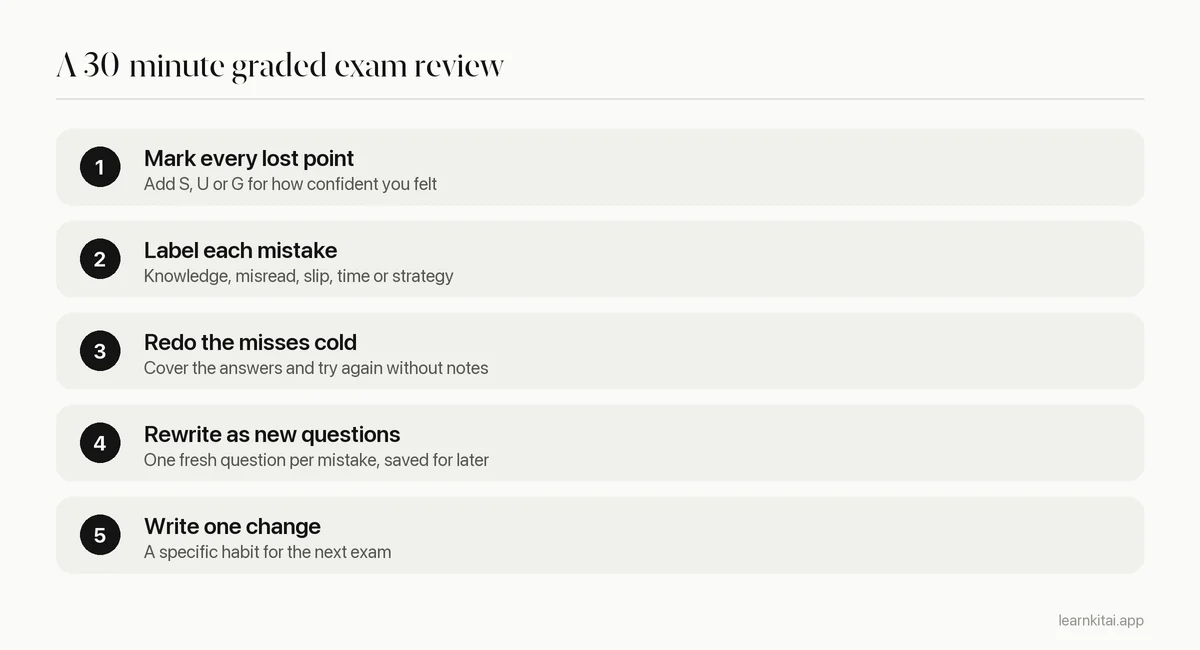
Step three is where the learning happens. Cover the correct answer and try the question again from scratch. If you can now solve it, great. If you cannot, you have found a real gap, not a slip. Only then look at the solution, and explain each line to yourself in your own words. This is the same idea behind self explanation.
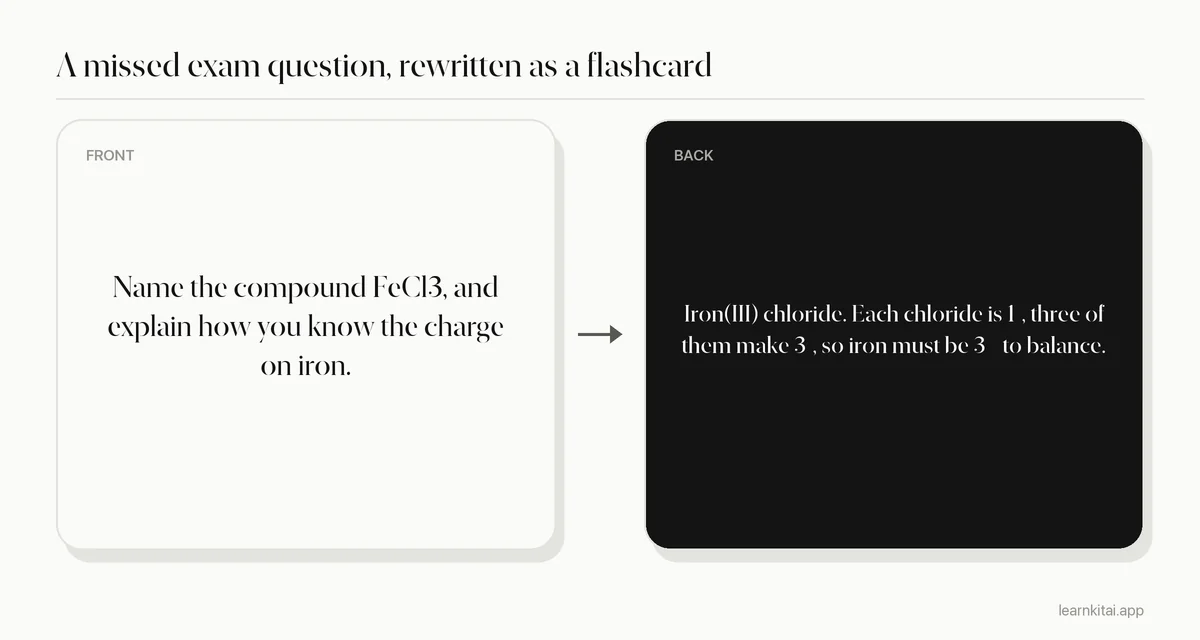
Step four turns the review into future practice. Each miss becomes a new question that you will answer again in a few days. Keep these in one place, such as an error log, so the next exam review starts with the questions you already know are weak.
A worked example: a 68 on a chemistry midterm
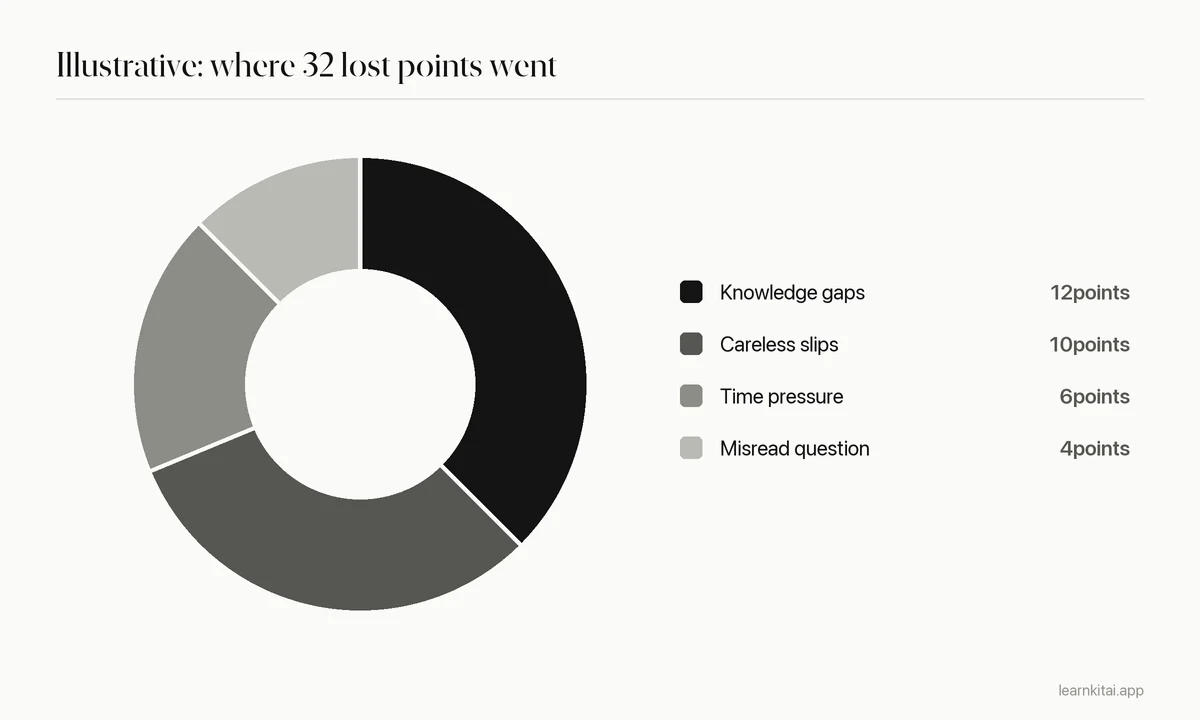
Say Maya scored 68 out of 100 on a chemistry midterm. She lost 32 points. Her labels came out like this: 12 points to knowledge gaps (she could not recall how to name ionic compounds), 10 points to careless slips (two unit errors and a dropped negative sign), 6 points to time pressure (the last problem was half done) and 4 points to a misread question.
Before the review, Maya planned to reread the whole chapter. After it, her plan was different. She made 15 flashcards on naming rules. She added a three-minute unit check at the end of every practice set. She started doing one timed problem set a week. Rereading would have touched only a third of her lost points. The new plan targets all of them.
How do you turn exam mistakes into study material?
Rewrite each missed question so it tests the same idea in a slightly different way, then answer it again after a few days. Changing the numbers or wording stops you from simply remembering the old answer.
Copying the correct answer onto the paper feels productive but teaches little. A better move is to write a new version of the question. Change the numbers. Swap the example. Ask for the reverse. Then answer it later, without looking. Testing yourself this way is one of the two highest-rated study methods in a large review of learning techniques by Dunlosky and colleagues, alongside spreading study over time.
If your notes for the unit are long, you can also feed them into a quiz tool and practice the weak topic again. LearnKit can turn a chapter PDF or your lecture notes into a short multiple choice quiz, which is a fast way to check whether the gap is really closed.
What are the most common review mistakes?
Only reading the right answers, reviewing only the questions with the most points, waiting a week, and making a vague goal like study more. Each of these feels like review but changes nothing for the next test.
- Reading answers instead of redoing questions. Seeing the solution creates a feeling of understanding that does not hold up in the exam room.
- Ignoring questions you got right by luck. Mark guesses as weak spots too, even if they scored.
- Waiting too long. After a week you no longer remember why you chose an answer, so you cannot label the mistake.
- Writing vague goals. Study harder is not a plan. Do a timed set every Sunday is.
- Skipping the teacher. One five-minute question in office hours can clear up a misread rubric for the rest of the course.
What if the exam went badly?
Run the same review, just slower. A low score is mostly data. Sort the lost points, talk to your teacher about options, and build a short recovery plan before emotions push you to avoid the subject.
A bad grade makes the paper hard to look at, which is exactly why a fixed routine helps. You are not judging yourself. You are counting. If the result changes your course plans, read our guide on what to do after failing an exam for the next steps. And when the next test is close, fold your error log into a proper practice testing plan.
Frequently asked questions
Should I do exam corrections even if my teacher does not give credit for them?
Yes. The value of corrections is the learning, not the points. Redoing missed questions without notes shows you which gaps are real, and that is worth more for the final than any partial credit.
How long should reviewing a test take?
About 30 minutes for a typical one-hour exam. If you lost many points to knowledge gaps, add short follow-up sessions over the next week to re-test the rewritten questions.
What is an exam wrapper?
An exam wrapper is a short reflection sheet completed when a graded test is returned. It asks how you prepared, what kinds of errors you made, and what you will change next time. You can make your own with five questions on a single page.
Is it worth reviewing an exam I did well on?
Yes, but briefly. Check the questions you guessed or felt unsure about, since they may not hold up on the final. Then note which study methods worked so you can repeat them.
Sources
- Exam Wrappers, Eberly Center, Carnegie Mellon University (Describes exam wrappers that ask students to review performance, spot error patterns and judge their preparation.)
- Surprising feedback improves later memory, Psychonomic Bulletin & Review (Fazio and Marsh, 2009) (Hypercorrection effect: high-confidence errors are more likely to be corrected after feedback.)
- Which Study Strategies Make the Grade?, Association for Psychological Science (Review of 10 techniques rating practice testing and distributed practice as the two high-utility methods.)
Keep reading

Practice Testing: The Study Habit That Beats Rereading
Testing yourself is not just a way to check what you know. It is one of the best-supported ways to learn. Here is how to do it well, week by week.
Error Log Studying: Turn Every Mistake Into Points
An error log is a simple table of every question you got wrong and why. Kept well, it becomes the most targeted study guide you will ever own.
Failed an Exam? A 7-Day Plan to Find Out Why and Recover
A failing grade is data, not a verdict. Here is a calm seven-day plan to diagnose what went wrong, talk to the right people and change how you study.
Self Explanation: Talk Yourself Into Understanding
Stopping after each step to ask why it works is one of the simplest study habits with solid research behind it. Here are the prompts and a worked example.
The Testing Effect: Why a Quiz Beats Another Reread
Taking a test is not just a way to measure memory. It changes memory. Here is what the research shows and how to use it this week.