The Testing Effect: Why a Quiz Beats Another Reread
The testing effect is the finding that trying to recall information makes you remember it longer than studying it again for the same amount of time. In a well known 2006 study, students who were tested on a passage recalled 56% of it a week later, while students who reread it recalled 42%.
Most students treat a test as the end of learning: you study, then you find out how much stuck. The testing effect turns that order around. Pulling an answer out of memory is itself a strong form of study, often stronger than reading the page one more time. Psychologists also call it test-enhanced learning, and it is one of the best supported findings in the science of memory.
This post explains what the key studies actually found, why the effect is easy to miss, and how to turn it into a weekly routine without writing a single formal exam. If you want the wider picture of using questions to study, the practice testing guide is the hub for this topic.
What is the testing effect?
It is the finding that retrieving information from memory strengthens later recall more than restudying the same information. The benefit shows up after a delay of days, not minutes, which is why many students never notice it.
The most cited demonstration comes from Henry Roediger and Jeffrey Karpicke at Washington University in St. Louis. In their 2006 paper in Psychological Science, students read short prose passages. Some then read the passage again. Others wrote down everything they could remember, with no feedback and no second look at the text.
On a test five minutes later, rereading looked better: 81% recall against 75%. But two days later the order flipped, 68% for the tested group against 54% for the rereaders. After a week it was 56% against 42%. The tested students remembered as much after a week as the rereaders did after two days.
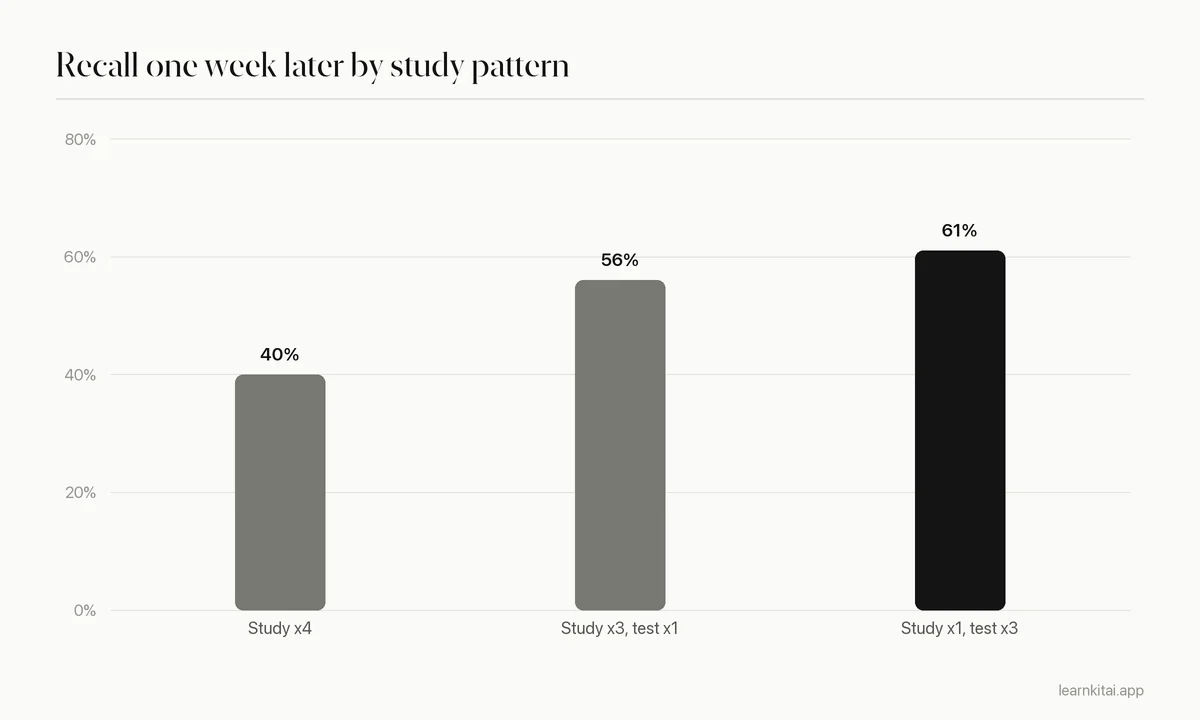
A second experiment pushed further. Students who read a passage once and then tried to recall it three times remembered 61% a week later. Students who read it four times remembered 40%, even though they had read the text far more often. The repeated readers also felt more confident that they would remember it. That gap between feeling and result is the heart of the problem.
Why does testing improve memory more than rereading?
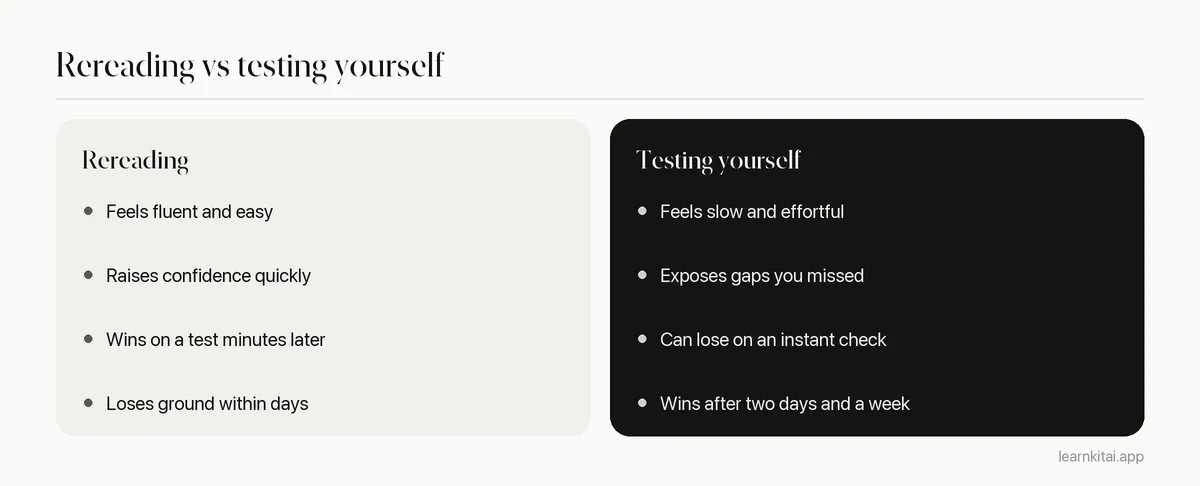
Recall forces you to rebuild the path to an answer, and each successful rebuild makes the path easier to find again. Rereading only shows you the answer, so it feels smooth but trains recognition rather than recall.
Think of memory less like a storage box and more like a network of trails. Rereading walks you past the destination with a guide. Testing makes you find the way yourself. The effort of searching, even when it is slow or partly wrong, is what strengthens the route you will need on exam day.
Testing also gives you honest information. When you reread, everything looks familiar, and familiarity is easy to mistake for knowledge. A blank page tells you exactly which parts you cannot produce yet. That is why rereading notes tends to inflate confidence while quizzing deflates it, usually to a more accurate level.
How strong is the evidence?
Very strong for a learning technique. A 2013 review of ten common study methods gave practice testing its top utility rating, and a 2017 meta-analysis found practice tests beat restudying and every other comparison condition it examined.
A team led by John Dunlosky reviewed ten popular study techniques for the journal Psychological Science in the Public Interest. Only two earned a high utility rating: practice testing and distributed practice. Rereading and highlighting were rated low. You can read the summary of that review on the publisher's site.
A later meta-analysis by Adesope, Trevisan and Sundararajan in Review of Educational Research pooled results from many classroom and lab studies. Their conclusion was blunt: practice tests were more beneficial for learning than restudying and all other comparison conditions. The size of the benefit varied with test format and timing, but it showed up for both retention and transfer to new questions.
Does the testing effect work for every subject?
It has been shown with word lists, prose, science concepts, maps and classroom material from middle school to medical school. It helps most with material you will later need to produce from memory, such as definitions, processes, steps and arguments.
There are limits worth knowing. If you cannot recall anything at all, a test without feedback teaches very little, so pair hard quizzes with a quick check of the answer. Testing also does not replace understanding. For a concept you have never grasped, first explain it, for example with the Feynman technique, then test yourself on it.
How to use the testing effect this week
You do not need formal exams. Any act of recall counts: a blank page, a flashcard, a question you answer aloud on a walk. Here is a simple routine that fits around a normal week of classes.
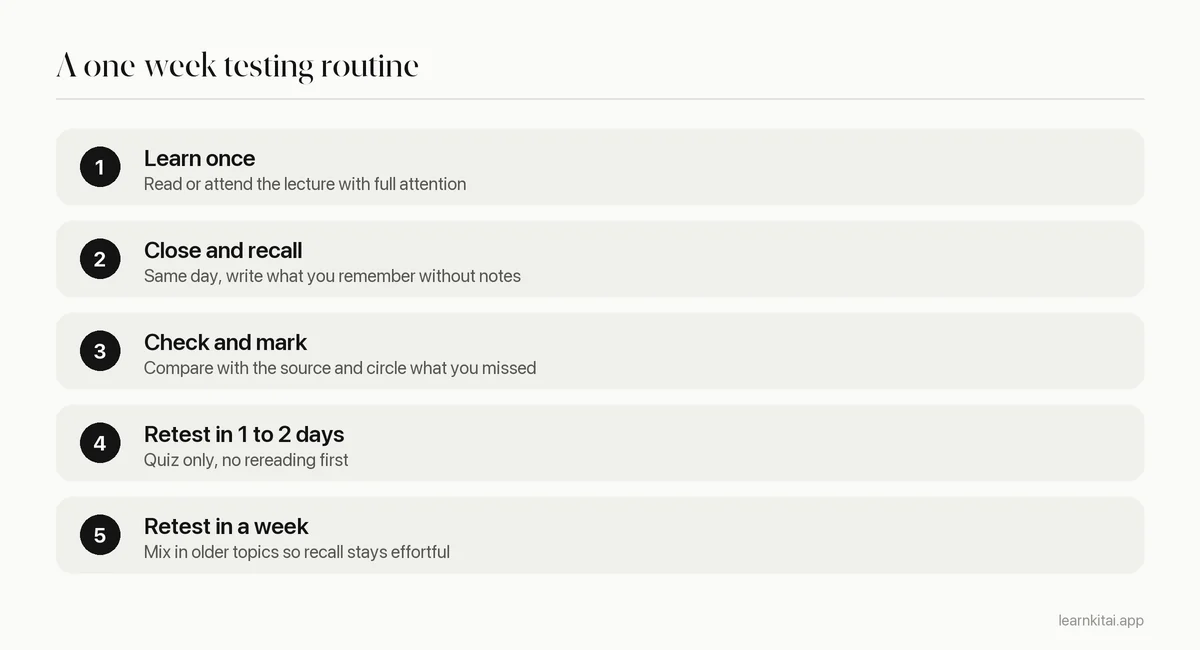
- After each lecture, spend five minutes writing the main points from memory before you look at your notes.
- Turn each heading in your notes into one question and answer it the next day without peeking.
- When you get something wrong, write the correct answer in your own words, then test it again in a later session.
- Space the retests. The gap matters as much as the test, which is why the testing effect pairs naturally with spaced repetition.
- Keep a few quick questions for the bus or the queue at lunch. Two minutes of recall beats ten minutes of scrolling through notes.
If writing questions is the step you keep skipping, let a tool draft them and spend your effort on answering. In LearnKit you can add a PDF or your notes and get a short multiple choice quiz with explanations, then retest yourself on the same set a few days later.
Common mistakes that waste the effect
- Peeking too soon. Glancing at the answer after two seconds turns recall back into rereading. Give yourself a real attempt first.
- Testing only what you know. It feels good to ace easy cards. Spend most of your time on the questions you keep missing.
- Quizzing once, the night before. One late test is better than none, but the big gains come from repeated, spaced attempts.
- Judging by how it feels. Testing feels harder and slower. That difficulty is part of why it works, a pattern researchers call desirable difficulties.
The short version: every time you are about to reread, ask yourself a question instead. You will feel less sure in the moment and remember more a week later, which is the trade that counts on exam day.
Frequently asked questions
Is the testing effect the same as active recall?
They describe the same idea from two angles. Active recall is the study habit of pulling information from memory, and the testing effect is the research finding that this habit improves long term retention. If you practice active recall, you are using the testing effect.
Do multiple choice quizzes trigger the testing effect?
Yes, as long as the wrong options are plausible enough that you have to think. Recall formats such as short answer tend to help more when you get feedback, so mix both types if you can.
How many times should I test myself on the same material?
In the 2006 study, three recall attempts beat one, and one beat none. A practical target is to retrieve each key idea at least three times across a week or more, with gaps between attempts.
Does getting answers wrong on a practice quiz hurt my learning?
Not if you check the right answer afterward. Mistakes on a low stakes quiz followed by feedback are among the most useful moments in studying, because they show you exactly what to fix.
Sources
- Test-Enhanced Learning: Taking Memory Tests Improves Long-Term Retention, Psychological Science (Roediger and Karpicke, 2006) (Recall figures: 81% vs 75% at 5 minutes, 68% vs 54% at 2 days, 56% vs 42% at 1 week; Experiment 2: 61%, 56% and 40% at 1 week)
- Improving Students' Learning With Effective Learning Techniques, Psychological Science in the Public Interest (Dunlosky et al., 2013) (Practice testing and distributed practice rated high utility; rereading and highlighting rated low)
- Rethinking the Use of Tests: A Meta-Analysis of Practice Testing, Review of Educational Research (Adesope, Trevisan and Sundararajan, 2017) (Practice tests more beneficial than restudying and all other comparison conditions)
Keep reading

Practice Testing: The Study Habit That Beats Rereading
Testing yourself is not just a way to check what you know. It is one of the best-supported ways to learn. Here is how to do it well, week by week.
Quiz Yourself From Your Notes in 15 Minutes a Day
Your notes already contain the questions. Here is how to pull them out, five ways to test yourself, and a short daily routine that keeps old topics alive.
The Forgetting Curve: Why Exam Knowledge Vanishes
You studied hard, passed, and a month later it is mostly gone. The forgetting curve explains why, and what kind of studying makes knowledge last.

Active Recall: Why Closing the Book Beats Rereading
Rereading feels productive but fades fast. Here is how to study by pulling answers out of memory, with a session plan, examples and the mistakes to avoid.
Make a Practice Test That Feels Like the Real Exam
A good practice test copies the real exam's format, mixes topics, and comes with an answer key you check honestly. Here is a step by step build.