Interleaved Practice: Why Mixed Sets Feel Worse but Work
Interleaved practice means mixing different types of problems or topics in one study session instead of doing all of one type before moving on. It feels harder and slower, but it trains you to recognize which method each problem needs, and in classroom studies it has led to far higher scores on delayed tests.
Textbooks teach in blocks. Read section 4.2 on the quadratic formula, then do problems 1 to 20, all of which need the quadratic formula. By problem 5 you are on autopilot, and it feels like mastery. On the exam, though, the problems arrive mixed and unlabeled, and the hardest part is no longer solving them. It is knowing which tool each one needs. Interleaved practice trains exactly that skill by mixing problem types from the start.
What is the difference between blocked and interleaved practice?
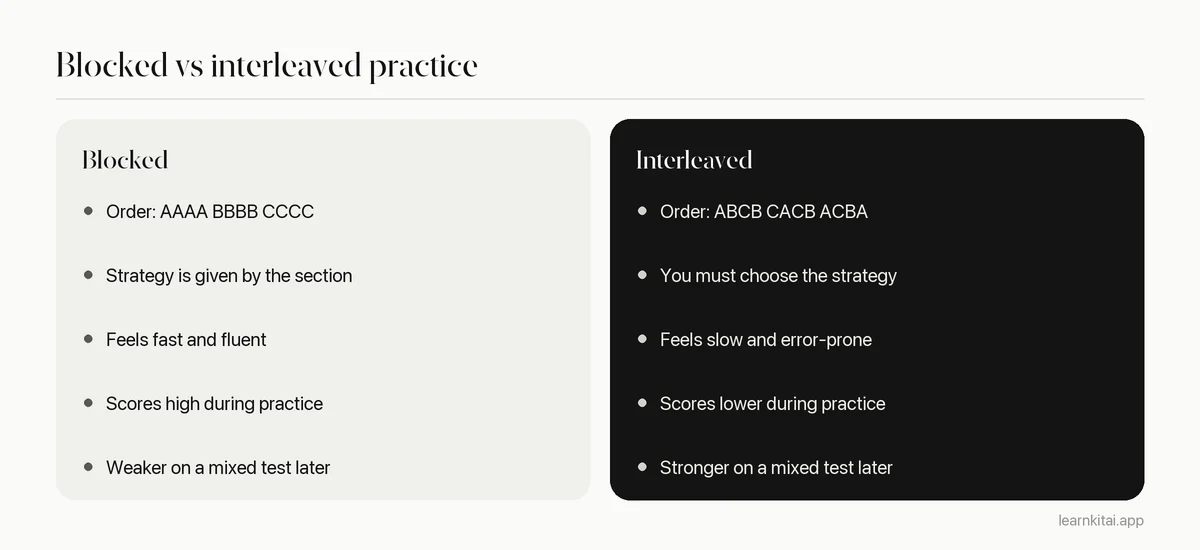
Blocked practice groups problems by type: AAAA, BBBB, CCCC. Interleaved practice mixes them: ABCA, CBAC. Both use the same problems. The difference is that in a mixed set, you must decide which method each problem calls for before you can solve it.
In a blocked set, the chapter title tells you the strategy. You only practice executing it. In a mixed set, each problem forces two steps: identify the type, then solve. That first step is what exams test and what blocked homework never practices.
Does interleaving really improve test scores?
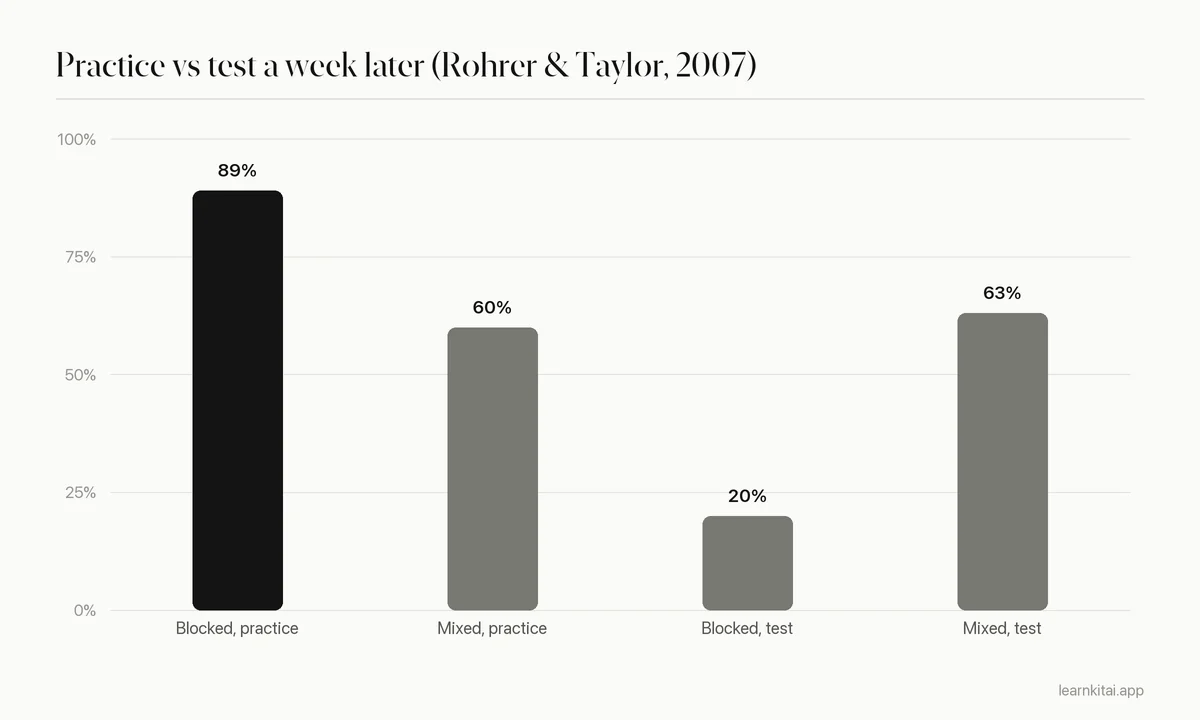
Yes, especially in math and in learning to tell similar categories apart. In one college study, mixed practice led to 63% correct a week later versus 20% for blocked practice, even though the blocked group did better during practice itself.
In a 2007 experiment by Doug Rohrer and Kelli Taylor at the University of South Florida, college students learned to find the volume of four kinds of geometric solids. One group practiced in blocks, one kind at a time. The other group got the same problems shuffled. During practice the blocked group looked far better, 89% correct against 60%. One week later, on new problems, the result reversed sharply: 63% for the mixed group, 20% for the blocked group.
This was not a one-off lab result. In a classroom study of 140 seventh graders, students practiced over nine weeks and took a surprise test two weeks later. Material learned with interleaved practice scored 72%, compared with 38% for blocked practice. The effect held even though the problem types looked quite different from each other.
Interleaving also helps you learn categories. In a 2008 study by Nate Kornell and Robert Bjork, people studied paintings by 12 artists, six paintings each, either grouped by artist or mixed. The mixed group was better at naming the artist of new paintings. Most participants still believed grouping had worked better, even after their own test results showed the opposite. In medical training, a study cited in the 2013 Dunlosky review found students who practiced mixed ECG diagnoses scored 47% on new cases, against 30% after blocked practice.
Why does mixing topics feel so much harder?
Because it removes the hint. In a blocked set the section tells you which method to use, so practice feels smooth. In a mixed set you must retrieve and compare methods every time, which is slower and causes more mistakes during practice, but builds the skill you need later.
That feeling is the trap. Smooth practice looks like learning, so students and even teachers tend to prefer blocking. A 2022 survey study found that most undergraduates judged schedules with little spacing or mixing to be the most effective, and rated the mixed ones as harder and less enjoyable. Interleaving is a classic desirable difficulty: worse during practice, better when it counts.
When does interleaved practice not help?
It helps most when problem types are easy to confuse and need different methods. It helps less for memorizing unrelated facts like vocabulary lists, and it can backfire if you mix topics before you understand any of them. Learn each method first, then mix.
- Before you understand the basics. Mixing three methods you have never seen is just confusing. Do a short blocked set first to learn each one.
- Simple fact lists. Studies on mixing vocabulary by category have shown little or no benefit. Spacing matters more there.
- Categories that are very varied inside. When members of one category look very different from each other, some research suggests a little blocking helps you see what they share.
- Unrelated subjects at random. Mixing chemistry with history in one problem set does little. Mix topics that compete for the same kind of question.
How do you build an interleaved practice set?
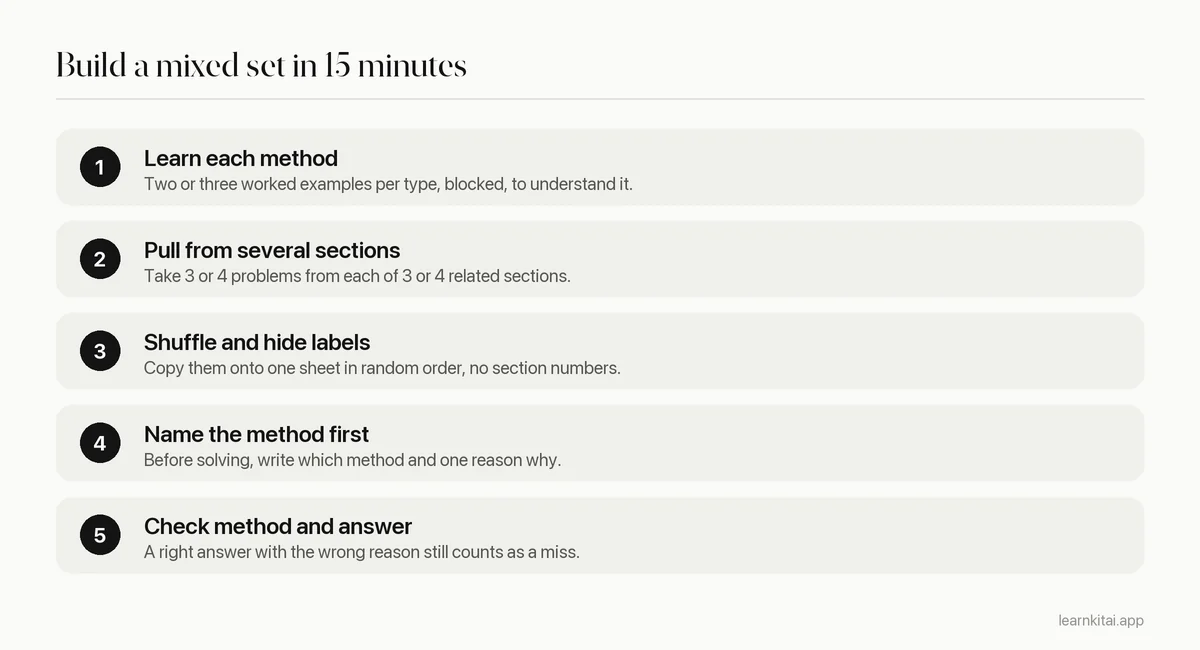
Learn each method with a few worked examples, then pull problems from several sections into one set, shuffle them, and remove any labels. Before solving each one, write down which method it needs and why. Check both the method and the answer.
Examples by subject
- Math: mix integration by parts, substitution and partial fractions in one set.
- Physics: mix energy, momentum and force problems so you must choose the principle.
- Chemistry: mix limiting reagent, percent yield and molarity questions.
- Biology: mix diagrams of mitosis and meiosis stages and identify each one.
- Languages: mix grammar points, such as past tenses, in one translation drill.
Here is what that looks like for a real week. Say your chemistry unit covers stoichiometry, gas laws and solution concentration. Monday and Tuesday you learn the gas laws with a short blocked set. From Wednesday on, every homework session is twelve problems: four gas law problems, four from last week's stoichiometry and four on concentration, shuffled. You will be slower on Wednesday than you were on Tuesday. By Friday, you will start to notice the clues in each question that point to the right method, such as a pressure and a volume pointing to the gas laws. That noticing is the skill the exam rewards.
Interleaving pairs naturally with spaced repetition: when you mix today's topic with last week's, you are both spacing the old one and practicing discrimination. And every mixed problem is a recall attempt, which is the heart of active recall. For more on building exam-style sets, see how to make a practice test.
If you do not have a ready-made mixed set, you can make one from your materials. In LearnKit, add notes from two or three chapters and generate a quiz; the questions come back from all of them, so you have to work out which idea each one is testing.
Frequently asked questions
Is interleaving the same as spacing?
They are related but not the same. Spacing is about time gaps between reviews of the same topic. Interleaving is about the order of different topics within a session. Mixed sets usually create some spacing too, which is one reason they work well.
How many topics should I mix in one session?
Two to four related topics is a good range. Fewer than two is just blocking. More than four can feel random, especially early on. Add more types as you get comfortable.
Should I stop doing blocked practice completely?
No. Short blocked practice is useful right after you learn a new method, so you can see how it works. Switch to mixed sets once you can solve a basic problem of each type on your own.
Sources
- The Shuffling of Mathematics Practice Problems Boosts Learning, Instructional Science (Rohrer & Taylor, 2007), USF repository (Blocked 89% vs mixed 60% during practice; 20% vs 63% on the test one week later.)
- The benefit of interleaved mathematics practice is not limited to superficially similar kinds of problems, Psychonomic Bulletin & Review (Rohrer, Dedrick & Burgess, 2014) (140 grade 7 students; 72% vs 38% on a delayed test.)
- Learning concepts and categories: is spacing the enemy of induction?, Psychological Science (Kornell & Bjork, 2008) (Interleaving paintings improved artist identification, yet learners rated blocking as more effective.)
- Scheduling math practice: Students' underappreciation of spacing and interleaving, Journal of Experimental Psychology: Applied (Hartwig, Rohrer & Dedrick, 2022) (Most students judged schedules with minimal mixing as most effective.)
- Improving Students' Learning With Effective Learning Techniques, Psychological Science in the Public Interest (Dunlosky et al., 2013) (Interleaved practice rated moderate utility; ECG diagnosis accuracy 47% interleaved vs 30% blocked; little benefit for vocabulary.)
Keep reading

Active Recall: Why Closing the Book Beats Rereading
Rereading feels productive but fades fast. Here is how to study by pulling answers out of memory, with a session plan, examples and the mistakes to avoid.

Desirable Difficulties: Why Harder Studying Sticks Longer
Study methods that feel smooth often fade fast, and ones that feel hard often last. How to tell a useful struggle from a pointless one, with a four-question check.

Spaced Repetition: Why Forgetting Is Part of the Plan
Reviewing right before you forget builds memories that last. Learn how long the gaps should be, with a ready schedule for exams one week to one semester away.

Make a Practice Test That Feels Like the Real Exam
A good practice test copies the real exam's format, mixes topics, and comes with an answer key you check honestly. Here is a step by step build.

How to Study Science: Think Like the Exam, Not the Textbook
Science asks for four kinds of knowledge at once: terms, mechanisms, problem skills and data. Here is how to study each one, and how they fit together.