Make a Practice Test That Feels Like the Real Exam
To make a practice test, list the topics your exam covers, write questions in the same formats the real exam uses, mix the topics together, and write an answer key before you start. Take it under timed, closed book conditions, mark it strictly, then retake the missed questions a few days later.
Old exams are the best practice material, but there are never enough of them, and they rarely match this year's syllabus. The fix is to make a practice test yourself. It takes about an hour, it teaches you while you build it, and it gives you something no amount of rereading can: an honest score before the score that counts.
This guide walks through a build you can repeat for any course. It sits inside our wider practice testing guide, which covers why testing works. Here we focus on the craft: what to put on the paper and how to use it.
Why make a practice test instead of just reviewing?
Because recall under exam conditions is a different skill from recognizing material on the page. A practice test trains that skill directly and shows which topics you only think you know.
In a classic 2006 experiment by Roediger and Karpicke, students who recalled a passage instead of rereading it remembered 56% a week later against 42% for the rereaders. A test you write yourself puts that effect to work, and the act of writing questions forces you to decide what matters in each topic.
How do you make a practice test step by step?
Map the exam, choose formats that match it, write questions from each topic, write the answer key separately, shuffle, then sit the test timed and closed book. Mark it, log the misses and retake those later.
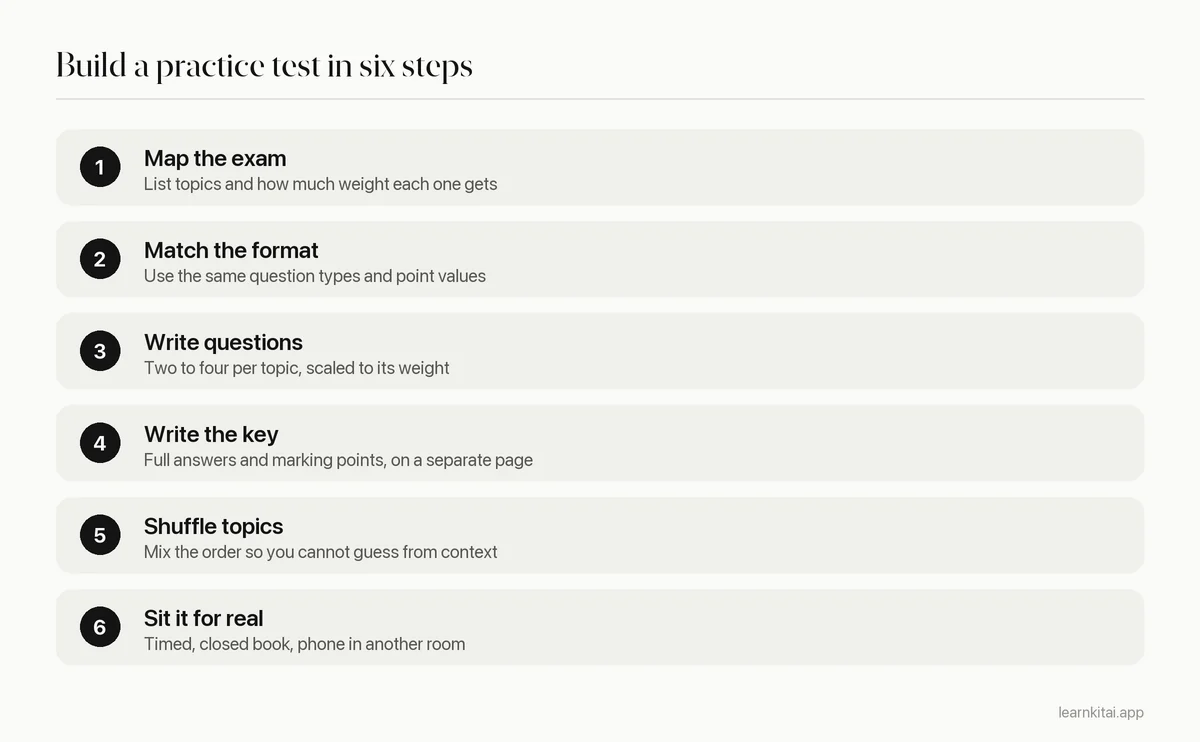
1. Map the exam
Start with the syllabus, the learning objectives, and anything your instructor said about the exam. Write each topic on a line and estimate its share of the marks. A topic that got three weeks of lectures probably deserves more questions than one that got a single slide.
2. Match the real format
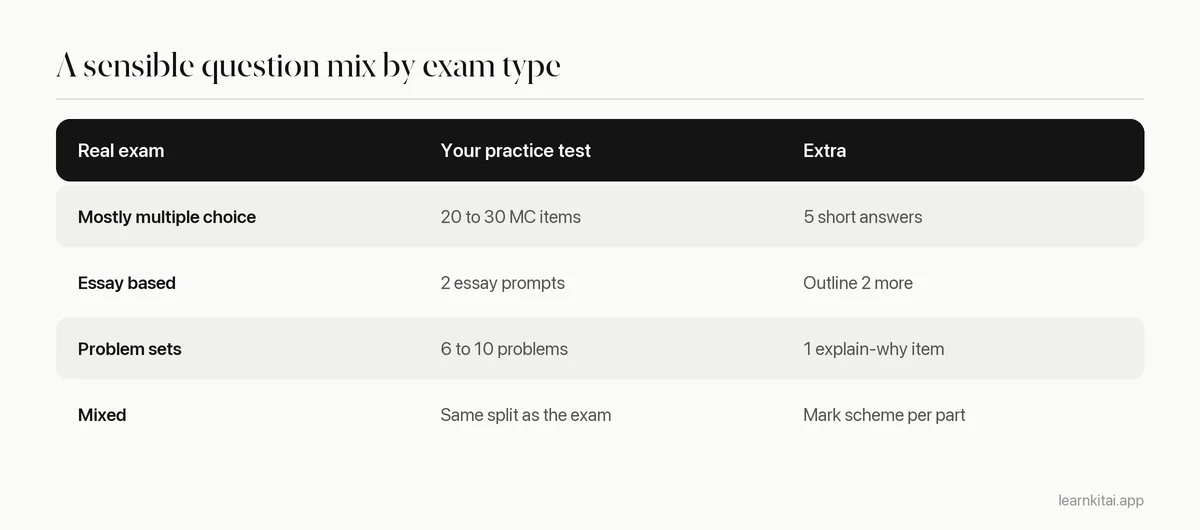
If the exam is mostly multiple choice, your test should be too. If it has essays or worked problems, include them. Format matters because different questions call for different kinds of recall. A study of test formats by Kang, McDermott and Roediger found that short answer quizzes with feedback led to the best final performance, better than multiple choice quizzes or rereading the facts. So even for a multiple choice exam, add a few short answer items.
3. Write questions that make you think
- Ask for application, not just definitions: "Which of these is an example of..." or "What happens if...".
- Write wrong options for multiple choice from real confusions, such as two similar terms from the same lecture.
- For each topic, add one question that links it to another topic. Exams love those.
- Avoid copying sentences from the textbook. If the wording is familiar, you may recognize it without knowing it.
4. Write the answer key before you sit it
Writing the key first stops you from being generous later. For long answers, list the three or four points a marker would look for. This is also where you will catch questions that are vague or have two right answers, so fix those now.
How long should a practice test be?
Long enough to cover every major topic, short enough to finish in one sitting. A good default is half to two thirds of the real exam's length, timed at the same pace per question.
A full length mock is useful once or twice near the end, mainly for pacing and stamina. Earlier on, shorter tests are better because you can take more of them. Three 25 minute tests across two weeks will usually teach you more than one three hour test the night before.
When should you take it, and when should you retake it?
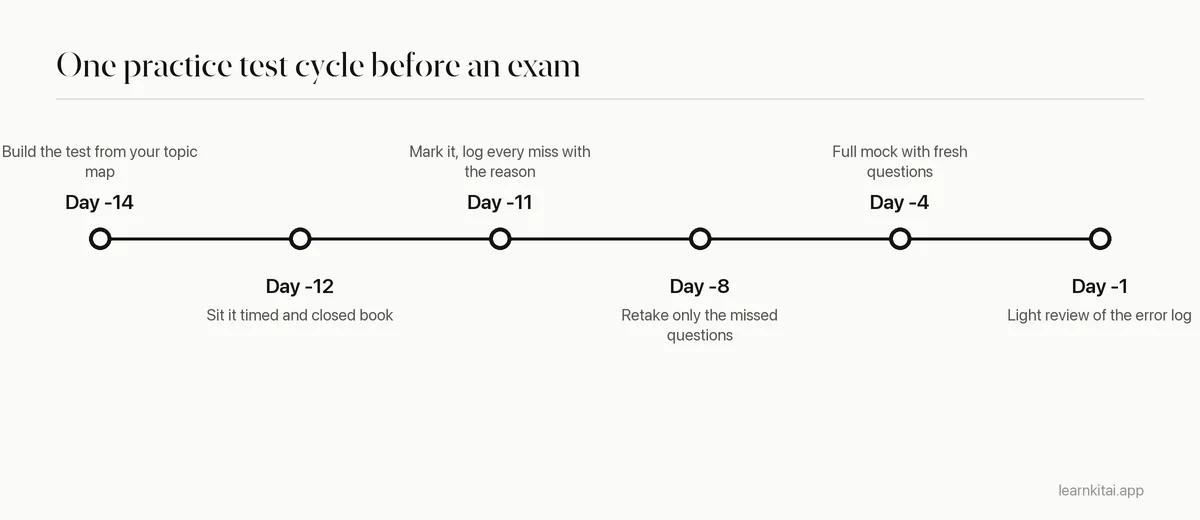
Take the first one about one to two weeks before the exam, then retake missed questions after a gap of a few days. Research on spacing suggests the best review gap grows as the exam gets further away.
A large study on spacing effects by Cepeda and colleagues tested more than 1,350 people. For a test one week away, the best gap between study sessions was about 20 to 40% of that week. For a test a year away, it fell to about 5 to 10%. In plain terms: for an exam in a week, review again in roughly two days, not two hours.
Marking: the step that does the teaching
Feedback is where most of the learning happens. In a study of word learning by Pashler and colleagues, giving the correct answer after an error raised one week retention by 494% compared with no feedback. Feedback after correct answers made little difference. So spend your marking time on the misses.
- Mark strictly against your key. Half right is wrong for review purposes.
- For each miss, write the right answer in your own words and one line on why you missed it: did not know, mixed up, misread, ran out of time.
- Move those items into a mistake log and retake them a few days later.
- Track your score per topic, not just overall. That tells you where your next study hour goes.
Writing questions is the slowest part, and it is fine to get help with it. LearnKit can turn a PDF, a lecture or a page of notes into multiple choice and open questions, which you can then edit, mix and time yourself on.
Common mistakes when making your own test
- Writing only easy questions. If you score 95% the first time, the test is too gentle to teach you much.
- Keeping topics in lecture order. Real exams jump around. Shuffle so each question has to stand on its own.
- Taking it open book. Checking the notes mid test turns it into rereading.
- Never retaking it. A single test shows the gaps. The retake closes them. See how to review a graded exam for the same approach after real tests.
Frequently asked questions
Can I use the same practice test more than once?
Yes, but change it a little each time. Reorder the questions, reword a few and add new ones on weak topics, so you are recalling the material rather than the position of an answer.
Is it cheating to use AI to write practice questions?
For your own study, no. It is a study aid, like a textbook's end of chapter questions. Check the questions against your course material, since generated questions can contain errors, and follow your course's rules for graded work.
Should I swap practice tests with classmates?
It is a good idea. Their questions expose blind spots that yours will not, because you tend to write questions about what you already know. Agree on a format and share answer keys afterward.
Sources
- Test format and corrective feedback modify the effect of testing on long-term retention, European Journal of Cognitive Psychology (Kang, McDermott and Roediger, 2007) (With feedback, short answer quizzes led to the best final test performance)
- When Does Feedback Facilitate Learning of Words?, Journal of Experimental Psychology: Learning, Memory, and Cognition (Pashler et al., 2005) (Correct-answer feedback after errors increased one week retention by 494%)
- Spacing Effects in Learning: A Temporal Ridgeline of Optimal Retention, Psychological Science (Cepeda et al., 2008) (Over 1,350 participants; optimal gap about 20 to 40% of a one week delay, 5 to 10% of a one year delay)
- Test-Enhanced Learning, Psychological Science (Roediger and Karpicke, 2006) (56% vs 42% recall after one week for testing vs rereading)
Keep reading

Practice Testing: The Study Habit That Beats Rereading
Testing yourself is not just a way to check what you know. It is one of the best-supported ways to learn. Here is how to do it well, week by week.
The Testing Effect: Why a Quiz Beats Another Reread
Taking a test is not just a way to measure memory. It changes memory. Here is what the research shows and how to use it this week.
Multiple Choice Strategies That Beat Guessing
Cover the options, answer first, then eliminate. Plus what the data says about changing answers, and how to study so the right option jumps out.
Predict Exam Questions Like the Person Who Writes Them
Your instructor leaves clues everywhere: objectives, repeated examples, old papers. Learn to read them, write the likely questions and answer them first.
Error Log Studying: Turn Every Mistake Into Points
An error log is a simple table of every question you got wrong and why. Kept well, it becomes the most targeted study guide you will ever own.