How to Study Science: Think Like the Exam, Not the Textbook
To study science well, split it into four kinds of knowledge: terms, mechanisms, problem skills and data. Learn terms with flashcards, mechanisms by explaining them from memory, problems by solving mixed sets without notes, and data by interpreting real graphs. Test yourself every session and keep a log of your mistakes.
You can read a chemistry chapter twice, follow every worked example, and still freeze on the first exam problem. That is not a sign you are bad at science. It is a sign the way you studied did not match the way you were tested. Learning how to study science starts with one shift: stop asking "Have I read it?" and start asking "Can I do what the exam will ask me to do, without help?"
Science exams ask for several different skills at once. This guide breaks them apart, gives you a method for each, and ends with a weekly routine you can use in biology, chemistry, physics, anatomy or any other lab science. Each subject also has its own guide, linked below, for the details that make it different.
Why does science feel harder to study than other subjects?
Science stacks several loads at once: new vocabulary, invisible processes, math, and experiments. Topics also build on each other, so a gap in week three can break week eight. Studying that works treats each load on its own and checks the foundations often.
In a history course, a weak week usually hurts one topic. In science, it often hurts every topic after it. If moles never clicked, stoichiometry, solutions and equilibrium all wobble. If you are fuzzy on how membranes work, nerve signals and kidney function will be harder too. That is why science rewards steady, cumulative review over end-of-term cramming.
Science also asks you to picture things you cannot see: electrons, enzymes, electric fields. Text alone is a weak way to learn invisible processes. Diagrams you can draw from memory are a strong one.
What are the four kinds of science knowledge?
Terms (what things are called), mechanisms (how and why processes happen), problem skills (applying rules to new cases), and data skills (reading graphs and experiments). Each needs a different study method, and most exams test all four.
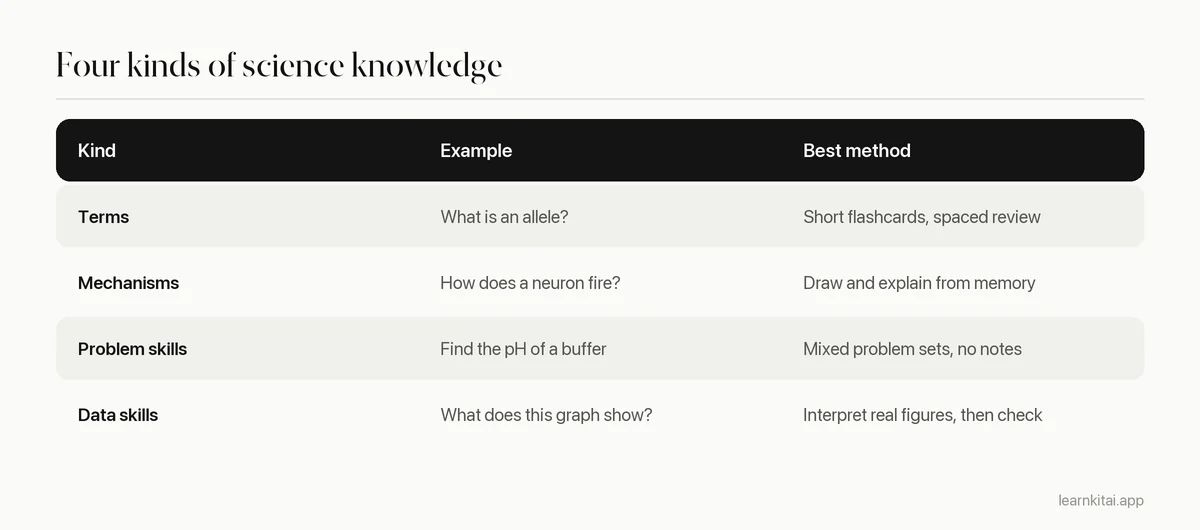
Most students spend almost all their time on the first row and then wonder why the exam felt unfair. Terms are the easiest to study and the easiest to feel good about. But a typical university exam gives more marks to mechanisms, problems and data. A useful check: look at a past paper and sort its questions into these four kinds. Then compare that split to how you spent your study time last week.
Why does active learning matter so much in science?
Because science is a skill as much as a body of facts, and skills grow through doing. A major review of college science courses found students in active classes did better on exams and were less likely to fail than students in lecture-only classes.
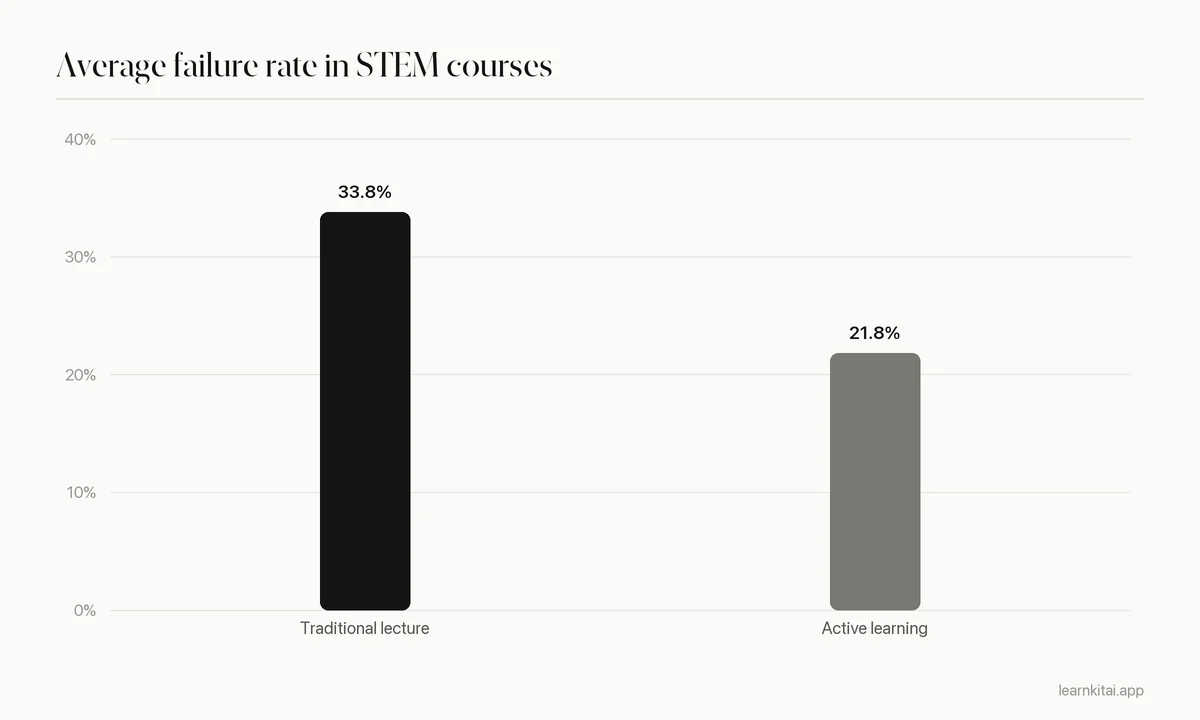
Freeman and colleagues pooled 225 studies of undergraduate science, engineering and math courses. Students in classes built around active learning scored about 6% higher on exams. Students in traditional lecture classes were 1.5 times more likely to fail. The average failure rates tell the story.
You cannot always choose how your course is taught. But you can choose how you study, and the same principle holds at your desk. Watching a worked example is like a lecture. Solving a problem with the book closed is active. Reading a diagram is passive. Drawing it from memory and labeling it is active. Every method below is a way of doing the active version.
How do you study science concepts so they stick?
Close the book and explain the process from memory, out loud or on paper, step by step and with a diagram. Then check the source and fix gaps. Recall like this beats rereading and even beats building concept maps with the book open.
Karpicke and Blunt compared two ways of studying science texts with about 200 students. One group built detailed concept maps with the text available. The other read the text, put it away and wrote down everything they could recall. A week later, the recall group showed about 50 percent better long-term retention, even on questions that asked them to make inferences. Students had predicted the opposite.
The draw-and-explain method
- Pick one process, such as photosynthesis, an SN2 reaction or a heartbeat.
- On a blank page, draw it from memory and label every part you can.
- Explain each step in one sentence, including why it happens, not just what happens.
- Open the textbook and mark gaps or errors in a different color.
- Two days later, do it again on a fresh page. Compare the two versions.
Step three is where understanding shows up. If you can only say what happens next, you have memorized a sequence. If you can say why, you can handle a question that changes one condition. Explaining in plain words like this is the core of the Feynman technique, and pairing words with your own diagrams uses dual coding. Both are forms of active recall, the habit behind almost everything in this guide.
How should you practice science problems?
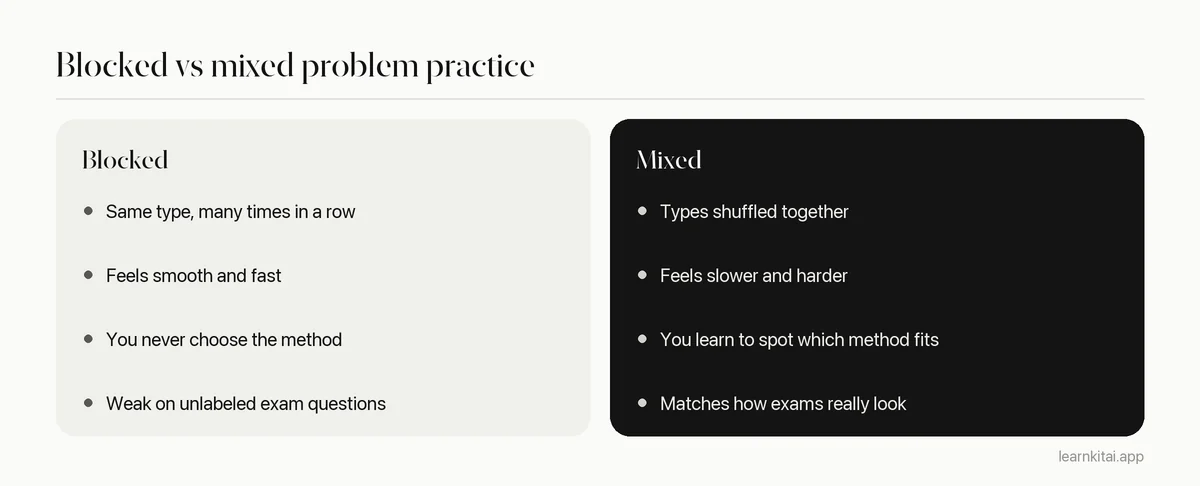
Study one or two worked examples, then solve problems without looking. Mix problem types instead of doing twenty of the same kind, and log every mistake with its cause. Mixed practice feels harder but prepares you for exams, where problems come unlabeled.
Textbook problem sets usually come in blocks: twenty problems on the ideal gas law, then twenty on stoichiometry. Blocks feel productive because you already know which method to use. Exams do not tell you that. Research on mixed, or interleaved, practice found that students who shuffled problem types struggled more during practice but did vastly better on a test one week later. Our guide to interleaved practice shows how to build mixed sets.
Then log your errors. For each wrong answer, write one line: the topic, what went wrong, and the type of error (concept gap, misread question, algebra slip, units). After two weeks, patterns jump out. Many students find that half their lost marks come from one or two repeat causes. A mistake log turns those patterns into targets.
How to study science, subject by subject
The four kinds of knowledge show up in every science, but in different proportions. That changes where your time should go.
- Biology is heavy on terms and mechanisms. Learn processes as stories with causes and effects. See how to study biology.
- Chemistry leans on problem skills built on a few core ideas like moles and bonding. See how to study chemistry.
- Anatomy is spatial: you need to place structures and know what they connect to. See how to study anatomy.
- Pharmacology links drug classes to mechanisms and side effects, so grouping is everything. See pharmacology study tips.
- Psychology mixes theories, named studies and research methods, so data skills matter a lot. See how to study psychology.
- Programming and computer science reward building and debugging over reading. See learning programming concepts.
A weekly routine for any science course
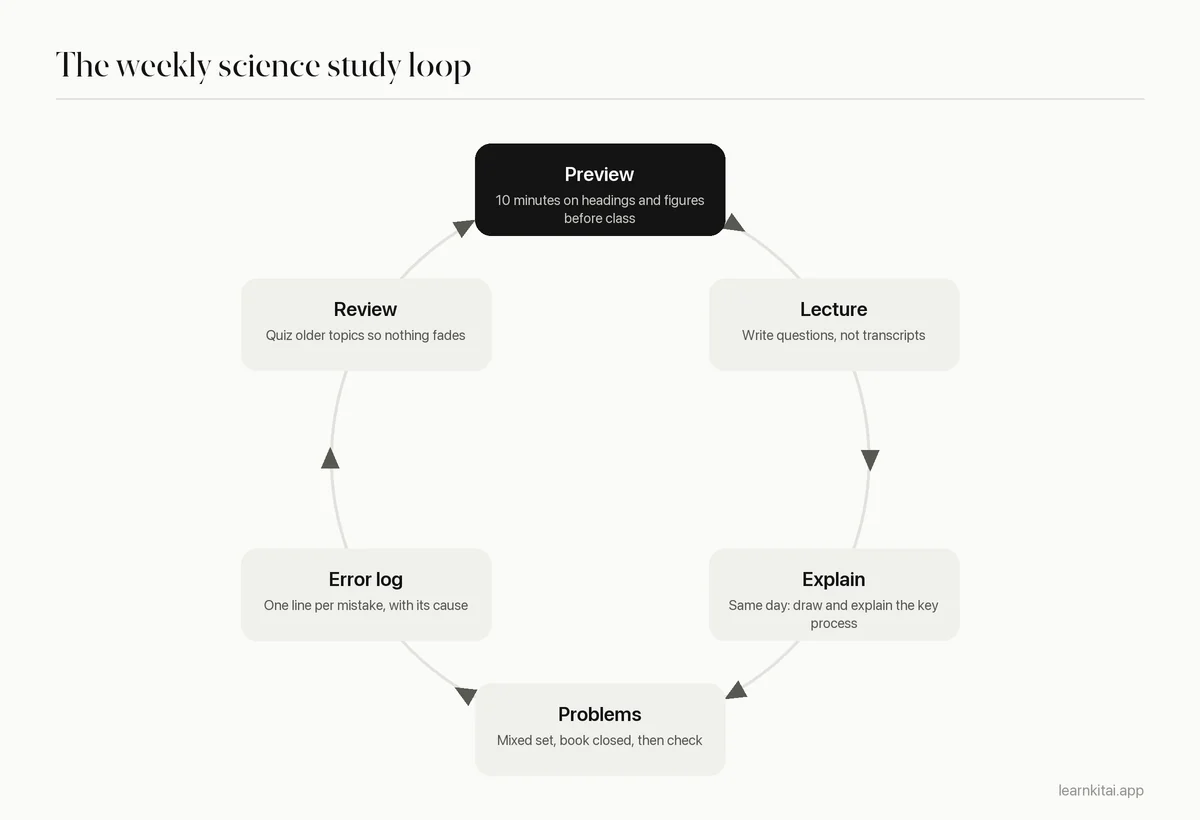
The last step keeps science's building blocks solid. Each week, spend part of one session quizzing yourself on topics from earlier in the course. Ten minutes on last month's material costs little and prevents the slow collapse that shows up right before finals.
Making those quizzes is where AI can save you real time. LearnKit turns your lecture slides, notes or a photo of a textbook page into a multiple choice quiz or open questions, so the review step does not depend on you writing questions first.
How should you prepare in the final week before a science exam?
Shift from learning new material to rehearsing the exam. Take timed practice papers, sort every lost mark by kind of knowledge, and spend the remaining days on your weakest kind. Keep terms in short daily reviews and protect your sleep.
The week before a science exam is not the time to read the whole textbook again. It is the time to find out exactly where your marks are leaking and plug those holes. Here is a simple plan for that week.
- Day 7: Sit one full past paper under timed conditions, book closed.
- Day 6: Mark it honestly. Sort every lost mark into terms, mechanisms, problems or data. The biggest pile is your focus.
- Days 5 to 3: Spend most of each day on that pile: redraw mechanisms, do mixed problem sets, or interpret graphs. Keep 15 minutes for flashcards on terms.
- Day 2: Sit a second paper, or a mixed set built from your error log.
- Day 1: Light review of your error log and key diagrams. Sleep at a normal time.
This is the point where knowing how to study science pays off most. A student who sorts lost marks by kind of knowledge can see, for example, that terms are fine but data questions keep costing marks, and fix that in three days. A student who just rereads cannot see it at all. For a wider exam-season plan across all your courses, see how to study for finals.
What are the biggest mistakes science students make?
Rereading instead of testing, watching worked examples instead of solving, studying only terms, doing problems in blocks, and leaving review until the end. Each feels productive and each leaves you unprepared for unlabeled exam questions.
- Following, not doing. Nodding along to a worked solution feels like understanding. Only solving it alone proves it.
- Copying slides. Beautiful notes are not the goal. A list of questions you can answer is.
- Skipping the math. If algebra or unit conversion slows you down, ten minutes a day on it pays off across every topic.
- Ignoring graphs. Data questions are often worth many marks. Practice describing trends, then explaining them.
- Cramming a cumulative subject. Science builds on itself. Short weekly reviews beat one heroic weekend.
Studying science is less about talent than about matching your practice to the test. Split the subject into its four kinds of knowledge, practice each one actively, and review the foundations every week. Start with whichever subject guide above fits your course.
Frequently asked questions
How many hours a week should I study for a science course?
It varies by course and level, so check what your instructor recommends. What matters more is how the hours are used: several shorter sessions with self-testing and problems usually beat one long reading session.
Should I read the textbook before or after the lecture?
A short preview before class, focused on headings, figures and bold terms, helps you follow the lecture. Do the deeper work afterward, when you can explain and practice what was covered.
Are flashcards useful for science?
Yes, for terms, definitions and key facts. They are less useful for mechanisms and problem solving, which need drawing, explaining and practice problems. Use cards as one tool, not the whole method.
How do I study for a science lab exam?
Practice the actual tasks: identify equipment, read real data tables, sketch the expected graph, and explain what each step of a procedure controls for. Ask your instructor for past lab questions if they exist.
Sources
- Active learning increases student performance in science, engineering, and mathematics, Freeman et al., PNAS, 2014 (via PubMed Central) (225 studies; lecture students 1.5 times more likely to fail; average failure rates 33.8% vs 21.8%; exam scores about 6% higher with active learning.)
- Learning science: Actively recalling information from memory beats elaborate study methods, ScienceDaily (Purdue University) (Karpicke and Blunt, about 200 students: retrieval practice gave about 50% better retention after a week than concept mapping.)
- The shuffling of mathematics problems improves learning, Rohrer and Taylor, Instructional Science, 2007 (Mixed practice led to much better performance on a test one week later than blocked practice.)
Keep reading
How to Study Biology: Learn the Story, Not Just the Words
Biology looks like a mountain of vocabulary. It is really a set of cause-and-effect stories. Learn them as stories and the words follow.
How to Study Chemistry: See It, Draw It, Write It
Chemistry asks you to think on three levels at once. Here is a routine that trains all three, plus a practice plan for problems.
How to Study Anatomy: Learn the Map Before the Streets
Anatomy feels like thousands of names. Learn the layout first, decode the Latin, and test yourself with images, and it starts to fit together.

Active Recall: Why Closing the Book Beats Rereading
Rereading feels productive but fades fast. Here is how to study by pulling answers out of memory, with a session plan, examples and the mistakes to avoid.
Interleaved Practice: Why Mixed Sets Feel Worse but Work
Doing ten problems of the same type feels great and teaches less than you think. How to mix topics so you learn to choose the right method on exam day.

Study Literature by Asking Better Questions of the Text
Literature exams reward arguments backed by evidence, not plot summaries. Here is how to read, collect quotes and practice for that.

Case Briefs: Read Like a Judge, Not a Stenographer
A good brief is short, written in your words, and built to answer the questions a professor or an exam will ask. Here is how to write one.
Study Economics by Drawing the Graph Before the Words
Economics is a set of models told three ways: in words, graphs and numbers. Learn to switch between them and exam questions get much easier.