The Leitner System: Five Boxes That Schedule Your Reviews
The Leitner system sorts flashcards into numbered boxes. Every card starts in Box 1, which you review most often. A correct answer moves a card up one box, to be reviewed less often. A wrong answer sends it back to Box 1. Hard cards get frequent practice, easy cards get spaced out.

The Leitner system is spaced repetition you can build with a shoebox. A German science journalist, Sebastian Leitner, described it in his 1972 book So lernt man lernen (How to learn to learn). The idea is simple: cards you know well should come back rarely, and cards you keep missing should come back often. A row of boxes does the scheduling for you.
This guide gives you a five-box setup you can copy, a 16-day calendar, the two versions of the rules, and a way to fit the gaps to your exam date.
How does the Leitner system work?
Cards live in numbered boxes. Each box has its own review interval, short for Box 1 and longer for each box after it. Answer a card correctly and it moves up one box. Miss it and it goes back to Box 1.
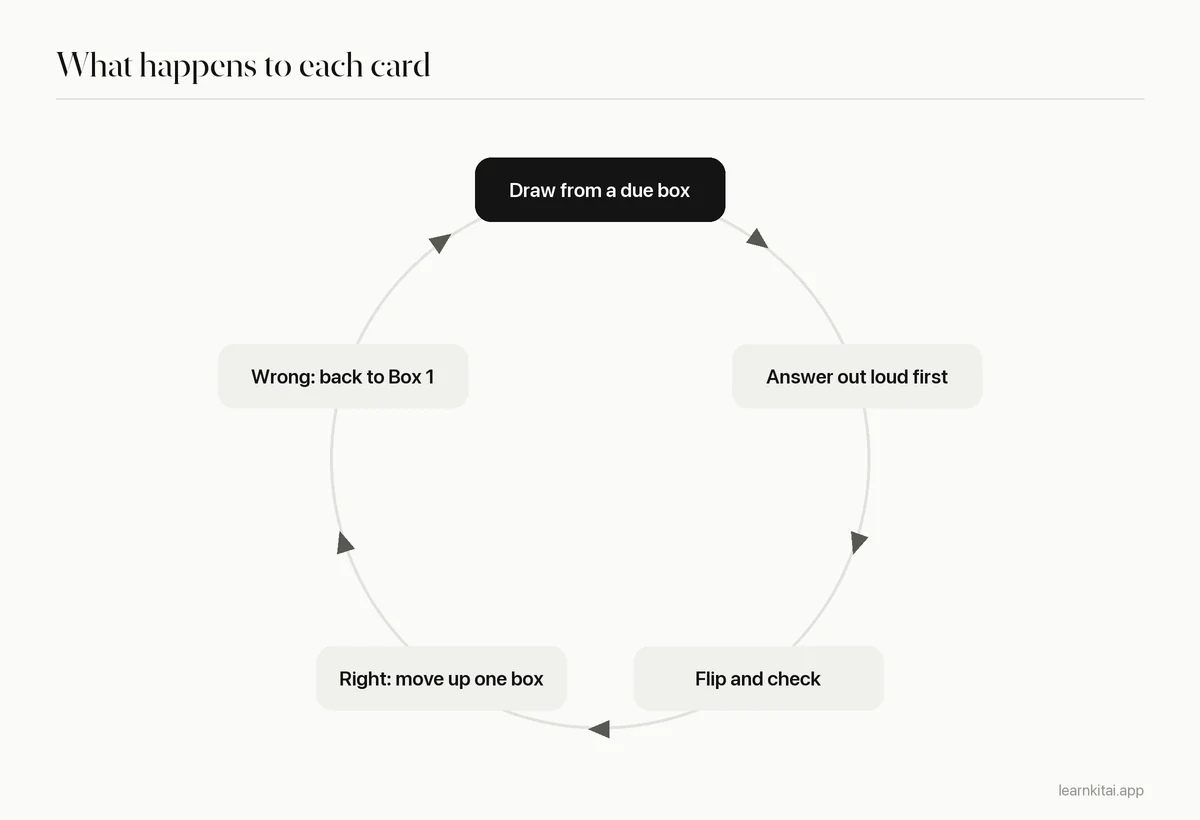
The real benefit appears gradually, over several weeks of consistent sessions, as the deck sorts itself according to difficulty. Easy cards climb quickly and stop eating your time. Hard cards stay in Box 1 and get daily practice until they stick. You spend most of your effort where your memory is weakest, which is the whole point of spaced repetition.
What schedule should each box follow?
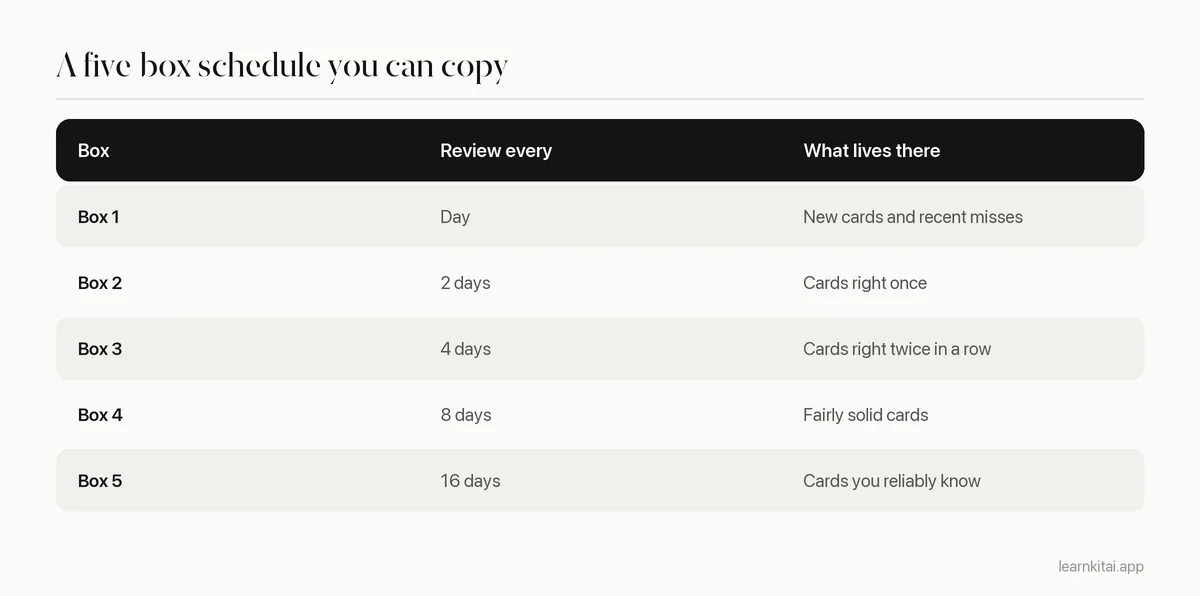
A common five-box setup doubles the gap at each step: Box 1 every day, Box 2 every 2 days, Box 3 every 4 days, Box 4 every 8 days and Box 5 every 16 days. Shorten the gaps if your exam is close.
Leitner's original design and later versions vary. Wikipedia's summary of the Leitner system shows a three-box example with reviews every day, every three days and every five days. The doubling schedule below is one practical version for a semester-long course. Treat the numbers as a starting point, not a law.
The 16-day calendar
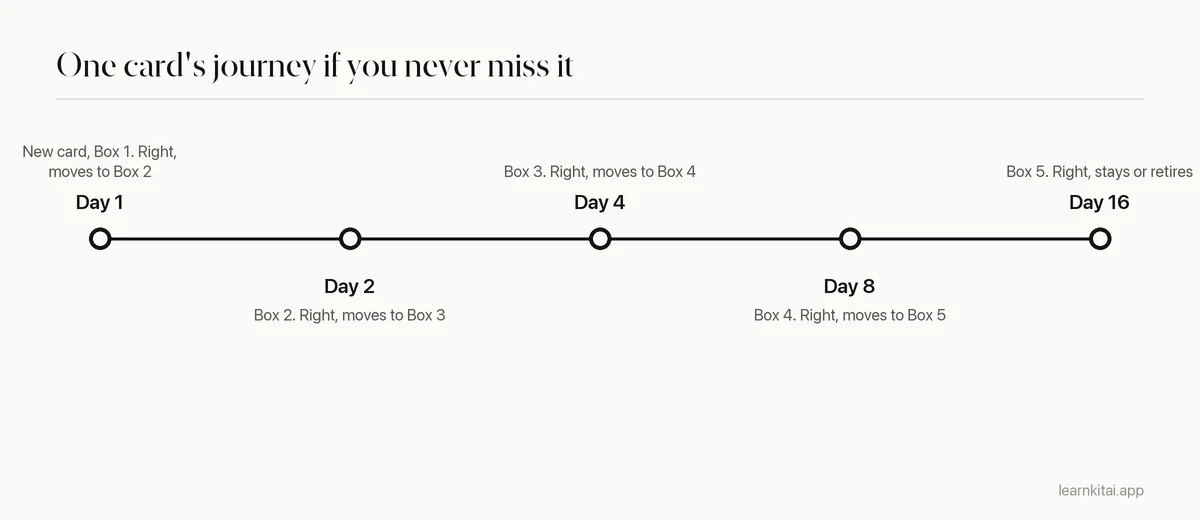
To avoid calculating dates every evening, number your study days consecutively and follow this repeating pattern. Box 1 every day. Box 2 on even days. Box 3 on days 4, 8, 12 and 16. Box 4 on days 8 and 16. Box 5 on day 16. Then start again at day 1. Always review the higher boxes first on days when several are due, so the long-gap cards get your freshest attention.
Should a missed card go back to Box 1 or just down one box?
The classic rule sends it back to Box 1. A gentler variant moves it down one box. Use the strict rule for exam-critical material and when the deck is small; use the gentle rule when a big deck makes Box 1 overflow.
The strict rule is honest: if you forgot a card after a sixteen-day interval, the memory is still fragile and deserves daily attention again, even though this means Box 1 can quickly become crowded. The gentle rule keeps the workload smoother, but a card can hover in the middle boxes for weeks without ever being truly secure. A good compromise is strict for Boxes 1 to 3 and gentle for Boxes 4 and 5.
How do you set up a Leitner box?
Get a box with five dividers or five envelopes, label them, write a small batch of cards, put them all in Box 1 and start the 16-day calendar. Add new cards to Box 1 only, in small batches.
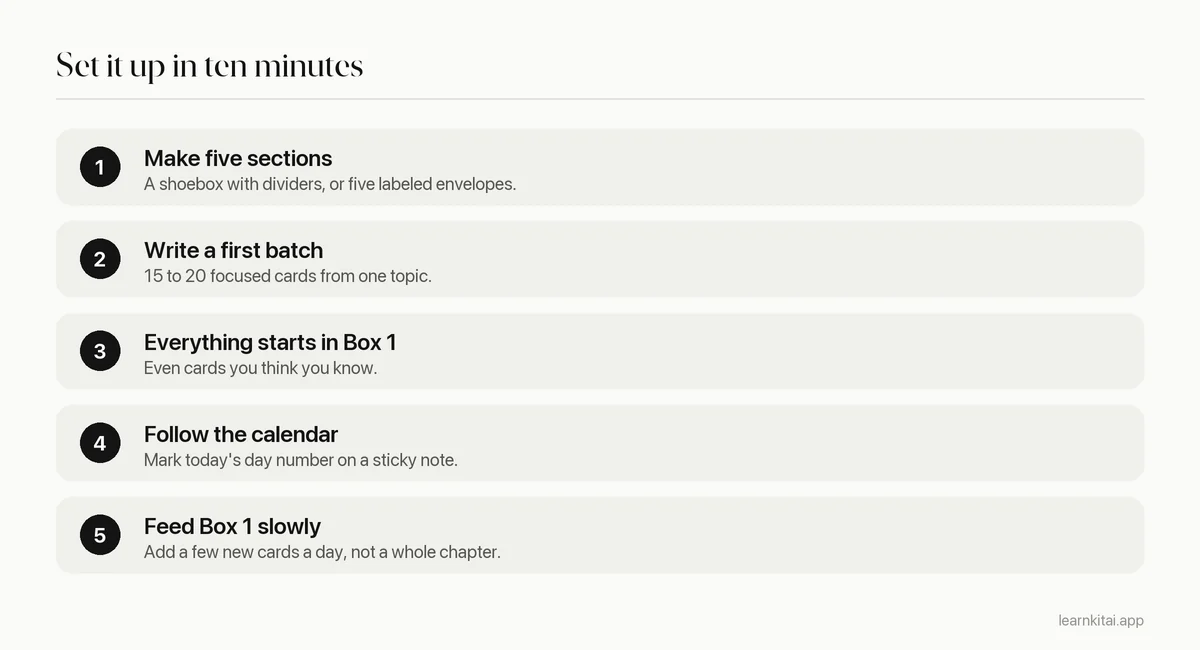
The cards themselves matter as much as the boxes. A card that asks for five facts will bounce in and out of Box 1 forever. Write one idea per card with a clear question; our guide on how to make flashcards shows the rules with examples.
How do you fit the boxes to your exam date?
Make the longest gap shorter than the time left. Research suggests the best gap between reviews is roughly 20 to 40% of the time until a test one week away, and a smaller share for tests months away.
A large study by Cepeda and colleagues tested gaps and delays with more than 1,350 people. As a share of the time until the final test, the best gap fell from about 20 to 40% for a test one week away to about 5 to 10% for a test one year away. For a student, that turns into a simple rule: if your exam is in two weeks, cap your longest box at a few days. If it is a semester away, the full 16-day schedule is fine.
- Exam in 1 to 2 weeks: use three boxes, every day, every 2 days, every 4 days.
- Exam in 3 to 6 weeks: use four boxes, up to every 8 days.
- Exam months away or a cumulative final: use all five boxes and keep Box 5 cards in rotation until the exam.
Also watch Box 1. If it holds more than about 30 cards, stop adding new ones until it shrinks. That is the paper version of the advice in how many flashcards per day: new cards create future reviews, and a flooded Box 1 means the system has stopped spacing anything.
One more practical consideration: the Leitner system depends entirely on your honesty when grading. Counting an approximately correct answer as correct feels harmless, but it promotes cards that are not yet reliable and gradually fills the upper boxes with material you cannot actually produce under exam conditions. Decide in advance what counts as correct, such as the exact term or every step of a definition, and apply that standard consistently.
Is the Leitner system better than a flashcard app?
It uses the same principle as app schedulers, just with coarser steps. Apps adjust each card's gap more precisely and never lose track; boxes are free, visible and work offline. Pick the one you will open every day.
Spacing is what matters most. In a 2009 study by Kornell, spaced flashcard practice beat massed practice for 90% of participants, even though most of them believed the opposite. Any method that gets you spacing reliably will help. If you are unsure which format suits you, compare paper and digital flashcards.
Frequently asked questions
How many cards should I add to Box 1 each day?
Start with about 10 to 20 new cards a day and adjust. If Box 1 keeps growing or daily sessions pass 30 minutes, add fewer until it settles. Consistency matters more than volume.
What if I miss a day of Leitner reviews?
Do not try to double up. Review the boxes due today and move on; the missed boxes will come around again. If you miss several days, start with Box 1 and work upward.
Can I use the Leitner system for subjects other than languages?
Yes. It works for any material you can put on focused cards: anatomy terms, formulas, dates, legal rules or definitions. It works less well for skills like solving new problems, which need practice sets.
Should I shuffle cards within a box?
Yes. Shuffling stops you from learning the order of the cards instead of the answers. Also try to answer before you flip, out loud or on paper, so each card is a real recall attempt.
Sources
- Leitner system, Wikipedia (Proposed by Sebastian Leitner in 1972 in So lernt man lernen; correct cards move up, missed cards go back to the first box.)
- Spacing effects in learning: a temporal ridgeline of optimal retention, Psychological Science (Cepeda et al., 2008) (More than 1,350 participants; optimal gap about 20 to 40% of a 1-week delay, about 5 to 10% of a 1-year delay.)
- Optimising learning using flashcards: Spacing is more effective than cramming, Applied Cognitive Psychology (Kornell, 2009) (Spacing beat massing for 90% of participants.)
- Optimising self-regulated study: The benefits and costs of dropping flashcards, Memory (Kornell and Bjork, 2008) (Dropping cards had small but consistently negative effects on learning.)
Keep reading

How to Make Flashcards That Still Work Three Weeks Later
Most flashcards fail before you ever study them, because of how they are written. Seven rules, real before and after cards, and a study routine that keeps them working.

Spaced Repetition: Why Forgetting Is Part of the Plan
Reviewing right before you forget builds memories that last. Learn how long the gaps should be, with a ready schedule for exams one week to one semester away.

How Many Flashcards per Day? Count Reviews, Not Cards
The right number of new flashcards depends on the reviews they create later. A simple formula, a budget table and the warning signs that you are adding too many.

Paper vs Digital Flashcards: Why the Format Matters Less
Studies comparing paper cards with apps mostly find a tie. What decides the winner is spacing, honest recall and whether you actually open the deck.

9 Flashcard Mistakes That Feel Like Progress
Flipping fast, dropping known cards, studying in tidy little stacks: the habits that make flashcards feel productive are often the ones that waste your time.