9 Flashcard Mistakes That Feel Like Progress
The most common flashcard mistakes are flipping before you commit to an answer, cramming, packing several facts onto one card, studying in small stacks, dropping cards too early, memorizing what you do not understand and ignoring cards you keep failing. Each one feels efficient in the moment but weakens long-term memory.
Flashcards are one of the best study tools there is, which makes it frustrating when they do not work. Usually the tool is fine and the habits are the problem. The tricky part is that most flashcard mistakes feel like good studying. The deck moves fast, the answers look familiar, and you finish with a sense of progress. This article walks through nine habits that create that false feeling, the research behind why they backfire, and a simple fix for each.
Why can a deck feel easy and still fail you on the exam?
Because ease during practice is a poor guide to what you will remember later. Seeing an answer you just saw feels like knowing it. Real memory shows up after a delay, which is exactly when cramming and fast flipping stop paying off.
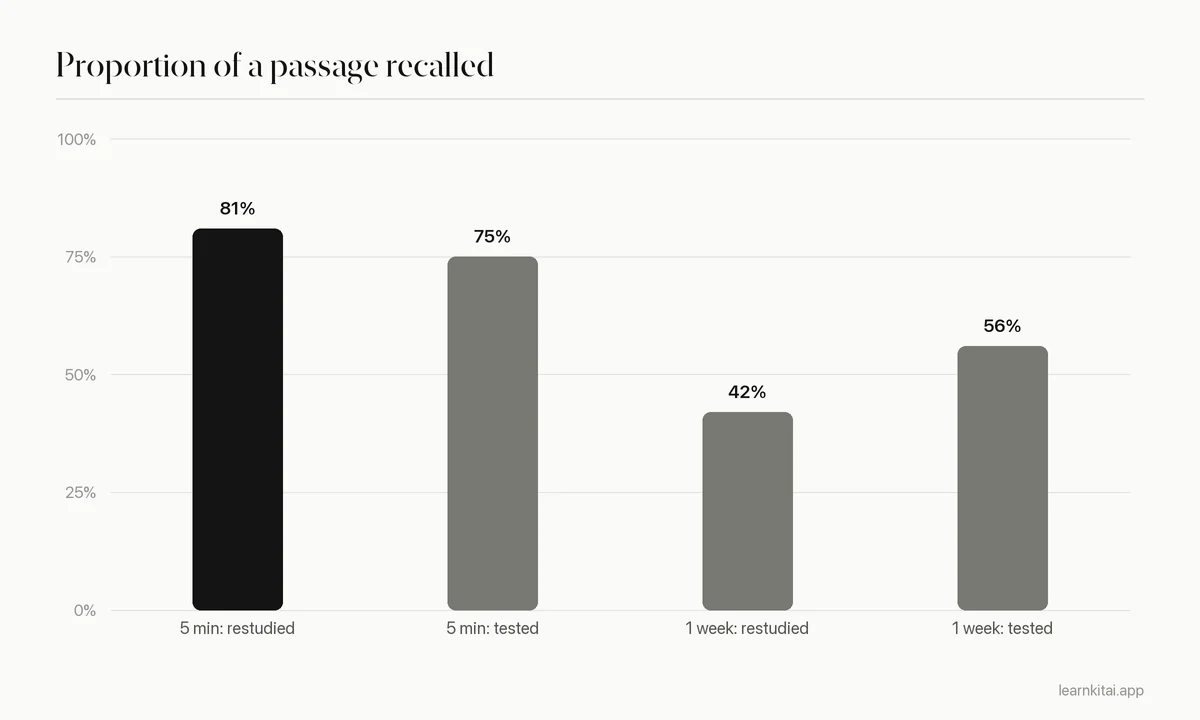
Psychologists have shown this gap many times. In Roediger and Karpicke's 2006 study, students who restudied a passage beat students who tested themselves on a test five minutes later. One week later the result flipped: the tested group remembered much more. If you judge your methods by how you feel at the end of a session, you will pick the wrong ones.
Mistake 1: Flipping before you commit to an answer
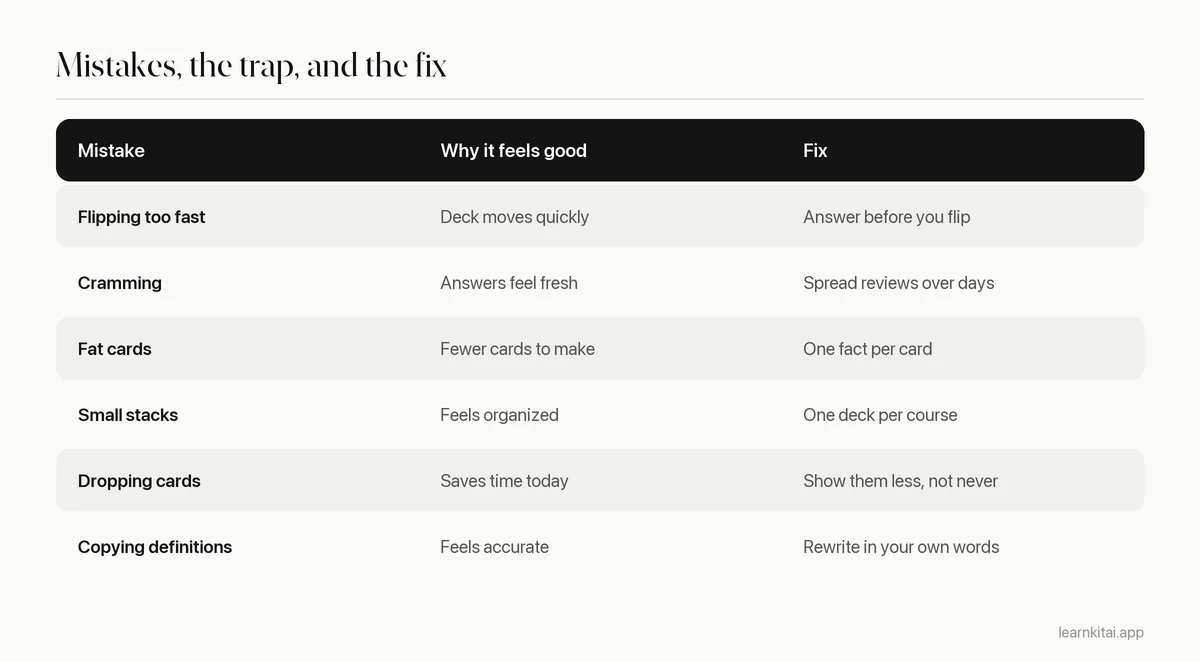
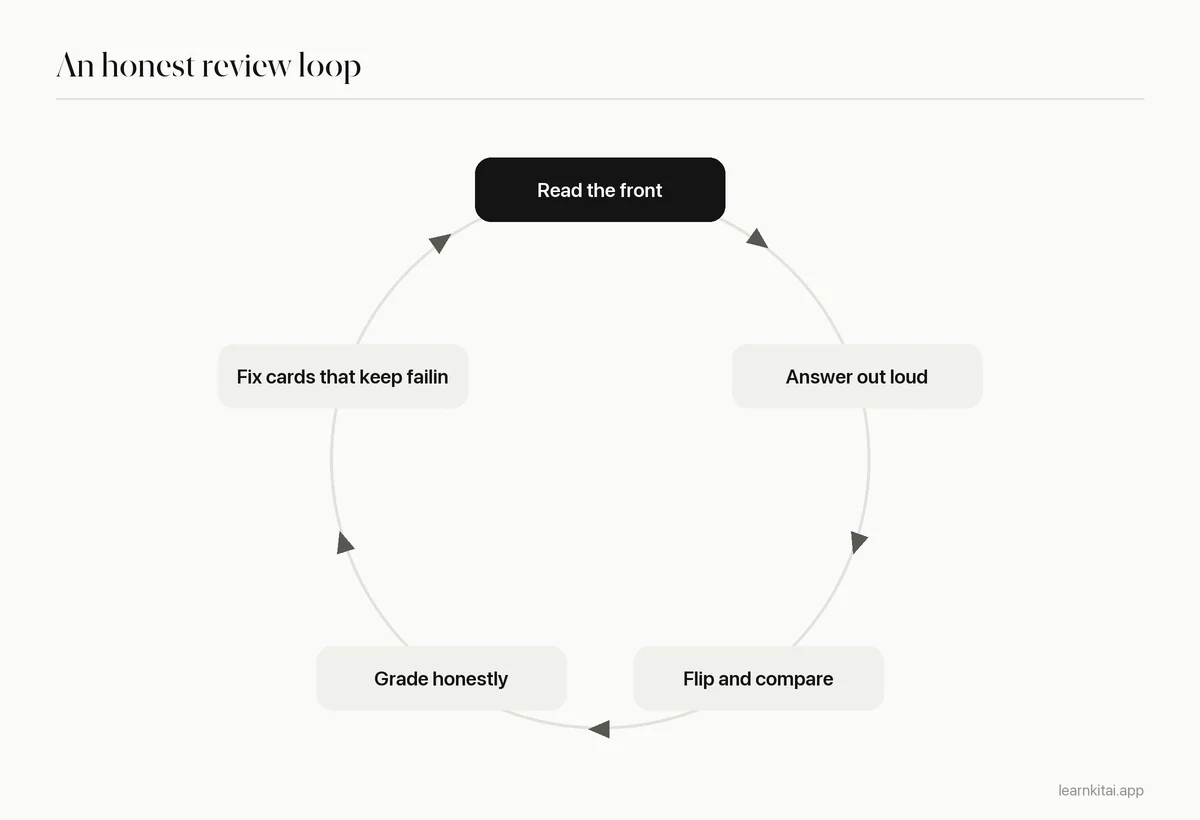
If you glance at the front, think yeah, I know this, and flip, you are practicing recognition, not recall. Fix: say or type the answer before you flip. If you cannot produce it, it counts as a miss, even if the back looks familiar.
Mistake 2: Cramming the whole deck the night before
Cramming feels great because every answer is fresh. In Nate Kornell's 2009 flashcard study, spacing beat massed study for 90% of participants, yet 72% believed massing had worked better after the first session. Fix: start reviews early and spread them out. See spaced repetition explained.
Mistakes 3 and 4: cards that ask for too much
Mistake 3 is the fat card, where the back holds a paragraph or a list. You get most of it, call it a pass, and the missing piece never gets practice. Mistake 4 is the list card, such as Name the eight parts of speech. Long unordered lists are very hard to recall as one unit. Fix for both: one fact per card, and break lists into overlapping fill-in-the-blank cards. The full method is in the minimum information principle.
Should you drop cards once you know them?
Not too early. Setting aside cards you think you know feels efficient, but in a series of experiments, letting learners drop cards produced small but consistent losses. People often feel they know a card before the memory is stable enough to last.
That is mistake 5. In Kornell and Bjork's 2008 experiments, dropping cards rested on two weak foundations: people misjudge what they know, and they undervalue extra practice on items they can already recall. Fix: keep easy cards in the deck and let them come back less often instead of never. A scheduler or a Leitner box does this automatically.
Is studying in small stacks a mistake?
Usually, yes. Small stacks bring each card back quickly, which feels productive but removes the spacing between repetitions. Studying one large stack spreads each card out and, in Kornell's experiments, led to better learning than four small stacks of the same cards.
Mistake 6 often looks like good organization: a deck per chapter, drilled until each one is perfect. The problem is that the gap between repetitions becomes tiny, and every chapter is only reviewed when you choose to open it. Fix: combine related decks for a course and let reviews mix topics. The mixing has its own benefit, covered in interleaved practice.
Mistakes 7 and 8: memorizing before understanding
Mistake 7 is making cards for material you have not understood yet. You end up memorizing a string of words that you cannot use on an exam question phrased differently. Mistake 8 is copying textbook definitions word for word, so you learn to recite a sentence rather than the idea. Fix: read and explain the idea in your own words first, then write the card in your own words. Wozniak put it bluntly as rule one of his twenty rules: do not learn if you do not understand.
What should you do with cards you keep failing?
Stop reviewing them as they are and rewrite them. A card that fails again and again is usually unclear, too big, or easy to confuse with another card. Split it, add an example or image, or make a new card that asks you to tell the two confusing ideas apart.
That is mistake 9: treating a problem card as a willpower problem. Flashcard users call these cards leeches, because they suck up review time. Ten more reviews of a bad card will not fix it. Five minutes of rewriting usually will.
A five-minute audit for flashcard mistakes in your deck
- Open ten random cards. Does any back contain a list or more than one sentence? Split it.
- Check how many decks you have for one course. If it is more than one, merge them.
- Look at your last session. Did you answer before flipping on every card?
- Find the three cards you fail most. Rewrite them today.
- Check your schedule. Are you reviewing a little each day, or a lot right before tests?
If you generate cards with AI, run the same audit on the output. Generated cards are often well written but too long, and they sometimes include trivia your course does not need. With LearnKit you can create a small set from your notes, then edit or delete cards before you start reviewing.
Most flashcard mistakes come from trusting how a session feels instead of what you can recall a week later. None of the fixes take long, and most of them make reviews faster, not slower. If you want to start a deck from scratch the right way, read how to make effective flashcards, and for a sense of a healthy daily load, see how many flashcards per day.
Frequently asked questions
Is it bad to shuffle flashcards?
No, shuffling is good. A fixed order lets you learn the sequence instead of the answers, because each card cues the next. Shuffle paper cards before each session; most apps mix the order for you.
Should I study flashcards in both directions?
For vocabulary and terms you need to produce, yes, but as two separate cards. For many concept cards one direction is enough, because the reverse question would be vague.
How do I know if my flashcards are working?
Test yourself in a different format, such as practice questions or explaining a topic out loud without notes. If you can answer the cards but not the questions, your cards are training recognition of their own wording rather than understanding.
Sources
- Test-Enhanced Learning: Taking Memory Tests Improves Long-Term Retention, Psychological Science (Roediger and Karpicke, 2006) (Experiment 1: restudy 81% vs testing 75% at 5 minutes; testing 56% vs restudy 42% after one week.)
- Optimising learning using flashcards: Spacing is more effective than cramming, Applied Cognitive Psychology (Kornell, 2009) (Spacing beat massing for 90% of participants; 72% believed massing was more effective; one large stack beat four small stacks.)
- Optimising self-regulated study: The benefits and costs of dropping flashcards, Memory (Kornell and Bjork, 2008), UCLA Bjork Learning and Forgetting Lab (Allowing learners to drop flashcards produced small but consistent negative effects on learning.)
Keep reading
How to Make Flashcards That Still Work Three Weeks Later
Most flashcards fail before you ever study them, because of how they are written. Seven rules, real before and after cards, and a study routine that keeps them working.
Minimum Information Principle: Small Cards, Big Recall
One flashcard, one fact. Here is why splitting fat cards into tiny ones makes reviews faster and memories stronger, with worked examples.

The Leitner System: Five Boxes That Schedule Your Reviews
A shoebox, some dividers and one simple rule give you spaced repetition without an app. Here is a ready-to-use five-box schedule and how to adapt it to your exam date.
How Many Flashcards per Day? Count Reviews, Not Cards
The right number of new flashcards depends on the reviews they create later. A simple formula, a budget table and the warning signs that you are adding too many.

Spaced Repetition: Why Forgetting Is Part of the Plan
Reviewing right before you forget builds memories that last. Learn how long the gaps should be, with a ready schedule for exams one week to one semester away.