How Many Flashcards per Day? Count Reviews, Not Cards
Most students do well with 10 to 20 new flashcards a day. The real limit is reviews: the Anki manual estimates that 20 new cards a day leads to about 200 reviews a day. Start from the minutes you can study daily, divide by your review pace, and keep new cards near a tenth of that number.

Ask how many flashcards per day you should study and you will hear numbers from 5 to 100. The honest answer depends on one thing most people ignore: every new card you add today creates reviews for weeks to come. Pick the number of new cards based on the reviews you can handle, not on how many cards you want to get through.
This guide gives you a quick formula, a budget table you can copy, and the warning signs that your daily load is too high.
Why does the number of new cards matter so much?
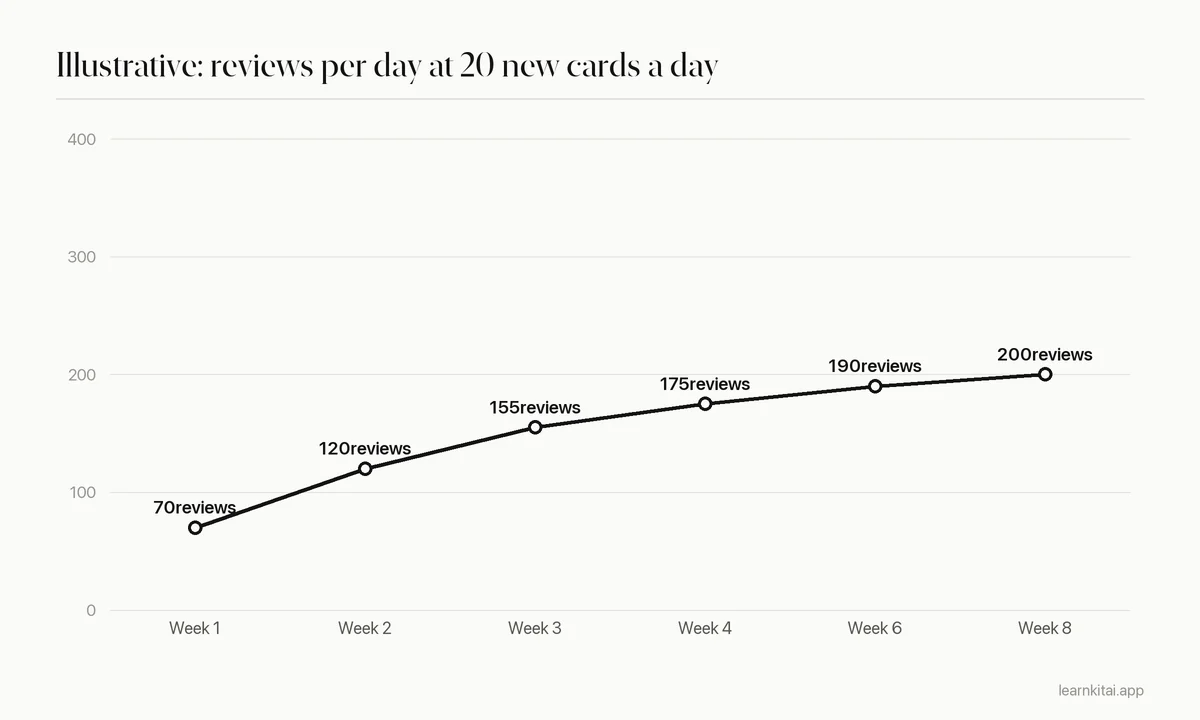
Because each new card needs several reviews before its gaps grow long. Add 20 a day for a few weeks and you face around 200 reviews a day. New cards are cheap today and expensive later.
The Anki manual puts it plainly: if you consistently learn 20 new cards a day, expect roughly 200 reviews a day. That 10 to 1 ratio is a rough guide, not a law, but it explains why so many students quit spaced repetition after two weeks. They start with 50 or 100 new cards a day, feel productive, and then drown in reviews.
How many flashcards per day should you learn?
Work backward from time. Estimate how many reviews you can finish in your daily study minutes, then set new cards to about one tenth of that. For 30 minutes at roughly 8 seconds per card, that is about 20 new cards.
Here is the formula in plain steps. Time yourself for one session to find your own pace, because it varies a lot between a vocabulary deck and a pharmacology deck.
- Choose your daily minutes. Be realistic about a normal day, not your best day.
- Measure your pace. Time 50 reviews and divide. Simple cards might take 6 to 8 seconds; cards that need explanation can take 15 or more.
- Find your review capacity. Minutes times 60, divided by seconds per card.
- Set new cards to about a tenth. That leaves room for the reviews those cards will create.
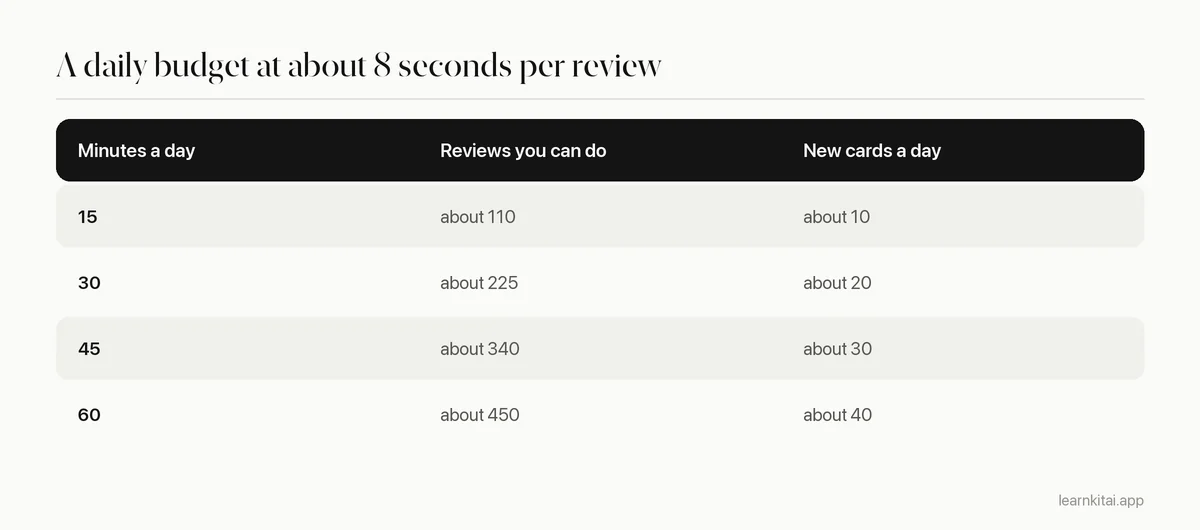
If your cards are slower, say 15 seconds each, halve the new card column. A student with a dense medical deck and 30 minutes a day should add closer to 10 new cards, not 20. This is why the right answer to the question of how many flashcards per day differs from one person to the next.
A worked example
Imagine a first-year biology student with three lectures a week and about 25 minutes available for flashcards each evening. After timing one session, she discovers her average is roughly 10 seconds per card, because many of her cards involve diagrams and short explanations. Her review capacity is therefore about 150 cards a day, so a sustainable target is approximately 15 new cards daily.
Each lecture produces around 30 useful cards, which means roughly 90 new cards a week, or 13 a day across seven days. That fits comfortably inside her budget. If a particularly dense lecture produces 60 cards, she does not add them all at once; she spreads them over four or five days, so the extra reviews arrive gradually instead of in one overwhelming wave. The calculation takes two minutes and prevents the backlog that makes most students abandon their decks by midterms.
What are the signs you are adding too many cards?
Your reviews keep growing week after week, you skip days because the queue feels huge, or you rush cards and mark half-known answers as correct. Any of these means you should pause new cards for a few days.
A backlog does not mean the method failed. It means the input was larger than your time. Set new cards to zero, clear the overdue reviews over a few days, then restart at a lower number. If you use paper cards, the same rule applies to Box 1 in the Leitner system.
Should you study all your cards at once or in small groups?
Keep one larger shuffled pile rather than several small ones. Spacing between repeats of the same card helps memory, and a larger pile creates that spacing naturally.
In a 2009 study by Kornell, students learning word pairs did better with one large stack than with several smaller stacks. Spacing beat massing for 90% of the participants, yet 72% thought the massed approach had worked better after the first session. Small piles feel easier because you see each card again quickly, which is exactly why they teach you less.
How should the daily number change before an exam?
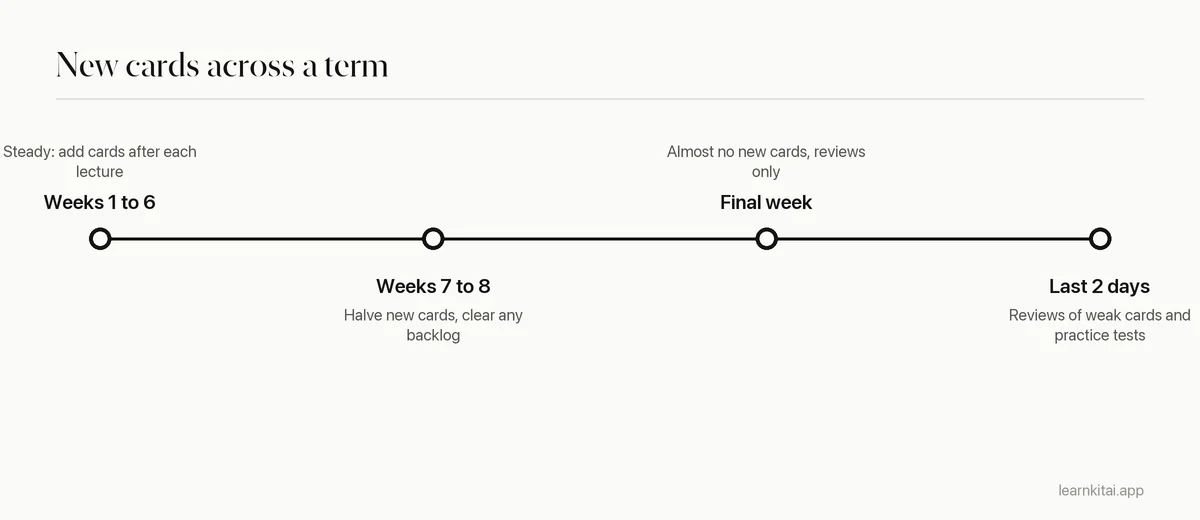
Front-load new cards early in the term, then taper. In the final week, add almost nothing new and spend your time on reviews and practice questions. Cards added two days before an exam barely get a second review.
This is the opposite of cramming, where everything is new in the last days. If you are already in that position, see our guide on cramming the night before an exam for damage control. For the full picture of why spacing works, read spaced repetition explained.
Does a higher retention target change the math?
Yes. Asking a scheduler to keep you at very high recall shortens the gaps and multiplies reviews. Anki's default target is 90%; its manual warns that above 90% the workload rises quickly and above 97% it can be overwhelming.
For most courses, the default is a sensible trade-off. Raise it only for a short period before a high-stakes exam, and lower your new card count at the same time to keep the daily load stable.
Finally, fewer but better cards beat more cards. A deck of focused, one-idea cards reviews faster and fails less often, which brings the whole budget down. Our pillar guide on how to make flashcards covers the writing rules that keep review time low.
Frequently asked questions
Is 100 new flashcards a day too many?
For most students, yes. By the 10 to 1 rough ratio, 100 new cards a day would lead to around 1,000 reviews a day, which can take hours. It can work for a short sprint with very simple cards, but it rarely lasts.
What if I only have 10 minutes a day?
Then aim for about 5 new cards a day with quick cards, and protect your reviews. Ten minutes every day beats an hour once a week, because the schedule depends on showing up regularly.
Should I count cloze cards from the same sentence separately?
Yes. Each blank that becomes its own card adds its own reviews. A sentence with four separate blanks counts as four new cards in your daily budget.
Do review numbers ever go down?
Yes. As cards mature, their gaps grow to weeks or months, so each one costs less time. If you hold new cards steady, daily reviews level off. If you stop adding, they slowly fall.
Sources
- Deck Options: Daily Limits and FSRS, Anki Manual (20 new cards a day leads to roughly 200 reviews a day; stop new cards when behind; default desired retention 90%, workload rises quickly above 90% and can be overwhelming above 97%.)
- Optimising learning using flashcards: Spacing is more effective than cramming, Applied Cognitive Psychology (Kornell, 2009) (One large stack beat small stacks; spacing beat massing for 90% of participants; 72% believed massing was better.)
- Spaced Repetition Promotes Efficient and Effective Learning, Policy Insights from the Behavioral and Brain Sciences (Kang, 2016) (Review of hundreds of studies showing spaced review beats massed repetition for long-term learning.)
Keep reading

How to Make Flashcards That Still Work Three Weeks Later
Most flashcards fail before you ever study them, because of how they are written. Seven rules, real before and after cards, and a study routine that keeps them working.

The Leitner System: Five Boxes That Schedule Your Reviews
A shoebox, some dividers and one simple rule give you spaced repetition without an app. Here is a ready-to-use five-box schedule and how to adapt it to your exam date.

Spaced Repetition: Why Forgetting Is Part of the Plan
Reviewing right before you forget builds memories that last. Learn how long the gaps should be, with a ready schedule for exams one week to one semester away.

Cloze Deletion: Fill-in-the-Blank Cards Done Right
Cloze cards are the fastest way to turn notes into flashcards, and the easiest to get wrong. Rules, examples and the exact Anki syntax.

9 Flashcard Mistakes That Feel Like Progress
Flipping fast, dropping known cards, studying in tidy little stacks: the habits that make flashcards feel productive are often the ones that waste your time.